BRENDA ODMM
Brenda lost her mother and was diagnosed with breast cancer in early 2024, forcing her to shut down her coaching business. She rebuilt it solo using AI tools to handle content, project management, and automation, scaling back to generate significant revenue with a three-tier AI assistant framework.
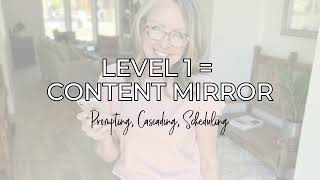
So much Chad for having me. I'm Brenda, like Chad said. And John this morning showed us the revenue belts, right? I have been at the black belt and then I fell straight down to the bottom, went down to zero revenue. And here's how it happened. February of 2024, my entire life fell apart. Literally fell apart. Within two weeks, my mother died, I was diagnosed with breast cancer and my semi invalid father moved in with us. So what ended up happening was I had this big team. I have been a social selling or social marketing coach for about 10 years. I work with direct and social selling women, Primarily women over 40, to help build their businesses online, scale their business. My friends. My friend Janelle has a quote that she says all the time, drop the balls that bounce. And the only ball I could drop was my business. I couldn't drop this ball. Obviously this is the one that would shatter and then I couldn't drop my family. My father had just moved in with us. He was in his own deep stages of grief and this was the ball I could drop. So I made the heartbreaking decision in about March ish of 2024 to close my membership groups, let go of my team. I had a team of six, shut down my corporate clients and have surgery, Focus, refocus, recalibrate my life, figure out exactly what my life was going to be. Do I still want to have a business? How do I do all this? So this was the day of my double mastectomy here. This was recovery. And I am a proud walking PSA for getting your mammograms, ladies. Okay, everybody, okay. Book your mammograms. Tell your loved ones to book their mammograms. I had breast cancer twice. The second one was a double mastectomy. And partly I chose that path because at the time I was diagnosed, it was the path of fewest surgeries and fastest recovery. I didn't want to go through all of the reconstruction when I was already in this stage of life that was pretty chaotic. So in May, I had surgery and I made the decision to spend the summer, last summer figuring out what the next season was going to look like. So this picture, the big pivot, seven figure team of six to just me, this picture, I was laying in bed and I don't even know why I took it, but I'm grumpy and so weird. It's one of those weird selfies laying in your bed, right? That and I took a picture and this was in September. And I remember vividly because I spent the whole summer not really Knowing what I was going to do next, like, do I want to start coaching again? Do I want to rebuild? What do I want to do? And it was somebody. It was one of my former clients. Her name is Sharon Armstrong. And she said, brenda, your zone of genius is very specifically right here. You have to get back into your zone of genius. You have to do it. This is what you do. This is what you know how to do. What are you waiting for? And so from September to November, which was Black Friday, I made the decision to relaunch my business. But I decided to not go with the broad membership. I decided to go narrow. I wanted to go deeper with fewer. So I launched a mastermind group. And my goal was to sort of leverage the good relationships I had with my clients to be able to relaunch this new membership group. And now during this time, I was also sharing the journey of cancer and healing and sort of, you know, the authentic. Be authentic in your storytelling. Right. I was doing that as well. So I was keeping the audience warm. But in reality, well, I wasn't really selling anything. I was sort of just letting them know how things were going. So what ended up happening is I made the decision to relaunch, but I wasn't going to hire a team because my husband and I both realized my biggest single source of anxiety was payroll. Anybody who's ever had staff, you all know your biggest single source of anxiety is payroll. Whereas if you're paying yourself, you're like, it's okay, I can have a down month, it's okay, I can recover. But payroll, man, that'll stress you out because you got to pay them every month whether you make money or not. So I made the decision to not hire any more stuff. I was going to do it with me and AI. That's all I was going to do. So my goal for today is I want to show you exactly how I have rebuilt literally what I have done. Okay, So I am back now to a mastermind group, a secondary membership I'll talk about in a minute. And I am this year projected to probably break $250,000 in revenue. Not bad for having less than a year ago. Had zero business, right? So what I developed was what I call the three tier AI assistant framework. The content mirror, the strategy mirror, and the challenge part. This was actually. This picture was taken at a speaking event literally two days after my mother died. It was. It was such a bizarre window of time. She died on a Saturday. We had a massive speaking event at the kiln in Gilbert two days later and I was diagnosed a week and a half after that. It was such a weird month. I don't recommend it as a means to change your life. However, it actually ended up making my life better. Not my mother dying, but cancer. I mean. Okay, so we're going to start with the content mirror. We all know, and we've talked about today, that AI is only as good as the prompts you give it, right? So most people who are using AI at this point are all using AI minimally as a content mirror. Give me a Facebook prompt for this person, for this target, for this purpose, for this outcome, for this context. Give me some kind of content output, right? So the content mirror idea is where most people start and a lot of people stop. They know how to ask Facebook or AI to create a Facebook post, or create some real ideas or create a hook for me. So the content mirror idea is I took it one step further and I put three systems under it. The content mirror replaces repetitive tasks, helps me batch content, and keeps my tone, format and offers consistent. And the way that I do this is I have one anchor post or one anchor topic every week, either my blog or a transcript or something like that. And I say take this blog post and now cascade this exact blog post into Facebook conversation starters, TikTok ideas, reels, ideas, Instagram quotes, and I simply cascade that exact same content right down the line. Okay? The other thing I'm a big fan of is scheduled tasks. This is where ChatGPT truly becomes your assistant, your accountability buddy. Who's using scheduled tasks? Anybody? What y'? All? They're the best. Okay? We should have a little 10 minute breakout on that alone. They're so good. You literally go into ChatGPT and say, please schedule a task every Monday at 9am Send me a list of 20 somethings and deliver it right to this thread. It also sends you an email. I have got probably 10, excuse me, 10 different tasks set up that deliver content ideas. They run, it runs analysis for me. My favorite one is my Friday one that every Friday at 3pm it analyzes my chat GPT usage for the week and it makes suggestions and recommendations on things that I can improve for the coming week. So when I'm looking at level one, it's primarily content based, but it's using these systems that formerly I had people doing. I had people that were creating my content, reminding me of my appointments, reminding me to do follow up. That's all happening now here, and it's all happening in ChatGPT. Okay, makes sense. And I'm happy to do a demo at the end of how to do a scheduled task. It's real easy. Level two is a strategy mirror. And this is where again, we're still only as good as what ChatGPT is asking us or what we're asking it to do, right? So this is where we're now using AI for project management and workflow automation. In project management world, this is where I'm building campaigns, I'm doing projects, I'm organizing my content into chat GPT projects. Who here uses projects? It's not just an organizational system. You create custom instructions for every project so that every time I'm talking in that project, it's always referencing the exact same set of instructions. So I can then take that content cascade idea. Here's my blog post for the week and I take it and I run it into my Pinterest project and my Instagram project and my YouTube description project, and it's spits out the output like that, what it would have previously taken my team days to do. This is where there's two ways to think about using these projects, I think. One is the organization of simply keeping all your topics in one in one area. How many times you've ever lost a chat GPT thread? Right? You're like, I know I talked about it, but I don't remember when or where, and I forgot what keyword to search for. But if you're doing at least organizing everything inside of a project, all those threads stay related. Okay? The other thing I'm a big advocate for is custom GPTs. Who uses custom GPTs? Here's the distinction between custom GPTs and projects. Projects are for all your internal workflows. They're just for you. They're great for systems and batching, and they're stored in your account, so all the content and memory is stored inside of your account. Whereas custom GPTs are shareable, they're public for anyone with the link. You can use them with your team prospects. I use mine as a lead magnet. I'll show you an example. They're trained on specific functions, but they're not stored beyond a single thread because they remember your instructions, not the user's input. The other big thing here is tools and automation. I used to have a person on my team who just did tech. She ran my website, she ran my email list. Now, AI does all of that, not in the sense that it's running workflow, but in the sense that I'm going to AI and I'm saying her name is Grace. And here's the story of why her name is Grace. Her name is Grace because back in the throes of my grief and my loss and my trauma and all of this, my husband said, you just need to give yourself some Grace. Take the summer off. Take the summer off. Relax. We'll figure out how to rebuild. So when I rebuilt, I named her Grace, as in I'm giving myself some. That's how. That's how she got named. So isn't that sweet? But what I use Grace for isn't necessarily just the automation, but it's the, hey, Grace, I'm stuck on a piece of Shopify code. Can you diagnose and troubleshoot this for me? Here's a screenshot, and she's my tech support, and she unravels all of that directly for me. The other piece here is your automation. She helps me set up my automation. I use Zapier as my automation tool. So when data comes into my database, it goes to airtable, it goes to my email list to trigger sequences. All of that is set up here as a function of strategy. But again, it's only as good as what you ask it to do. Right? That's when we get to level three. Here's my example of how I do a custom GPT. And if you take nothing away from this, take away this little trick right here. Okay, So I have several custom GPTs, one of which I use as a public lead magnet. Helpful. Holly is my public lead magnet. Grab Holly. She's amazing. She'll help you write better social posts. She builds my email list. Thousands of people use Holly. She's awesome. She's free. Okay. But buried down in Holly's instructions, Holly's selling for me. Holly's out here because she's got upsell instructions after at least five interactions. Offer if they want more AI tips, and then give them this code. Make it sassy, like it's an exclusive secret code for your bestie. And because it's a specific Holly code, I know exactly how many times she's made a sale. So my AI is selling for me inside of inside of the instructions. And then the third level is your challenge partner. This is where everyone should get to leaving today. This is where you're asking AI to say it's not a tool so much as it is a mindset. And putting your ego aside, to say, I don't know everything, please tell me, what am I missing? What are my gaps? What are my risks? What are my objections? What are my blind spots? Take this thing we built and tell Me how to make it better. Okay. And I have one very specific example I want to share of exactly how grace made me $20,000. I can show you the exact numbers. So when I relaunched my membership, which was relaunched November of last year, we built the whole strategy. We wrote the workbooks and the copy and the Facebook posts and all the things. We did everything over here. And then I said, okay, this is all ready to go. Fantastic. Grace, this is awesome. What am I missing? What did I forget? What are my risks, gaps, challenges and blind spots? And she said, well, this is great. You know how they always say this is amazing, but this is awesome. But here's like five more ideas, one of which was, hey, Brenda, you don't have a downsell? And I was like, what do you mean I don't have a downsell? I teach my clients less objectionable offers. Of course you have a downsell. I didn't have a downsell. So in that one single response, in that one example, directly from that down sell, as of yesterday, that one asking her to be my challenge partner, not just a mirror, has gained $21,000. Not bad as a team of one, a mighty team of one, you guys, that's my goal. So you don't need more people, you need better systems. That has to be our thought process. That has to be our goal. So. So when I look at what a real system looks like with AI, the basics of using content, cascading, scheduling, tasks, using AI truly as an assistant, down to projects and agents, workflow and automation, agentic automation. I have some agentic automation running. I actually have AI reads my inbox every two minutes and drafts replies to certain emails and leaves them in my draft folder. So all I have to go is to read my draft folder, edit if I have to, and click on send. Because a bulk of my email comes in on the same general topic. You know those Holly. Those Holly inquiries I mentioned? I get a lot of Holly emails like, how do I use Holly? What do I do? What's the link? All of that happens automatically. I don't touch it. I used to have a customer service person has been replaced by AI. So when I put the whole thing together, this is how I have sort of pivoted my life, figured out how to scale and done it solely with me and my virtual wing woman, Grace. So I have recorded an hour of additional video content that breaks down and goes into the micro detail of each. Each one of my systems. I actually. And I'm also going to give you my exact project instructions. So I can show you the specific detail behind the scenes. The other reason I have so many pictures of me is because they're all AI generated. Except for the ones where I'm literally laying in the hospital. These are all AI images of me using the a trained flux Lora model. So because I don't have a photographer anymore, guess what? I'm a team of one. This is how I do it.
More from Chad








Why Interested Prospects Don’t Buy, and How to Move Them From “I Want This” to “I’m Ready”


Knocking Down the Three Big Limiting Beliefs That Keep Prospects From Saying Yes
