CAVU Coaching 10/3
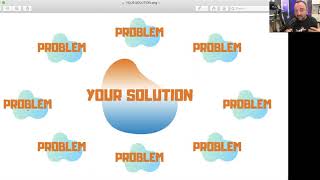
Chad Thibodeaux walks through a framework for Facebook Live content: identify a problem your solution fixes, teach how to solve it, and use that visibility to drive people to your product. Credibility and authority on the problem turn viewers into customers.
Hey, everybody, how are you? Chad Thibodeau here. Hey. It's time for another edition of Kavu Coaching. Today is Thursday, October 3rd. For whatever reason, we're struggling a little bit with the integration with Facebook Zoom and Facebook isn't working right now. So I thought what I would do is I would come on here and I'm going to do a little bit of reteaching from something that I taught the folks at the event this weekend. And it's basically how to. How do you come up with the content that you need in order to solve problems on Facebook Live? Right? So in other words, you're trying to become an expert in your field or you are an expert in your field. What we use is, we used a secondary acronym for Kavu and it looks just like this right here. Okay? So C A V U. The first C we said stands for credibility, okay? So you have to have credibility in your business if you're going to earn a lot of money, right? So credibility. Now, you get credibility mainly by social proof, okay? So if you have social proof, your customers who you worked with say you've done a good job, you get credibility. The second thing is, is some kind of authority, okay? You have to be an authority in your particular field, and authority is where you merge knowledge and practice, ok? So you have knowledge and then when you put that into practice, you become more of an authority in your particular field. The third one, which is what I'm going to talk to you about today, is what we call visibility. Visibility, okay? And if you have credibility at authority and visibility, then that equals. That equals unlimited profitability. Okay? So let's talk a little bit about visibility. How do you get visibility? Because that's a huge, huge question that so many of us have is how do we get it? Because, you know, you're like, chad, boy, you know, if I had it, you know, I'd definitely use it. But I don't have it. So how do I get it if I have it? So I want to show you this little diagram. Going to share the screen. I'm going to show you this little diagram and it looks just like this. We're in the middle. You have your solution, and around your solution, you'll notice that I have eight problems. Now, what is your solution? Your solution is whatever it is that you sell. So if you sell a coaching program, that's your solution. If you sell an online course, that's your solution. If you have an agency, that is your solution. If you have a lead magnet or an ebook, that's Your solution, if you have a funnel template, whatever, that's your solution, whatever it is that you're giving away or selling, that is your solution. And what you need to do is then you need to come out here and you need to be able to create a series of problems that your audience will have that your solution resolves. Okay, so let's say that we're talking podcast, right? So I have an online course called Get Paid to Podcast. What I can do is I can think about some of the problems that my podcast course solves. And so, like, for instance, like, one could be like the title, right? So you may need a title. One could be like the software to run a podcast. Another one could be the equipment. Another one could be how you're going to get traffic. Another one could be how you're going to monetize. Another one could be how you're going to get guests. Another one could be how you're going to interview guests. Another one could be what platform do you broadcast on? Whatever. So I could come up with eight different main problems that my program resolves, and then I just put them like this. And what I'm going to do is I'm going to come on here then, and then I am going to resolve or solve a particular problem. So let's say that this problem here is, you know, how to get better sounding, how to have professional quality sound on my podcast. So what I'm going to do is I'm going to come here and I am going to solve this and. And then I'm going to point them back to my solution. Okay? I'm going to point them back to my solution. So this could be. Hi, everybody. Today I'm going to come here and I'm going to talk to you about how to get professional sound out of your podcast, okay? And then I'm going to come on and I'm going to teach a little bit. So I may talk to them about microphone or whatever. And then I'm going to move them back to my entire software or, excuse me, my entire course called Get Paid to Podcast. So I'm going to move them back to my solution. So, so my problems should be micro and my solutions should be macro, okay? And so all you're gonna do is come up with a list of problems, seven or eight of them. I recommend eight. And then you're gonna teach on them and move back. Now, here's the thing. One thing that you know is there's a little formula, okay? Little formula. And the little formula is this. I'm gonna type it here, then I'll erase it. The little formula is this, okay, want blank, but I lack blank, okay? So that's the. That's the little question that your audience says. Your audience. So the. For instance, in this one, I want professional quality sounding podcasts, but I lack equipment, okay? And then you can come on here and teach the lack so they don't lack anymore. And then once again, you point them back to your solution. So what is it they lack? So, for instance, so if the big problem is professional audio, okay, then what you know is there are sub problems. So the sub problem could be mic, sub problem could be wires. Sub problem could be a mixer. Sub problem could be, you know, I don't know, aesthetics, like acoustic. Acoustics, okay? Another problem with, you know, with professional sounding audio could be the room itself, like the height of the room, whatever, right? So you can come up with a series of subtopics on your main problem. And then I could do an entire show just on a mic. I could do an entire show just on wires. I could do an entire show finding mixers. I can do an entire show trying to figure out how to do acoustics in my room. I could do an entire show showing how to bring the ceiling down in my. In my studio so it doesn't sound so echoey, right? Whatever it is, what they have is they have a big issue and they have many small issues. And all you have to do is in the problem, write out what the big issue is, and then just do a little bit of brainstorming with yourself and come up with 4, 5, 6, 7, 8 different, you know, sub problems to the main problem, okay? And then you can do that simply by saying, I want blank, but I lack blank. And whatever it is they want, okay, that's the big one. And whatever is they lack, that's the little one, okay? So I want professional sounding audio. That's the big issue. But I lack microphone, wires, mixture, acoustic height, right? Those are the sub problems. So, so imagine if you had. If you came up with eight big issues, the eight big problems, and then you could get five sub problems out of every big problem you would have in nearly an entire year's worth of content if you went live one time per week. Okay? If you went live one time, but if you go live and you don't point people back to your solution. So in other words, you're not moving people to your online course or to your coaching or to your agency or whatever, then what was the point? What was the point? So you want to go help people. But in the end, your little Facebook Live is going to help them. But what's going to solve their issue is whatever it is that you're selling. Whatever it is that you're selling. So as you take this training today, you take this little class today, I want you to remember, this is how you get the visibility that you are going to need. So you get the visibility that you're going to need is you simply take the problem whatever it is they want. I want blank, but I lack blank. Okay? And then you just resolve that on a Facebook Live or on Instagram live or on a YouTube live or on a podcast or on a blog or however you do it, okay? And then you just get that out to the public and that is how you gain visibility. The nice thing about visibility is the more intentional you are about becoming visible, the more authority you get and the more credibility you get, which by default will lead to more profitability. Hope that helps.
More from Chad








Why Interested Prospects Don’t Buy, and How to Move Them From “I Want This” to “I’m Ready”


Knocking Down the Three Big Limiting Beliefs That Keep Prospects From Saying Yes
