mtm are you an expert 240p
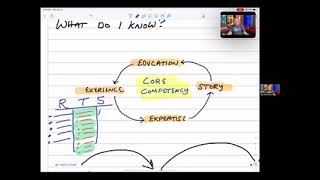
This is a YouTube video titled "mtm are you an expert 240p" created on August 3, 2025. The content is a training module focused on helping viewers determine if they have become an expert in their field. The speaker explains a process involving identifying what one is great at, the problems they solve, and their knowledge, breaking down core competency into education, experience, expertise, and personal stories. The video is instructional and appears to be a solo presentation without multiple speakers.
As we come to the end of this particular module called Become an Expert, it's really important that we clarify and we have confidence that we actually are an expert. So in this training, what I'm going to do is I'm going to share my iPad with you, my iPad screen with you, and I'm going to draw a little bit. I'm going to show you the litmus test that you can go through to ensure that you have become an expert. So let me go ahead and share my screen with you for. From my iPad. And. And you'll be able to see. You'll be able to see how you do this. So there's some questions that you ask, okay? So the first thing is you have to ask, what am I great at? Okay, what am I great at? So if you're. If you're just starting out, you're trying to figure out, like, you know, am I any good at this? Just ask yourself, what am I great at? Okay. And what we mean by great is there's various levels. In our level, it's expert level. Okay, so what am I better at than most people that I know? Does that solve a problem? What problem do I solve? And it's the perfect formula that we did a little bit earlier. We were able to figure out, like, what it. What problem actually do I solve? And then what do I know? So if we can answer those three things, chances are we become an expert. What am I great at, what problem do I solve, and what do I know? In fact, when I sit down with clients, a lot of times, the very first thing I do is I work through this little process. What I want to do is I want to talk with you about core competency. The other day we were talking about it on another module, but let me break it down like this. Core competency is known for this. So it starts with education. Okay? It starts with education right here. Okay, what have I learned? That's the question that you're asking here. What have I learned? Okay, this could be formal education, like high school or college, or maybe you've done some. Some kind of certification program or, or you've read some books or you've done something to learn something. What have I learned? Then you come over and you answer the question and say, okay, what have I done? What experience do I have? This could be formal experience, like in a job or a hobby or something like that. But what have I done? The third one that is, is expertise. It's like, you know, so if this is, you know, what have I learned? This is what do I know. So what expertise do you have? And then finally, what story can you tell? These four things combined make up your core competency. So let's go back and let's start with education. Okay, so in my particular business education, I've got a few. I mean, so I've got an undergrad degree in. I've got two of them. One in professional studies with an emphasis on business, and one in religious studies. Okay, the. So that's my formal education, but I've also studied a lot. Like, I've read Russell Brunson's Dot Com Secrets, his Expert Secrets. I've taken some John Maxwell courses. I've done certification programs through the ClickFunnels program. I've got a lot of formal education that's helped me learn things. Right, so we all know things. Maybe you guys have taken online courses. Maybe you've read particular books. You got to spend some time outlining what you know. And in fact, inside your workbook, I believe it's on page 18. Inside your workbook, the yellow brick road down, I believe on page 18, if I get this right. Oh, I'm not right about that. So let me, let me find the right page inside your workbook. I've got a place in here where you can begin writing down those, these particular things. So give me a moment, I'll find the, the exact page for you so you can have this. I'm sorry, I thought it was page 18, but apparently, apparently not. So 18 is where you put the problem you solve. 19 is the solution. And then, oh, there we go. And then when we come over to part two, which is end of espresso, which we'll get to when you look here on page 28. That's what it is, page 28. Down at the bottom, you can see that I have places for you to write some of this. Okay, once again, that's it. This is more for the next module, but this is sort of setting you up for that. So you, you have to take some time and list, like, what, what do I know? Or you know, what have I learned? Right. Where have I learned it? The reason is, is because that begins giving you credibility that you put into your core competency. Now you're going to come over and you're going to list your experience. We like to do this with what I call rt5. Okay, now, what is rt5? Well, if you look at it this way, okay, if you take your, your, your experiences, resume, everything you've been paid for, okay, and you put it over Here, Okay? Or maybe everything you've done, maybe. Maybe you did something and you didn't get paid for it. Like, maybe you were on the board of directors somewhere, or maybe you volunteered someplace, or maybe you just decided you didn't get paid, but you could put it on your resume. You list all these out. Then you take the time to then come here and you list out, like, every task that you've ever done at this particular job. Okay? So when I did this, I end up with, like 15 things over on the left and in the middle, I had several hundred. It took several pages because I listed out everything that I've ever done. These are tasks, okay? So R is resume. T is task. What's everything I've ever done at a job that I've been paid for or something that I volunteered. And I listed all those out. Then I took my highlighter, Okay. I took my highlighter, okay? And I said, okay, well, I like to do that when. And I like to do that one. And I like to do that one, and I like to do that one. And I went through and I highlighted the things that I like to do, and it came up with several. But then I forced myself to come here and to list. To come here and to list. Okay, if I could get paid $100 or, excuse me, a hundred thousand dollars to just do these five things, what would these five things? So I came over here and took. Out of the dozens that I highlighted, I forced myself to come over, and these were the five things that I did, and I put those under experience. These five things became sort of who I was or what I love to do. So I know that I loved, you know, part of my core competency. I know that I love to teach, and I know that I love to motivate, and I know that I love to do video or whatever. All of those things were under experience. So education is what I learned. Experience is what have I. What have I done? The expertise is what are you great at? Okay, this is where you take some time to list out the talents that you have. Okay? That's. What do I know? Excuse me? The talents that you have that allow you to do what you want to do. And so for, you know, for me, my talent is video. Okay? Me, my talent is writing. Okay? Me, my talent is connecting, whatever. So you just list out, like, all of your talents that you have. And you may have several. Several talents here. And then finally, your story is. What are your signature stories? Like, if I can just talk to people about certain things that happen in my life that would allow me to connect with them and move them to where I want to go. We have some. So for me, I have my. You know, what I call my August 11th story, okay, which is the story that where I almost lost my home, and I got to the point where I couldn't afford anything and I knew I had to make a change. I talk about my landscaping business, okay? Over here, where I was 16 and I started a landscaping business. This is how I learned entrepreneur. Over here, you know, I may. You know, I have another signature story where I talk about Russell Brunson, you know, given me what I call a top 30 award, which claimed me to be a top 30 designer of funnels in the entire world. I'm like, oh, my gosh, I'm really good at this, but I hate this. Like, what am I going to do? So I've got several. I've got about 10 signature stories over here. All of this combined makes up my core competency. This is what allows me to understand what am I great at? What problem do I solve? What do I know? I put it through this process right here, and when I do that, I can very clearly understand what is my core competency. Why is that important? Because in the next module, when we come over here, the next module, we're going to figure out what problem does my core competency solve? Okay? And once I can understand that, once I understand what problem does my core competency actually solve, then, man, I'm well on my way to starting.
More from Chad








Why Interested Prospects Don’t Buy, and How to Move Them From “I Want This” to “I’m Ready”


Knocking Down the Three Big Limiting Beliefs That Keep Prospects From Saying Yes
