Webinar: Immigration in the US By Mr Charles Foster
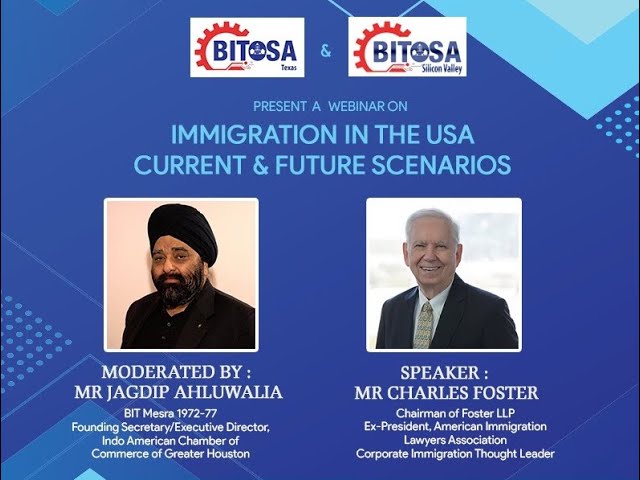
The BITOSA alumni chapters (Texas and Silicon Valley) hosted a live webinar on the BITOSA Global platform featuring immigration attorney Charles Foster, chairman of Foster LLP. The session opened with introductions to BITOSA and the purpose of the event – to inform Indian‑American professionals about the rapidly changing U.S. immigration landscape during the COVID‑19 pandemic. Foster outlined the immediate operational impacts of the pandemic on U.S. Citizenship and Immigration Services (USCIS) and U.S. consular posts, including office closures, suspension of in‑person biometrics, extension of response times for Requests for Evidence, acceptance of electronic signatures, and the suspension of premium processing. He then explained the April 22, 2020 executive order that temporarily bans immigrant visa issuance abroad (with limited exemptions) and its likely extension, and discussed how the order affects H‑1B holders, green‑card applicants, and future non‑immigrant visa measures. The webinar covered the H‑1B lottery results, cap‑exempt filing options, strategies for extending H‑1B status beyond six years using approved I‑140 or PERM filings, and the challenges posed by long backlogs for Indian nationals under the 7 % per‑country cap. Foster provided detailed guidance on dependent visas (H‑4 extensions, H‑4 EAD, F‑1 OPT/STEM OPT), remote‑work considerations, and alternative immigration pathways such as O‑1, E‑2, H‑3, and status changes to student visas. A moderated Q&A addressed specific attendee concerns about I‑140 approvals, salary reductions, grace periods, remote work amendments, PERM filing under the executive order, and procedural questions about biometrics and EAD issuance. Throughout, Foster emphasized filing as early as possible, monitoring legislative developments (e.g., S.386/H.R.1044), and seeking individualized legal counsel.
Chapters
Hello everyone. Good morning, good afternoon, and good evening. And I know these are very unprecedented times. I hope you and your families are all well and safe, and thank you for joining us.
Thank you.
Today, this is for the first time that 2 chapters and 2 of our very vibrant alumni chapters, BITOSA Texas and BITOSA Silicon Valley, have come together to host this webinar on the BITOSA Global platform. So thank you to everybody in both these chapters as well as the BITOSA Global chapter to help us put this together. I know we have some non-BITians from various institutions also on the call, and just for them, very briefly, I thought I will quickly introduce BITOSA and BITOSA chapters. BITOSA is the official alumni chapter for BIT Mesra in Ranchi, which is one of the premier institutions in the country, and we have multiple chapters all over the world. In the US, we have more than 9 chapters that are very vibrant. And as you can see, 2 of them have collaborated today to bring you this very important session on immigration, which I know is close to everybody's heart. Many of us have gone through it and many of us are going through it now. When I first came to this country, people said there are 2 I's that you should always be very focused on. and I didn't quite understand what it meant. I thought these were 2 I's, and the 2 I's then represented the IRS and the INS. Of course, they have both changed over time, and I know we both— all of the people in the US touch these 2 institutions all the time. So that's why this one is very, very important. That said, I will also address a few housekeeping points. I know many of you have already sent some questions over to us, and we have curated those questions, and we have provided that to Charles to review them and try and answer them. Obviously, we won't be able to answer all questions, but you are welcome to reach out to Charles, who, as you know, is a very well-known, very well-established attorney in the immigration space, not just in Houston, but for all over the US. And he works with clients all over the world. So you can always do a direct consultation with him. We encourage you to do so, uh, and we'll of course try and give you as many answers as possible. So each case, as we know, is quite unique. So that is why all the answers here will be at the broadest level and may or may not necessarily respond to your specific needs. And that's why it's important that you reach out to your own attorney or to Charles to take that further. So with that quick background, I would like to welcome, uh, Jagdeep Aluwalia. I think most of you know him. He is a very, very well-known alumni of BIT Mesra. He was also a faculty at BIT Mesra, and his tenure from a student standpoint was between 1972 to 1977. He has also been a founder of some very important institutions including the Houston and Indian Chamber of— Indo-American Chamber of Commerce. So I would also like to welcome Charles Foster, Chairman of Foster Immigration, and I will have Jagdeep introduce Charles and then we will get the webinar started. So with that, Jagdeep, thank you very much and over to you.
Thank you very much, Arup and Chandrasekhar. When the two of you reached out to me, I was very honored and privileged that you were reaching out to the Houston group to be part of the great work that your group is doing, because as always, Silicon Valley is ahead of the curve and you guys do a great job. Charles Foster, who I reached out to, is one of the most eminent attorneys in our area all across Texas. He's also a past chairman of the Asia Society. He is an acting consul general for the country of Thailand and a personal friend. So whenever I reach out to Charles, he never says no. I would like to mention that we had done a similar event with the Indo American Chamber recently, and one of the people on the call came back several times with questions, and I had to turn around and explain that A webinar like this is basically more for information. And beyond that, you would need to set up a consultation either with your own attorney or with Charles, who's always available, and he is the best. From my BIT days, Arup mentioned I was there from '72 to '77. What I loved more about the institute was the extracurricular activity. And then when I went back to work for my father, who had a manufacturing unit, I got invited back to teach. So I taught from '80 to '86 in the Faculty of Production Engineering. But again, what I enjoyed more than the teaching was the ability to be involved with the UNESCO Club, with the theater movement. And my proudest moment was when I was able to bring the National School of Drama for a 10-week intensive theater workshop on campus. And we were able to include some of our students in that. Training program. And for many years after that, BIT was winning championships across the country. So I have a very strong connect with BIT. I did go back in recent years with a memorandum of understanding for a joint degree with BIT Mesra and the University of Houston. But unfortunately the then vice chancellor passed away and all that went into cold Cold Storage. With that, let me come back to the reason we are together today. Charles Foster, an active member of the chamber, is chairman of Foster LLP, the largest immigration law firm in Texas and the Southwest, which provides comprehensive immigration legal services, is past national president of the American Immigration Lawyers Association, and was a senior immigration policy advisor to President George W. Bush in the 2000 campaign. And also immigration policy advisor to President Obama in the 2008 campaign, and is the founding chairman of the Texas State Bar's Committee on Immigration and Nationality Law. So ladies and gentlemen, I will be now handing over to Charles Foster, asking him to start his presentation. If you have any questions that were not already sent in to us, please type them in in the question and answer box. We have already, as Arup mentioned, have a list of questions, and if time permits, once we have gone through the questions that we had already received ahead of the program, we will try and answer some of the other questions. So with that, without any further ado, Charles Foster. Charles, on to you.
Okay, thank you very much, Sharad. It's my pleasure. Thank you for your friendship and that kind introduction. I want to also thank Bet Tosa for sponsoring this webinar on an important topic for the United States, for many communities, particularly for the Indian American and Indian community in the U.S. and abroad. I want to particularly thank Haroop and Chandra for helping arrange this program as well. As Janet mentioned, we're one of the largest immigration law firms in the country. We have offices in different cities in the U.S., particularly here in Texas, but we have offices abroad as well. I prepared a number of slides for you to look at so you don't have to look at me during the entire presentation. Here's one right here. So again, I want to thank BITOSA as well as JADA for helping arrange this webinar. Okay, the next one. Please, next slide. Next one. B. Also simultaneously, of course, a big question is the impact of President Trump's executive order of April 22nd, how that all impacts individuals seeking lawful permanent residency in the US, particularly given the backlogs into the quota, the recent H-1B lottery and what that means. And I'm going to conclude talking about foreign students because there are a number of Indian foreign students in the U.S. and what it means for them as well. Okay, next slide please. This just shows that we have offices in different places in the United States and the rating of our law firm. Okay, next slide. All right, so the coronavirus has had a big impact on all of us. I trust you're all staying at home and you're following social distancing and doing the right thing to first take care of your health. The immediate impact on U.S. Citizenship and Immigration Services, referred to as CIS, is that they've closed their offices. So individuals that had any appointments for adjustment of status or for taking their fingerprints or biometrics in connection with their employment authorization document or for an asylum interview or any type— or an InfoPass appointment. All of that was closed down through May 4th, and that will be extended. But I expect those offices will be open sometime in late May or early June. But temporarily, all the offices are closed of the Immigration Service for in-person interviews. There's been some speculation that clean adjustment cases, employment-based cases, they may waive the interview. It was not that long ago that all employment-based immigration cases through adjustment of status did require interviews. Okay, the other significant developments is that the CIS has agreed to accept, in terms of filings, electronically produced signatures, which is a big thing. The other thing is they agreed to, for purposes of renewing your employment authorization document, that they would accept the biometrics already on file since you would not be able to go and have your fingerprints taken at one of the application support centers. The CIS has also announced that rather than the normal 30 days, if they issued a request for evidence, or a notice of an intent to deny, that they would give you a 60-day rather than a 30-day response time through May 1st. And yesterday it was announced that May 1st would be extended to July 1st. So that's good for you and good for attorneys like ourselves, that it gives us more breathing room in terms of responding to requests for evidence. Also premium processing, which can be critical for cases, which allows the petitioner to pay a fee, a high fee, to get a decision within 15 days on their I-129 nonimmigrant visa petition or their employer-based I-140 petition. That has been suspended, and we, we do not know when that will be restored. My inclination is to say it will be restored relatively soon for a very simple matter. The CIS is funded entirely by the fees that we pay, you pay, employers pay. Thus, they really need the, the inflow of fees, and premium processing is a big source of revenue for the CIS. Okay, next.
Next slide.
Well, before I get to this one, I overlooked one point. Not only has the CIS temporarily closed, but American consular posts abroad, all American consular posts as well as U.S. embassies are closed. Therefore, any appointments that would be necessary to issue your H-1B visa or any other type of visa renew or issue a new F-1 student visa for obtaining a B-1 business visa. Obviously that's impossible. You can still go online and make appointments, and we do anticipate that again these offices should be open, I believe, by sometime in May. Okay, as this slide indicates, a really, really big development was the president's late-night tweet on Monday, April 20th, followed by his signing of an executive order on April 22nd. banning all legal immigration from abroad. That's a really big deal, and unfortunately, given the all-news, all-coronavirus news coverage all the time, the impact of that has sort of been lost because there has not been that much coverage which we would normally have expected. But we, again, everything has been set aside to cover the coronavirus issues. So what does this mean? Just what it says. All applicants for immigrant visas abroad, they are now banned for a stated period of 60 days. The only exception are spouses of U.S. citizens and children— that's unmarried children under the ages of 21— for a stipulated period of 60 days. But I'm convinced that that 60-day period will grow and is more likely to run through at least through the election in November. Why? If you remember when the president imposed his first Muslim ban that was later recharacterized as a travel ban, that ban was issued according to the executive order for at least 90 days. That was more than 3 years ago. And while at the time when the Muslim ban, and it was rephrased as a travel ban, was issued, there was a great deal of litigation, a great deal of focus, but with the passage of time, people forgot about it. And so now it's just, it stays there. Here we are 3 years later and no one's paying much attention to that. So I think this ban is likely to stay, unfortunately, much longer. in 60 days. Fortunately for most Indian Americans who are applying for their immigrant status, so-called green card status, they're doing so through adjustment of status. They're here in the U.S. in H-1B status or other temporary non-immigrant statuses, and so that so far is exempt, and that's very good news. I would say 80% of the employment-based immigrant visa cases, the applicants are already in the U.S. on a temporary visa, in many cases H-1B status. But unfortunately, that executive order also provides that there will be additional measures within 30 days that will apply to non-immigrant temporary work visas. Now we do not know what that means. at all, but one can make reasonable speculation and it's not good. It's almost certain it will apply to some— in some ways to the H-1B, uh, nonimmigrant visa specialty occupation classification. Now most of you know we've just gone through the big H-1B lottery and those cases that have been selected And I'm going to get to that for adjudication. Those petitions are already being filed. So what would the new executive order do? Will it apply only to new cases on future lottery? Will it apply to cases where the H-1B petition has yet to be filed? We don't know where that line will be drawn, but it will be almost certainly Will it apply only to individuals applying for their H-1B status abroad? That would be better than preventing someone already in the U.S. from changing their status. So mostly the best thing anyone can do is do as much as one can when you do not know when that line will be drawn. So if you're fortunate enough to have your H-1B petition selected, as part of the initial lottery, you have had— your employer has from April 1st, 90 days to file that H-1B petition. But my recommendation is file ASAP, file as soon as possible, because you don't know how that line will be drawn. It could likewise also apply to the L-1 intracompany transferee visas. But again, we do not know. It's somewhat less likely that it will. It could have— there's 2 parts of an L-1: L-1A managers and executives that are normally those coming to start a new company, an affiliated company, and L-1B specialized knowledge workers. It could be that only L-1Bs are affected. But as a general rule, If you're thinking about having your company or you're filing for a would-be employee or for yourself, the sooner the better. You— in my experience that goes over decades, I've learned that the best thing you can do is always the sooner you file, the better. The system has always become more restrictive, not more open. Okay, let's go on to the next slide. All right, I've already referred to the fact that many Indian applicants are impacted by the executive order if they're applying abroad. If they're here in the U.S., however, and they're in status, H-1B status, they can wait. So unfortunately, the executive order did not apply to them. But unfortunately, as most of you know if you're in that situation, there are so many— and this is intended to be a compliment— members of BTOSA and others that are so well educated in the fields of science and technology that there are far more Indian applicants seeking to apply that have qualified for— to qualify for lawful permanent residency, so-called green card status, under the 3rd employment-based preference, which normally requires at least a bachelor's degree, or under the 2nd preference, which normally requires an advanced degree. And so that's both good news and bad news. The bad news is that Indian applicants, more so than any other nationals, are facing huge waiting periods under the annual quota, which restricts every country to no more than 7%, which was imposed in the name of fairness, but unfortunately prejudices big countries, huge countries like India. So that 7% applies to India and it applies to Belize, but there are far, far more Indian applicants in terms of education and numbers that are qualifying than those from a small country like Belize. And so many argue that that's highly prejudicial and that the 7% cap should be lifted. Right now the big question is how long. And the backlog for— on paper for both countries is back to 2009. If you did the math, that's 11 years, but we know it's much, much longer than that because monthly we get— and I'm sure you look at the visa bulletin issued by the visa office of the U.S. State Department— and you can see just how slow that, that date advances. Instead of advances— of advancing a month at a time, it could advance a week at a time. Sometimes it jumps ahead faster, but no one believes that it's just an 11-year backlog. Most would say it's closer to 20 years than an 11-year backlog. Now, good news is If your employer, and I think most of you know this, has already filed a labor certification, a permanent labor certification known as PERM, or filed another I-140 petition for you on some other basis such as a national interest waiver, and that they have filed timely before the end of your 5th year, and if you're in H-1B status In theory, you can keep on extending that H-1B status in the name of your employer beyond not only the 6-year limitation on H-1Bs, but for a 7th, 8th, 9th, 10th, 11th, 12th year, and so forth. So if you do not get anywhere close to that 5th year, as a general rule, as I said earlier, the best thing you can do is to file sooner rather than later. You'll never make a mistake that way. I could get in questions, allow it, into recapture as well and how that works, because you're entitled to a full 6 years. So if your job requires you to travel and work abroad extensively, under certain conditions you can recapture. Okay, let's go on to the next slide. Uh, okay, I saw some artwork there temporarily. Let's talk about the H-1B lottery very briefly. We've already gone through— so there were more registrants— I say registrants because rather than filing a petition, you registered first— than in history, 275,000, remembering there's an annual cap of 65,000. Plus an additional 20,000 for individuals with advanced degrees from U.S. universities. So the, the, the good news, if any, are for individuals with advanced degrees. The way the cap was administered, they allowed those individuals with advanced degrees, irrespective of where they were obtained, to first participate in the regular cap. And then those not selected but with advanced degrees from US universities could participate in the additional 20,000 cap. As a result, approximately 46% of all registrants selected were individuals with advanced degrees, or advanced— mostly with advanced degrees from the United States institutions. of higher education. Okay, next slide please. I've already covered that. Now if you were not selected, of course that's bad news.
The—
so what to do? I would point out that there is one little sliver of hope. Since this H-1B lottery was conducted, the world has changed and many employers who had their application, their petitions selected now will not file that H-1B petition because all of a sudden they've gone from very low unemployment to they're looking into financial perhaps serious financial issues. And as we all know, many U.S. companies are going through layoffs. So if they're going through layoffs, it's logical to assume that those companies will not in every case file an H-1B case even when they're eligible. So what we don't know how many numbers, but there will be some additional numbers that will open up. So some individuals that were not selected in the initial registration may learn that there's life after death and that their petition will be selected. Let's hope that helps you if you're in that situation. Okay, next slide, please. All right, some employers— I think you know this— are cap-exempt. So if your employer is an institution of higher education, That would be a junior college, a college, a university, a nonprofit affiliated with that institution of higher education with a direct affiliation with appropriate agreements, a nonprofit research— primarily a dedicated research organization, as well as government research organizations. They can file H-1B petitions at any time. They're not subject to a cap. Furthermore, if you're fortunate enough you already have H-1B status and there's time left, you can— you're mobile. You can move to another H-1B employer. That H-1B employer can petition for you, and upon receipt of that petition, you do not have to wait for adjudication. You may want to, to make sure but you're authorized to go to work right away. There's also other strategies. For example, if you're— if you are working for a cap-exempt institution, you can work part-time for a non-exempt employer as well. All right, let's go into the next. Okay, all right, now this is a big issue. Given the coronavirus, its huge impact on the economy and our employment situation, and the reality that people are being laid off, they're being sent home, their hours are reduced, their wages are reduced. If you're working in H-1B status, that's a big issue because All of those, any of those would constitute a material change and in theory would require your employer to post a new labor certificate, a labor conditions application, LCA, and upon its approval file an amended H-1B petition. Now that's a real challenge in this time because many employers will not be as empathetic and that you would not necessarily want to go through that. Who would be exempt? If you're required to work from home, for example, most of our employees today are working remotely. If you're in the same— if you're home, hopefully you are working close to your employer, to work, very practical thing to do. If you're within the same metropolitan statistical area, MSA, then there's no need to file a new labor conditions application. There's also something called short-term placement. So if your employer has sent you home or if you're working remotely because you prefer to do so, keep it under 30 days because under the short-term placement rules you would not be subject to having to file an amended LCA thus an amended H-1B petition, which could not only result in additional costs but would be a triggering event with some employer that might effectively have that employer reevaluate your employment situation. Okay, next slide. Okay, I've already referred to significant backlogs under both the go-to preferences for the vast majority of Indian nationals seeking to become lawful permanent residents, so-called green card holders. Here we have a format of a green card that's actually green, although since that was first— alien registration card was first imposed during World War II, it's gone through a variety of formats and colors, so it's nice that it's back to green again. I've already referred to the fact that file your PERM or your I-140 petition prior to the 5th year. All right, let's go into the next slide, please. Okay. Before I get to this, I meant to address in with that slide another issue, what to do That's a big question I answer all the time. You're here, your H-1B, your— was not selected, your H-1B petition was not selected for registration. One thing that can be done is hope like the cavalry coming to the rescue, that the U.S. Congress will come to the rescue. The U.S. House of Representatives passed almost with no controversy House Bill 1044 virtually unanimously removing the annual employment-based cap, which would have an immediate positive effect on Indian applicants, and that backlog would have been cut, unfortunately not entirely, but perhaps as much as 50%. which would have helped many of you. It also increased the cap from 7% to 15% for those individuals waiting in line with a family-based petition. That would have helped many people from Mexico and the Philippines in particular. But unfortunately, as you know a little bit about our civics, anything passed in the House must also pass in the Senate, and it looked like Senate Bill 386, which was the equivalent of House Bill 1044, was going to go through the Senate under the leadership of U.S. Senator Michael Lee of Utah on a— under a procedure that required— that would have allowed them to pass that as long as there was no objection. But unfortunately, there was an objection by Senator Durbin of— first by one or more senators and eventually by Senator Durbin. There was a lot of negotiations back and forth, and it looked like at different times there was going to be an agreement reached and the Senate bill was going to pass without objection, but it failed to do so. So I think it's safe to say that given the current conditions where Congress is barely functioning right now except for issues on the coronavirus, that it's not likely that this legislation is going to pass anytime soon. I, I could go into this, but I just say when the, when the U.S. Supreme Court deals with DACA, Deferred Action for Childhood Arrivals, that has put about almost 800,000 individuals into a temporary lawful status, who— people that were brought here as children and have been unlawfully in the U.S.— that will force Congress to deal with immigration. And it's possible that there will be some horse trading and this proposal will be part of a bigger deal that will include legislation to protect DACA beneficiaries.
Okay, next.
Next slide.
Well, before I get to this, I want to say what else if legislation doesn't come to the rescue. Some could qualify for H-3 trainees if they're running out of H-1B time or OPT time that I'm going to address. Some could possibly qualify for— as aliens of extraordinary ability as O-1s. We do a lot of O-1 cases, and if you have a strong resume, you've published, you've gotten recognition, you've received awards, it's possible you could be in the O-1 ballpark. The advantage of the O-1 is it's not subject to any cap. I'm always surprised at the number of O-1 cases we get approved. It does require your employer to file that petition, and you have to show how you're your extraordinary ability will be used by that employer and a number of other— you've got to meet 3 out of 6 criteria. We always try to meet more than those 3 so that if one looks weak, we will have covered that base. I'm just going to mention some extreme options that we sometimes— we deal with, one of which is for certain countries, if you make a substantial investment under a treaty provision, that could be as little as $150,000 you can get an E-2 treaty investor status within the U.S. or abroad if consular posts are open. Unfortunately, the U.S. does not have an E-2 treaty investor provision in any bilateral treaty between the United States and India. We've had some clients that were so determined that we assisted them in acquiring third country citizenship in a small country where they can make a nominal investment and acquire a third country citizenship with the country that does have such a bilateral treaty. We've had a few individuals who were waiting for their visa numbers and they went to Canada to hold out by having their office set up a branch there so they could be still working but from Canada or of course from India too. Finally, for those of you who are still in F-1 nonimmigrant student status, of course, all following the president's declaration of a pandemic, all universities closed. Many Indian foreign students went home and they're sort of stuck there now given the lack of flights between the United States and India and other concerns. many Indian-born students stayed in the U.S., and fortunately in both cases they've been able to maintain their student status by taking their courses online, which, which the INS— CIS now permits, and that's a good thing. Now when you graduate, let's go to the next slide, if you're a foreign student in F-1 status, A really great thing is you're entitled to 12 months of practical training, OPT status, but many Indian students are in the sciences, technology, engineering, mathematics, the STEM fields, and you're entitled to 36 months of OPT. You must apply 90 days before graduation within a 120-day period. But you can only apply for OPT if you're physically in the US. So if you are applying for your OPT, do so timely. Always, as I said earlier, better to file sooner rather than later. If you're in India, try to figure out how you can get back and timely file for your OPT. You must be physically in the US. Okay, I think that covers all of the topics. I could go on, but I know we're running out of time and I want to leave plenty of time for Q&A. And I'm going to pass this back to Jyoti.
Thank you very much, Charles. As explained earlier, we had requested and we have received 8 questions which I will address to Charles. Any further questions can be typed in and we will keep track and depending on the time available, if there is time, we will address those questions. Otherwise, we'll send them to Charles's office with a request to answer as many of them as he can at a later time. The first question is, my I-140 was approved 3 years back. I'm on H-1B. Is there anything I should be worried about from this executive order?
Not in the initial executive order of April 22nd, nor do I think— even though I expect a second executive order dealing with nonimmigrants, I think it's almost certain that they will exempt those individuals currently in H-1B status. So I don't think you have anything to worry about except the issue I've already addressed. You've got to maintain your H-1B status as long as you're— until a visa number becomes available. And that could be a number of years for you. So always timely file for your H-1B extensions. And if you've got an approval of an I-140, even when your H— your 6 years expires, you can continue to file for H-1B extensions in 2-year segments. Okay, next question.
My daughter and her fiancé are both on F-1 OPT status. They are coming to India for marriage later in the year. Do they need to get a marriage license before coming for the marriage? Will a U.S. marriage license help in any way?
If I understand, there are in India on OPT. First, I would say—
No, Charles, they are going to India. They are here right now on OPT. They will be going to India for their marriage later. Do they need to get a marriage license before they leave for India for the marriage? Will the license help in any way when they're in India?
Yes. I would say this. In normal times, That's— I fully understand the importance of having that marriage ceremony in India, and that would be no problem at all. And they— there would be a marriage entered into lawfully in India is a valid marriage in the United States. It would be recognized for such purposes. They would not need to get a marriage— it would be redundant to get a marriage certificate first in the U.S., they can be married in India, no problem. That is normal times, but we do not live in normal times. As a general rule, I would say if you want to complete your OPT and have other options you're going to utilize to stay in the U.S., it's better to stay in the U.S. We do not live in normal times. We already know that at any moment the president could shut down travel from any country in the world. We already know that flights are very hard to come by, and so I think the only problem I would raise in these times would be the possibility they could go home and be trapped in India and not able to come back to complete their OPT.
The next question is, what will be the impact on the H-1B with I-140 approved residence visa renewal? What is the probable risk if the companies start the salary reduction?
What's the last part of the question?
What is the probable risk if the companies start salary reduction?
Okay, there's 2 answers to that. First, it's good that the person has H-1B status and you need to file the extension. The impact of the executive order I've already referred to. We do not know because the second executive order, so-called additional measures, has yet to be published, but it could be published within 30 days. We do not know when that will be. The president tends to jump the gun and go sooner rather than later, but we know the direction of that is to be restrictive. Um, so if that person is, uh, has a reduction in hours, if I think that's what you said, or reduction—
It's either a stop in salary or a reduction in hours.
Is it whether it's a reduction in hours reduction in salary, all of those would be deemed to be material changes and would normally require that employer to go back and file with the U.S. Department of Labor an application, LCA, Labor Conditions Application, and upon approval to file an amended H-1B petition. From my 129. So that's not good. It's not good because it opens up this Pandora's box with the employer, uh, going to the employer and say, oh, by the way, you need to file and incur this additional expense on my behalf. Uh, these are very sensitive times, and I would hate for that person, uh, to do that and just have that employer say, well, in that case, I'm just going to let you So you've got to be very careful how that issue is handled. And I would certainly— the person should know how valued they are. If they're a valued employer, of course, the employee— of course, that employer is going to do whatever they have to do. The other thing is, if they reduce the salary below the prevailing wage, then you would not be able to get an approval. That would be a separate issue. Okay.
Thank you, Charles. You probably answered the next question, but just for the benefit of the person who sent it in, I'm going to address it to you. Can immigrants work remotely at a different location temporarily? I am stuck temporarily at a different location, and I'm wondering if any amendments need to be filed for this temporary situation.
I did answer that, but to repeat, They would have to file an amended LCA and H-1B petition unless they are working remotely within the same MSA, metropolitan statistical area. So they're, broadly speaking, generally speaking, if they're working close to their— from home close to where their original employment situation is. And secondly, if it's for less than 30 days. So if that individual has any discretion, try to keep it under 30 days.
The next question, I am on H-1B. There is a very high chance that my company is going to lay off many engineers. I'm getting worried because of the grace period of only 60 days. Is there anything I should be prepared for? What are the chances that the grace period will be extended to 180 days?
I think the chances of the grace period being extended are quite close to zero. The trend under the Trump administration, particularly given the influence of Stephen Miller in the White House, who's a huge anti-immigrant restrictionist and who plays up to all these anti-immigrant groups on behalf of the president, they're trying to cut, reduce, shrink immigration. This administration is not going to— the question is not whether something is going to be getting bigger and extended, it's just how much.
Right.
Cutting there will be. So the grace period will almost certainly not be extended. If the individual loses their job, the question is, of course, what to do. The first thing that comes to mind is how much H-1B time is left. You have 6 years and you can subtract from that 6 years any time spent abroad working, vacations, So if that person had to spend time abroad for their employer, he can recoup that time. If so, the most important thing you could be doing is looking for another job at a job that— at a salary that would meet the prevailing wage, which should be going down, by the way. So that's the most important thing. Now, unfortunately, some people will not have that option, so they can consider other options that we, we represent people all the time that just have to stay in the US. Often they're motivated by keeping their kids in school. They want their son or daughter or their children to finish high school. They don't want to have them leave and miss their last year or year or two. So they're desperate to stay here because their children have a status dependent upon theirs. So if you cannot go to another H-1B employer, One of the parents could think about changing their status also to student status. I always joke that I've kept many clients in school with many, many advanced degrees, more degrees than you can imagine, because they've just been trying to keep their status. So either the applicant or their spouse could decide to go back to school. and the whole family could switch over to another F-1 status, to an F-1 status with the dependents having F-2. The last hope which we've done is not great. I can tell you all the downside, but sometimes you don't have a perfect situation, but you're trying to stay in the U.S. to keep a foothold, and that's switching from H-1B the visitor. And we've done that with surprising success, although no one can guarantee that. And we're living in difficult times, but it does give that individual hope and a foothold to stay here for some period of time. Okay.
The last 3 questions on my list. How much time does the H-4 extension take? Has it increased due to the COVID-19? I have filed for my wife's H-4 extension in January 2020 and have not heard back yet.
The COVID-19 has changed that only in human dimensions. There's no— specifically, the CIS has not closed down at all except for in-person interviews. So in theory, that has not changed. And the interviews continue. I mean, the adjudication process does. As a practical matter, we all know as employers or as employees that there's probably been some loss of effectiveness and they may be taking more time. So that period of time to get that extension is not unusual. I would say even in normal times, it could be 4 to 6 months before it's adjudicated. And we're not living in normal times. So I would add, if anything, I would add some— expect that it would take a little bit longer than normal, although there's not been any formal changes in that area.
The second last question, will H-4 EAD continue? President Trump was planning to revoke H-4 EAD.
We have been waiting since the president has indicated one might say threatened to cancel a very great benefit that these— under certain conditions, a spouse to an H-1B visa holder in the process of obtaining permanent residency can obtain employment authorization, an EAD, that is a generic employment authorization, good to work for anyone. But this administration has indicated early on their intent to revoke that. The good news was that threat seemed hollow. Nothing happened. It was the dog that didn't bark. But I'm worried, and I think it could be canceled because right now we've got— there's a team working on this second executive order specifically addressing nonimmigrant temporary workers in the US. And I think it's going to cover a catch-all of issues, and that could be the place where they'll also rescind the regulation that allows H-4 spouses to obtain an EAD, an Employment Authorization Document, under certain conditions.
The last question: my company is about to file my PERM application. Is the executive order going to impact my PERM? And then, Charles, I have a few questions that have come to me directly on the chat line, but I'll let you answer this one first.
Okay, the PERM refers to PERM, Permanent Employment Certification. So the short answer is no, there is nothing in the president's executive order that impacted the process of going through the U.S. Department of Labor to get a certification that there are no available willing and able U.S. workers at a particular time and place. That is the process. But I would say we have gone from the best of times, meaning the US with a relatively low unemployment rate, to the worst of times where we have a growing and plummeting rate of unemployment. So not only will that make it far more difficult to prove that there are no qualified, willing, and able US workers depending upon the occupation, salary, and location, but it also— I've gone through this for decades. I know that the folks at the Department of Labor who administer this program, that they just hate to certify that there's a shortage of US workers.
Yeah.
At a time when we have high unemployment, even though there may— even though you're successful in proving the elements of a PERM case, that there were no qualified applicants, they're gonna— it's gonna be harder to get a PERM approved. Having said that, as I always say, the best answer is full speed ahead. It will never get any better. If your employer is willing to do it, you have nothing to lose to go ahead.
We have 6 minutes left on the authorized time. I will pick up a couple of questions that are generic. I have some more personal questions which I will forward to you, Charles, and if you have the time, you can respond or have somebody from your staff respond. I am I-140 approved H-1B visa. Can I apply for a new job and will the new employer be able to file an H-1B petition?
Yes. You're— if you have remaining H-1B time, which you do with that approved I-140 petition, if I understand it, you can find new employment and that New employer can file a new H-1B petition on your behalf, and once it is receipted, you do not have to wait for the approval. You can go to work immediately, although it may be better to wait to make sure you're gambling that it's going to be approved. We often know when we file a petition whether it's going to be approved, but there's some cases that are sort of Iffy, and you wouldn't want your employee to jump the gun.
So this is a different kind of question. It's on the role of the BIT alumni or similar professional alumni in pro-legal immigrant bills like the S.386, which ends the country of birth criteria. Any influence that our alumni can have on these bills will help everyone coming from India. So this is a question for Charles. Do you think an organization like ours, the Alumni Association, could influence any of these bills?
Yes, broadly speaking. And this is an area in which I have focused a good part of my career, that is immigration policy, having worked for 2 presidents as a— in the case of President George W. Bush as his senior immigration policy advisor, and for President Obama, I also worked as an immigration policy advisor for a period of time. So, and I had the opportunity to regularly testify before both the Senate Immigration Subcommittee as well as the House Subcommittee, and I know Senator John Cornyn, our state senator, senior senator, who happens to be the chairman of the Immigration Subcommittee.
Senator.
So all immigration legislation is political, and members of Congress respond to their, quote, constituents. And the one consistency I have gathered over decades is they always tell me, Charles, Charles, you're right, I agree with you, but I cannot vote that way because I, I'm glad to hear that from you and what you say is correct, but 90% of my mail or my emails or my phone calls, they're all anti-immigrants, they're all anti this bill, and nobody contacts me about why I should be voting for this. So first point I would make is volume— size matters. volume matters. Not only the organization, but more important, members, as many members should contact their local congressman and US senator of their state, or senators, each state has 2. And in a very simple way, email probably being the better because letters get— have to be— sanitized and all of that, and saying a simple message, a pro-immigration message. This bill is a good bill, fair, it's good for America. And they literally— my son used to work for a senator— they literally would give the senator a report. He wouldn't read any of that stuff, but they'd say, what'd you get? We got 20 phone calls today for the bill and 100 against it, or we got 100 for it, or emails 100 for it, 20 against it. So that's what they're hearing. So yes, in the name of the organization, but numbers are the most important.
Thank you, Charles. So though we have several questions, I'm going to ask you one last question because we're already at 11:29. After this question, we're going to hand back to Arup to sum up everything. But before I do that, I want to thank you once again, Charles, for taking the time. There will be a couple of questions that we will forward you, and if you or anybody in your office could respond to them. So the last question I'm asking is a brief one. I have a pending I-485 but no biometrics notice as of now. Can I get my EAD/AP without biometrics?
I'm going to interpret that question that he is filing for his EAD, his Employment Authorization Document, And it has yet to be approved. I mean, he's never had an EAD. It's not an extension. If it's a new EAD application for an I-765, he needs to have his fingerprints. He needs his biometrics. And so as I mentioned earlier, that on an extension, they've agreed to accept metrics that are already on file under your name. But if you have never filed before, they would not be able to do that. That's the bad news. The good news is I expect the Application Support Centers to open up sometime in the month of May, so it should— you should be able to proceed relatively soon.
So thank you very much, Charles. Before handing over to Arup, I want to thank Arup and Chandrasekhar and the Bittosa Group for giving Charles and the Chamber this opportunity to share Charles' knowledge with all of you. I would suggest anybody whose question has not been answered to please send them to Chandrasekhar so he can collate them together, and then we can go through them and see the ones that have not been answered. We can forward them to Charles and his office. With that, over to you.
Thank you, Jagdeep. First, I'd like to thank Charles. Thank you very much for providing Great insights and clarity. And I know this is such an important topic of immigration because this has a profound impact on many people's lives. So that's one of the reasons why we have such a good attendance today. As Jagdeep rightly said, I'm sure there are more questions. Like we said at the beginning of this session, I— we encourage everybody to either speak to their attorneys or to come to you. Ideally come to you, and of course everybody must recognize that you know any further questions will be on a on a consulting fee basis with your office and with yourself. But I do want to thank Charles for his his time today. I know it is a weekend, so thank you for coming. Thank you for sharing your insights. Thank you for being with us. I also like to thank Jagdeep Aluwalia, who is a BIT master alum. Like I said earlier, he's been such a great driver, supporter, help to this whole community. So thank you, Jagdeep, for spending your weekend with us as well. I'd like to thank Chandrasekhar, who works tirelessly to make this happen on behalf of Vitosha Silicon Valley. We have a number of webinar series of this nature. Next week, I would encourage everybody to stay tuned. We are celebrating Mother's Day. So we have our alumni from all over the world are going to be on a webinar, and especially women, uh, will be talking about how to celebrate Mother's Day. So please stay tuned, we'll send you more information. I hope many of the people on the call benefited from this webinar. I certainly did. It clarified, it added to my own knowledge about this area because we deal with it in my own organization. I would like to also thank Bitosa Global for making this possible, and all the volunteers, all the people, team members in Pune, in Bangalore, who work behind the scenes to make this happen. And finally, to all of you who joined us today, thank you very much. I wish you all the very best. Be healthy, be safe. Thank you, and best wishes.
More from Charles


2016 Immigration Law Lecture Series (1 of 3) - Featured Speaker Charles Foster