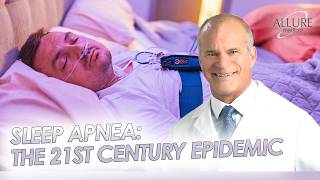
This is a YouTube video titled "Sleep Apnea The 21st Century Epidemic" featuring a detailed monologue or presentation about sleep apnea, its health impacts, diagnosis, and treatment options. The speaker discusses the prevalence of sleep apnea, the importance of screening, and various treatment methods including CPAP, surgery, and a laser procedure. The content is educational and aimed at raising awareness about sleep apnea as a widespread health issue. There is no indication that Dr. Charles Mok is a participant in this content.
Foreign.
I'd like you to take a moment to introduce your book. It's on sleep apnea. And tell us a brief synopsis about your in office sleep apnea treatment that you can do for your patients.
Yeah, it's called sleep apnea in the 21st century epidemic we could call a pandemic. And interestingly I wrote this during the pandemic in 21. And sleep apnea, let's diversify what it is. Why we should know if you have it. And the real take home point is everybody should be screened for sleep apnea. This flies in face of what your insurance company would tell you or maybe what your family doctor tells you you're allowed to do. But you can always pay out of pocket to get a sleep apnea test. And they're very, very inexpensive. I want to go over that, what your alternatives are if your normal healthcare system won't permit it. Sleep apnea is an epidemic and it's a situation where it's a step past snoring, where people also have periods where they under breathe and don't get enough oxygen or pause breathing for at least 10 seconds a certain number of times per hour. So let's restate that sleep apnea gives us. We do a test called the apnea hypopnea index. Hypopnea means under breathing. Apnea means stopping breathing. So somebody, they stop breathing for 10 seconds, oxygen drops a certain amount, 3 or 4% and we get a score that says, well this happened five times an hour, which is considered pretty normal. Happens ten times an hour, abnormal happens 30 times an hour. That's severe. And what does that have an effect on your health? So now the traditional way to measure sleep apnea is go to a hospital or lab. They'd have a technician there watching you sleep. You're wired up to hoses and tubes. And electronics now can be done with a device that looks kind of like an apple watch. It's got a little sensor in your finger and one in your chest. There's even some smaller ones than that. I even wear an OURA ring here. That won't give me a score, but it shows me if I have apnea events during the night. So there's a lot of ways to check for this that really don't require you going through your health insurance company which typically won't pay for unless you have obvious sleep apnea. In my opinion, everybody should screen for it and we'll talk about why. So back in 1988, the National Institutes of Health commissioned a study in Wisconsin University of Wisconsin, Madison to figure out what's this apnea stuff. We didn't treat it back then regularly. We didn't know what to do about it. We didn't even know if it's a problem or not. So they measured healthy adults 30 to 60 years old, and they did a apnea test on them and they gave them a score and they gave the people the results of the score. But they didn't do any intervention because we didn't really routinely treat sleep apnea in 1988. And they put that study to sleep for 20 years. And then 20 years later, in 2008, they came back and they looked at the death rates of people and correlated to their sleep scores. They even matched people based on other, we call comorbidities. You know, were they smokers, obese, other health problems. And what they found is adjust even when adjusting for other diseases. People that had a sleep score over 30, which we call severe, were three times as likely to be dead. 20 year follow up, and again they started at 30 to 60. So now they're 50 to 80 years old, three times more likely to be dead. The most common cause of death was cardiovascular disease, Heart attacks, strokes. People with moderate and even mild sleep apnea were about 50% more likely to be dead, but it was considered not statistically significant. In other words, they couldn't say that mathematically that was for sure, 50% more, but it was increased. So what have we learned since then? Well, we should be sleeping. Treating sleep apnea. You should be treating it now. What's interesting is that health insurance companies go by a consensus called the United States policy Preventative Health care Task Force. This is a non governmental organization paid for by the government that specifically says we should not routinely screen for sleep apnea. I think that's an absurd recommendation, but it does save health insurance companies money in the short term. But we know in the long term, if you treat sleep apnea, you have less health care costs because you're healthier. And we look at this cardiovascular disease, you know, we have a lot of treatments for that. But also people with sleep apnea, we didn't know this back in 08, we know it now. People that have sleep apnea untreated get Alzheimer's on average 10 years sooner, and they're 67% more likely to get Alzheimer's. It's not treatable. That's not treatable. Even treating sleep apnea in early stages, Alzheimer's can actually reverse some symptoms of sleep apnea of Alzheimer's. And it's Kind of like the hidden disease that you don't know you have. Most people with sleep apnea don't know they're having it because they're sleeping. You don't generally wake up during those apneic events. Maybe your significant other can hear you snoring, hear you choking. They go sleep in another room. And some people even have sleep apnea that are not snoring, but it's very correlated to snoring. So most people with snoring do have some degree of sleep apnea, even, even children. And the treatments are pretty straightforward. There's devices that people can wear at home called a cpap. It's a device that you wear to help breathe for you. There's a surgery for it. We have a procedure called night laser apnea. Lays where we use a laser to remodel the tissues of your airway. Non surgical. It hurts a little bit, like it's a little hot. Getting it done takes about 20 minutes. But it's totally tolerable. No downtime with it. And typically we reduce sleep apnea scores by about 70% which is equivalent to using the machine or the CPAP machine or the surgery. So the real take home message is everybody should be tested for sleep apnea. It's very inexpensive. If your insurance doesn't cover it, we buy the Watchpats which is the medical device FDA approved for sleep apnea. It's suitable for most people compared to a hospital lab. And our cost is like $96. I think we charge 106 cover our shipping. And that's an easy way to get tested to see if you have sleep apnea. I'm putting a price on a video that might change. The prices go all the time, but that's I think about what it is very inexpensive relative to leaving sleep apnea totally untreated. I would recommend everybody get a sleep study. Talk to your doctor about it. I prefer the at home ones because the compliance is much higher. If your doctor gives you a prescription to go to a sleep lab, probably not going to go. It's estimated only one out of five or 10 people that have sleep apnea know about it. Only about 1 of 3 that know about it are treating it. Which means 94% of people with sleep apnea are not getting treated. And the economic impact of not diagnosing and treating sleep apnea in $2015 is about $150 billion a year. $150 billion a year. So identify it, treat it. Doesn't matter what treatment you do. A CPAP inspire surgery our night lace procedure. They all work about the same. The CPAP is sometimes covered by insurance. The surgery generally is not. But it could be by certain insurance carriers or the night lays is not. But it's not very expensive expensive. So I think the real take home message is get tested and do some kind of treatment if you have it, test your loved ones and it's very, very easy test to do.