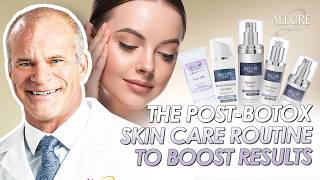
A skincare expert breaks down the products and routines that protect and extend Botox results. Use professional-grade sunblock, vitamin C, retinol, and glycolic moisturizers. Sirolimus and other treatments can boost the effects further.
Foreign. I'd like you to tell us a little bit about your skin care program and the essentials after somebody has invested their time and money into getting youthful appearance with Botox and injections and other things. Let's go with the importance how you feel about your skin care.
So we think about when we're trying to get healthier on the inside, we might do things like diet and exercise, might get tested and see what nutrients we're deficient in, may take some supplements, might modify our eating, so we're healthier on the inside based on our individual needs. And people, you know, forget about their skin and they might try different things that may or may not work for them. And we look at if you went to Target or Ulta and looked at the skin care, it's really confusing. There's a lot of stuff out there. This has led to the biggest growth in cosmetic medicine, which is physician dispensed skincare, which is a professional grade, much stronger. And that's. It really only comes from a doctor's office because they're going to have to give you instructions on how to use it. I'm going to go over that a little bit because they're a little too strong to use without specific instructions. And if you look at, you know, you have a hundred things that you could use, what's the most impactful? And there's really, really four that, you know, everybody should be doing, in my opinion, that have the biggest impact. And you can add on things condition specific after that. Now, one, without a doubt is sunblock. That goes on after your skin care. And sunblock has the ability to slow down aging. And it was interesting study, I think it was Johnson and Johnson did this. They published it about six or eight years ago. And they were using a skin elixir to help aging. And they gave people the skin elix or placebo for two months. And he found this special skin elixir had less brown spots, less redness, less capillary, slightly less wrinkling. And when they unveiled what it was, it was simply sunblock. And we don't think about the exposure we get to ultraviolet light because we call it sunblock. It actually should be ultraviolet light block. I'm standing here in a building that was built in 2000. It's got fluorescent lights that spew out ultraviolet light. You can get a sunburn from ultraviolet light. We did a surgical mission in Peru a few years ago and they had fluorescent lights that would not be allowed in America, but we all got sunburns and keratitis of our eyes because there was so much fluorescent. Fluorescent most much ultraviolet light giving off by lights. By the lights. No LED lights don't have that. But. But fluorescent does. So does natural sunlight, so does incandescent lights. We're exposed to that all the time. So we slow down aging with this sunblock and that goes on last. We're going to just talk about that and I think you can have your opinion. What kind of skin care to use. Typically a mineral based skincare is what we use, but they also sort of work. So the big three are a vitamin C. Not just a vitamin C, a potent multi strand vitamin C. So there's many forms of vitamin C. This one has seven in it called radian C. And the vitamin C reduces what's called oxidation which is really the mother of ag aging and senescence. Something that causes your skin to break down which is constantly having to fix itself. And eventually your body's ability to fix itself gets impaired. And with vitamin C we have less, we see less redness, more brightness to the skin, less brown spots, better texture to the skin. And then something of what's called a retinoid or retinol. Retinoic acid, retinaldehyde. We use a tretinol which is the. A strong, a strong form of vitamin A. So this is a vitamin A retinol and the alcohol forms of vitamin A are the most suitable for. For anti aging purposes. Very well tolerated. They do cause some drying but they not as likely to is a. Is a acid form which would be like retin a little too strong. And then glycolic moisturizer. Alpha hydroxy. It's called alpha hydroxy acid. The most common anti aging cream that exists. So these three. So we have a medical grade skincare vitamin C that's, that's professional grade that typically might be too strong for some people. They have rosacea or a lot of redness. You can start using it two or three days a week. Retinol in the case we use a tretinol which is a little stronger than standard retinol that's usually used about twice a week. And then you gradually increase it as tolerated. Some people can use it every day, but most people are using it a few times a week. This is put, gets put on at night, vitamin C in the morning, vitamin A at night, vitamin A against retinol and the glycolic moisturizing we use twice a day. If you just do these three things for three months, your skin will be brighter and more youthful. In our case, if you buy from us or it's free, we guarantee it. So more youthful and brighter or it's, it's free. These are, these are the sure thing. And this is our, really our mainstay for skin care. We have some other things as well. We use this eventone age defense which is a, for somebody that's got melasma or some pigment disorder. And it uses a mixture of things like Kojic acid, some anti inflammatories and hydroquinone. We've got our own sunblock. We have our eye repair serum, which is a lighter form of vitamin C, vitamin E and retinol to use around the eyes. For dark circles around the eyes or skin crepiness of the eyes. We also have a strong moisturizer used for once people have medical conditions of their skin or they're getting a laser resurfacing done. One of the biggest mistakes I see in our practice and our providers and in the public is people wanting to do a laser treatment to treat some condition of their skin. And they don't invest in the skin care. You are wasting your money. Particularly some treatments like Clear and Brilliant or Fraxel, which is really designed to get medications into your skin. If you're not doing skincare, you're gonna get that stuff back, you know, come back faster than you wanted to. So don't do the treatments if you're not gonna do the skin care. And one I'm really fond of is called sirolimus. Some of you might have heard of Rapamycin is the same drug. So sirolimus is a drug or romapamycin, let's call it. Rapamycin is a drug that's being tested for aging, slowing down aging in humans as a pill that I take. And it appears a slow down aging of every animal and creature and plant has been tested on is being tested in humans currently, but it has been tested pretty extensively on the skin. And it does slow down even to some degree. Reverse the age of the skin, increases the collagen content of the skin, increases the thickness of the skin, appears to reduce pore size, improve texture and color of the skin. So sirolamus is not to be used with a laser. It does impair healing. If you have a laser injury and something you use two or three days a week, one bottle will last about three months or so. And that comes from a pharmacy. It's got to be prescribed. We can't guarantee sirolimus because it's a prescription. We get it from a different company. But that's like to see people are really of any age, as is using children for certain conditions safe at any age. And if I talk about my big three plus a sunblock four, then seromis might be number five is an optional one. Once you're doing this first three. I wouldn't do seromis without it because it's not preventative. It's more repairing stuff. So I think skincare is something that is maybe in our practice, we've not been the best at communicating to our customers about our patients, about particularly when they're doing laser services. Services. And I hear a lot of times people say, well, they just want to do laser and see how it works. Well, if you're doing a laser that's designed to get get medications in your skin, you're wasting your money if you don't. The medications in this case vitamin C, retinol and some conditions, specifically.