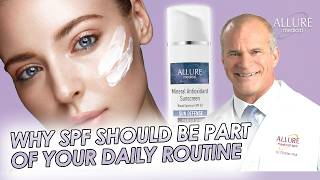
Short interview promoting daily SPF use. The expert emphasizes mineral-based sunscreens (zinc oxide or titanium dioxide) that reflect rather than absorb UV, recommends year-round use because of UV exposure from sun and some fluorescent office lights, and explains UV-driven skin aging through reduced collagen, elastin, and facial fat. Practical guidance includes daily mineral sunscreen applied last, topical multi-form vitamin C (~36-hour binding to collagen/elastin), intermittent retinol/tretinoin use (sun-sensitizing — avoid before heavy sun exposure), glycolic/hydroxy cleansers or moisturizers, and seasonal adjustments.
Foreign.
We're here with your SPF skincare line product and I'd like to talk about the importance how and why the SPF should be used as part of our daily skin care routine.
So it should be used our daily skincare routine all year round. So this is a mineral based skincare. So the mineral base is typically going to be zinc oxide or titanium. With these mineral based, they're basically metal based sunscreens. They don't absorb in your skin, so there's no toxic effects like some of the chemicals that people might be concerned about. It actually reflects the sun. So there's sun blocks that absorb the sun which actually generates heat, might make things like melasma worse or inflammation worse. And there's ones that reflect it which would be a mineral based sunscreen. So we like to use a mineral based one. This is our brand. But all year round you're getting exposed to ultraviolet light. So the sun has the most ultraviolet light. I'm in an office right now, it was built in 2009 and these fluorescent lights, they're leaking ultraviolet light. And ultraviolet light penetrates your skin. It slows down the growth of collagen and elastin. It slows down the replacement of your pre adipocytes and the fat cells in your face. We deflate a little bit, we get more wrinkles, more redness, more brown spots. So good skin care in the summer is really good skin care year round. But it's probably more important in the summer. Let's talk about what you might do different in the summer than in the winter. If you're living in say where I'm at, Michigan might be different. In Florida we have summer almost like summer like conditions year round. So vitamin C bonds to your elastin and Collagen for about 36 hours. A topical vitamin C. Use a vitamin C that has seven different forms of vitamin C. In it way they don't oxidize. And it actually helps keep your collagen and elastin from degrading. Increases your brightness to your skin, decreases redness and brown spots. A retinol or tretinol that we use, there's different types of vitamin A forms, retinols and vitamin A. And these are a little sun sensitizing. So like I'm recording this right now on a Tuesday and Wednesday I'm going on a poker run on the boat. So I would not be putting on retinol tonight because it might be a little more sensitive to the sun tomorrow. But typically you're using that two or three times. A week when you're not going to have a lot of deliberate sun exposure. Casual sun exposure is fine. And then something like a benzoyl. I'm sorry, like something like a hydroxy wash for your skin. Those are literally the four things. Vitamin C, retinol, which is a vitamin A glycolic moisturizer or wash and sunscreen. Sunscreen goes on last. I like the mineral sunscreens better. We should be using that year round. You'll get less damage from your office lights. Now, just case in point, some people are moving to LED lights in their office buildings to save on energy. Those do not give off ultraviolet light, or not nearly as much so. But casual through your windshield. Casual in buildings that you're walking through. Sunscreen is anti aging.