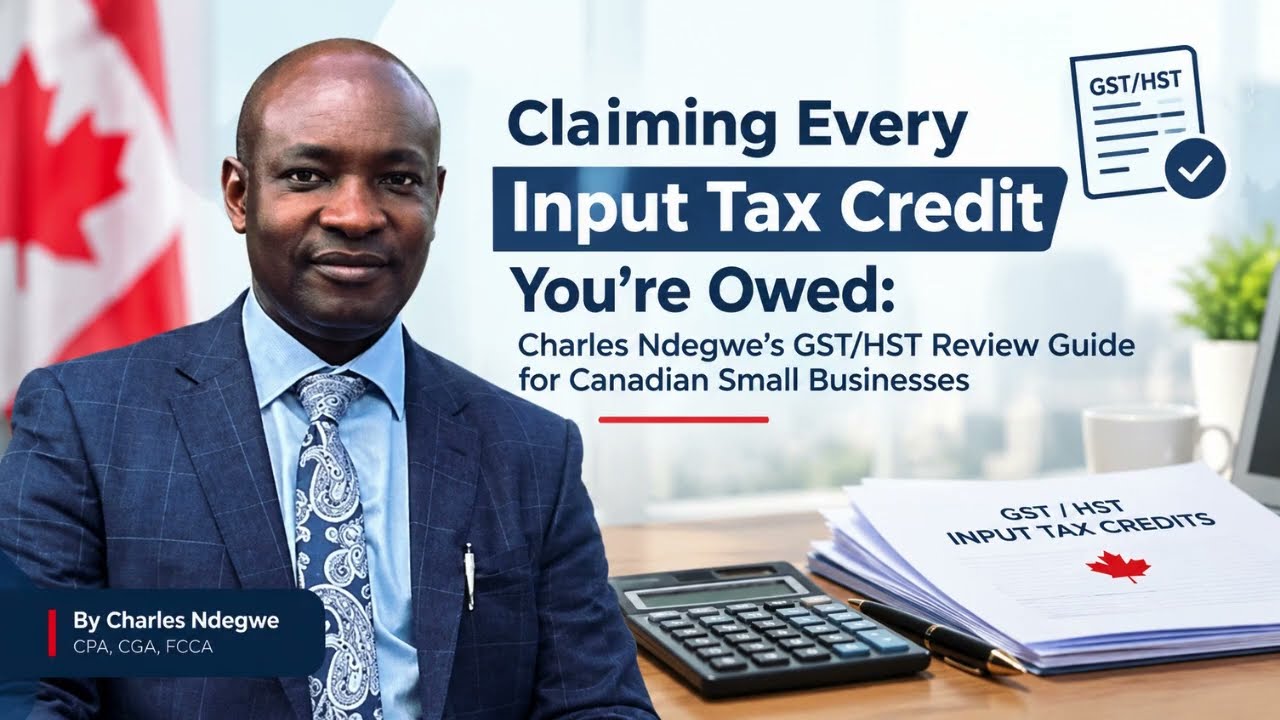
In this YouTube explainer, Charles Ndegwe walks Canadian small‑business owners through his GST/HST Review Guide, showing how unclaimed Input Tax Credits (ITCs) can represent thousands of dollars of lost cash. He defines ITCs, outlines the three‑tier documentation requirements based on purchase amount, and highlights common tax traps such as the 50 % cap on meals and entertainment, mixed‑use asset allocation, vehicle cost‑ceiling limits, and import documentation. Ndegwe stresses the four‑year rolling claim window and warns that claims older than five years are forfeited. He then presents a five‑step annual ITC review (reconcile HST accounts, test completeness, eligibility, documentation, timing/allocation) and lists the top bookkeeping errors that prevent recovery. A comparison of the Quick filing method versus the Standard method illustrates how filing choices affect ITC eligibility. Finally, he recommends engaging his firm, CNA Professional Accountants, for formal reviews, especially before major asset purchases or when dealing with CRA correspondence, positioning the process as a “treasure hunt” to reclaim lost money.
Chapters
Welcome to this explainer. Right, when most of us hear tax compliance, we instantly think of mountains of paperwork and endless bureaucratic red tape, don't we? Well, I want you to completely reframe that today. We're looking at Charles Ndegwe's GST/HST Review Guide for Canadian Small Businesses, and I want you to think of this explainer as a high-stakes mission to recover your own lost money. We're going on a treasure hunt, and the hidden gold? It's the cash you've rightfully earned but unknowingly left sitting on the table. $10,000. Just let that sink in for a second. According to Charles Ndegwe, this figure represents the potential cash lost over 4 open years by your average small business. And this isn't money lost to grand, sweeping market changes or a bad quarter. No, this is 10 grand silently slipping right through the cracks simply due to poor coding and unclaimed tax credits on everyday expenses. So, if that number just caught your attention, well, you're in exactly the right place. Okay, let's dive into this roadmap. 1. The Hidden Money. 2. The Rules of the Game. 3. Navigating Common Tax Traps. 4. The Treasure Map. And finally, 5. Filing Methods and Final Tips. Right then, Section 1: The Hidden Money— Uncovering Lost Cash. Let's just quickly nail down the definition. An Input Tax Credit, or ITC, is a mechanism allowing businesses to recover GST/HST paid on purchases related to their commercial activities. You already know that when you collect GST or HST on your sales, you're essentially holding it for the government. But when you pay it out on your own purchases, you can claim an ITC to get it back. Now, what makes an ITC so incredibly powerful, and why we're talking about it today, is that it is absolutely not like an ordinary income tax deduction. It reduces your GST/HST remittance dollar for dollar. So, a $1,000 ITC? That is literally $1,000 straight back into your pocket. And this brings us to a rather stark warning from Charles Ndegwe. He says, the money that disappears is rarely noticed because no one sends a bill for a credit that was never claimed. Let's put that into perspective, shall we? Imagine a typical invoice of $2,260 from an Ontario supplier. That contains $260 of HST. Normally, you'd recover that $260. But if the invoice is missing a bit of the right information, or if someone simply forgets to claim the credit within the time limit, that money vanishes. Poof! Gone. And because no one is ever going to invoice you for a missed credit, it vanishes in total silence. The rules of the game: adhering to strict rules. So, there are 3 tiers of documentation requirements set by the Input Tax Credit Information Regulations. It's all based on the total amount paid, including tax. Let's break it down. For purchases under $100, nice and simple, you just need the supplier's name, the date, and the total amount. Move up to that middle tier, between $100 and $499, and suddenly you also need the supplier's GST/HST registration number and the specific tax amount or rate. Hit $500 or more, and you need all of the above, plus your own business name as the purchaser, the payment terms, and a clear item description. Ndegwe specifically warns us here: a credit card statement alone is almost never enough to meet these rules, mainly because it rarely shows the supplier's registration number or what you actually bought. Navigating Common Tax Traps. Avoiding Common Pitfalls. Meals and Entertainment. ITCs on most meals and client entertainment are strictly capped at 50% of the GST/HST paid. Think about it like this: let's say you spend $6,000 before tax wining and dining clients. That generates $780 of HST at 13%. You cannot claim all of it. You are legally limited to claiming half, which is $390. Claiming the full 100%? Well, that's a classic red flag that's gonna fail an audit straight away. Next up, we have mixed-use assets— things like home offices or vehicles. Where a purchase serves both commercial and personal use, only the commercial portion actually qualifies for an ITC. For individuals and partnerships, claiming Capital Cost Allowance on passenger vehicles generally requires more than 50% commercial use. The absolute lifeline here, and I cannot stress this enough, is having a consistently applied written allocation method. For vehicles, that means a proper, documented mileage log. A rough guess just will not hold up when the auditor comes knocking, I promise you. Speaking of vehicles, there are strict capital cost ceilings you need to keep an eye on to ensure you don't accidentally overclaim on major asset purchases. For vehicles acquired in 2025, the standard passenger vehicle limit for calculating your ITC is capped at $38,000 before sales tax. However, if you're purchasing a qualifying zero-emission passenger vehicle, That limit jumps up— rather nicely— to $61,000. Knowing these limits before you head to the dealership is absolutely essential. The Treasure Map: Tracking Down Cash. So, the crucial point here is this claim window. The clock starts ticking the moment the tax becomes payable or is paid. For a few specific entities, like listed financial institutions, the limit is generally 2 years. But for most small businesses, you've got a 4-year rolling window. This means a missed claim discovered today from 3 years ago is literally cash in hand— you just pop it onto your current return. But if you drag your feet and discover a claim from 5 years ago, well, it's gone forever. In this case, time is quite literally money. All of this builds perfectly into Charles Ndegwe's definitive 5-step ITC review. Honestly, if you run this annually, you are going to uncover missing money. Here's how it works. Step 1: Reconcile your HST accounts from your general ledger. If the balances don't match up, you know something is wrong from the start. Step 2: Test completeness. Check that vendor ledger for expenses recorded without tax. Step 3: Test eligibility, just to ensure those purchases genuinely belong to taxable activities. Step 4: Test documentation against those 3 tiers we chatted about earlier. And finally, step 5: Test timing and allocation to ensure your claims actually fall within that 4-year window and have solid written allocation methods. Now, while you're running that 5-step review, here are the absolute top bookkeeping errors you're hunting down. Ready? Let's go rapid-fire! First, bookkeepers entering the total expense without separating the HST. Classic mistake. Second, using credit card statements instead of proper invoices. Third, claiming ITCs on invoices from suppliers who aren't even registered for GST/HST in the first place. Fourth, claiming meals at 100% instead of 50%. And lastly, claiming import GST using just the supplier's invoice. For imported goods, you absolutely must have the actual customs documents or notices. Catching these little errors? That is exactly how you find the treasure! Filing methods and final tips. Securing your findings. Let's quickly compare filing methods, because this trips a lot of people up. Some eligible small businesses use the Quick method, which lets you just remit a set percentage of sales. It definitely reduces paperwork, which sounds great, but here is the catch: it generally disallows ITCs on your regular operating expenses. Contrast that with the Standard method. Yes, it requires detailed tracking, but it allows maximum recovery of your operating expenses. So, whilst the quick method is simple, it can actually cost you a fair bit more money if your business has significant expenses that would otherwise generate valuable ITCs. Always, always run the numbers before choosing. Sometimes, you know, the absolute smartest move in a treasure hunt is simply hiring a seasoned guide. The guide recommends contacting Charles Ndegwe at CNA Professional Accountants, particularly before you make any major asset purchases, import goods, change your mix of taxable supplies, or Definitely, if you ever receive a letter from the CRA. Getting an expert in to arrange a formal review, reconcile your accounts, test those claims, and set up a proper monthly process— it just keeps your books completely clean, compliant, and headache-free. Well, we've covered the hidden money, the strict documentation rules, the common traps, and that crucial step-by-step review process. So, I'll leave you with this final thought to ponder: Are you unknowingly leaving a $10,000 tip for the government? Or are you finally ready to start your ITC treasure hunt today? Go on, check your ledgers, review your receipts, and stop leaving your hard-earned money behind. Thank you so much for joining me for this explainer, and happy hunting! Thanks, ITC!