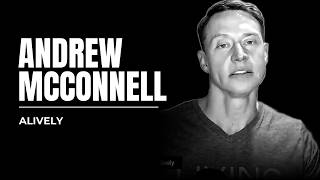
Andrew McConnell, a former McKinsey consultant and Rented.com founder, built Alively, a wellness platform that uses wearable data to prescribe one daily habit for employees. He credits a whole-plant diet with dropping his cholesterol and A1C, uses Stoic philosophy to manage stress, and sells directly to large employers with AI-prototyped demos.
Chapters
Welcome to another Founder Wisdom pod. We have Andrew McConnell with us today. Love Andrew so far with my conversations with him. He's an ultra athlete. He's the CEO of Alive.ly, which is very relevant with his background and what we're gonna talk about today. We're gonna talk about healthspan, lifespan today. We're gonna talk about podcasting, authorships, him being a speaker. He went on TEDx stage a couple of times. And of course open water swimming. We're probably gonna start with that. So Andrew, welcome to the pod. Tell us a bit more about yourself and what you've been up to.
Yeah, thank you. It's great to be here. About myself. So kind of winding road. I saw myself for the first 20+ years of my life, I was a swimmer. That's who I was. That was my identity. Made the national team for the US in open water. At that time, it was not an Olympic event. I'm old. Didn't become an Olympic event until 2008. And then when that career kind of ended, I had lost my identity, but I was still in school. So I became a student and that was really what I saw myself. And so stayed in school for a while, did law school in the US after college, did law school in the UK, um, while doing law school in the US and was able to swim there. Cambridge didn't have eligibility rules. So even though I'd used up my 4 years in the US, I was able to swim there.
Mm-hmm.
Which was fun, very different competition, but was able to set 9 university records and like do a bunch of fun things, swim shorter events. And then after doing 2 law degrees, did the bar exam but never practiced law, went to McKinsey, was a management consultant all over the world, worked in Afghanistan and Copenhagen, all over the US. And then a partner I worked with recruited me to what I thought was a startup. It was only doing $100 million a year in business. They asked me to launch a new product line and was able to grow that to $24 million in the first year. I said, "Man, this building something is really fun, but I'm getting a piece of this upside. I want all the upside. Let me go start building stuff." Airbnb and VRBO and those kinds of companies were taking off. This was 2012. I just saw a bunch of opportunity there. I started a marketplace business initially, that was a wholesale market. So instead of renting a night or a week on Airbnb or VRBO, owners would say, "Hey, here are the 45 weeks I'm not going to use. Let me get all the management companies to bid against each other to buy that whole block." I love that. And so we were brokering those contracts. Then I built a financial product on top of that to fund those transactions. And then once I had thousands of properties under management, I built a software product to price all my properties and then started selling that to enterprise vacation rental management companies. The third one was Rented.com, ended up selling that to private equity in 2022. And that same year wrote a book, not tied to vacation rentals at all, called Get Out of My Head: Creating Modern Clarity with Stoic Wisdom, just as a passion project. With my company, we would always talk about we maximize your most valuable asset. And as COVID was hitting and I was watching how we lived, I realized, wait, no, our most valuable asset is not anything you can touch. It's our mindset. And we are constantly giving our mind away to other people and trying to rent the pieces left back to ourselves. Oh, I don't have time to train. I don't have time to do these things I want because I had already given it all to someone else. I said, well, why in the world would we do that? That seems insane. And so the whole book was my research into that and then using Stoicism as a framework of how do you fix that? Look, this is natural to humans. But there are tools that you have. And so each chapter has a worksheet or a tool, and there's a whole workbook that goes with it on here's how you can address— stop running to other people, stop running to events and circumstances outside your control, and stop running to imaginary or desired versions of yourself. Just be here in the present. How do you get there? And so I'd been in vacation rentals this whole time, write this book, it becomes a Wall Street Journal bestseller, doing speaking on it. I just started getting inundated with people saying, "Your book changed my life. It came in at the exact right time for me. Here's what was going on. I read your book and then I went and quit my job. This was the impetus I needed." I thought I could really do a lot more with my life than price vacation homes. So once I finished my earnout, I wanted to go into this area of mental health and mindset, and started building there and realized it is foundational. It is a pillar of our health, but it is one of 5 pillars. Our mindset and managing our stress is certainly a pillar, but so is sleep and how we recover our body. So is nutrition and how we fuel our body. So is movement and how we move our body. And then ultimately, so is our social connection, our purpose, and what we put out into the world. And so that's where Alive.ly came out of that and say, if I want to support people, I need to look across all these. And the way to do that is not tell them across all these, here's everything to do. It's to find their just one thing to do right now, because typically anything greater than one equals zero. And so that's what we do. We work with individuals, we plug into your Whoop or, or Apple Watch, find exactly what is the one thing to work on and find your minimum enjoyable action. You're just one thing to do and support you in doing that. And we do it through employers. We're able to offer it Net, no cost to the employee. Net, no cost to the employer. Every employee that signs up gets paid $500 to $2,000 more a year. Every employer that signs up gets paid an extra $623 a year, all thanks to US government subsidies invested in preventative health.
Lots to unpack here in a short 45 minutes. I guess the first question the audience would have looking at you is like, what the fuck are you on? You look like a model. You look like, um, Dave— if Dave Asprey would look very good, you know, like Dave Asprey, you know, like a bit older. I don't know, there's genes in there. But dude, what's your protocol like? And also, while you answer that, answer: does someone that is mentally— is mentally healthy, does you— does it usually reflect on how they look physically? If you could address that as well.
Wow, that is, uh, okay, let me do the first one first and then I'll come back to that second one cuz I, I don't yet have an answer on that. I did, I'm thinking, but the first one, it, it is a moving target, right? Like in terms of what I'm on, I, I do, well, this was my first year doing it. I did a dry January, not dry in terms of no alcohol. I don't drink alcohol, but in terms of all supplements cut out. So it was just what I was eating. I didn't do anything. And the only thing I noticed cutting everything out was I seemed to kind of shrink without my creatine. Creatine seemed like it was, it was probably helping me retain some— Yeah.
Water. Creatine's a must.
Yeah. Yeah. So it's, it's a moving target and I can kind of go through some of the supplements and things I do. But if I, I look back 4 years, 5 years, it, I didn't look that different. The, the one thing that seems to have changed is in 2022, '23, I read Dr. Greger's book, How Not to Die. You know, how not to get Parkinson's, how not to get Alzheimer's, how not to get diabetes, how not to get cancer. And the answer every single time, once it clicked at some point in the book, was, oh, it's to eat plants. Eat whole plants. Like, that was the answer. Eat whole plants. Stop eating meat and processed foods. And I was, I was running the numbers yesterday because I just got my function results back, and my cholesterol went from 250-something to like 138 within 2 years of just moving over. And, uh, I was still doing a cheat day and I was staying pre-diabetic even though, you know, you looked at me as 6-pack, like, look great. But I still, my A1C was still not great. Once I cut out the cheat day, the last 2 years, boom, boom, boom, the A1C and my glucose levels went down. So the, the thing visibly that changed in that time, once I moved to the plant-based all the time people say, wow, like, is your skin real? Is that real? Your skin? Like, I don't have some complex skin routine, anything, but I think just—
Is that Zoom filter?
Yeah. No, I think it's, it's just, 'cause right now, like, I typically don't even wash my face. It's just kind of water that goes on. I read some longevity book and this lady who was older and said, I use Buran oil and you go find it. And it's like a 2-year supply. It costs $10 on Amazon. It's just this cheap oil, and I kind of put that on my face, and it's nothing expensive or complicated, um, to use. But I, I think it's more the nutrition, putting really good antioxidants, whole foods in our body, and not putting things that are inflammatory, things that are, uh, creating different negative reactions in our body. I think that's probably the most helpful.
And then the other elephant in the room, we got that one out, um, who are your parents, dude? Because you mentioned like all these accomplishments, and I couldn't stop like smiling. It's like 8 records in the swimming team, and you know what kind of kids get put through the swimming team, right? There's like parents that are usually very competitive. Swimming for most people is not nice, it's painful. It's like being choked underwater, some type of thing. But the upside of that is once you've done so many hard shit, like in the pool, everything outside of the pool becomes like super easy, right? So it's sort of a chocolate-covered carrot that your parents put you through, sort of. So who are your parents? Like, why are you that way?
Yeah, it's a good question. My parents, I would say, never pushed me in anything, academics or sports. My parents, They, by their model, they did, right? Both my parents were physicians. My dad's a pediatric cardiologist. There you go. My mom's a pediatric hematologist oncologist. They never had to tell me— like my mom was Miss Alabama, Miss Spirit America, absolutely gorgeous woman, all this, but also published in the New England Journal of Medicine and ran huge multimillion-dollar NIH grants. Like she's just an amazing human. My dad had many different careers depending where he was, he would just create things. He would write textbooks. He would get Teacher of the Year when he was teaching at the university while practicing. Like, they were just incredible people who loved— and now they're retired— but loved what they do. Like, I talked to their parents, their patients that have grown up, and their patients like, I love my doctor. Not a lot of people can say that, but I love my doctor. And they, they love my parents. My parents were just wonderful at what they did. And so I think it was not a thing they did to me. It was just watching someone Their actions. Yeah. Who cared, who committed, and I didn't even get to see it all. It's only in the past year I learned after my dad would come home, work on homework with me, have dinner with me, all this, we'd go to bed and he'd go back to the office. There wasn't digital health records. He had to go do all his charts and everything after, but he didn't want to do it and take away dinner. So, he'd come home, spend time with the family, and then go at night and do this stuff. And they would rotate. My mom was working 80 hours a week. They were just committed, but they were— my mom was a majorette at University of Alabama in the marching band. My dad was a high jumper, had the state record and everything in Alabama. It was their own sports. They didn't know a ton about swimming. It was just the thing that I got into. And so they were super supportive. They let me go to boarding school my last year and a half to really focus on that in high school. And it, yeah, I think it was more their model. You know, there's probably a lot that's just nature. You came out this way and there's a lot of I love and admire these people and I want to be like them.
And then you told me about distance swimming. What kids choose distance swimming? Like 10% in the sport? Is it the minority or—
I think it's a minority. It's a— so there are a couple of things that happen. A lot of people, once you come into something, if you're not very good, you don't want to stick with it, especially something like boxing. Like if you're bad at boxing and you're just getting hit in the face a lot, you're probably not going to stick with that sport. So Most people stick with things that they're pretty good at. It's more fun when you're good at something. But with swimming, a friend of mine who was very talented on the national team, he said, "There are two kinds of swimmers. Those with talent and distance swimmers." And so I don't think I was super talented. I was just willing to do things other people weren't willing to do. I was willing to come to practice an hour early. I was willing to swim on Sundays when they weren't willing to come in and just go longer and harder. And when we'd go into the weight room, I just see what the sprinters were lifting and I'd have to lift heavier, heavier than them. Probably not helpful for distance swimming, but it was just this mindset. I'm going to do more and I'm going to do better than anyone else. And, and if, even if I didn't have the fast twitch fibers to do the sprinting, like it'd be way fun to have a 20-second race instead of a 5-hour race. But if I can go be top 3 in the world in the 5-hour race, and I would just be some other guy swimming, I'm going to go do the 5-hour race. I'd rather be good. Yeah. Good?
Well, the boxing thing, right? A lot of people have issues in that sport, and that's how they canalize them, or at least that's their identity. And the counter to that is like, look at UFC 250, right? Uh, Alex got his ass kicked by Cyril, and both are like incredible, but you can get your ass kicked at any time at the elitest levels in the competition. That was very There was also like a lot of upsets, right? Ilia Topuria, which is like a top UFC fighter, got knocked out by Justin Gaethje. Like that's very unexpected. And it's like, you can operate at any time, but as soon as you start having your lights out in the UFC, like eat a couple of punches, you're in danger, right? And you don't fight as well as you used to. So that's what makes the sport upsetting. And to get that to swimming, Or parallels I can draw with my brain is like genetics. I didn't have them at that age as well, but nowadays I would probably kick anyone's ass at like whatever they kicked my ass back then. Why? Because I can outlast them, right? And that's also my business mindset. It's like, okay, yeah, you might outrun me in the short term, but I'm playing the very long-term game and I'll kick your ass like sooner or later, right? I'm like an anaconda choking its prey. It's like, I'm not going anywhere, right? I'm only tightening and getting better.
Um, well, you bring up, you bring up something that is important, that we can shape it. So I remember being, this is maybe 6 years ago, 5, 6 years ago, at, at a public kind of pool at a gym. And I get out and now I weigh 25, 30 pounds more than when I was competing in distance swimming. Right? Like you didn't wanna carry around—
So you're like, uh, 190 pounds.
185. Yeah. But I, I was getting down to like 155 when I was having to feed myself kind of 160 maybe in season. And the, so I get out and the lifeguard says, oh, there was another guy, you know, swim. He does, he does long distance stuff, but not anything you could do. Right. Cause he sees my body type. And I didn't want to tell him, like I was third in the world in 25K. Like I can do long distance. I went and built this separate body. Now that I'm not doing those kinds of races, like you just, you can shape to the thing that you're trying to do. Right. Uh, but it was just his perception of like, this would be impossible for you.
Yeah. And that's like, just, uh, I wouldn't call it chip on their shoulder. It's definitely a motivator for guys like us. I want to ask you a question, right? What happens if another competitive guy gets in the pool same time as you, you know, and is in the same swimming lane? When I'm training for Ironmans or like long distances and someone gets in the pool whatever, however much kilometers I'm in, I'm just gonna stay longer and try to beat their asses. It's very toxic because then I have to swim like as fast as them, even if they're doing 1K. I'm like, yeah, no way I'm getting that guy past me. And then it gets really intense, right? And it's like almost if I have hard time breathing. Like, you've probably got into these scenarios hundreds of times, so What happens if someone gets in your lane? Yeah.
So typically that only happens at my level if you're going to train with someone, right? Like if I'm going to train with someone else that's at my level and we like, we're racing each other, we're pushing. Typically anybody else that's in the pool, I'm just counting how quickly I can lap them. I'm like, am I going twice as fast as them or 3 times as fast? So it's just like, there aren't times—
You're always going faster than them. Like that's not the case.
No matter how fast, like they can try, they'll wait and try to sprint. I could be going 3K straight and they'll sprint a 25. 25, and like, I'll make sure I beat him on the 25, but it's like, it's not— I'm not having to push it that much.
Boy, okay. Um, and then the other point I wanted to bring up with, uh, distance swimming— do you feel that you went that direction because— and you continued swimming? I know that nowadays you're sort of taking breaks, I think you told me last time. But do you feel that this is the number one sport to have you get better at life and at business, right? Do you like fundamentally understand that part? Because ultimately that's what kept me in endurance sports. I think it's the biggest hack to be a better dad, be more patient, be a better human being, tolerating pain and being a better CEO and business owner ultimately. What do you have to say about that?
I actually, I don't think it's tied to swimming or necessarily even to sport personally. I think it's tied to, dedication and commitment and excellence. And so finding the thing— this is a conversation I had with my daughter. Her mom was on the national team in the UK, right? And so my daughter, "Well, don't I need to be a swimmer because you and mommy were swimmers?" I said, "I don't. That was my life. I had my life. I chose swimming. I loved it and that's why I chose. My parents never told me. So I just want you to find something you love because you are naturally talented." Right? You can go in, right now at 10, and you're the best person in the pool, but you can be very good. You will never be great if you don't love it, 'cause you're not gonna put in the work. The reason Messi's great and Ronaldo's great isn't because they started off naturally good. It's because they loved it, and all they do is work on their craft. And so learning the rewards of compound interest on commitment, I think, is the gift that carries over. Whether it's in sport, whether it's in art, whether it's in coding, right? Like you're creating something. You see what Bill Gates or Steve Wozniak did, the compound interest on that. So I think it's just tied to not being lackadaisical and mediocre across your life, but finding excellence.
It's funny because Wozniak never played any sport, but his sport was like breaking his back building computers, right? Just that I find that in business sometimes, you can get like too much in one specific mindset in one direction, and sports are incredibly beneficial because you're in a different environment, different settings, you're not behind a computer, your brain generates dopamine, serotonin, all these good chemicals, and you can get business insights out of that, I find. How did stoicism find you?
This is a good question. I don't know. There was someone in my EO forum who was telling me about The Obstacle Is the Way. There was Tim Ferriss, Tools of Titans, and things like that, that the book that kept coming recommended was Meditations by Marcus Aurelius. And so I think those things were converging, and I don't know which I came to first. I don't know if I said, "I really should pick up this meditations book," or, "Hey, let me listen to this guy and say The Obstacle Is the Way." But I do remember walking my dog, and I was listening to meditations audio, And there was this line about, think of the whole universe and how small and insignificant you are in it and this, that, and the other. I'm like, man, this was a guy, they didn't have telescopes. Like this guy didn't know about the universe, but he understood this, right? This is from meditation. This guy's 2,000 years ago writing this to himself.
I'm like, oh wow. Wow.
Yeah, this is universal truth. There must be a lot in here that it just stands the test of time. And so then kind of kicked off a whole deep dive get into Seneca and Epictetus. And yeah.
Fascinating. And yeah, you can think of Einstein. It's always fascinating to study people that were before their times, right? Because you can try to model their models and try to see how does that fit to our times, which are very different by the way, right? Like, I don't know, with COVID social media, and all the pressures that are coming in all directions, right? But stoicism is such a low-hanging fruit. I would describe it as such, right? As CEOs, we're often on the battlefield and we face a lot of stress. And it's just like, what can I focus on that's logically gonna bring the greatest outcomes? And usually that's not drama, right? That's not like being inside your thoughts and just going spiraling downwards negatively, right? It's just focusing on the next positive outcome and bringing momentum to the play, right? So I guess it came out at that time. My next question for you, it's related to Goggins. How can a guy like you that had a privileged background— I had a privileged background too— how could you, how can you relate to Goggins and his fucked up ass, you know?
Yeah, I mean, because I think a lot of it's still just mindset. I mean, it's regardless privileged, because you could see your privileged background is not privileged because it didn't make you hard in certain ways, right? You didn't get the advantage of this. It's sharpening. It's the friction that polishes the stone. And so in either case, because it's the same person in Goggins, could say, well, I have unprivileged background, so I didn't get all these things. But it's just how do you frame it? Tony Robbins talked about some guy is like a criminal in and out, kids by all these different women, blah, blah, blah. And he has two sons and one son becomes this high-powered exec and super dedicated family man. Instead, the other guy ends up in jail. And you ask them both, why are you like this? They said, well, look where I came from. Of course I ended up like this. And it's like, it just depends on which story you tell. You can use anything as fuel. And Goggins just uses everything as fuel. And that's just, it's a decision. It's a decision you make of, am I gonna use this as fuel to get better? And I get to define what better means.
How have you used this philosophy yourself to get out of holes? Because you had massive victories, but you also had big challenges, pretty much like everyone, right? Yeah. Um, how did you use your own methods to get you out of like tough places you were in the last couple of years?
Yeah. I mean, like just super, super personally, as we record this right now, I am in an appeal hearing right now. My attorneys are in appeal hearing where my daughter, who I had 71% of custody of after the divorce, I had majority of care all through the marriage. And then after, She got taken away from me in a foreign country in a kind of kangaroo court. And I am in appeal right now. And this has been going on for 15 months of this back and forth. And every single person I talk to says, I am amazed how well you're dealing with this.
Dude.
And look, I'll go to the gym and I'm breaking down crying at the gym, but I still show up at the gym. And the guys at the gym, these old men, they're giving me hugs. They're like, you can't take away a daddy and his daughter. It's supportive. And so it's not that I don't feel any, I still feel it. Like there are times I break down and I'm sad, but you also have to get up and just move forward. And so I literally go back to the tools in my book. I'm like, hey, I'm dealing with this right now. Okay. What can I control? How can I prepare for the future? What are the things I can do? Okay. I can review this legal document. I can pull these things. I can get these to the attorneys. The other stuff I can't do. Like I need to separate from this because I am not in that courtroom. I cannot argue that case. That is with the lawyer. That is not with me. I'm right here with you. I'm being present. And so I'm using it right now, you know?
Yeah, dude, that one is striking. By the way, I have a guy that I can refer you to that helps men deal exactly with this, right? Like, because that's, the court systems are pretty much in women's favor in that regards nowadays. And then it's complex because it's like foreign country, right?
Oh yeah. And the judge that made the ruling worked for my ex-wife's attorney for 8 years. It's all just—
Oh my fucking God.
Yeah.
I wish people would understand that methodologies that are preached by people most of the time are built first and foremost for themselves, right? Sometimes people look and it's like, oh, this guy's fucking preaching stuff for me, but no, this guy made a method for himself. He successfully used it for that long in the toughest scenarios and situations, and then because it worked for him, then he can deploy it for you, right? So it's like you're the number one fucking case study for your own methodology, right?
Mm-hmm.
What have you seen with people that come to you and are like, "Hey, you changed my life. I use your methodology." What pain points did they face initially and how is your, methodology different from other methodologies? 'Cause there's so many out there, right? You named Tony Robbins.
Yeah.
There's Mel Robbins in the Robbins family, right? Like the 5 Second Rule and all of that. There's a lot in the self-development space. Why launch another fucking method in that space and how is it different?
Yeah, Lord Alfred Whitehead had this line on, every man is the proponent of his sub— some other man's philosophy, right? Like literally Stoicism's in the title of my book. So I'm not saying something that's new, it's thousands of years old. It's repackaged in a different way. And why did I think that was necessary or useful in any way, shape, or form? And one thing that was a wake-up call for me was Tim Ferriss's 4-Hour Body. And it's this 900-page tome, 30 chapters of 30 pages each on totally different things, back pain, giving a 5-minute orgasm, losing weight, adding muscle. And so, I gave it to my dad for Father's Day. And over the next year, this guy was a pediatric cardiologist, lost 65 pounds, and started running half marathons and said, "I just had to unlearn everything they taught me in med school about nutrition." I said, "Well, what triggered it for you?" And he said, well, you know, in that chapter on the weight, there was a guy who was a NASA scientist. And he goes into the store to buy clothes. And they're asking about this, that. And he goes, why does it matter? I'm not going to look good in anything I put on. And then that guy has this aha moment and says, wait a minute, I'm a NASA scientist. I've been good at everything I've cared about in my life. I can be good at this. I just need to choose to be good at this. So he got good at and lost all this weight. And my dad being my dad was like, wait, I'm good at everything. I could be good at this. And so for him, that was his wake-up moment. And he goes and does it and puts thousands of patients on it. My brother-in-law reads the same book and asks him, and he goes and loses 30 pounds. And I said, what's your aha moment? He goes, oh, there was this whole thing of you could have this visceral fat. You couldn't see it. You could look skinny, but you have this fat around your organs and it's really, really deadly. And oh wow. Okay. That was yours. My father-in-law got the book, didn't change anything. Then we go on a hike and he can't keep up with his wife, with anybody. And as soon as he got home, he's like, I'm going to go do what he said. And he loses 25 pounds over the next year. Every single person had to have their own aha moment. And so, what it was, wasn't like— no book is universal. Meditation is not going to be universal to everyone. Obstacle Is the Way, not universal. Get Out of My Head is not. But Each chapter, I would put, here's my story, here's how I came into it, here's the historical context, here's a historical story, here's a modern business leader or Olympian or somebody and how they use it, trying to give people different entry points for their aha moments. And so you need the right aha moment for you at the right time. I had conversations like, look, if I read this 3 years ago, it wouldn't have meant anything to me. It's because of where I am right now, that this hit in this way. And so that's part of why putting it out, like, the same things need to be said in different ways to hit people at the right time for them.
And that's why people should revisit books, right? Especially classics at various times of their lives. What have been some of these books for you?
Yeah, I mean, we already mentioned meditation. So meditation's one I've read multiple different translations.
I never got hooked on meditation. I think it's maybe the language should be rebuilt for more modern times. Or something.
Well, there are multiple translations. I have multiple different translations.
Okay. Send me your best when we're done with the—
And the, the Tao Te Ching is one I reread.
That's one good one for sure.
It helps because they're, they're short.
Um, Art of War.
Art of War or The War of Art, right? Like The War of Art, I think is another—
Pressfield, right?
Yeah. Pressfield is a fantastic book. There are other books I've revisited that were so good to me at the time. And then I go back and I'm like, what was it? You know, so like Remembrance of Things Past by Proust. It is a commitment, right? It's 7 volumes, it's all this. And when I read it, I was like, this is the single best thing ever written, blah, blah, blah. And then I read it as an adult and I'm thinking, man, his view on love and relationships is really messed up. Like, I don't agree with anything this guy is saying now, but when I was a teenager, this was really resonant. So it can go both ways. Yeah. Yeah.
Your day-to-day nowadays, what does a day in your life look— looks like? What have been habits or weird quirks that you've adopted that is hugely useful? Like you told me when you were in the— what was it? Uh, not Bermudas, right?
Like— Yes. Bermuda.
Yeah. Okay, Bermudas. Yeah. You were swimming in the ocean at like every morning. That's weird. Um, so like what other habits have you adopted since then and why?
Yeah, I mean, I think for me, movement 3 different times a day, like deliberate movement 3 times a day. Yeah. So there's a, right when I wake up, I have a whole mobility thing where I go through each joint 5 times through and kind of build mobility. Um, and, and some overhead squats and kettlebell swings to get like a little weight in there. And so that, that takes 13, 14 minutes. Like there's that, Little movement after lunch. There's a separate thing, kind of some hip openers and again, overhead squats and kettlebell swings just to get some weights in there. Uh, and then the third would be my workout session. So that's, it could be a swim, it could be yoga, it could be weightlifting, typically 4 days of weights, 2 days of cardio, 1 day of yoga. Um, that's probably the weirder thing of, hey, it's not just, I move for 60 minutes and then I go sit at my desk for hours. It's, I try to move deliberately 3 times a day. I, because I'm in the health and wellness space, I probably experiment with things more than other people do. Try a bunch of different products, different supplements, see if it's having an impact or not. Take the blood work. And then now I mean—
Standing while you're having meetings?
Yeah. So standing while I have meetings, when I do a podcast, I don't do the treadmill desk. So I have, I have a treadmill. Desk. Like a lot of times I'm walking.
Yeah, people were like, why are you walk— why are you moving so much? That's what I used to get. But I'm about to re-add it to my stack because of back pains, like lower back pains, right?
Yeah. And that's, that's why I did it initially, right? Because initially it was moving from sitting to standing, but just standing still and having all the blood flow down for 8 hours is not that much better than sitting. It's slightly better, but we really were built to move. And you think on the savannas, we'd be sitting in real squats. Chairs do not exist in nature. So we'd be sitting in real squats or we'd be moving. And that's kind of what is natural for our body, not sitting at a computer hunched over, you know.
And what are your business goals nowadays? Right? You seem super optimized on a personal level. That seems to be your core. You absolutely need to be optimized personally to be successful in business. That's one of, my core philosophies, right? Like what's on your radar this year for Alive.ly?
Yeah, the entire goal of my life is to help more people live healthier longer. And so with Alive.ly, it's getting this in the hands of as many people as possible because we see the majority of people who use it improve 20% or more in the first few months and just keep compounding. Like we know it works. So it's just getting it to people so it can work for them and help them feel better, sleep better, have more energy, be more loving to the people in their lives. That's one. I have a book coming out in a year, right, due to the publisher in a couple months on the same topic, Wellness at Work. How do we put wellness to work in our life and what does that look like in a workplace? How is a company able to make money by investing in the wellness of their team? And there are some great examples working with— Yeah. Eli Lilly, working with Delta, working with SaaS, with JP Morgan on here's what that looks like when done well.
How do you reach out to these guys? Is it your network? What's your number one go-to-market channel?
Yeah, I mean, this is the, being older, this is one of the benefits of being old is my network's very different now. So my buddy could be the CEO of this company, CFO of that company, COO of this company. And so like, hey, I have this great thing that does these wonderful things. Okay, let's try it. And then they see the results and it works. So it has been very relationship-based, uh, so far. Yeah.
Are you fundraising for that one?
No, that, that's another benefit of being older. You know, I've done the VC world, raised for all my other companies, and now I just sell fun. Yeah.
Why? You like, you had bad experiences with VCs, or you're just like very healthy from an MRR perspective and just don't need external capital?
Yeah. One, I can fund myself much longer because my bank account's very different than when it was 15 years ago. Two, with AI, I can build— I sat with an exec at a Fortune 50 company yesterday who was like, we were having a conversation, he was trying to get some help on something, and I was like, cool, we just pulled up Claude. I built him an entire prototype with a landing page and with a a whole sales deck. Like, here you go. And I don't know if you're going to use this, but my point is, anytime you're going into a conversation, you know, you can just sit on the Wi-Fi and just do this on your computer. So let me show you how to do this. This is replicable. And when you can do that, you just don't need the same number of people in marketing, the same— like, my— every engineer I have is worth 5 to 6 engineers 10 years ago. They can just get so much more done. And so it just doesn't cost the same.
You feel corporations are aware of that? Aren't they like not even conscious that this is a problem? Like I faced that working with companies in your category before.
Yeah, the corporation, that's being AI native versus trying to make the AI transition is way easier, right? If I was a big company trying to make this transition, and having to go through all the change and change management and education and train people. It's very different than I get to build the team. And so every interview is like, hey, what have you built recently? And if somebody said, well, I just kind of do my job, I'm in marketing, they're not getting a job. If they're, oh my God, let me tell you, because I spend my weekends with friends' kids building AI games with them. I don't touch the keyboard. I just coach them on how they go build it. My daughter's on her third game. She monetizes all of them. She's post-revenue. She's 10 years old. So if you don't have that level of desire and curiosity and open-mindedness, you're just not gonna work with me. So maybe the corporates, like, you'll be safe there for a while, but AI-native companies, they're just not gonna hire people that aren't doing stuff like that.
So it's you and a couple of employees, and you believe in the vision of one-man billion-dollar company, you and a bunch of agents. Is that the future of companies?
Yeah, I mean, I don't know if it'll be that small, right? We already saw with what, MedVie, like 2 people, $1.5 billion.
Yeah, but that was—
They might go to jail.
Catastrophe, yes.
Yeah, yeah, they might go to jail. So that like— They will go to jail. Yeah, so certainly don't do illegal things, but—
Don't join SBF.
No, I don't think, I don't think it's just one in all ages. I think there are models for that. We're in health. And we're in relationships. Like we have live launch events, we support, it's not going to zero and I don't want to do everything. I want a team. I love working with the people I work with. It's just, I was at a roundtable with 10 CEOs the other day and every single CEO, one had just started a new company after exiting the other one. He was like, I can build 10x a business with 1/10 the staff.
Oh, wow.
And it's not going to zero, but I can build 10x a business in 1/10 the staff. So just think about what that does. We were talking to the city, and they're like, "Well, how do we create jobs?" This, that, and the other. I said, "Stop fighting against it. Don't try to set up to go make people scale and hire. Be the best place in the world for people to start those businesses. Have a startup in a box." For the 42-year-old who got laid off and had deferred a dream, it was like, "You know what? Now I actually can go build this thing that I always wanted to go build." Yeah, you can. Let's make it super easy. You show up, we'll in an hour get you set up with an LLC in Georgia, blah, blah, blah, blah, blah. Like walk them all through it so that they're ready to go.
I love it, dude. Two things. One, masterminds and communities, you mentioned like that CEO mastermind, is that helpful from an emotional perspective, building a community of like-minded people? Like what's your take in your system on surrounding yourself with like-minded people that can help you grow?
Like-minded and different, different-minded, right? Like just surrounding yourself with smart people that are—
Weirdos.
Yeah, making you ask questions. So I had this conversation last night. I'm gonna do it again right now because there's a business idea I just keep giving away, and if nobody starts, I'm gonna have to do it when I'm 80 or something. But we have communities when things are at their very best. We have Tiger 25 and YPO and EO where you get these forums You're all together. You get to know each other super deeply. You share everything. You get— again, friction polishes a stone. Your life is enriched because of these communities. When things are absolutely falling apart, we have AA and NA and Sex and Love Anonymous, like all the different things when your life is— and again, like I just read the 12 and 12. I just read the Big Book. Like I've always been fascinated by AA.
It's a cult.
Yeah. But in a really beautiful way, like with no single cult of personality other than a dead guy, Bill Williams, but it's really about the community. And each one is its own community and this really tight-knit group. And yet, in the middle where most people live most of the time, there's not that community. There's not that closeness. We got away from Kiwanis and Shriners and churches, and people have lost that. And so, I think— this was my second TED Talk, my TEDx Bermuda Talk, it was very much about social connection. Like it is the missing pillar in most people's life. If you're Bryan Johnson, you're just optimizing, oh, my sleep time and the nutrients I take in. And fortunately now he has a girlfriend and he has sex and he tells us about it. But before that, like he was just super isolated and like, I was like, man, you're really missing this really important part of health. And why are you doing it all? It's for what we put out and how we engage with the world. So I—
Yes.
I, I think those communities are incredibly important. It.
And last one, GLPs. What's your take on it?
I, I think it's early, right? Like, it's— with so much, we're living an experiment. They could be miracle drugs. They could absolutely be miracle drugs. And it could be, after 25 years of consistent use, they create horrible tumors all over your body. And we actually don't know. Like, we haven't used them that long. We know for this period of time they do these wonderful things. We just don't know long, long, long term. Um, But I, I just had a post today on it. Obesity for the first time in, in like recorded history has gone down in the US. We have almost 8 million fewer obese people, and of the loss, 40% of that is muscle mass. So we are getting a skinnier population. We have also hit record numbers of diabetics. So it hasn't actually reduced— as obesity has gone down, it's not reduced the people that might need dialysis down the road. And by the way, we now have super frail people with 40% less muscle mass, how many more broken hips are we going to have? Like, what is that going to look like? And so I think I am uncertain, you know, like, it's difficult making predictions about the future. And so I just say, we'll see.
Gut issues, right? You could picture someone eating McDonald's on GLPs. It's like that.
It's like— Oh, I definitely see that because they say, well, since I'm only eating this much, I can eat junk food. And just be totally undernourished. They're not getting nutrients. And it's like, that terrifies me.
Yes, same here. Andrew, thanks so much for today. Where can people find out more about you?
Yeah, the best, I mean, go to alively.com. That's the business. My personal website, mandrewmcconnell.com. That's also my handle on Instagram. That's where you can find me on LinkedIn and Twitter or X.
Drew and Charles?
More from Charles




Founder Wisdom: the full audiobook (7 hours of quotes and stories from 600+ founders and CEOs)






