Bryan Walley - CEO at Forward Inheritance
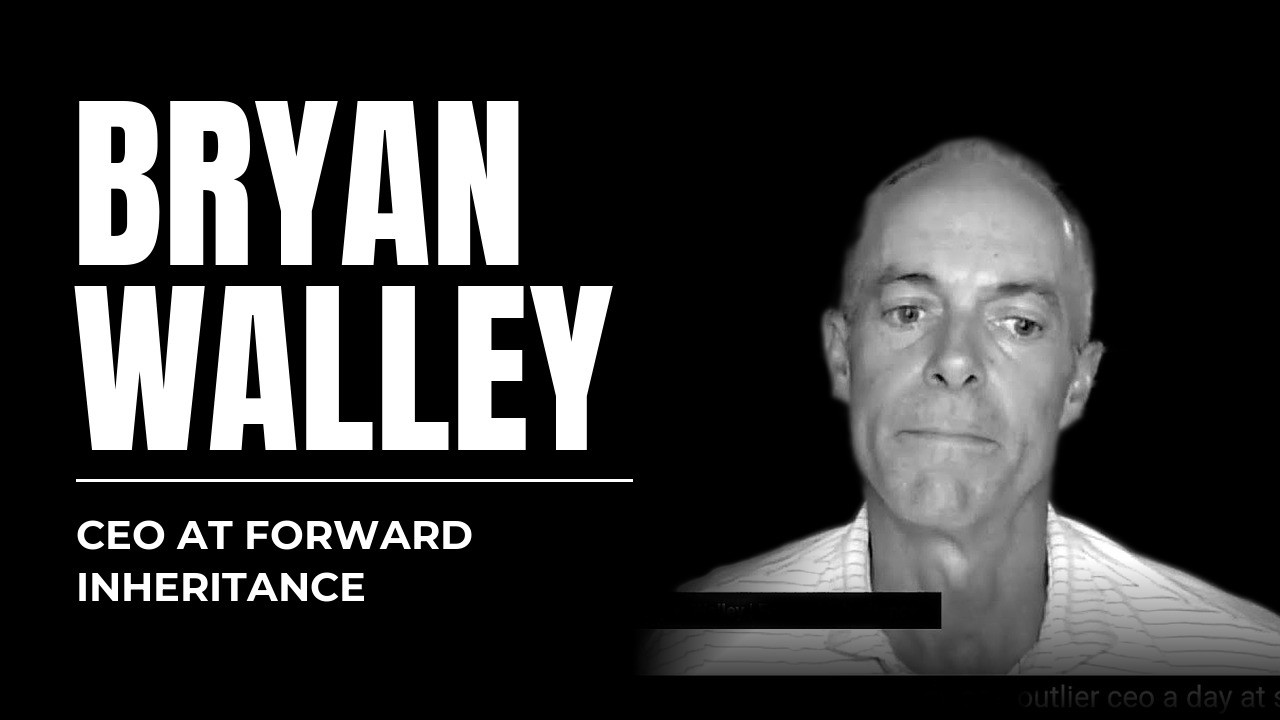
Bryan Walley, CEO of Forward Inheritance, built a SaaS platform to organize estate planning documents and connect families with attorneys and wealth managers. Half of U.S. homeowners lack a will, creating costly probate problems. The platform charges $20 per household monthly and includes a marketplace for vetted professionals at discounted rates.
Chapters
Welcome to another CEO Wisdom Podcast. We have Brian Wally with us today. Brian is a CEO at Forward Inheritance. He's in Pasadena, previously COO at a bunch of companies including Formstack, Exactuals, former RBC, and Intuit. I'm glad to have you on, Brian. Tell us a bit more about yourself.
Charles, thank you so very much for having me. It's an honor and it's a pleasure. Thank you. If you look at, call it the arc of the career, it's much more about looking at systems and processes and saying, oh, I don't think I want to pave that cow path. Let's define a better way to do it. Let's automate it and let's help everybody in the process. It has to be, it has to be a win-win-win for everybody so that we all— well, if not everybody's winning, it's not a very good business long term.
There you go. Um, your experience, right, like you started out as a systems manager, uh, then a director of ops, and then in banking— Citi, uh, National Bank was called, but RBC later on. Um, yeah, what got you to Ford Inheritance in today's position?
So I think you can understand how I became a CEO based on my career, but I think the personal way on how I got to Forward Inheritance is what matters maybe a little bit more. And we're building something for my own family, and we're building something, candidly, Charles, that I bet you your family needs too. You know, it was a few years ago when I had to look my father in the eye because of some family situations that I'm not going to get into, and I had to say, Pops, where's the will? And he goes, it's fine, bud. And I was like, we're past the it's fine time, Dad. I need the documentation now. And that was a wild moment. And I looked around and there was nothing, Charles. There was nothing that my family could use to organize and optimize our estate. I shouldn't be keeping this stuff in Google Drive. There was nobody that cared about the family first. And so, well, we decided to build it ourselves because we need it for our own family first. And that's why we're building this entire business.
And that's a wild moment, right? Like asking your own dad if there's a will in place. Um, yeah. How did— How did that happen? I mean, me, I think I'm a bit weird. Like, I don't care about, like, the money I'm gonna be inherited. Maybe my brother can fully have it. I'm already wealthy. And but if there's no will, chaos may happen. I may need to hire lawyers and pay from my own pocket, which I wouldn't mind doing either. But what's— why does a will need to be in place? Can you tell us a bit more about that?
Sure. So Here's the thing. I think you hit on something really important, and then I'll answer your question. It's not about the money. Of course it's about the money. Let's be very clear, it's always about the money. But you can plan and have a good family communication that has nothing to do with money. After my divorce, I had to go get a new trust, and I had to be like, Dad, I just had to go get a new trust. Where's yours? That is a family estate conversation that we're having that is not about money. It's about planning paperwork and process. So now to answer your question about a will, if you die without a will, how, how are we supposed to divide your estate? Nobody knows. So what happens is, is the state in which you live in will take your assets and call it probate, and they will administer them until everybody comes up and says, that's mine. Now let's make that super— like, that's a very reasonable answer, right? Cool. But let's put that— make that practical. You die without a will, which 50% of homeowners in this country do not have a will. So if you die without a will, your family home goes to the state so that your children can then go argue with your state government for months, years, that that is their family home and they deserve to own it, right? That's wild. All because you didn't spend $100 to get a very simple piece of paper. Come on, everybody. Like, come on, America. We can do this better, and we're here to help. So yeah.
Yeah, it's crazy that 50% have an actual home, which is like such an important financial decision, uh, especially for normal human beings, right? But don't have a will. Don't they have people to tell them to do that? Like their, uh, I don't know, people that manage their bank accounts? Or isn't there like someone telling them that?
Is your wealth manager paid to look at your paperwork, or is your wealth manager paid to increase the value of your 401? Cool. A wealth manager serves a very, very—
Can't you take a percentage of that estate and manage it? Like, is that legal?
But, but by definition, your wealth manager does not care if you have a will or not, right? Why do they care?
They don't care if they're not in it. Well, I don't think they can legally do it. I, I don't think they can take it.
What I'm saying is wealth managers have a very valuable part in this ecosystem. Like, I love wealth managers. I have a wealth manager. We all have one. Cool. Those are very valuable humans, and I'm not here to replace wealth managers, okay? I'm here to enable a wealth manager to make better decisions for the family. Maybe if they knew about your real estate portfolio, they'd make different I don't know, asset allocation decisions. Maybe if they knew that this was the structure of your, I don't know, extended family, or these were your retirement goals, maybe they'd make different decisions for you. So the wealth manager is paid to increase assets under management, right? AUM. That is what a wealth manager is paid to do. They're not paid to make sure you have a will or to make sure that you have a trust. Did you fund your trust? All of those things are nobody's responsibility but the family. So we start from the family as the center. and bring all the professionals to help run the business of the family more efficiently.
Are there competing businesses to that? Like, ultimately, your software to manage your will, right? I think I had a couple on my pods. They were the best option.
Well, I don't even create your will. I do not want to be your estate attorney, just like I do not want to be your wealth manager. There are estate attorneys. BeyondWill.com is a phenomenal partner of ours. TrustAndWill.com is a great, you know, 800-pound gorilla in the space. You can go get a $5,000 estate attorney from Newport Beach, California to write you a will. That's fine, or a trust or whatever you need. That's what's right for your family. I want all of those partners to continue doing their job. That's great. But again, I go back to who loves the family but the family? We need the professionals to run the business of the family like a business so that we can have better family communications and better family wealth and better outcomes of more money, like more money, art, jewelry. Furniture, clothing, what have you, right? You have an insurance problem. Would you like to handle that? No? Okay. Maybe we look at your high-yield savings account and say it's 50 basis points off market. Would you like a better high-yield savings account that makes your family more money? Oh, you hate money? Okay, we'll come back next quarter and say maybe here's a new mortgage. We can help the family optimize based on their data. We can optimize the family wealth on their behalf and make it super simple to be like, hey, we help you here, but we don't tell people what to do.
Interesting. Okay, uh, it's $20 per seat. If, uh, my brother wants a seat, does he need to pay as well? Is that how it works?
Yes. So think about it, $20 per household, per tax return, per family, like per nuclear family. So a good way to think about it is my father pays $20 for his estate, right, per month. I pay $20 for my own estate. Each one of my sisters is paying $20 from their estate, but we all know we're related. What if there's an inter-family loan or an inter-family gift that we need to coordinate between the estates? So we actually don't even go to the bank. We use the bank of the family to fund maybe a liquidity need of one of my sisters.
I love that business, man. Uh, I would invest in it. It seems like a gold mine.
Um, you can have that conversation, uh, offline, Charles. That'll be great.
Yeah. Have you raised capital? Was there stage of the business right now?
We have. We've raised a little bit of capital, uh, and we're about to raise a priced venture round as well. Um, and so, you know, this is my sport. This is the, uh, the career that I've chosen. And it's an absolute honor, uh, to build a company this way and really to put ourselves in a position to serve families for decades and for generations, because that's really what we want to do. The nobility of this business is just beautiful.
What's Exactuals as well? Because that led to, uh, yeah, Ford Inheritance, right? Like, tell me a bit more about that one.
Sure. Xactuals is a payments system in the entertainment industry. Think all of the writers, actors, and directors from SAG-AFTRA, Writers Guild, Directors Guild. Think of all the musicians and the songwriters on the music side. And what I love about that is it taught us— there are many folks from Xactuals on the Forward Inheritance team— and it just proves that we know how to build a secure system and keep private things private and ensure that we are— can be trusted with this level Look, this has to be secure, it has to be scalable, it has to be done with the best possible industry standards and whatnot. And that is exactly what this team's experience for the last decade at Xactuals allows us to do and gives us that credibility, if that makes sense.
But did you exit Xactuals like almost a decade there? Like, where did you scale that company and where did it stop?
Yeah, sure. I helped Mike Hurst and Jason Hiller, who are the 2 co-founders of Exactuals, raise their A round at Citi. I was at Citi National Bank and said, oh, we should invest in this company. So I helped lead that A round inside of Citi National Bank, then joined the company as employee number 6, Chief Operating Officer. We were an independent company for about 5 years. We scaled that to, well, a good— we raised a good amount of venture capital. We scaled that business. And City National actually bought us back in 2018, and then we were independently operating, wholly owned subsidiary for another 5 years. Uh, I became president, Mike Hurst became chairman, I became CEO, and I ran that business for, you know, 2 and a half, 3 years or so as CEO. And it was just an honor. It was great.
Right. The software, it looks like, uh, I don't know, banking dashboards. Aren't banks taking care of trusts and wills?
A lot of banks will have, let's say, a trust department or, right, that kind of a high net worth and investment department. But I'm gonna ask you, have you ever seen a system from your bank that does this and just serves the family the way it should and connects everybody?
No.
And we built this because I need this for my family, my 3 beautiful sisters and my father and my children. We needed this and it didn't exist, so we made it so.
And that industry of, uh, wills and trusts, like, it's a very long exit. And the fact that you're building a SaaS on it is like taking that full runway of cash that could be potentially spent. I think it's, it's a genius industry, but are there like, um, challenges in that industry to get to the customers, right? Like, to get people to use you? What's the The challenge in that niche?
So I think there's twofold. One, everyone thinks if you have a trust and will, you're good to go. Where's your power of attorney for medical decisions? Where's your power of attorney for financial decisions? Mom fell and broke her hip. Who can make the call on what kind of, you know, medicine she's supposed to get? Dad just got a dementia diagnosis. Who can make the financial decisions? There are many— call it 10 operating agreements for the family that need to be true, just like in any business, right? You need a trust, you need a will, you need power of attorney, you need insurance policies, et cetera, et cetera, et cetera. Those operating agreements, if a business was worth, call it $1 to $5 million, we would all expect that there are operating agreements, that there are legal agreements, that there are succession plans, that there is proper accounting for the assets and the liabilities of the business, right? Super normal stuff. There are 12 million families with $1 to $5 million estates right now, and over half of them don't have a will. Like, we— it will not be the great wealth transfer, Charles. It will be the great probate unless we do something now.
Yeah. Um, and what if that money could be invested, right? Because a lot of people just have their full assets and don't do anything with them. Most of these assets depreciate, right? So at what point should the children make decisions? Uh, because yeah, like most old folks tend to lose their mind in the process. I think that's an industry in itself, no?
You couldn't be more right. And I will also tell you, mom and dad are living longer, right? Which is awesome, which means we get more time with them. How are we going to pay for that? How are we going to pay for long-term care? How are we going to pay for assisted living? How are we going to pay for nurses in the home? How are we going to do this? Do we have the ability to do it? You better start accounting for those assets and liabilities today so that we can ensure that there is a plan and a process that's well known so that the siblings don't end up fighting each other and suing each other over money they didn't earn. had to be spent on mom and dad as they live longer, right? Like, we need to be able to do this better. This is a— well, like, at the risk of repeating myself, we're about to have the great probate and a whole bunch of lawsuits if we don't get our house in order today.
And do most, um, adults or seniors run out of money eventually, or do most actually have enough money to take care of themselves?
You know, most do. If you think of like baby boomers, they do, but But yeah, are we sure? Do we know there's a plan? And arguably their most illiquid largest asset is the most unutilized, and that is their home, right? And I am not advocating— is a reverse mortgage the right thing? Maybe. Is a home equity investment the right thing? Maybe. Is a HELOC the right thing? Maybe. Is selling the property the right thing? Maybe, right? So we can make broad generalizations, but it's really family by family by family specific. So what you got to do is first you got to organize it, and then we can figure out how to optimize it. And that's how we create family wealth going forward.
Yeah, Asma says that they do run out of cash. Uh, what do you do when you're that old and you can't work, you're disabled sort of, and you're running out of cash to buy, put food on the table, or put your medicines on the table? What happens? You go to the government? How quick does the government help you, right? It's like Give me a bit more details there.
Yeah, sure. Uh, our government has a lot of ability to help. I would submit the United States of America, per policy, is not the most proactive of helping the elderly. Okay, there are many other examples across this rock that do it maybe differently. Some would say better. I'm not going to wade into a political conversation on that. Fair. What I will also tell you is, you know who typically bears the burden when mom and dad can't figure it out? It is the eldest daughter.
The eldest daughter, huh? Not even the— not even the, the man's. Like, that's weird.
The eldest daughter tends—
I mean, the time and energy, right? But the capital as well, you're saying?
Well, sure. Or the eldest daughter's family, right? So you're asking the eldest daughter to quit her job, so stop earning revenue, to take care of mom and dad, to work for free, right? And then at the end Right. You just say, I don't know, we'll split the whole estate evenly. Oh, I don't think so. I think there needs to be a quote unquote estate credit, for lack of a better term, for the fact that the older daughter is the one who jumps on, who handles that situation for the family. Right. Let's just say it's— you could do the math, right? It's $50,000 a year for care and maybe she gets, you know, $40,000 of estate credit in the estate so that when the estate settles, There's equitable distribution, not equal distribution. Those are 2 separate concepts that I think a lot of families wrap their minds around.
Yeah, it makes a lot of sense. But a lot of these adults have trusts, right? So their, their money is already parked and generating income somewhere, right?
Ah, your trust is a legal document that needs to be funded. This happened to me, Charles. So after my divorce, I had to go get a new trust. So my friend Liz, I paid her thousands of dollars for a document. At the end of it, she goes, cool, go fund your trust, Brian. And I was like, I'm sorry, what? She goes, yeah, go fund it. I was like, I don't know what you mean. I was like, I grew up in Newport Beach, California, and I live in Pasadena, California, and I dress like this every day, and I have no idea what you mean when you say fund your trust. And she goes, oh, well, thanks. You know, she goes, oh, you have to change the title of your home to the trust. You have to change the title of your bank accounts to the trust, the title of your cars to the trust. So that now my trust owns much of my property. I do not personally own much of my property. And the reason for that is if I were to get hit by a bus, there is less ambiguity that that is my children's property now, not right, as opposed to the state and the probate states, uh, the probate courts' property or problem.
So, okay. But to come back to my points, right, like some of these guys were policemen, teachers, and they have trusts, right? They have, they have funds in which they park their money that is generating, uh, an income for them, some kind of income, right? So isn't that where most of the pop— because my point is, you know, for folks that have assets that are not producing, what if the government would manage that money for them, right? So that ultimately the taxpayers wouldn't have to pay for these elderly people, right? Um, why doesn't that exist? But it seems it already exists. these types of funds, right, in which you park your money as an old person and it gets managed on autopilot and is generating revenue for you, correct? Or—
Yeah, absolutely. And that is what your wealth manager should be doing for you for decades, and the whole time, and making sure you have enough money and etc., right? Like, that is a conversation with your wealth manager especially, and is more effective when you say, oh, you know, we also have these homes and we also have these assets, these these other business interests and whatnots that you can maybe use to help with the cash flow needs of elderly parents. So it's not just about the financial accounts. It's about what other assets does the family have that we can use to ensure that there is liquidity for the family when needed. College, long-term care for mom and dad. Life is expensive, right? So there are other ways to help.
You started that company like 2 years ago. What's the scale of it now? How many users and what feedback are you getting So far?
Sure. So look, uh, we're a private company, Charles. I'm not allowed to give you actual numbers. What I'm telling you is we've been growing the numbers of families on the platform, which is great. We have increased the number of neighbors in our neighborhood. We have an internal marketplace lovingly called the Neighborhood, and it is supposed to be Costco for your estate or Angie's List for your estate. I need a wealth manager. I'm looking for an estate attorney. Uh, do you offer 529 plans, right? Anything you need for your estate, you should be able to come to our neighborhood and find someone who will take care of you like a neighbor. Everything's 5% off so that the family gets a deal and there's no customer acquisition cost for the service provider. Everybody wins. It's just like literally Costco for your estate. And I say that in the most respectful way possible because Costco is an amazing business.
Yeah, I love Costco as well. Studied them on this channel here that says studythegreats.com. Um, Isn't one of your best channels to actually outreach to these wealth managers and people that would actually refer people to your platform?
Absolutely. So we partner with wealth management firms, we partner with estate attorneys, we partner with long-term care facilities and skilled nursing facilities and say, hey, look, uh, you are seeing the family at the same moment we want to see the family, right? So you can refer us business, and that's great. Or you can white label our solution, and that's great. And I— we're happy either way because what we care most about is that we're serving families for decades and generations, and we want to increase the great neighbors in our neighborhood and the number of families and the scale, because that just increases, uh, just like Costco, with more scale we can go get better deals on 529 plans and better deals on other things that we can offer the families, uh, systematically every single year.
So how do you make sure to reliably get in front of, uh, CPAs, wealth advisors, estate attorneys, insurance executives reliably on a daily basis?
Well, besides amazing podcasts like yours, uh, you know, we have a whole go-to-market motion on— I'm doing LinkedIn outreach to those kind of folks. We go to the conferences. You know, it is, uh, honestly, one firm at a time, one family at a time. That is how we build this business. And that is exactly— we say that internally, one firm at a time, one family at a time. Let's go.
What is your top goal as a CEO this year? What do you want to accomplish with the company?
Yeah, I cannot wait until I would— this year alone or just overall? Just this year?
You can, you can shoot for 5 and 10-year goals as well if you have these.
Okay, cool.
10 years would probably be an exit, right? It's like, I don't know, maybe $100 million value.
Yeah, I believe we have the ability To become the verb in this industry, right? The default, the Kleenex, the Google, what have you.
I love it.
If we become the verb in this industry, that means we are serving Americans and other families so shockingly well that we've earned the right. And what an honor it would be. That is the goal. The goal is millions of families, and let's make everybody healthier, wealthier, with better family communications and outcomes. That's the goal.
There you go. I love it. Brian, where can people find out more about you?
Absolutely. So forwardinheritance.com. It's a long URL, but it's an obvious one. And then all the obvious socials. Personally, I'm BT Wally everywhere, and then it's Forward Inheritance everywhere else, right? So your LinkedIn, your Twitters, your Facebooks, Instas, that kind of stuff.
More from Charles




Founder Wisdom: the full audiobook (7 hours of quotes and stories from 600+ founders and CEOs)






