Chris Berta - Partner, Laurel Group
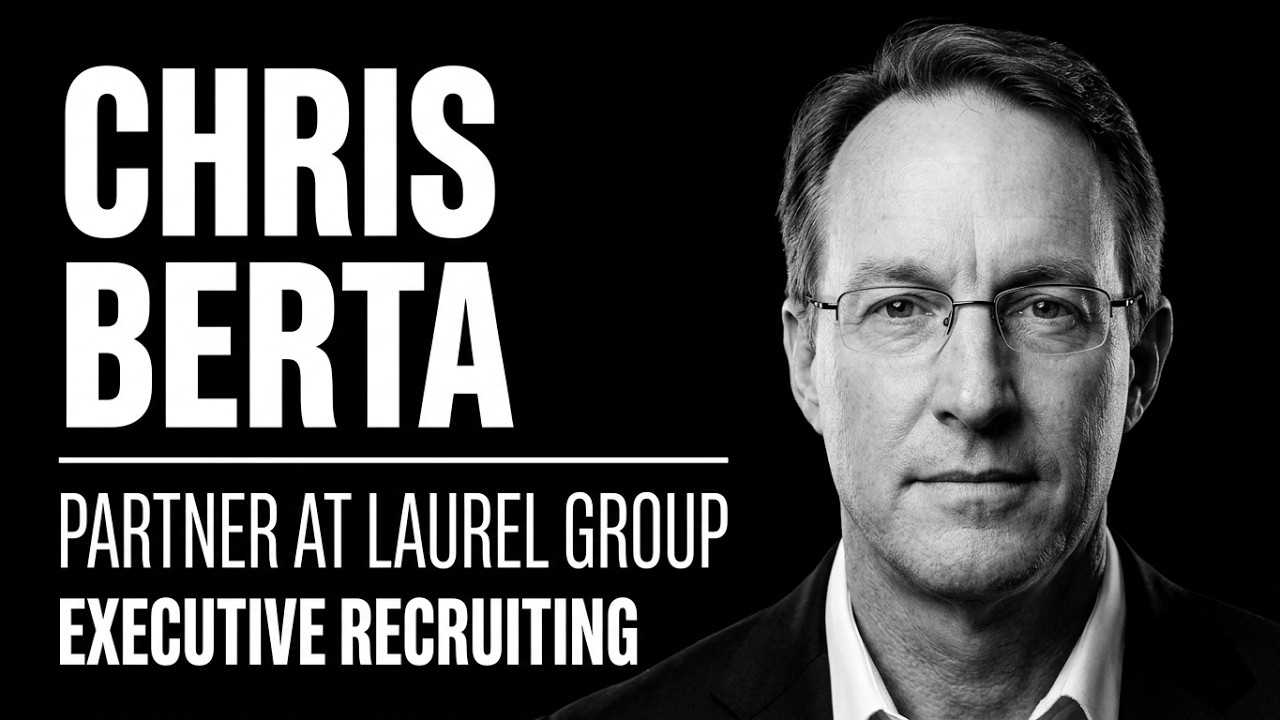
Chris Berta runs Laurel Group, an executive search firm founded by former Heidrick & Struggles consultants. He explains how AI floods recruiting with resume noise while also giving small teams more capacity, and why CEOs still need search firms for senior roles once their networks run out. The firm charges a retainer split into thirds, typically around a third of the placed candidate's salary.
Chapters
Welcome to another Founder Wisdom Pod. We have Chris Berda with us today. Chris is a partner at Laurel Group. He does retained executive search for software, SaaS, networking, e-commerce, and power generation. He's into marketing, product, sales, and GM leaders, 90% repeat client base. So that's a pretty good retention rate. Chris, welcome to the pod. Tell us a bit more about yourself and what you're up to.
Hi, Charles. Good to be here. Yes. So yeah, the Laurel Group, we're an executive search team. We're a boutique organization. The founders had come from Heidrick Struggles, which is like the 800-pound gorilla of executive search. And so they wanted to cut out a lot of the middle management layers and be closer to the market. And so they built the Laurel Group to be much more streamlined. And now with the advent of AI and a lot of the capabilities that AI presents, you really can get a lot more done with just a lot fewer people than before. And so we're seeing a lot of advantages of being able to be nimble, be able to understand what our clients need directly, and then be the people that are actually talking to the candidates to make sure that we're representing them correctly to the client and then representing the client correctly to the market.
And how did you get into this? Because you spent some time at Amazon, Washington Mutual, right? Like, how did you get into that?
Yeah, it's funny. I, uh, started at a company called AQuantive, um, and it was a startup. There's about 25 people when I started there. Uh, we grew that, and ultimately Microsoft acquired it for $6.3 billion or something along those lines. And so it was a fun, rapid growth company, and I enjoyed that startup environment. Then I went over to Amazon and I built out the initial ad tech capabilities of the company. And I liked that initial nascent stage product growth. And then ultimately I went over to Washington Mutual, which was the largest savings and loan bank at the time, and wanted to start the online marketing there and had a lot of great ideas. The tough part is I ran into the friction of a large bank, and so I didn't get nearly as much budget as I wanted to, to do a lot of the projects I had envisioned. And so then when I got approached by the founders of the Laurel Group, um, I initially pushed them off for like 6 months and I said, nah, that doesn't sound right. I— yeah, recruiting always seemed like, uh, used car salespeople to me. And so I, uh, held them off and then they're like, well, no, executive search is much more about talent management and representing talent to clients and then also understanding what clients in the market needs. In finding that right kind of talent, so it's that matchmaking. And it was a startup at the time. I enjoyed that initial stage of a company, and so started 22 years ago now. And so we've grown the company as the fastest growing company in Puget Sound, according to the Puget Sound Business Journal. Back in 2008, we were probably the fastest shrinking company in 2009 when the. financial meltdown happened. Uh, but we've had businesses that we've spun off as well and sold to VCs. Um, so it's just been a very dynamic environment, um, which has been exciting over the years.
What has changed in the age of AI in the executive recruiting space?
Yeah, it's remarkable. Um, and we've really been at the forefront of a lot of technical evolution. So When I first started in 2004, it was when SaaS was just coming into the picture. And so we were advising companies on what that's going to mean for them from a leadership standpoint, from a financial standpoint, from a talent standpoint. Then, of course, cloud. And I'm in Seattle. And so not only is it cloudy from a weather standpoint, but also we've got a lot of cloud companies like Microsoft, Amazon, and Google has set up a shop here. Oracle as well. So we're at the front end of a lot of those hires and growth environments. And now we have AI and what we're seeing. And I wrote a paper about this, about AI and its impact on recruiting and just making it much more of a crowded and noisy. And really it's gunking up the machine of recruiting and being that there's so many people that are able to apply. But everybody starts looking the same because they're using AI to tailor their resume, to tailor their cover letter. And then there's so much on the other side of the ATSs who are just, you know, trying to screen people in or out based on keywords. And so you end up having this dynamic where you have now hundreds, if not thousands of people applying for one role. And it just makes it very difficult for the internal recruiters to find the right person. They have to go through all those different resumes. And then there's a black hole when someone applies on the other side for a role. And so where I'm claiming and what my value proposition is that I'm touting is that, look, if you want to find the right person and cut through all that noise, that's what executive search people can do for you. And so we should know the people who are loose in their chairs, so to speak, and are the right not only functional fit, but also the cultural fit for that environment. And so that's where we have seen a great deal of success is that companies are just saying, yeah, we're getting overwhelmed. Can you help us come in and find the right people in a timely manner? And so I think there is that challenge. And then everybody starts looking the same because how do you know, you know, if you don't know somebody, you're— if everybody's writing the same resume using the same keywords as their method, It just ends up becoming kind of generic. And so people are unique. People have their own unique characteristics, just like companies do. And so you need to make that connection.
And who are your clients right now? Who are you recruiting for?
Yeah, so for the last year, 18 months, we've had, uh, Bloom Energy, which has been a huge client for us. They at the time when we first started working with them, they were like $12 or $15 per share. Now they're about $270 per share. And I can't take credit for that growth in their stock price, but we've placed over close to 15 people there in senior leadership roles. And so they have had definitely a material impact on the business. And so that's been a good one. There's been other clients that are in the drone business that we started— have started working with. Um, one of my big clients over the years, we've had a long-term relationship, has been a company called DuckDuckGo, which is a privacy search engine. And pretty much their leadership team is, uh, we've placed them over the past, like I said, 7 years. Um, so we run the gamut from, you know, companies that are public companies to smaller growth companies. Um, I had a smaller, um, I was working on a head of product management for an AI-forward, um, company that does CRM and sales enablement. Um, so that was an interesting search to take to a, uh, to market because it was such a small company that no one had heard about. Um, so it's been fun to see this spectrum of sized companies that we've worked with and just the different value propositions that you have to communicate and then the right kind of talent that's going to be appropriate for each of those kind of companies.
Interesting. What's your process when you get a new client, like to get their essence down and also to get their ideal candidate essence down and ultimately to make matches?
Yeah, so that's where, like any kind of project, if you're doing— I mean, building, if you're doing any kind of project, it's a lot of the initial research up front. And the engagement, the interviews, making sure that you've got a great perspective across their different functional teams, that this person in this role that we're looking to fill, who they're going to be interacting with, and make sure that there's alignment on the hiring team about what they need. And so it's interviews across the company, interviews with people who hopefully you've known in the past that have worked there. Looking at their competitive set and looking at their who they compete against, and then showing some different profiles. You know, in those initial, it's kind of like when you go and look at different building. You know, we just had done a remodel of our house, and so when you hire a remodeler, you want to see what they've done in the past. And so you want to make sure that hey, is this the kind of profile? that looks appropriate for what you're looking for in this role. And then you can look at where the strengths and weaknesses of that person are and make sure you have consistent buy-off and consistent agreement with the rest of the team that's going to be making a decision on that person. And then it's talking to customers, finding out what their reputation is in the market, looking at different research that the researchers or evaluators of that product, where they sit in the Gartner Quadrant, and then, you know, how does that map and what are some of the analysts saying about the company? There's a lot of information online that you can gather about a company. And so we end up doing all that research. And then that way, when we take the product to market or the company to market with that specific role, we know what to anticipate from pushback on by candidates. And a lot of it is since we've been doing this for 22, 24 years, you can anticipate where there's going to be some pushback. And so making sure that you've addressed those questions as much as possible up front so you can make the right kind of pitch to the candidates in the market, because most people that we talk with are not actively looking. They're, you know, hopefully they're open to consideration, but they're actively engaged right now. And so It has to be something better than where they are, and we want to make sure we communicate that correctly.
And do you do some prospecting as a partner? How do you get your new clients?
Yeah, like I said, 90% or so comes from repeat customers, you know, and repeat clients. So a lot of our business is— and all of our business is really referral. It really is difficult to do a cold outreach. to somebody and have them bring us on because so much of this is trusted experience in the past. And so most of our new clients come in from people who we've placed previously or who were clients of ours previously that have gone over to a new company. And so then, you know, they bring us along with them. And so it's really much more of a relationship. And that's the great thing about executive search is that Clients are candidates, or clients become candidates, and candidates become clients. And so it really is interchangeable. So it really is around the relationship that you're building with these leaders.
And the fees, are they typical? Like, uh, if you're on the candidate side, you take like 10% of their salary for the next 3 years. And if it's for a company, is it 10% also? Like, what are the fees like?
Yeah, no, we're solely client So the clients pay us a fee. So they retain us, they hire us to go and find the right candidate for their role. Industry is about a third of their compensation. And so we're not necessarily at a third all the time. We try to set a flat fee and then break it into 3 different tranches. So when we kick off the search upon a milestone, And then when we complete the search. And so, it breaks it up into 3. But that way, they can budget what that cost is going to be for the duration of that search.
And what do you do like CEOs? What's been the highest placement, highest salary role you've ever done?
Highest salary. I mean, the greatest, the biggest role that we've done was, I'd say the biggest, the most senior role has been a CEO and have been CEOs. Typically, that's at a smaller organization or growth company, so they may be a VC-backed firm, you know, so those— I wouldn't say those are the highest salaried because, you know, when you work with a Microsoft and Amazon at senior levels, you know, those compensation packages, you know, they're in the millions. And so, you know, it gets up there in range.
What's the CEO personality like and how, how has that changed over the years? Like, are they still buttoned-up CEO, mostly finance background? Like, what have you seen in that area?
Well, it really depends on the industry. So one of the CEOs we placed was more of a sales— had a sales background and moved into more of a— moved into the CEO role after getting into greater levels of sales seniority. Chief Revenue Officer and then moved into being a CEO. Another CEO we've placed came in through more of the technology side because it was more of a technology, technical product. And so that person came in through more of the CTO route. And then another one was Chief Operating Officer. And so it really depends on the industry. If the industry is more technical or the product that they're the company's producing is more technical, you may see more people come in from the technology side. And then if the company is more geared towards, say, the audience that you're selling to is a salesperson, a salesperson in foundational— their foundational skills could be a salesperson or a product manager that moved up through the ranks. So I'd say it's more industry or product dependent as opposed to, well, you know, evolution of companies. But I think the most often we see a COO that moves into a CEO role. I mean, if I was gonna put a functional precursor to the CEO function, I would say it's probably the stepping— last stepping stone is oftentimes a COO.
And have you AI-ified like your full process, like all the candidates in your database and I don't know, remind them of your existence, see if they're still fit for the job, right? And on the other side, there would be companies and their needs, or is that still sort of your brain and your gut?
Yeah, we haven't really AI'd that because a lot of it, what I'm seeing is when I've tried to do— if I try to do like a mass mailing or a mass outreach, it doesn't necessarily communicate the uniqueness of that relationship. That I have with that person. And so we've, you know, we have some AI tools that help in the researching. We have AI tools that help in, uh, sending out general emails to, uh, people. But if you have to, if you— with our business being so relationship-based, you really want to tailor that message to that person because we've had interaction in the past, you know, we've had a conversation, you know, a year ago or 6 months ago, and you want to refer back to that. And oftentimes that doesn't get picked up correctly in some of these AI tools. Maybe over the years it'll get better, but right now I still am using my database and what my previous notes are about that person and then including that in the email. So it's It's much more tailored. Um, so you can't really just do mass emails. Um, I think I save that for maybe when I do a LinkedIn post or something like that, just to stay on top of people's radar through some of those outreaches, or I should say, um, postings.
And if you'd have to AI-ify it, like, is that even doable? Because I think there's a lot of, like, human gut magic at play here. It's like, oh, this guy's a fit I just have a hunch, right? I can't explain exactly why, but like my body knows it for some reason, right? What do you think about that?
Yeah, it's funny. I just placed a person and they were like, how did you find me? Because my background doesn't line up directly with this role. So their current— their previous title would not be appropriate for the function I was looking to fill. But I could tell by the skills, the projects that they had worked on, that they probably could be appropriate for this position. And then it's just a matter of having a conversation with them and saying, hey, you know, are you open to having a conversation? And if so, here's something that we're looking to fill. Would this be of interest? And here's why I was thinking it could be appropriate for you. And then they're like, yeah, that be worth a conversation. Let's, let's continue this dialogue. And so yeah, there's, there is an art to this that you can't necessarily just go by AI these days or just keywords and just try to, you know, map to it. It has to be what are the right kind of projects. And this is where it becomes difficult, like when you're seeing 1,000 people come into a, for a job application. How does an internal recruiter get through all that appropriately without passing over a lot of qualified people that the hiring manager may say, hey, you know what, they actually did a project that could be compelling for what we're looking for. It doesn't line up exactly like with a competitor or anything like that, but it is a similar problem set that they're trying to solve for that they end up filling or fulfilling. And so It really is just, I think, your wisdom that you get over the years.
Let's say I'm a CEO, right? Like, I already have a network. Why would I hire an agency? And that would take like a big part of my salary. Like, haven't I have the current and existing network to just reach out at scale and get like my dream job?
Yeah, no, and we recommend people try their first network first. And especially smaller companies that they want to know the people intimately that they're bringing on board because it's such a close-knit environment that they're going to be working from. That makes complete sense. But as soon as you reach that scale, and that could be a, you know, B round or when you get to 100, 150 people, now all of a sudden you end up exceeding your reach, your network, your close association. And so now you need to find the people that are gonna be appropriate for that next scale of growth. And that's where we end up coming into play a lot of times. And sometimes, you know, we go in even earlier, you know, than what I'm talking about right now, just because they don't have the bandwidth and they're like, you know what, just bring us 4 or 5 people that are gonna be appropriate for this role. We don't have the bandwidth. I'm trying to build my product. I'm trying to get the team, you know, humming. I need to have somebody that can just take this off my plate. And that's when we come in as well. Or bigger companies, they just, they have internal recruiting teams, but it may be a more specialized function that they're looking to fill. We were doing a search for, we had a year-long retainer for Amazon because they're looking for this senior-level GM, VP-level engineer. And they had specific requirements that they were looking for. Some of the roles that they had given to their internal team were open for 250, 300 days. And so they said, hey, can you take these on? And we took them on and we filled them. You know, we had 7, I think 7 or 8 people that we placed there over the course of the year for roles that had been open over a year. So it ends up being very specialized oftentimes, and it's the roles that a person is just not able to do internally or their team's not able to do internally. Uh, or they just have such volume that they handle the more gen— you know, the junior-level roles, and then those more senior-level roles that may have to have some sort of confidentiality around it, or just they don't want to see the— they don't want to have the market know that they're looking for that function. That's when we get brought in as well.
And how do you recruit, uh, partners at Berta? Tell me a bit more about your— at Berta— at Laurel, your process. Yeah.
Yeah, you know, a lot of it again is the network. And, you know, we've had people that we've brought on that were, um, known to us, uh, from on a client side or on, uh, other recruiting firms, um, that we've brought on. Uh, so it's a unique, you know, because we're a boutique, so we want to make sure that they not only fit, you know, the functional experience and, and can work on their— be a full desk, you know, meaning that you bring on your own clients as well. as, you know, fulfilling on some of the other searches that we're working on. Um, but then also, uh, have the right cultural fit and that you're a good click, uh, with us as well. So it, you know, is it just like we preach this to our clients that we find the right functional and cultural fits for them? We're looking for the same thing. And so, um, it just, uh, it's a unique beast too because, uh, you know, we've hired a number of people over the years that were, you know, good recruiters, um, but they— that's— they wanted just to recruit, um, or they were good business development and that's all they really wanted to do. And, you know, as we want to streamline this as much as possible, we really need someone that can do both.
Interesting. But isn't there like a funnel to become a partner? Like, uh, you start in a normal job, then you get, uh, offered a partner role after some time?
Oh yeah, I mean, and again, this is all negotiation, right? If they're pretty senior right now and they're a partner at another firm and that's what they would require to come over here, yeah, I guess we would entertain that. But yeah, it would be great to, you know, have them start off as an associate, uh, and then move into being more of a, uh, director and then ultimately a partner. But, uh, you know, there is a Depending upon the seniority of the person that we're talking to, it just depends.
And do you feel that partner model is scaling? And why aren't there more companies using that partner model in different industries, right? I believe that model to be very specific to the consulting space. Why don't other companies scale using that model?
I think it is a services structure where— and a lot of it is because So much of consulting is relationships. And so how do you build those relationships? It really just takes time. And so they— in order to become a partner, they'd want someone to invest the time and demonstrate that they have the ability to bring on clients, have those relationships solidified, and just have a good track record. I think, you know, I did a paper recently about there's gonna be a gap, a leadership gap with AI because there's not as many entry-level roles. And so with that more limited number of entry-level roles, where does someone learn their craft? You know, be it accounting, be it sales, be it marketing, whatever it might be, how do they learn their craft on one hand, But then how do they become good marketers or good leaders? And so I think that's where we're gonna see potentially in 5 years a gap in training for leadership. And my recommendation is to set up a deliberate and structured apprenticeship program. So having a person get the reps, get the experience working on small, then, you know, more larger, larger projects over time. And that's similar to a partnership model as well, where you're saying, hey, let me take you under your wing, under my wing, as me being a partner and an associate, let you take on greater levels of responsibility. And then ultimately, once you demonstrate success there, then become a partner. So I think there will be more formalized apprenticeship— call it apprenticeship programs, partnership programs— that companies will institute just so that they can make sure that their employees are getting the right kind of skills.
Thanks for being on, Chris. Where can people find out more about you and the company?
Yeah, so I'm on LinkedIn at Chris Berta, and then our website is www. laurel-group.com. And so, um, yeah, we're probably— both of those spots are probably the easiest to— and then my email address is chris@laurel-group.com as well.
That's Chris and Charles for another CEO Wisdom podcast.
More from Charles




Founder Wisdom: the full audiobook (7 hours of quotes and stories from 600+ founders and CEOs)






