David de Gruijl - Founder @ Anto (YC F25) | Pharmacology x Gastroenterology
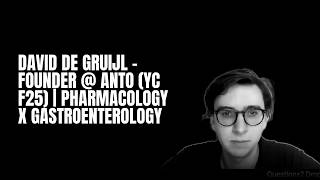
David de Gruijl founded Anto to use AI on gut microbiome data to predict how bacteria affect drug metabolism. His startup filters noisy sequencing data through a process called sparsification, then feeds it to language models for mechanism predictions pharma companies need. A fecal transplant trial boosted Keytruda response from 35% to 77%, showing why this matters.
Chapters
And I'm gonna try not to butcher your name, by the way. That's, uh, that's, uh, David and Charles for another YC Wisdom pod. David de Gruge.
Nice try.
Yeah, how's it again?
DeGruge.
Oh my God, that was like so far. Um, my subconscious brain didn't even like digest the pronunciation last time, so shame on it. Uh, Dave is founder at Anto. It's a YC F25 company. It's pharmacology meets, uh, gastroenterology. Me and him were talking about the gut-brain axis last time we spoke, and just a fascinating field. So David's also a fellow at Sigma Squared Society. He's a founder of a next stealth company. We'll talk about that one. Graduate researcher at Harvard Medical School. You're a bunch of things. Uh, give a quick intro about yourself, Dave.
Yeah, sure. My name is David. I'm originally from the Netherlands. I'm currently founding a company in the space of the gut microbiome and how the gut microbiome influences how we respond to drugs and foods that we ingest. Um, we predict that using our own trained foundation models I've been in the space for about 6 years now, originally in Zurich and then later at the gastroenterology department of Harvard Medical School, and started this company together with a labmate that I met in Boston.
And when we first spoke, I was like, this is so obvious, right? Like, uh, I'm like a guy like me that's been studying the gut, that's been a biohacker for quite some time, it's just obvious that your gut's health will help the absorption of drug and make them more efficient in many cases. Why do you think that no one else have been starting something in that space before, or have they?
So there has been a wave of companies in this space about 10 years ago. I think one of the main barriers around the gut microbiome was that we didn't really understand what was going on at all. Like, we didn't have the tools to actually study the microbiome in depth. So essentially, we knew, oh yeah, there's some kind of correlation between gut microbes and the way that we respond to food and drugs, but we don't know what, like, the correlation exactly is. And if you don't know what the correlation is, what can you actually do about it? And then about 10 years ago, we started developing better tools in terms of like sequencing, so understanding the DNA of those gut microbes and other chemistry tools to understand how these microbes function. And that kind of landed the first wave of companies that, for example, tried to do microbiota transplants.
I'm not sure if you've ever heard of this disgusting fucking pill that you swallow, but yeah, do describe it really so that we can have a couple of listeners vomit.
Yes, so essentially it was clear that there's this kind of correlation between like how we respond to drugs and like your microbiome. So there were some people like that maybe you knew that to a certain medicine or whatever, they are super responders. Like once they took the medicine, their tumor shrank like incredibly fast.
Basically their ancestors were poop eaters.
I think so. Yeah. Yeah.
Like they followed today's Asprey.
Yeah. I like, it's not really clear exactly why those people have like a quote unquote good microbiome and other stuff. The reason I just said, dude, though, But what people started doing is like, okay, let's just give the people who are not responding very well antibiotics, so like destroy their own microbiome, then take the poop of those super responders and just give it to them in a pill with the hope that they're like— the super responders microbiome will, will last in the digestive tract. And that that will like turn like someone who doesn't respond well to the drug into someone who does respond well.
And the science do that, the level, because again, to me it's obvious for some reason, but I mean, you've researched that way more than I did. But when you eat something in the gut microbiome, these bacteria digest the food, they break it down and they have it enter your bloodstream, right?
Yeah, correct.
So the same thing happens when you swallow a pill, no? It will actually digest some components of the pill and put it into your bloodstream. So why, why is that still not obvious? I'm just—
it is obvious, it's just not so obvious what to do about it. So if it's obvious that it exists but like you cannot predict it, nor can you like change anything about it, you might as well just ignore it.
And why is it not obvious? Is it that it's not scientifically researched, or that reaction has not been studied enough, like taking that component of the pill you just took and the digestion actually helping it? Or is it because there's other mechanisms and there's like so much at play and we haven't isolated that? Specific mechanism?
We have— yeah, we haven't isolated any specific mechanism. So like, because we don't really know what the mechanism is, the best action you can take is just like replacing someone's entire microbiome. If you knew what like the mechanism exactly was, you could take more targeted interventions.
And the poop pills, is it the best way to do it? Because there's tons of, um, gut microbiome supplements out there, even prebiotics nowadays. These are not as effective. Why does poop like literally replace my full gut microbiome? Wouldn't like some of my microbiome stay there? Tell me a bit more about that.
Theoretically, that would work, you know, like giving people prebiotics or some other kinds of supplements which kind of shift your microbiome in such a way that it's more like a super responder or like someone who responds well to like medicine, or in that case food, that would like actually work. But again, like we, we don't really know how to do that precisely. So like we just take like the most coarse-grained like solution That is like kind of the first generation of companies in this space. Now, like our company and like the next generation of companies, we figure out like in more detail, we have the tools to find those mechanisms and then like propose more targeted, uh, solutions to these kind of problems.
I'm watching your video on the website. What will be you guys' first product?
Yes, so our first product is actually just predicting mechanisms, uh, of like what the gut microbiome does and how it influences like the way we break down compounds. So we work with companies that essentially have some issues with them, with like a clinical trial, and they have no idea what the issue exactly is. They saw that the trial didn't work as expected, but they don't know why exactly. And they start hypothesizing that it might be the gut microbiome. And then we kind of help them more as like a tech-enabled service to figure out whether the microbiome was involved in, in like the unexpected results and what they can still do about it now that they have a trial that has like terrible results.
What is sparsification?
Yes. So essentially, like modeling the gut microbiome is incredibly hard. So just building like kind of large AI models in the way that we do with text doesn't result in great models. It's like as if every word has a spelling mistake in microbiome data, you know? And you just feed like these words with huge amounts of spelling mistakes to an LLM. And you train the LLM and then you expect it to understand language. Uh, it's usually just garbage in, garbage out. So what our company actually has developed is certain, like, preprocessing type of algorithms that deal with these spelling mistakes. So we filter out all the words with spelling mistakes and we only keep the words that likely don't have any spelling mistakes and we only feed those words to our language models. If we do that, then these models perform much better because they're not trained on noisy data.
Why couldn't— why couldn't Pfizer or any big company do that themselves without you?
That's a great question. Like, I think eventually they would be able to do that. And that is like kind of the golden lining of every single foundation model in biology is like any big pharma company could do anything that you are doing. I think I have two like responses to that. I used to work at a pharma company. I worked at Johnson Johnson and we started a project in 2019. And as far as I understand, they're still trying to implement this project 7 years later. So these companies, they innovate a lot by acquisition and not a lot like by, by internal innovation.
Yeah, yeah, yeah, yeah. That's the key, right? Like one employee, one YC founder's worth 100 employees or something like that. And I'm not joking, and that might sound very arrogant, but these guys are just paid to just take things— everything's slow. They're not super creative, they're just like 9-to-5ers.
Um, exactly. And it just takes super long to get alignment in these companies. So from my perspective, during that project, um, there was like every single team like was solving it within this company, was solving the problem in a totally different way.
They were solving how to meet on Zoom.
Yeah, exactly. Like, they, they essentially, like, to get them all, all these different teams together and say like, no, no, we're gonna, from now on, we're gonna do it this way and we've built this tool. It was like almost impossible to get them all together, agree to that. Pilot it.
Um, it's crazy. And then don't get me started on corporations, right? Like, corporations are just over-bloated financial instruments. They're not productive for— very productive for society. Startups would be more productive for, for most of society. Um, and it's not just the FDA, right? It's not just like compliance. It's the companies themselves that move so slow. Like, deploying a drug in 15 years is fucking ridiculous. It should take days and weeks, right? And I think we can move at this pace nowadays. What do you think?
It's true, but I think like one of the things you see in this space is like part of that like speed comes from the companies that might be like very bloated and have a hard time moving fast. But part of it also comes from all the other stakeholders and institutions that play a part in this. So especially in clinical development, if you have governments that you need to interact with, you're dependent on how quickly governments move, which you, for example, see in China right now, is that one of the big advantages that China seems to develop in, in biotech is that the government simply moves faster. And then essentially you also have these limitations around— if you, for example, try and cure a rare disease, you have to find a significant enough sample of people with this rare disease to test your drug on for a clinical trial. It's not so straightforward to find all these people. And have them all together, make sure they don't drop out of the trial for whatever reason. So this logistics part is, is like complicated too.
Is rare disease as a vertical attractive as a business model? And are— what are rare diseases? Aren't they micro branches of a macro disease?
Yeah, usually, usually it's micro branches of a macro disease. That's right, as far as I understand. Um, I think like it depends also on the government, uh, whether that is like an attractive market. So you see, for example, in the US there are certain regulations— don't quote me on this, like please do fact-check— but there are certain regulations as far as I understand that, um, basically doesn't put price caps on drugs with like that are for rare diseases so that like pharma companies can charge a lot more for these rare disease drugs than, um, for like other kind of drugs that they would develop. And this makes it in the current— like, makes it evil environment. Yeah, it is evil, and it makes it in the current environment very attractive for pharmaceutical companies to go after rare diseases because like you can, even though there's not that many people with the disease, maybe you can charge like half a million dollars per treatment.
Oh boy. And on the clinical trial side of things, do you see an efficiency? There's been innovation on that side as well. Lots of companies, many YC companies have been using AI to do in vitro, uh, clinical trials, right? Like, what have you seen on that? Is it promising? Because that could 10x the drug research, um, uh, to speak from, uh, inception to market, right? Like, it could go from 5 years to 2 years. But of course, we need to accept that. So what's the latest development in that space of things?
I think it's incredibly valuable. Because I think like one of the limitations that you have in drug development is that it's so expensive, that expense partially comes from time. Like, the longer things run, the more money is put into it, obviously. So with like any kind of technology or innovation that reduces that time component or resource efficiency in a way, um, that improves the amount of shots on goal you can do. So how many drugs you can try that actually, um, like how many drugs you can try and see if it actually works. So you have this one side of like being more efficient and making sure that you have more shots on goal so less cost per drug. And you have this one side where you're trying to make sure that more shots on goal actually hit the goal.
So AI, on the other side, like, so we try and make sure that more shots hit the goal, right, by giving companies, uh, an algorithm that filters the crappy data and gets them to where they want faster, which is pretty genius. I'm going to come back on that in a second. But, um, AIs can reliably have, uh, human AI avatar models now that is reacting the same as my body would in a clinical trial. Is that like said and done? Is that like, uh, applied right now?
It's definitely not really applied right now. And it turns out that, uh, I know companies are working on it. Um, I'm not sure how validated some of these technologies are. And one of the things you run into is that the body is really incredibly complex, right? So if you have this model that is sort of like a digital twin or a digital avatar of you, and you take into account only human genetics, so like the differences between you and me in terms of what kind of genes we have, but you don't take into account, for example, the microbiome, you might miss like a crucial part as to why people are going to respond to that drug and others don't. And I think like that is like kind of the issue with like figuring out whether things work or not is that human biology is incredibly complex, so many dependencies.
Right, because you need to reproduce like my full biology, right? And what biochemicals are you tracking? There's like thousands, right? The before, the after, and then have a reliable timeline of that data. So take a patient that has done tens of clinical trials, if they survived. Yes. Um, and yeah, that is complex in itself, right? But technically, from the first principles, right, take all the data, uh, well, align on, I don't know, like hundreds, hundreds of biomarkers before and after. If you put that in a database, you could create some kind of avatar, um, and you could start from there, right? But, um, where am I wrong in that thinking?
Theoretically, that's true, and I think even practically it can be very helpful And it would like potentially increase the amount of like, or the hit rate or the success rate that you have in, in clinical trials. It's just like practically speaking, I think one of the issues we have is that like, there's always something that we didn't take into account that just pops off. Let's say like, And because like essentially what we use right now is like our digital avatar of a human is an animal, right? Like we, we test on medicine first on mice, then on like maybe rabbits, then on, on pigs, and then on Brian.
We moved all together. If we have AI humans avatars just to make a decision on where to focus their time, money, and energy on what drug, right? I'm pretty sure that's smarter than— yeah, legally you need to do it on mice as well, or the regulations are kind of changing around that.
So a lot of, like, even the, the FDA put out a call, I think last year, to reduce animal models in clinical trials and use more, like, human-relevant data, which kind of includes the microbiome, right? Like an animal that has a diet of corn, um, doesn't have like the same microbiome as a human. But like, yeah, yeah, yeah. So like, there, there is some initiatives on that, but the question is always like, is the AI actually more accurate than the animal model? That first has to be like kind of true. In order to— for, uh, like, a company to be confident if that AI is constantly improved.
Yes, uh, would be my, my theoretical, uh, shot at it, right? Um, especially if there's a recursive loop in between. Oh, okay, we did the, the virtual AI avatar test first, we focus on that drug, we make the human trials and, oh, was it a good decision made by the AI? And then you do that enough times and you reduce the cost in the meanwhile, and so you increase the test, so the AI gets exponentially better is what my gut feeling tests. And it seems so fucking archaic, the mouses, you know, like when I did my nootropic, uh, like 10, 12 years ago, we did studies on it and It was like the, the mice swimming test, which was like so fucked up. Like, give the mice some supplementation and then it would find its way like quicker. Um, and yes, yeah, like, that's cruelty, man. That's so fucked up.
It's crazy. That's actually a little bit on how, um, how Anto, our company, initially started, like So we were dependent in our lab on pig studies because pigs, they have a similar size stomach. And yeah, yeah. And like even the lab's logo, it used to be a logo of a pig, you know, like, and we actually were thinking like, okay, the animals of, you know, like domestic animals, right?
They're pretty nice creatures. They're smart.
And Incredibly smart. Yeah. And if you could reduce the amount of studies that you can do on pigs by just computation or even like, uh, experimental studies, that'd be great. What we realized over the span of like years is like the reason why people still use pigs is because recreating someone's digestive tract in the lab is like not very accurate and not very scalable. So you might as well use a pig because it's like basically your most accurate model. Well, for us, like the scalability, it can be solved by computation. And if the— if, if you can also make it more accurate, than a pig because essentially the microbiome of a pig is different than that for a human. So if you simulate a human microbiome, then you solve both that scalability problem and the accuracy problem at once.
Isn't the human gut so different by design because we're vertical creatures?
To some degree, yes. When it comes to like basically, um, like for example size, if you're trying to test like some kind of— let's say like we used to have these tubes that you could put through someone's nose and then it ends up in someone's stomach. They use those kind of tubes in the intensive care units. It's called nasogastric tubes. And like, you cannot test the nasogastric tube if you have, like, if you're building a new one, for whatever reason, on a mouse, because obviously, the tube is not gonna fit into a mouse's nose, right, and not into a mouse's stomach. So if you want to do it in like a human realistic way, you want to test that on animals.
Got it. Billion dollar market. Seems small, right? Because if all the drugs are influenced by that, that would be trillion dollars, wouldn't it?
Correct, correct. Like, essentially, you see it with those, uh, fecal transplants, is that for the most sold drug in the world right now, it's called Keytruda, uh, you could double the response rate to that drug by just changing people's microbiome.
That's insane.
Yeah. And this is like—
what's the science behind that? Is that a guess, or—
the science is actually— it doesn't necessarily have to do with breaking down the drug. It's like an indirect interaction between your microbiome and the drug. So what happens is that the microbes in your gut, they change your immune system, and this drug works on your immune system. And as far as we understand, it's like if you have your guts constantly work, or the gut microbes constantly working against this drug, it's a competition between the microbes and your drug. Um, and the only way to change is by changing the microbes at this point. So that is like one of the reasons that we think this is the case. There's other theories behind it too, where like this drug acts on a certain target. So you have like the molecule and it has to bind to a certain protein, but the microbes seem to produce molecules that bind to exactly the same protein. So the drug cannot bind to it anymore. The protein is already like occupied. Let's just say it that way.
Insane, man. Imagine, because if you, you said like, uh, 50%.
Yeah, yeah. So it's like a $30 billion revenue drug, right?
So, or in terms of like saved, right? How crazy is this? It's like couple millions lives saved.
It's huge difference. Yeah, yeah.
So why don't, why aren't all of these patients having a fecal transplant then while taking the drug?
So it's still going, like, people are working on this. And I think recently a Phase 2 clinical trial was, um, was released that showed like this kind of difference. I think the overall response rate, so whether the tumor was shrinking or not, was 77%, whereas normally if you give the drug randomly to people it's 35%.
Oh my God.
So it's like a huge difference.
Peer-reviewed and, uh, great methodology. That was a study done by this big company, right, that does the drug? I forgot who it was.
Or, uh, Merck.
Okay, so that was a study done by Merck, or it's a study—
I think it's done by— I'm not sure if I think a company was also involved, but it's actually an, uh, that does it. So the, the study is called FMT Illuminate.
It's crazy, but also it assumes— I'm not— what was the sample size? How many patients?
I think it's like, it's a small sample size. I think it's like in the tens in the US, like not the, like the thousands. And it's, I think it was based in France.
Okay, in France. Because my next question is like, do all of us have shitty microbiomes or some of us already have good microbiomes and are already taking the drug and for us it's like incredibly more efficient? Um, so I I think like treatments, I'm pretty sure it destroys your gut as well, right? Like some of these—
I think like in that sense, like, so there's still more research that needs to be done, right? Like on such a small sample size, looks super promising. But the question is like, does this hold up at a large scale? I think for some of the companies that tried to do FMT these, they had a hard time, uh, proving that early on, like for other conditions.
My gut feeling, super positive on that one also. Like, that— I'd be bullish about that. Now, coming back to your business model, right, as a VC, like, what is— what do you sell for how much? Is it like Palantir-style, uh, software deployment in which you work, uh, with the company You do have a software that's already built, but you do adapt it to them. Multi-million dollar contract a year. What does the business model look like?
Yeah, so that is the initial business model exactly like you described. It's like Forward deployed, helping deploying these kind of models into their, their clinical trials. But at the long term, we actually want to capture way more of the value. And not just be like involved in, in helping other companies understand the microbiome and making sure that they can make drugs that where more people respond to this drug, but we want to like actually design some of those drugs ourselves. So like one of the things that's open when you help other companies is that they can, for example, take the action of like these fecal transplants What we really believe is that there's an opportunity in this space to be more proactive. So if you have a drug, for example, that's broken down by microbes in different ways, and because of that, maybe 2 out of 10 people respond to the drug, what if you, like, take that molecule and you redesign it in such a way, like the molecule itself or like the formulation, that the microbes that normally would break down this drug, they can suddenly not touch it anymore. Then suddenly maybe you can have a drug that is very similar to the original drug, but it works in 4 out of 10 people instead of 2 out of 10 people. And that would have a huge influence on, like, I mean, patient outcomes, obviously. Because it's a tragedy, a tragedy that we prescribe so many drugs to people that just simply doesn't work with their biology. And quite honestly, we're too lazy to test for it. That is like a bit like sad.
But yeah, it's ironic, right? Because there's all these, uh, health tests nowadays that we take to optimize our health, but there's no such test when we prescribe drugs to people.
It seems, yeah, it's very uncommon, right?
Like, even why not going that instead, dude? Like, wouldn't that be the starter?
I think like what we observed was, so for genetics, there's quite a bit more known on how, like, for example, certain enzymes that your liver produces, how that influences the way we respond to medicine. But quite interestingly, even for the medicine of which we know that those issues exist, a doctor would rarely test for your genetics before they prescribe this drug. So like, I, I never experienced that. I never had a blood test before a doctor prescribed me a drug.
That is so crazy, man. And I never thought— the craziest thing is I've never thought about that thing. Yeah, but it's so obvious, right?
It's like, so what like most pharmaceutical companies have done in this space is if they found out that a certain drug, let's say one common drug is warfarin, has like these huge issues depending on your genetics, and because of that people get many side effects and like they get the wrong dosing Instead of then, um, like doing a genetic test before prescribing warfarin, they just try and design a new drug that doesn't have the issues that warfarin has, and then they kind of try and convince doctors to prescribe this new drug instead of warfarin.
So why not launch a company doing that is my question to you. That seems more logical.
What do you mean?
Well, you start designing tests for Big Pharma that obviously doctors would be in charge, right? But you would target Big Pharma. People would do tests and that would double the efficiency of their medicines almost overnight, and you wouldn't have that many FDA hurdles. So the more economically sound and like a lower hanging fruit to save more lives.
The issue that you have is that, like I said, like, this adoption doesn't exist, or at least it didn't exist for genetics.
Why wouldn't doctors not want to double the efficiency of what they're prescribing? And the patient wouldn't want that too?
I think, like, there's several, several hurdles to it. I think, like, one of them is I guess like doctors like see it as like kind of, uh, um, like an extra step. So maybe not everyone wants to take that extra step. Well, please. Yeah, yeah.
And like, but it's true. I, I know I had a guy on my pod, by the way, that guy could be an investor for you, James Bates. Uh, he runs AdvMed or something like that and has a problem he's solving, like clinics are so inefficient. Uh, but go on.
Yeah, and the second comes actually from, um, from the pharmaceutical companies too, where like maybe the incentives there are not entirely aligned. Because if you can sell a drug and then you have this kind of test that, uh, like essentially cuts like the amount of prescriptions down Maybe you would not want that test to be there because I have a guy for you as well there.
Um, shout out to my client Barry Patel of Galt Pharma. Uh, that guy would implement your stuff. Maybe, yeah, I would fund you for that, like, if you want to go on a side quest. Uh, and that seems so obvious to me. I'm gonna do some research. I'm pretty sure there's already people. Yeah.
I think like one of the issues that we see just in this like space, and that's just generally the case for diagnostics and, uh, building diagnostics that decide whether you should take a certain therapy or not, um, is that like healthcare incentives are just so incredibly complex and—
or corrupt and evil.
Yeah, yeah, yes, that's like—
I didn't want to say it that way, but yes, it's infuriating at this stage. But yeah, go on.
And like, uh, essentially, like, because of those, those incentives, whether it's like the doctor, the patients, the pharmaceutical company that tries to convince doctors to prescribe their medicine, or even the insurance, and like where insurance covers certain things. If you add all of those things up together, it's really like a lot of companies get stuck in this like alignment, uh, problem.
Let's change that. You should have a manifesto on your website or something. But also, you probably shouldn't because the guys you work with are guilty of that, uh, to some degree. And by the way, they're not fully evil, right? Like, uh, these guys are saving lives and they're doing their best, right? But there is some of that, and that's that's when people call— you start calling them Big Pharma, right? And I'm not one of these guys, right? I'm not like conspiracy theory guys, but shit needs to change. Um, coming back to your model, right? Like, let's bring that part to a close. How do you get in touch with these guys? How do you close sales with them? Like, very long sales, very long time. Yeah. So how do you make it happen?
Yeah, so I think you always have to be quite patient in this case. Like, you cannot just— this with like your average B2B yourself, just like in the— after the first meeting, just send a contract and like the contract is signed.
I think you start the process and go on a world tour that lasts at least 2 or 3 years and then come back and then find an answer in your mailbox 3 years later after you contacted.
I think like one of the things that we've done as a company is like, first of all, if you build a company in this space, credibility towards like for the customers is incredibly important. So you cannot just show up and say like, hey, our model does X, Y, Z. It has to be sort of grounded in, for example, peer-reviewed research. So if you can show like, oh yeah, We published a paper on this and independent researchers agreed that whatever we were doing was legit, that really works. I think the second thing is like a lot of it comes from warm relationships. So if you don't have the warm relationships yourself, um, you need to find like a team or build a team around you of people who've worked with these pharmaceutical companies for longer. And where like the people in those companies really trust, uh, that person because for them their career hinges on sometimes on these kind of deals. If they make the wrong decision, their career can collapse.
Yes, good point.
So, so they like want to like only make those decisions if it's with people that they've dealt with to some degree before, and they know that these people will deliver.
Yeah, I love it, dude. Uh, thanks for being so upfront today. Uh, where can people find out more about you and the company?
So you can find us at www.anto.bio. Um, follow us on LinkedIn as well, and, um, Yeah, like, um, I think that's, that's most of our socials. Like, you can follow me on Twitter personally.
Um, there you go, dude. So that was David and Charles for another YC Wisdom
More from Charles




Founder Wisdom: the full audiobook (7 hours of quotes and stories from 600+ founders and CEOs)






