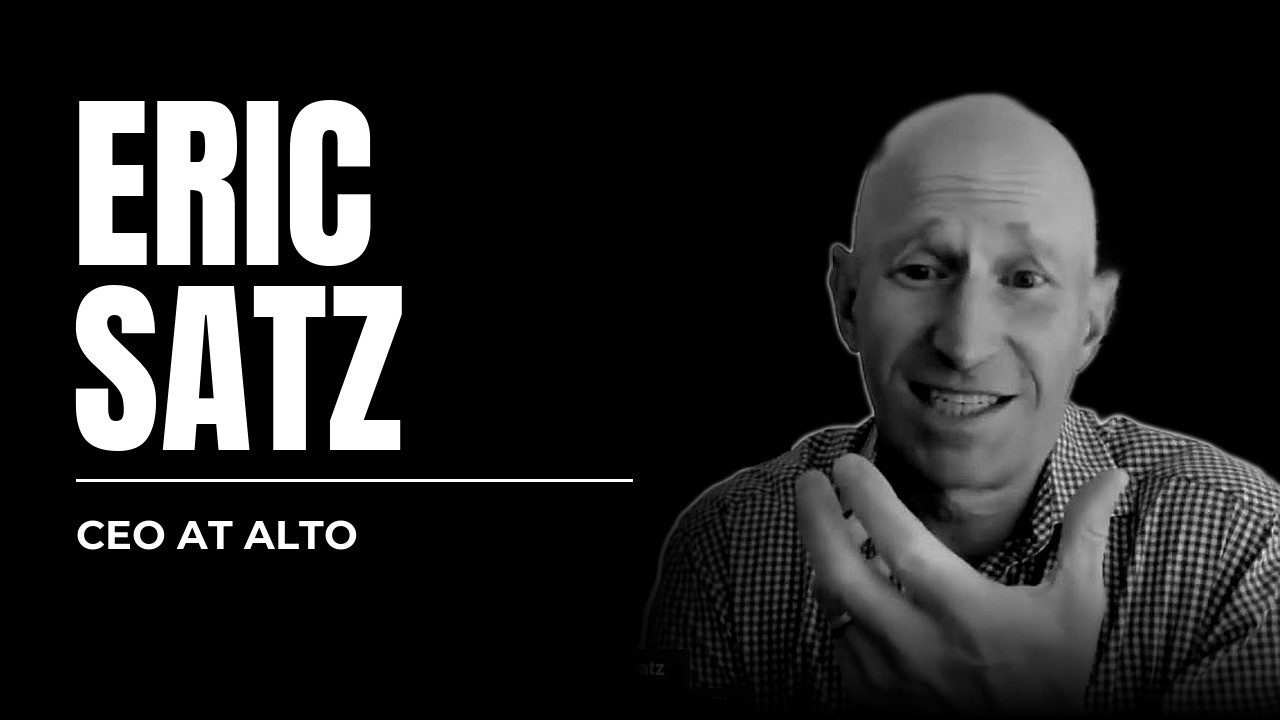
Eric Satz founded Alto in 2016 to let people invest retirement money in alternative assets like private deals. The company runs three businesses: a custodian, a broker-dealer, and software. Satz shifted from selling directly to consumers to selling to wealth managers and advisors.
Chapters
Welcome to another CEO Wisdom podcast. We have Eric Satz with us today. He's the CEO of Alto. He's driving innovation in retirement investments in Nashville, Tennessee. Alto's a hell of a company. Eric's a hell of an entrepreneur. He was co-founder of CureNext in '99. He also has a show called the Altogether Show. So Eric, welcome to the podcast. Tell us a bit more about yourself and what you're up to.
Charles, great to be here. Thanks for having me. So I started Alto actually back in 2016 is when I raised the first dollar and we launched in 2018 in connection with AngelList, if you know what AngelList is. And, you know, the theory at the time, because the JOBS Act had recently been passed, opening the door for every individual to invest in alternative assets and, and direct companies. And so the theory was, you know what, uh, we know that most people have a hard time, uh, saving money in their checking account or savings account and having extra dollars to actually put to work in long-term investments. But what, what, what is more realistic is to enable them to access the money that they've set aside in their retirement account make these long-term investments with long-term savings dollars, do what we call duration matching, and to make these investments on a tax-advantaged basis. So that was the thesis behind Alto. You know, if we roll the clock forward to 2026, you know, we're gonna have 60,000 customers, $50 million in revenue, $10, $12.5 billion in assets. And, you know, so it's been quite a journey.
Pretty crazy journey. Let's start with the first part of the journey though. What was CureNext? Was that your first entrepreneurial experience?
No, my first entrepreneurial experience was actually pulling weeds for my mom, and I think she paid me a dollar an hour per weed. Man, I hated that, you know, in Miami, Florida. But actually That really set the stage, I think, for who I am and what I do. I established a— so, as I just mentioned, I grew up in Miami, Florida, and I established a snowman frozen lemonade route where I would drive an un-air-conditioned van with a— it was one of the early versions of the food truck, right? So, I drive this un-air-conditioned van around. I'd create a route, I'd stop at construction sites and warehouse districts, and I would sell frozen lemonade. And, you know, it's a very simple business model. The more you sell, the more you make. And then when I went to college, I had a newspaper business. And so I sold and distributed the New York Times and the Boston Globe and the Amherst News. which is where I went to school at Amherst College before going to Wall Street and working for what I consider to still be the best investment banking ever, investment bank ever, which was DLJ, Donaldson, Lufkin, and Jenrette, for those old enough to remember. But I left DLJ to start a coffee company in New York City. And that was my first— that, that was my first big failure, by the way.
So, I know, um, yeah, coffee company, that's hard. What happened there and why was, uh, Howard Schultz more successful?
So, so Schultz was more successful because he knew, uh, 2 things that, that I didn't know. He knew where to open in Manhattan his first store. So Schultz and Starbucks is why I got into the coffee business in the first place. I was dating a, a woman from Amherst College who lived in Chicago in Lincoln Park, and down the block from her home was the first Starbucks that I ever saw. And I walked in and they're like, small, tall, or grande? I'm like, what are we talking about? Like, I mean, tall, grande? And I had no idea what a latte was. This was 1989. Maybe 1990, and and I saw this this this Starbucks thing, and I was like, I got to drop out of school and do this. Which you know, thankfully, I didn't drop out of school, but I ended up doing it. And so, what what's not known is that Starbucks had a pretty pretty strong wholesale business, and and the zip code in which they had their largest wholesale. Wholesale Sales was on the Upper West Side of Manhattan. And so that's where they opened their first store in Manhattan. And I opened on the Upper East Side and a little too north. I opened on the corner of 96th Street and 3rd Avenue. And so not only did I know where the Wholesale Sales We're gonna you know how how those would translate in into retail sales. But but I also didn't. I I got the three things about you know having a physical retail location wrong. Location, location, location. I got all of them wrong. And and so you know I I just what what can I say? It was it was my first real failure. And what I what I will say to any sort of entrepreneur out there is you learn a whole lot more from your failures than you do from your successes. The successes make you think you're so smart, uh, and, and that's just not the case. Okay, you know, it, it's easy to confuse luck with success.
And how does one go from investment banking to wanting to launch their own coffee shop? Didn't your colleagues were laughing like, it's like, what are you doing here?
Well, they were laughing, but they also invested with me. So, so, so, so, so, deal. It turns out that, you know, DLJ took— we did private placements for Starbucks and, and then we took Starbucks public. And, and coffee, you know, specialty coffee was just becoming a thing in New York at this point. And so I'm, you know, I'm not proud that I lost, you know, my money and other people's money on, on, on the coffee thing. Um, but, but there were a lot of, a lot of lessons learned. And so, um, you, you asked me about Kernex. Uh, so I, I then moved from New York to San Francisco with, uh, with DLJ. I was an internet investment banker. And I was having a conversation with one of my clients and it was very late at night and we were at the printers filing the S-1 for this company to go public. And he said, I have this really big idea. And I said, all right, what's the idea? And he told me, and I can't for the life of me tell you what that idea was. I said, that's interesting. I have a bigger idea. And he said, what's your idea? And I said, online foreign currency exchange. Trillions of dollars trade every day. It's completely inefficient. You can't get accurate bids unless you have 3 or 6 arms where you're talking to 6 different banks all at the same time saying, how much for dollar-yen? I mean, because the market moves that fast. And so he said, yeah, that's a really big idea. Let's do that. And so together with him, he was the CFO of the company that we were taking public, him, the CEO of the company, myself, and one other person, we founded Kernex, which would go on to sell to State Street for a sizable chunk of change. And You know, that was the first really big win.
Right, yeah, Keurig makes more sense, right? It's like coffee company, Keurig is like your specialty and it has a scalability aspect to it. How life-changing was the exit for you?
So there was a step function for sure, but, you know, I didn't buy a private plane. I don't fly on private jets or, you know, and I didn't buy a yacht at the time. I had 2 young kids. My kids are now 27 and 25. And so, I mean, were we worried about all the same things? No. But most importantly, Charles, I don't think it changed who I am.
And how did that lead to Alto? Because you did a bunch of things in between Alto and CurrentX.
Yeah, so what it enabled me to do is actually start a VC fund with some friends of mine, essentially people who I had known for a long time. We had been investing together in a whole bunch of stuff, and so we ended up starting a venture capital fund And it was while we were putting the capital to work that I had this idea for Alto. It was in, it was in 2013. And, um, I just, I, I think what happened was I, I had a retirement, um, uh, statement show up from Fidelity, and I like totally had forgotten that this money was there. I didn't really know what it was invested in, but I was like, why am I not using this money that I can't touch until I'm 62 and a half or whatever the age is? Why am I not using this money to invest in these companies? Long-term investable dollars, long-term assets. You really shouldn't expect liquidity for somewhere between, call it, 7 and 12 years. That cycle seems to have gotten longer for For for a lot of assets, and so I the only the only issue I I could identify was I didn't know if it was legal to do that. I didn't know if you could take your retirement money and invest in you know a private company. And so this is how I discovered the self-directed IRA industry. And you know that the other thing that I found when I made this first investment, first of all, is it took me ten weeks. It was incredibly time-intensive. I had to do all the work. And at the end of the process, I wrote a check to the custodian. I was like, but they didn't do anything. Like, I did it all. Why am I writing somebody else a check? And so this was really confusing to me. And so what I found, I sort of dug into the industry a little bit more. What I found was that it really hadn't changed in 40 years. So ERISA was created in 1973, and at the same time, it allowed for this thing that we now call self-directed IRA investing. But none of the custodians had employed any technology at this point. And so, um, you know, because I have this personality disorder where I want to solve my own problems, right? Like, I, I wanted to dig in a little bit to see if I was the only guy who was trying to do this, if there— or if there were other people like me. And how many assets sit in individual retirement accounts anyway? I mean, is this a big market? And it turns out that today, by the way, we have $19 trillion sitting in individual retirement accounts and maybe 2% invested in alternative assets. And so the thought was, if we build technology to make this easy for people to execute their transactions and to find a custodian, We can do for the self-directed IRA space what TurboTax did for self-filing, right? Filing your taxes was long and time-intensive and pain— unless you hire an accountant, but then you got to pay somebody to file your taxes. And what's so interesting about TurboTax is you could see a shift from just, you know, working with people directly to actually working with the tax accountants themselves. Right, like, so now you're a tax accountant. I can use TurboTax. I can, I can do taxes for 100 people in the amount of time that it used to be— used to take me to do for 5 people. And so that's exactly where we are, by the way, in this self-directed IRA industry. We are at this inflection point of this shift from working with the, the retail investor themselves to now working with their advisors, the financial advisors, the wealth management channel, as well as the asset managers. And, and so that's the big shift that's coming in our business right now and that we are, uh, enabling with our technology.
Okay, so let's start with the basics here. So what's the history of an IRA, an investment, uh, retirement account? Uh, what's the business behind it and why do people open them up?
So, um, let me make sure— let me try and say that back and make sure, make sure I under— understand the question. What, what, what's the business behind self-directed IRA investing and why do people do it?
Yeah, the history of that.
Yeah, so, so, um, whenever you invest with retirement money, uh, you have to involve a custodian. Someone who is reporting to the IRS that you are playing by the rules. Okay, and so Alto—we have a wholly owned trust company called Alto Trust. We're very creative with our naming, by the way. The wholly owned trust company is called Alto Trust. We have a wholly owned securities business called—you guessed it—Alto Securities, which it—which is a broker dealer. And then at the top is Alto Solutions, which is this software platform that we have built that enables all of the transaction execution and the ability to, to complete all of the subscription documents that come along with investing in alternative assets. And so, uh, I, I think it's important to understand when I talk about alternative assets, I'm talking about direct company investments Uh, private equity, venture capital, private credit, real estate, crypto— anything that's non-publicly traded, non-registered security. And that's important to understand because the traditional broker-dealers that most people know about, right— Fidelity, Schwab, Merrill Lynch, Morgan Stanley, whoever it may be— they don't custody these types of assets. On an everyday basis. If you're an ultra-high net worth investor with, you know, tens of millions of dollars at one of these broker-dealers, that yes, they will find a way to make an exception for you. But if you're the rest of us, not so much. So, um, you need a custodian to step in and, and custody the asset and report on your behalf to the IRS.
But to my question, right, historically people wanted to have bank accounts to hold their money for retirement. Retirement was a concept back then. I guess it's gonna disappear with time, with all due respect, right? Like, I don't think, uh, people when they have fun, I don't think they want to retire. Um, but yeah, it may happen at that stage of your life in which you're less healthy and you want to put money aside to pay for unexpected, uh, expenses, right? Um, then if I hold an IRA, um, I can't just decide and pull out my money. Is there like a specific way to do it? Like, how did you specifically do it without breaking the law?
Um, so great question, uh, and without breaking the law is an important part of what we do. So, um, for people who, who Actually, you're getting at the heart of a different matter, which is which of your assets should you use to invest in, let's call it, public highly liquid securities versus which of your assets should you use to invest in private market securities that typically require some duration in order to get to liquidity? My argument would be that you should be investing your after-tax dollars in public market securities so that you can access them quickly if you need to for health reasons or, or some other unexpected expense. But you can access that money quickly and without penalty if you try to just withdraw money from your retirement account. You you you pay you pay a fine for taking it out early, and you pay taxes. This is sort of like a double whammy, right? And and so you you don't want to do that. And so because we have a wholly owned trust company, you can have as many IRA accounts as you as you want, and you can constantly transfer money back and forth between. Respective IRA accounts without creating any tax consequences whatsoever, and that and that's just part of the law. That's just part of the regulatory environment, and that's what we enable.
And the product of IRAs maybe we should have started with that was created by banks so that they would have more cash flow, right? That's that was the reason.
Um, I you know I I think IRAs were you know that's an interesting question. Actually, it's so interesting no one's ever asked. Me who created this.
So obvious as a question when you understand banks, right? Like, that's how they operate. Like, the cash that is deposited is used for, for their own balance sheet. I mean, it's not computed as like revenue, but it's used to invest in other stuff that will create revenue for the bank, right?
100%. So I think the, the history of the individual retirement account though goes back to You know, when the 401 was created, which was meant to be a benefit for an employee, right? When we got rid— when we began to get rid of pensions, right, the replacement was we went from defined benefits to defined contribution, which is what 401 accounts are. And but if you didn't— if you weren't lucky enough to work for someone who was, uh, enabling you to save within a 401, well then the only other way you could do it is with the individual retirement account. And so it was an attempt to kind of level the playing field, if you will.
Yeah, interesting. It's a fabulous topic to study because in a 401, the employee wins, the employer wins, government wins, bank wins. It's, uh, it's pretty amazing product when you study it. Okay, so I can take that money and invest it in alternate products, right? And potentially if I have a higher return than if it just sits there or if I invest in common investments, right? Like non-alt investments. I guess most of your business is partnering with wealth managers and registered financial advisors, right? or wealth advisor— I forgot how you call these people— is that your main, the main way you, uh, grow nowadays, or do you also do direct-to-consumer marketing?
No. So up until now, by the way, it's almost been all direct-to-consumer, kind of word of mouth. That, that, that was how the business grew. Where we are headed now is to exactly what you were talking about, was the wealth management channel, RIAs. Not to be confused with IRA. RIAs are registered investment advisors. And so the reason that this is a significant channel for us in the future is because wealth managers, RIAs, are now trying to understand, how do I attract more customers? How do I attract more assets? And what's my differentiation versus the other person that also does what I do? Because remember, Robo-advisors are now everywhere. You don't really need a financial advisor to balance your portfolio, your public stocks and bonds. But what you could use a whole lot of help on is identifying new and interesting alternative investment opportunities and diligencing those opportunities. And so this is a new and growing channel for us, together with the asset management business, who is also trying to figure out Hey, how do we access retirement money in a way that makes sense for both us, the asset manager, and for the end investor? And so Alto really sits at the intersection, uh, of those 3 lines: asset management, wealth management, and retirement. And, and so it's this move from D2C to B2B now.
Interesting. Okay, uh, and what business are you into? How do you make money off all of this? You just take a brokering fee? In between the investments you advise, do you charge a monthly fee? Tell me more.
No, that's a great question. So I feel strongly that we do not deserve to take a percentage fee on the investments that you have found and make yourself. For that, we just take an administrative fee. That's why we call it assets under custody as opposed to assets under management. And so there, there, there's a fixed fee per account per year that we earn for that. And that's on— that has to do with what we call PDR, or private deal room, right? You have an opportunity to invest, you come to Alto, we help make it happen, but you did all the— you did really all the heavy lifting and identifying the opportunity and bringing it to the platform. The other side of the business is our marketplace, and that's where the Alto Securities business comes into play. So, you know, you, you, you've made some money over time, you want to diversify your portfolio, but you're not sure what alternative assets to invest in. And so you go to the Alto Marketplace and you look for those opportunities. Now, we've done a whole lot of homework on the, on, on the opportunities that live in the Alto Marketplace. And so we earn brokerage dealer fees when you invest in those. And so that's where there's commission side to the business. So it's, it's subscriptions on the, uh, private deal room side, and, and it's broker-dealer commissions on the, on the marketplace side.
Private deal room, help me understand that. And me bringing deals to the platform, I, I can't figure out how a consumer would find deals of their own. Do you mean like a real estate investment?
Uh, no. So, so, uh, so it's a great question. So I'm friends with Charles, and Charles is, uh, raising a next round for, for his venture fund. Okay. And, and so Charles comes to me and says, hey Eric, do you want to participate in, you know, the, the, the next fund? And I'm like, I do, but I want to use my retirement money because I know it's a long-term asset. So I go to Alto, I create an Alto IRA account, and then I will get a link that I can send to you which says, hey Charles, Eric's going to use his IRA account, come to Alto, create an issuer account as opposed to an investor account. So an issuer or a fund sponsor account. You come to the Alto platform, you set up your account. You put your offering material onto the platform, and you then make it available to me and only me. You can also make it available to any other any other potential investor you have, but but the material is only available, thus private, to the people that you say it can be available to. That's different from what's happened. That's different if you say, "Hey Eric, we want to be in Alto's marketplace." And we do a bunch of homework on you and your funds, and we say, yeah, we think this would be a great offering for, uh, our entire investor base. And so we put your fund materials up on the marketplace side, and then it becomes public for everyone who wants to invest. So private deal room is you have to be invited, you have to have a special invitation. Marketplaces, everybody gets to see it.
Got it. And what's been challenging about running that business specifically?
I, I don't think there's anything more challenging than, um, you know, anyone running any kind of startup and, and growth stage company. Yeah, yeah, like, what we do is hard, you know, what we do is hard. And, and, and so the markets move and, uh, you get— you, you can't You kind of got to be reading the tea leaves all the time. Like, so for example, um, we had a very large crypto IRA business, you know, it was about $800 million in assets under custody. And we, because of the way the market was developing and because we were losing our ability to differentiate our offering from, from others, we exited the crypto IRA, uh, customer business, retail business at the end of last year. And we sold it to a company, Public.com, who we felt was better positioned to really grow that customer base out into the future on the retail side. But the other thing that enabled us to do is really double down and focus on the traditional alternative asset side of our business. And so it's just constantly changing. And I mean, it's also the fun part of being an entrepreneur, right? Which is every day is different.
Yeah, I hope you have someone to outsource compliance to because compliance is pretty much the hell of any entrepreneur founder, and that's very much part of your business, right? Um, what's your, what's your main goal for this year as a CEO?
Um, my main goal for it, it's really to, um, show that we can spin that flywheel on the B2B side of the business. That's, that, that, that's it. That's this year's, you know, objective.
Um, well, Eric, thanks for being on the pod. Where can, uh, people find out more about you?
Um, well, I'm on LinkedIn if people want to, you know, if they're having trouble sleeping and, and, and they want to look me up on LinkedIn, you know, I'm just Eric Satz, SATZ. But more importantly, if, if you want to understand how to invest in alternative assets, um, and you want to do so in a way that makes the best economic sense from a tax advantage standpoint, go to altoira.com, A-L-T-O-I-R-A.com. And we have a, we have a very healthy, uh, section on alternative asset education and Um, you know, uh, it's a, it's a great way to, to, to get started. That was Eric and Charles.
More from Charles




Founder Wisdom: the full audiobook (7 hours of quotes and stories from 600+ founders and CEOs)






