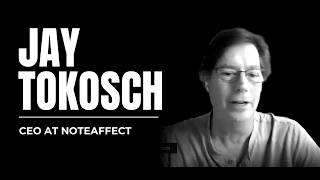
Jay Tokosch, a seven-time entrepreneur, built Note Effect after getting frustrated taking notes in back-to-back meetings. The AI platform captures and organizes content, targeting a $600 billion emerging market with 30,000+ event users so far. He bootstrapped the 10-person team and is now raising capital to scale.
Chapters
Welcome to another CEO Wisdom podcast. We have, uh, Jay Tokosh with us today. He's the CEO at Note Effect, uh, he's a founder, he's a growth operator, uh, in Baltimore. Uh, it's pretty rare and I often talk to Baltimore CEOs. And Note Effect is an AI-powered engagement learning platform, uh, transforming how education, corporate training, and events deliver content. Uh, so Jay, welcome to the podcast. Tell me a bit more about yourself and what you've been up to.
Yeah, thank you for having me on. Um, let's see, a little bit about me. 7-time entrepreneur, uh, this is, uh, my 7th company. My last company, CoreApps, was in the event space, conferences and trade shows, and sold that in 2019. Um, one of the unique things about us was, is that we were the first ones to do a mobile app in that space in 2009 when There was just the Apple 3G phone coming out and we had to create that market space in the event industry itself and it blew up from there.
Not your first company, right? So CoreApps that I see here, but you start— before we start talking about your entrepreneurial life, you were VP Sales, right? That's how you started your career.
Yeah, I was always in sales. I, you know, it's funny, when I went to college, I thought I wanted to be a developer. Back then, we called them programmers. And I found out real quick that I didn't like sitting behind a desk all day. I was actually good at development. But the company I went to work for, they were smart enough to see that I had a skill, being able to be a liaison between the customer and the development team. And so they moved me into having that interaction with the customer. And as we went along, I started telling the customer about new things that we could do for them, sort of in a sales role. And the next thing I know, it's like, well, if you keep doing that, we'll pay you commission. And I like commissions. So that we moved on very quickly from there.
Right. And what brought you from developer to sales role? Like, isn't that the opposite?
Yeah, it really, it really is. But I found that I like the interaction with people and, and I was good at the— I was good at the sales role. It came naturally to me. So I didn't like being behind a desk. I thought this will be a better way for me to go. And, you know, it's throughout my career, I think I collected a little bit of experience in every little area, you know, from that to, you know, moving into, okay, how does operations work? When I started to work for NEC, I got a good handle on that because I was managing 8 offices from Maryland to Puerto Rico. And there was a lot of operations piece to, to that position. So I gathered a little bit of those pieces along the way, which I think helped me in my entrepreneurial experience as I move forward.
Your first acquisition was in 2008?
2008, first acquisition. Well, I guess that was really sort of a starting piece. We, we were doing data centers at that particular time and we started with Edison Business Solutions. I realized from my customers that I was selling to and I was selling Cisco equipment. And I realized that that particular point that I was only selling one piece of that data center. And I wanted to be able to get into the data center early when they were thinking about building the data center so that I was set. And so what I did is I just started going out and learning more and more about how a data center was built and all the ins and outs of that. And so the next thing I know, we were selling parts of that, like APC equipment and specialized flooring, you know, the raised flooring, the fire suppression, the precision air cooling. And we just moved along there. And so what happened was, we became a very valuable piece to someone who was a manager of a data center, rather than trying to hire multiple vendors, they could just come to us and we could GC the whole thing.
And that acquisition, was it life-changing or was it sort of panic exit of like, I need to get the fuck out of here?
No, no, no, it was, it was life-changing. I really enjoyed it. We didn't have a lot of customers. We probably only had maybe 5 customers we would do a year and over the time frame, and then most of them were financial institutions. And over the timeframe that I did the company, you know, we never really— honestly, it was not a lot of hard work. It was a lot of knowledge, skills, and management skills to manage the whole thing and manage it on a timely basis. From there, the sad part to it was at the end was when it, you know, when the everything fell apart and people were not building data centers anymore during that timeframe, early 2008-ish, '09-ish timeframe, I had to decommission the data centers and I was selling the equipment that was in the racks and all the pieces for 40 cents on the dollar. So that was the, that was the sad part about it.
Came Core Apps, right? CoreApps, you launched it 2009, like right on the back of the crisis, right? How did that go?
So CoreApps was an interesting one because when I launched it, I was— I wasn't intending to launch it, so to speak. I had started another company called AV1 Studios where we were building a hardware piece, one of my first hardware pieces of entrepreneurship, and we were building a a, I guess you could call it a video audio server. This was before DVRs. This was, um, before Microsoft Sync and all of those. And so I had this idea of being able to take all of your movies and music and put them into one device and be able to stream them, uh, in multiple places throughout your house and in your car. And they could be different streams. And so I built a prototype And I was looking for funding to get there. And I was also looking for specifically for certain types of chips. And I went to CES because some of the manufacturers were there and I was supposed to have meetings with them. And when I got to CES, I found that they weren't in the booth areas that on the show floor that they were supposed to be in. And so I later learned that the printed maps were printed up a month or more ahead before the actual event started. And they were not accurate. And I said, well, there should be an app for this. You know, there should be an app for this. And we couldn't find an app. And I said, well, you know what, maybe we should develop an app. And so that's, we went down that road of developing an app. And the idea was sell it for $1.99, use that money to form AV1 Studios to be able to put that out there. And instead what happened was it became a full-fledged company, and I sold some of the technology off to the people who were working on the Ford SYNC, uh, company car, the car's, uh, technology inside of that, and never looked back. It was a great experience, right?
And that sort of led into Note Effect on the back of COVID Like, what prompted you to start that one?
So Note Effect was one of those things where I, you know, I did a lot of research. I— they say entrepreneurs build products that they need for themselves, and that was really my problem. I'd have back-to-back meetings all day long, and then at the end of the day, here I was trying to go back over my notes, and I was having a tough time with that and rolling out those initiatives. And 6 months down the road, I could never even find the notes, let alone that. So it was gathering all the content was one thing. Being able to recall the content was a whole different story. And when I started talking to people, they all had the same problem I did, right? People were trying to solve it in different ways, OneNote and so forth. And as things moved along, we were watching how the transcription apps were coming out— Otter, Fireflies, all of these different ones that were coming out, and they were great. And I was like, okay, well, that takes care of me writing the notes, but that doesn't take me to be able to recalling that information. Then we started seeing the brands like Microsoft, and here Apple's got a pendant coming out, all these other particular brands moving towards capture. That was fantastic, but now we have a problem with trying to find that information and retain it. I mean, it's kind of interesting because AI's not necessarily making people smarter. You know, it's accelerating the knowledge loss more and more because we're getting more and more data that we can't consume and retain. So that led me down the road to Note Effect, and it led me down the road of researching how people learn, right? Typically today, we're all learning via passively, you know, it's content to watch and notes are separate and everything else. And that's the least effective way to learn. The most effective way to learn is interactive, and so we wanted to make the content interactive. We wanted to bring that out and move that forward. That's really what got me started with Note Effect.
What's challenging about running Note Effect?
We're creating a new market. Once again, here I am creating a new market like the first time I did with Core Apps. This market doesn't exist today. The good news is, is that the visibility of the market from all the brands like Microsoft and Ray-Ban and Apple and Salesforce and all these others that are capturing content, um, that is there. And that's, that showed me that there, you know, is a market, $600 billion market actually. And we're looking to be that intelligence layer that sits below that that actually secures, manages that content, takes it from being fragmented, and makes it so that you can use it. Now, you can use our stuff to capture content too and do everything else, but, um, that's kind of where we are. And that's a challenge because, again, we're creating something that I think everybody will see the need once they kind of take a look at it, but it's also brand new, and, and you've got to educate people and make them understand how that all works together, right?
And your ICP, it's, uh, I mean, you have education, you have training for corporations and events. Aren't these ICP stuff to hit? Like education specifically, it's, it's very hard to sell to education buyers. Uh, corporations, it's sort of hard to get in their mailbox as well, but obviously it's easier than education. So what do you have to say on the the selling part to these people? Isn't it rocket science trying to get your product in there?
Education's hard. A lot of red tape, long sales cycle. Um, we've done okay with that in the, uh, private education space. Um, that, that's done really well. And, you know, one of the big things for us that, you know, people looked at us and said, man, that's scorched earth, right? I mean, you're trying to do everything for everybody. But the fact is, is that it's really our base platform just seems to fit all of those particular pieces. And we're actually using the event space as a sales wedge today to get to those enterprise customers. Right. They're coming to the event. We've got 30,000+ people using our product today at events. And that's, and that's a growing number. And when they're done using it, our goal is to convert them over to AgentAnswer and have them walk us in the door to the enterprise client, which is something that I think a lot of entrepreneurs miss, that, that particular piece. But that was planned from the beginning and, and part of our, our go-to-market strategy.
And you started your answer saying, here we go again, right? Like, do you have a love for pain or being in the arena as a founder? Why do you keep throwing yourself in there? It made me think of myself when I do these, uh, 100K+ runs, you know, and sometimes the, the thoughts crosses my mind, maybe that's my last one, right? Like, but I keep throwing myself again and again because there's something in there, right? Like, uh, what is that for you?
I think that's, that's, that's part of the entrepreneurial spirit that, you know, for us that have been successful in this is that, you know, we, we can't turn it off. We just keep going. And that's been my case. I have this process that I go through where I come up with these ideas and generally they're in the middle of the night, right? And I can't sleep and I get up and I write all the information down that I could possibly think of and remember. And then I take that idea and the next morning when I wake up, I look it back over when I'm sitting again and I, you know, it's a new day to see if it's still something that I wanna pursue. And what I do is if I do wanna pursue that, I start researching it, who else is doing it? What else is going on, you know, with regards to that? And putting it together. And I use something called the Mom Test. There's a book out there that basically says, hey, don't ask your mom or family relatives if they think it's a good idea because they love you. They're going to tell you it's a great idea. And that's not really what you want to hear. And that helps me put together sort of— I go through that process. It helps me put together the right questions to ask people to tell me if this is a viable idea. And I go through that process quite a bit, and sometimes it doesn't make it out. It dies there for one reason or another. And after I sold CoreApps, I thought I'll retire, go sit on the beach, play a lot of golf. I got bored with that really quick, and I found I didn't have a purpose in the morning when I got up. And it was— I said, well, you know what, I've got to go do something that's going to keep me interested and keep me fresh because I'm not enjoying this. And that was when I decided to go full bore into, into Note Effect. And yeah, it's a, you know, again, it's another let's start a brand new thing that doesn't exist in the market. But I felt really good about this because there were other big players who were driving into this market that was capturing it. And I felt like I had a good story behind it. Being able to put it together and utilize off of that.
You mentioned, yeah, having trouble turning your mind off. Is that a bug or feature?
I think for me, I enjoy it. I don't know that everyone can say that or everyone would say that. I think at times it is It is a bug, but I'd like to consider it a feature. I like to consider it a gift. Sometimes it doesn't always feel like a gift, but I think it is.
I think I suffer from the same bug, but I turned it into feature, right? I gave myself rules like no thinking of business before bed. I tell myself stories before bed, so it's still somewhat useful, like AGI stories specifically. Or other interesting warlike story because I'm a war type CEO on the battlefield for sure. Not recommended for everyone, by the way, because this would induce cortisol before sleep. In my case, it generates comfort, oddly enough. But I can relate to that constantly trying to map out the, you know, patterns and trying to understand this world and this reality. Do you feel that the best CEO and founder brains function that way? We think a lot about things, we question things, we compare things, we try to map out this reality to understand it better constantly.
I think so. And I think you have to not be afraid of what the answer might be, because if you're looking for a specific answer, um, I think that's a problem for you. And and it leads you down the wrong path. You have to accept what it comes to you and figure out how to, you know, like having a negative, well, this doesn't work or whatever, then you've gotta figure out how to make it work. And that's better than getting the positive, a false positive, I will say, to go from there. But yeah, I think if you're a good CEO, you're constantly thinking those things. And I think that's interesting that you said, I can't go to bed thinking about business. Read fiction before I go to bed. I cannot read anything to do with how you should sell better, any type of business. I— those times I read at lunchtime, those are generally my lunchtime reading pieces, um, they're my daily reading pieces. But if I do that at night, there's no way I'm going to sleep. It's not happening because my mind will start racing.
I used to dream about business and I would wake up like with my pillow doing a deal, you know, like it was that disturbing. And then it took me like 2 hours to get to sleep because my mind couldn't stop. And I think that's how— I'm not sure if you have a version of ADHD, but it's like the mind, uh, jumps step stones to one thing to another, right? And I think that's That's pretty much how serotonin and chain thinking works, right? It's like one thing leads to the next, and then you go into that rabbit hole, and then to this and that. And ultimately, I think that's how you find insights, right? Like, uh, but before sleep, it's toxic because us high performers, we suffer from not taking breaks and not caring enough for recovery, right? And I found that— I found that out about this the hard way, right? Like, you're just gonna hit a wall if if you don't sleep, if you're constantly thinking, if your cortisol is through the roof, especially nowadays in this world, right? Like with social media and all that noise left and right, it just comes at you in all directions. You really need to have a routine to recover, refill, and go at it again. What's your routine?
So my routine is— I now have grandchildren, so, so that routine falls into them where before I think it fell into other hobbies like music and things of that nature. But now that I have the grandkids, you know, we FaceTime, we do other things because they're not always around. But, but those are, you know, they fall into that routine that'll take me out of that. Right. And it's more focused on because they, they actually demand your attention. And so you, you do that and that'll, that'll take you to where you can calm yourself down, calm your mind down. Just enjoy that. Sports is another big thing for me. Baseball during the baseball season, hockey during the hockey season, football, etc. Those, those areas will help me, you know, focus, leave my focus behind for a little bit and, and, and recuperate.
Yeah, and humor. Humor is a good one, right? I started this, uh, these newsletters. Yeah, it's called Founder Humor.
Um, I've gotten a couple of those. Yes, and, and, and read them. I like the way that you do it because it, it drops it down, down, down to the next one, to the next one, to the next one. I like that.
Yeah, yeah, it's just like laughing once a day, right? Because I think as founders, we're like always super serious. And back then I don't know if it was like 3 or 4 years ago, I couldn't laugh really, right? I was taking everything so seriously. People would tell jokes and I'm like, where's the joke? It's like the, I had conditioned my brain to look at everything from a very rational and realistic perspective. And I think that's missing out and it's like way too much cortisol. And I think it's a good way to build culture as well when you can laugh it out with your co-founders and just people in your business, right? Like how big is your company, by the way? Like, and how's the culture there?
Yeah, so we're 10 people today, still very much growing. And the culture here is, you know, well, I have one of my sons working with us, and I have the other group of people that are working with me have worked with me before at CoreApps. So we all know each other, we know our families. I'm a big believer in work hard, play hard. So I don't want to manage anybody. I really want them to manage themselves, which, you know, the select group that I've got together that start this all know how to do that, which is fantastic for me. So, you know, they're not asking me for permission. They're more telling me, hey, this is what I plan to do and what are your thoughts? And I do the same thing with them. And it seems to work really well.
And what's next for you? What's the next, uh, big mountain to conquer?
The big mountain to conquer right now is funding. I've been funding this myself. Uh, I've been fortunate enough to be able to do that and bootstrap the company up to this point. Um, you know, when I built the company, like I said, I had a lot of— as, as you were talking about before, all the companies that you were part of, you learned something from each one of them. And I did the same thing here going into this one. I realized that, hey, You can't just— this is going to be bigger than what you can afford to do. So what you've got to do here is you've got to plan this out and you've got to build it in a way that you're showing a revenue stream, you're showing, you know, your, your go-to-market sales piece of this. You want to show them that they've— you've got users that are actually using all this, and here's how we're going to build it, and here's how we're going to plan it against the brands that are out there promoting the capturing tools that, that they're promoting behind it. So I learned to do all that, but I also learned, as you were saying here, is that with this company I can't be so always on. So I try to take during the summertime, you know, a little bit of time to go out and play golf with my friends, which I didn't used to do before, you know, um, uh, go visit the grandchildren for a day and do those kinds of things so that I don't miss out, because I I did miss out on those other things before. I was so focused on that, and I realized that I'm not losing anything by giving myself those pieces. And, um, and I wish I had done that before. But like you were talking about, you know, how you— oh, I gotta find humor, I'm gonna do this, I'm gonna do this newsletter, uh, you know, you realize that because you learned over the time why I can't just be always on. That, that doesn't work for me. It's not good for my mental health.
Yeah, not just that, but it's a huge product-market fit, you know. Like, I'm a product-market fit guy. Um, yeah, we're amongst founders. Is a deep need, um, and it's— there's not a lot of people serving that niche, right? And then Substack, it's pretty genius because it's like paid, right? It's so easy. It's like, oh, you get some free ones. If you want even more, then just like subscribe. Substack makes it so easy. So it's like product-market fit, distribution platform, check, check, you know. And let's see where that goes. Plus, it's Ikigai, right? Like, it's doing something that you love. And I love that piece of advice, right? When you start a business, you should launch something that you like doing by yourself, right? It's like, I— even if I don't have an audience, I would do this for free. Why? Because it's like healthy, is it, uh, it's fun, it helps me live longer, it's like a great way to connect. It's also like the last thesis on that one is that it's AGI resistant. Like, uh, although like ironically like AI makes most of this newsletter, it's also like super energy efficient, right? I don't spend lots of time, but humor is, yeah, it connects humans, right? And AGI super intelligence won't really like get it or laugh it out. It won't give it, right? And yeah, it's like connecting humans together, that thing. So it checks pretty much all of my boxes, right? If I invest in a business, I'm not sure how scalable it is. Of course it's a media company, right? But I'm just curious to see where it goes.
I think that's great. I've never actually looked at, at any of the, uh, AGR, um, any of the platforms and said, hey, can you tell me jokes, or can you write me a script for jokes, or anything like that. I don't know how— I don't know how it would respond. I don't know. That would be interesting to see.
You need to prompt it, but you know, GPT-5, and that was my measurement, oddly enough, or one of the many measurements I had for AGI. You know, like there's been a paper as of late that was deployed like 3 weeks ago about the definition of artificial general intelligence, but mine was like, how funny was it? You know, which is odd as well and is a bit stupid, right? Because all the team, all OpenAI had to do is like feed the large language model some humorous skits. But GPT-4 was funny. GPT-5 is quite really funny, right? It probably scraped The Onion and a bunch of humorous publication like that. And then the image creation is really good. I'm not sure if you've tried GPT-5, but—
Well, I'm on GPT-5 now and I just created an image today. It's funny that you say that. I just created an image today for a post that I did on LinkedIn. And you're making me want to go back now after this is over with and play with it a little bit to find out about the humor that you're talking about, because I've never really thought about that as I did it, but I'm going to try it now.
Yeah, and the thing, and I think that's how I'll finish like all my newsletter, is like any ridiculous situation you face as a founder, just feed it to this. And I'll turn it into something funny. So sometimes as founders, we're like resentful of like, oh man, this fucking guy, he crossed me the wrong way, right? You just feed this to the GPT and it just like makes a ridiculous version of it. Just like Harry Potter, right? Like the ridiculous, uh, uh, spell, you know? It's like it turns out, right, very intimidating into something.
Yeah, yeah, yeah, yeah, I know what you're talking about.
Okay, being a master judoka, right? Because as a founder, you're thrown so many hard and stressful and not fun situations. So you just like convert all of these into magic, basically.
I'm definitely gonna— I'm definitely gonna try this. I, I can't wait.
Yes, yes. Uh, Jay, thanks for being on today. Uh, where can people find out more about you and what you're building?
They can find more about me on noteffect.com, and Note Effect is spelled N-O-T-E-A-F-F. Ect.com. And if they go there, they can find that. And I'm also on LinkedIn. Last name's difficult to spell, you can see it on the thing there. But you know, if you put— type in Noteffect, I'll come up.
Alright, so I was Jay and Charles Cormier for another CEO
More from Charles




Founder Wisdom: the full audiobook (7 hours of quotes and stories from 600+ founders and CEOs)






