Mats Stigzelius - Managing Partner @ FounderFactor.com
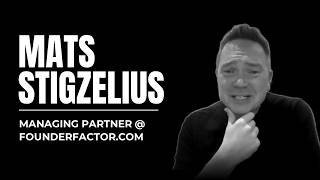
Mats Stigzelius runs Founder Factor, a fund that invests in Y Combinator startups using AI to screen founders and deploy $150-200k checks. He built the model on the thesis that YC produces top founders but European investors can't access them directly. The fund targets roughly 100 founders per year, betting on founder quality over product-market fit.
Chapters
Welcome to another VC Wisdom podcast. We have Matt Sigzelius with us today. Matt is the co-founder and managing partner at Founder Factor, uh, which invests in YC companies. He's also co-founder at Startup Bootcamps in 16 years. That's a lot of time. Co-founded a bunch of companies himself, including Raspberry. Um, so Matt, welcome to the podcast. Tell us a bit more about yourself and what you've been up to.
Thank you very much. Yeah, so, um, yeah, you covered kind of like the big bits. Uh, I've been a partner at Rainmaking for 16 years, and I mean, when we started it, we called it a startup factory because there really wasn't a right name for like startup incubators at the time. But yeah, we've built like 40 companies over the last 15 years. One of them was Startup Bootcamp, which is now like one of the largest accelerator programs in the world. I think we've had like 1,800 companies go through it. And about a year ago, we started Founder Factor with a specific aim of only investing in YC startups and backing the best founders coming out of each batch.
Where does the Rainmaking name come from? Is that a London thing or what?
So we were thinking more like making it rain kind of a thing, but like, now that you mention it, then yeah, it's, it's quite appropriate for, for where we live. There you go.
Yeah, that— and you first started your career, um, I'm gonna make you old here, but in, uh, '95 you started in the Finnish forces and then, uh, in banking and then in, uh, consulting, right, with McKinsey and JP Morgan respectively. So tell us a bit more about, like, your early life and how that did that shape you, uh, up to today.
Yeah, so I'm from Finland originally, so everyone in Finland has to do military service for, like, up to a year. So I did that. After that, I moved to, um, the UK to do a master's in aerospace engineering. I studied really hard, and then I never used my degree again. So I joined JP Morgan, then I joined McKinsey, and then I joined a private equity firm. So I did the— it's like the first 10 years of my career was basically your classic banking, consulting, private equity. And to be honest, I think had the financial crisis in 2008-9 not happened, I may well be now like, I would have been a private equity partner or something like that instead. Luckily it did happen and it kind of, uh, gave me the opportunity to start Rainmaking with my partners because it's been like the best 16 years ever. So, uh, yeah.
And what was your insight, uh, the moment you knew you had to start a venture studio-ish, um, or an incubator accelerator Because most founders just go on and found one company, right? You were like, I want to have many. Where did the insights to found your own incubator came about?
Yeah, so we kind of looked at it as like a shared pool of risk and reward. So, you know, there's a small group of Scandinavians and we are quite sort of egalitarian by sort of nature, I guess. We just thought that it'd be better to build 4 startups with 4 people, and if one of them succeeds, then we just sort of share the risk and reward. And we effectively had this idea of like, if management consultancies and law firms existed partnerships, we can kind of build a similar sort of a partnership that focuses on building startups. And It's a pretty unique idea, especially back in 2009, because, you know, we couldn't find anyone doing it and we didn't really know how to do it. But, um, we felt like it gave us an opportunity to, like, filter out bad ideas. Because if I would get excited about an idea, I'd have to convince the three of them as well, like, you know, if, if that was a good idea or not. Um, and if we all believed in it, then we would back it and, like, and build it out. So yeah, it was, it was— I think the fact that we're all Scandis had a lot to do with the fact that we did that instead of like 4 people just going off to build their own startups, right?
There's obviously one thing to say about product market fit. Maybe you have an expertise in that, maybe you have an alpha that, oh, the market wants this, right? But even if you have that idea, it's like, maybe this guy would be a better guy than me to execute upon it, right? So founder product market fit. Um, what success story did you have about Rainmaker, like, uh, give us examples of a couple of companies that really skyrocketed and actually panned out.
Yeah, so we've— it's— they've been, um, bootstrapped, most of them. So we, we don't have like a billion-dollar exit under our belts, but we've had about a third of the portfolio actually exit, and we've owned most of, most of the companies basically. So you know, even if you get like a good size exit and you own all of it, it's just, it's the same as having a huge exit and owning a, you know, a fully diluted bit of it. So, um, and we've been very lucky in the sense that we've had, you know, a, a high hit rate in terms of exits, and some of them have been quite good. But I don't think we've ever built like a household name as such, but we've had, um, you know, life-changing opportunities in terms of exits. And that's been great. But we also specifically built a studio that wasn't really building VC cases because spinning stuff out of studios is quite difficult in terms of like making them attractive for venture capital firms because by its very nature, the studio owns a lot of equity and the VCs don't really like that. So we just figured it would be better to be like, the, the majority shareholder throughout the whole journey, basically. And it's, it's worked out pretty well.
Interesting. And what led to founder factor, right? Like, YC companies obviously have a high strike rate. They're home to one of the greatest home runs, uh, in the world— Airbnb, uh, Dropbox, name it. You know, like, a good, very hard share of the strongest tech companies in the world nowadays have been in YC batches. What was your thesis? Why launch Founder Factory now in, uh, 2025?
So, um, couple of things. One was obviously we built Startup Bootcamp, so we know what accelerator programs can do. And if I'm honest, and I'm sure everyone at Techstars and everywhere else would agree, YC is just the best. It attracts the best talent and it produces the best startups. And the second one is that we've been angel investing for about 12 years now, and with mixed success because it hasn't been our sort of full-time focus and deal flow matters and everything like that. So like last, about a year ago, we just went like, where are the best startups in volume and where do they systematically come out of? Which program is it? And it's obviously YC, right? We then just decided that we wanted to build an investment platform that purely focused on backing the best founders consistently. So our aim is basically to back about 100 founders coming out of YC every year.
And are you the bridge to European capital? Is that your thesis? There's this guy, Gabriel Jarrosson, I guess, that's doing something similar, right? Like, is that the thesis, like giving opportunities to family offices in Europe to invest in YC companies?
Yeah, so we tried to do some direct angel investing at Demo Day a few years ago, and if you're a European angel, you're fighting with like several thousand other investors, and you, you know, if they come to you, you, you probably don't want to invest in them because like they, they kind of failed their funding round at that point, I guess. So, so, um, For European investors, it's been hard to get access to the top quality YC startups. And so we wanted to kind of, yeah, like you said, build a bridge that makes it possible for like, you know, European angels, family offices to have access to those startups. And conversely, when those startups then start scaling into Europe, you know, our, our network and our base can actually help them expand as well because, you know, you have captains of industry or partners at VC funds or etc. who can then open doors respectively wherever they can help, basically. So it kind of works both ways. But yeah, you're right, it's, it's that European aspect has been obviously key for us as well.
And have you deployed capital yet? I believe you already made investments. So how quick was it to get the fund off the ground? Did it take like a couple years legally, or to raise the capital? Tell me a bit more about the formation of it.
Yeah, so we, um, we decided to do it as SPVs to begin with, um, just so that we could deploy quicker. Um, so because, you know, raising an, uh, an LP-GP fund takes 18 months to 2 years, and, and we will do that eventually, I'm sure, but, uh, initially it was just easier to set up SPVs per batch so that we could just get up and running quicker. So the first batch that we did was Fall '25 in November, and then we, the second batch was Winter '26 now in March. And then we're obviously about to deploy the next batch of investment in early June to the spring batch. So, and we've done, and then we did about 44 investments so far across the two batches.
And it's $200K check size, right?
Yeah, so yeah, that's where we're going to end up in this upcoming batch. We did about $150,000 in the spring batch per startup, and we did 27 investments in the spring batch.
Interesting. And tell me about like the vetting side of things, like how do you decide to pull the trigger? Also the fund structure, it's you, your co-founder, and I think there's a bunch of other people as well. So tell me a bit more about the processes before you pull the trigger.
Yeah, so I kind of work for an AI, I guess, is one way to look at it. So not only do we invest in AI startups now, but I kind of feel like I work for one too. So we, so each, for those who don't know, like each YC batch at the moment is nearly 200 startups, 150 to 200, but they are towards 200. And so our thesis was that no human can actively due diligence 200 startups in a matter of weeks. And so we decided that, um, we should build an AI, um, selection, uh, uh, tool, uh, an AI model that would help us like shortlist the best startups. And based on the early stage of each of those startups, then it's obviously very founder-centric, and hence our name Founder Factor. So Effectively, we're looking for the highest quality founders and obviously founder startup fit in terms of what they're building. And we generate a shortlist and we then go and talk to those founders and then make our final selection. And that due diligence phase includes like YC alumni. So we have this like venture partner network of YC alumni who we bring into those meetings, uh, who then help us, like, because they've been through that process themselves as well. So mainly we're just like looking for red flags in terms of like co-founder fit and, and all of those sort of classic things that like complements the AI selection basically. But ultimately we trust the AI selection. It's been trained on a really comprehensive historical dataset. It's been comprehensively tested as well, and based on the first two batches we've done, it produces amazing results. So my job is not really to interrogate the founders, it's really just to kind of introduce us to them and then, you know, make minor filtering, but like mainly we trust the AI in the process.
Interesting. And can you give us a glimpse as the— as per the formula of that AI, like how does it scan the market and see if there's like an actual need, right? Because product-market fit is pretty complex. Me, I have a cold email machine that gives me real-time data of like what the market wants. And yeah, I'm pretty sure I'm like one of the only 10 or 50 guys on earth to operate on that level when it comes to knowing what the market wants. My specialty is also like B2B AI. I don't do anything that's outside of that. I won't do anything in health for now, right? Like, I mostly focus on agentic businesses, right? Um, which is also a pretty big field. But question is like, yeah, what are your criterias? How do you know if like this is gonna pan out or not? If we start with product-market fit, even before we talk about the founders themselves.
So this may be, may be slightly contrarian, but we don't really care about your traction at the point of investment, and we don't necessarily care that deeply about what you're building. Um, we, we obviously need to make sure that you as a founder are building in the right sector for your background, so, you know, there is that element, but specific solution and the product-market fit we don't really care about because it's, it's been kind of proven time and again that most founders, by the time they become the next Airbnb or Stripe or what have you, they've pivoted or at least have to change course once or twice. So what you're investing now is unlikely to be the, the business model that ends up succeeding. And the, the— so what you're really backing is the founder's ability to go from A to D, probably. So, and so it sounds kind of counterintuitive to, to make lots of investment decisions without actually worrying on founders, right?
This is great, but I don't know. Yeah, and pivoting always happens in YC, but like, what if you can back a, a, a horse that wins the, the first round, you know? And yeah, they may win the second as well, even if they need to pivot later on. Like, isn't the founder's ability to select the right market, right, like an actual good thing? And my thesis is I can recuperate them if they're good. I can even place them on an idea of mine for sure. But isn't it great also to back something that may lift from the get-go, especially to demanding investors?
Yeah, so I guess the sort of the filter, the way we would look at that is like, how investible is it for others? Because, um, you know, the SAFE note that everyone invests in at Demo Day is a post-money SAFE, and, and, you know, the startups tend to be raising $3 or $4 million, even more, $5 million at the moment. That's plenty of runway for a 2 or 3 person team to figure it out and then to start scaling the team as well. What we don't want to do is like have high conviction in a founding team that only raises $1 million because that doesn't give you enough runway to solve all of those issues. Whereas if you back a team that then goes on to raise $5 million with a strong lead VC and runway that gives them enough time to figure it all out. So where, where I think where the product market fit or the founder market fit really comes in is, do the more traditional investors who look at things from that lens, would they also invest in it, basically? So it does come into it, but it's only like 10 or 20% of our overall model, so to speak, whereas like 80% of it is like going really, really deep into the founders and like, you know, building out personality profiles and everything like that based on all like accessible data that we can build around them.
So then that begs the question, how do you quantify and qualify their personalities? Is it just taking the data that you have or you feed them the interview data? Like, how do you make sure that the founder is an actual savage?
So we, um, yeah, so, so the personality profile is the hardest one to pull together, especially because to actually make it validated, you have to do it for the 13,000 founders that have also gone through the last 20 years, right? So because even if you had like great data now, the AI training model, you couldn't backtest it to see if it's actually the right thing. So then, then you wouldn't be able to use it. So you can only use things that you can actually backtest as well. So what you can do is you can hoover up everyone's social media posts all the way back to beginning of time, basically, and build personality profiles based on what they've said and how they've said it. But if I'm honest, the personality profile is a smaller part than looking at like their sort of historical background in terms of like work experience, founding experience, raising money before? Have they, you know, built, uh, anything in the same sector before, or are they just completely into a new sector? All of those things collectively count. And, and interestingly, it obviously matters in what sector startup is being built. So if it's like healthcare or anything medical or, you know, scientific, then the founder profile is fundamentally very different than someone building a, you know, a D2C consumer product or crypto or anything like that. So, so we have to take into consideration like the founder fit to what they're building, including their sort of backgrounds as well. So, you know, academics matter a lot more in certain sectors, whereas they would like nearly count as a negative in some others where like, you know, the, the sort of the, the depth of knowledge would matter less versus experience in building something in that space.
Right. And give me examples of folks you've funded, right? I have your list here that you dropped like 2 weeks ago. Mendrall, Polymorph, Robbie, Carson.
Yeah, so Mendrall is my favorite example of that. So, you know, when you have the 2 founding engineers of Docker who then went on to build something else that was successful and now doing another startup in effectively the same space as Docker, I mean, if I'm honest, those founders didn't even need to go through YC and I think that they would've raised all the money they ever wanted basically. So we were very fortunate that they went through the program, the model just absolutely loved them and we were fortunate enough that they liked us enough to take our investment basically. So, but it is that, like, I mean, if you saw their founder's profile, It's just stellar. I mean, and on top of that, they're wonderful people as well. So, um, it's a, it's an, and like, we don't even need to necessarily look under the hood of what Menderel is building because we know that like they are, uh, targeting a problem space or solution space that they know intimately, and they have many millions of runway now to, to find the solution, and we know that they will.
Interesting. And out of all of these batches, where— like, how much do you expect to actually succeed? Is it the classic 10% power law? And, uh, are exit cycles shortening nowadays?
Yeah, so we think we can do twice as well in terms of picking winners. And I don't mean like unicorn hunting, but just like companies that don't die or like don't scale. Like, so the ones that like have breakout growth. We, we think we can pick them twice as well as effectively random chance at Demo Day if you were just a regular investor picking, picking at random. And like, that obviously turns into a portfolio that more than outperforms more than twice as well as sort of the average, average basket. Um, so I do think that they will— there will be— I don't think that there'll be that many more exits, but the exits that happen will be bigger. But then, like, so, so when one of the things that I get asked all the time is like, the entry price seems to be going up at the moment in terms of the SAFE node caps, and it has. We've even seen it in the last like 6 months. Um, but I would also believe that like the winners end up having larger exits, so therefore like the overall economics work. And that's why you can still compare the investments you make now to what you would have made like 10 years ago, basically.
So yeah, and don't you feel that the YC investment thesis is sort of limited because there's a lot of people jumping in to fund them and there's only limited amounts of companies or capital that they can accept?
Yeah, so, um, I mean, it's 200 companies raising about $3 or $4 million each, right? So it's, it's like $600 to $800 million every, every 3 months. And, you know, we, we, um, we tend to invest before Demo Day, and obviously a lot of the sort of more popular startups end up filling most of their rounds before Demo Day, or, or at least leaving the space for a lead VC, and then like the rest is filled by people like us. Um, but there's still capacity post-Demo Day for, for some of the other startups. So it's a lot of capital to deploy because the pool is so big. So I don't think that there's sort of a, at least at this stage where we invest, it isn't like a bun fight between investors. Um, but they do fill up and like, you know, if you're early enough, you get access. If you come a week later, you won't get access anymore. So it does tend to matter. Um, I, I think that the quality of YC startups, if anything, is improving, uh, at the moment. So like, I think it's like a great place to invest. I do think, like, as a side note, like, the Speedrun, like, so Andreessen Horowitz Speedrun is like the first worthy competitor to come out for a long time in terms of like quality of founders and quality of startups. So there are like, that's the one other place where I think you can find really interesting, um, you know, opportunities at the moment.
Yeah, I've studied Speedrunner a little bit. It was mostly on gaming companies initially, weirdly enough. Why do you think they're, uh, strong contenders? Just the A16z reputation? And why hasn't other funds not done this before?
Yeah, so I mean, I, I don't know them as intimately, but, uh, from what I understand, they, they moved away from like, so it started off as like sort of a gaming accelerator. They moved away from that. They used to have one cohort in San Francisco and one in Los Angeles every year. And I think they're just moving it to San Francisco now. It's become a generalist and the companies tend to be a little later than YC. So they tend to have like more substantial, like revenue base already coming through, a little bit more experienced founders. And the cohorts are smaller. They're like 60 at a time. Instead of like $150,000 to $200,000. Um, and then, um, A16z does about $1 million into the startups that it chooses to back, basically. So slightly larger ticket than YC's $500,000 as well. So, um, so they're slightly different, but like, um, it's definitely something we would look at as well at some point in terms of like doing a similar investment thesis into those startups, because based on what we can see, I think that they would be really high quality as well.
And do they compete for the same YC founders? Like, why would a founder go in A16z Speedrun and not YC?
I think, I think the good ones apply to both. And I know actually quite a few founders who have like applied to YC 3 or 4 times and only then get in, and then they end up doing really, really well. So I think it's one of those things where if you're a good founder, it's an accelerator. I don't think you would not be able to raise in the real world. I think that they just choose to go through these two programs because it gives you that network effect and the alumni effect that you, once you've been through it. So I think quite a few apply to both actually.
Yeah, maybe it's also chip on their shoulder from being refused 3 times and a strong desire to prove something. Maybe that's it, right?
I mean, that's a founder profile, isn't it? Like, I'll prove them wrong.
Yeah, it's like build up, right? Like, it builds up, and, uh, now, like, they absolutely, uh, think they value the application, one, and two, they value their time here. Sometimes it's also like more mature founders, right? So there's something to be said about that. Any tips on raising from LPs on your end? Like, what's your, your playbook for that?
Um, so obviously, like, you know, when, when you're raising LP capital, you have to be extremely careful about, you know, how you go about it because you're, you're governed by so many different regulations. And frankly, every country has different regulations. So, um, I guess the first rule of, like, raising is, like, you're not raising. So you're organizing events and having dinners and, like, you're, you know, and maybe the one thing you can talk about is your existing portfolio and the investments you've made and, like, effectively try and build a reputation on the of like track record and like showing what you've done and like use that as a honeypot effectively of like making people realize that what you're doing is, is quite good. It's hard when you've just like, you know, into your— you've only done 2 batches and 44 investments and you're 7 years out from your first exit, obviously. But like, I think what we do is slightly different than your normal fund. Um, so, you know, people like to talk about it and like learn more, so that, that works. But like obviously we can't do any marketing or outbound. We just have to sit silently and meet people, establish relationships. And it's a really, you know, I built various startups with short and long sales cycles, and this is like the longest possible sales cycle, right? So it's relationships and just patience, I guess.
What are your main goals for this year? What's next on the growth map?
Yeah, so we, we want to, um, increase our ticket size per, per investment that we make. So we, so we like the sort of 20 to 25 investments per batch, so gets us to about 80 to 100 investments per year. Um, like I said, in the last batch we did $150,000, and honestly we'd love to be able to deploy $300,000 per startup as, as soon as possible. So That's like sort of the biggest thing that we're like aiming to do because at that point you're really like coming in with 10% of the funding round for that startup. And I think that it just makes their lives that much easier. So I think they'll appreciate it. So we want to be as helpful as we can as investors to those founders and increase the ticket size.
There you go. Where can people find out more about you, Matt?
Find me on LinkedIn. That's always the best one. It's Matt Stigzelius. There literally is only one of me in the world. So if you can spell it, you can find me.
There you go. So that was Charles Cormier and Mats for another VC.
More from Charles




Founder Wisdom: the full audiobook (7 hours of quotes and stories from 600+ founders and CEOs)






