Millin Gabani - CEO at Worklayer
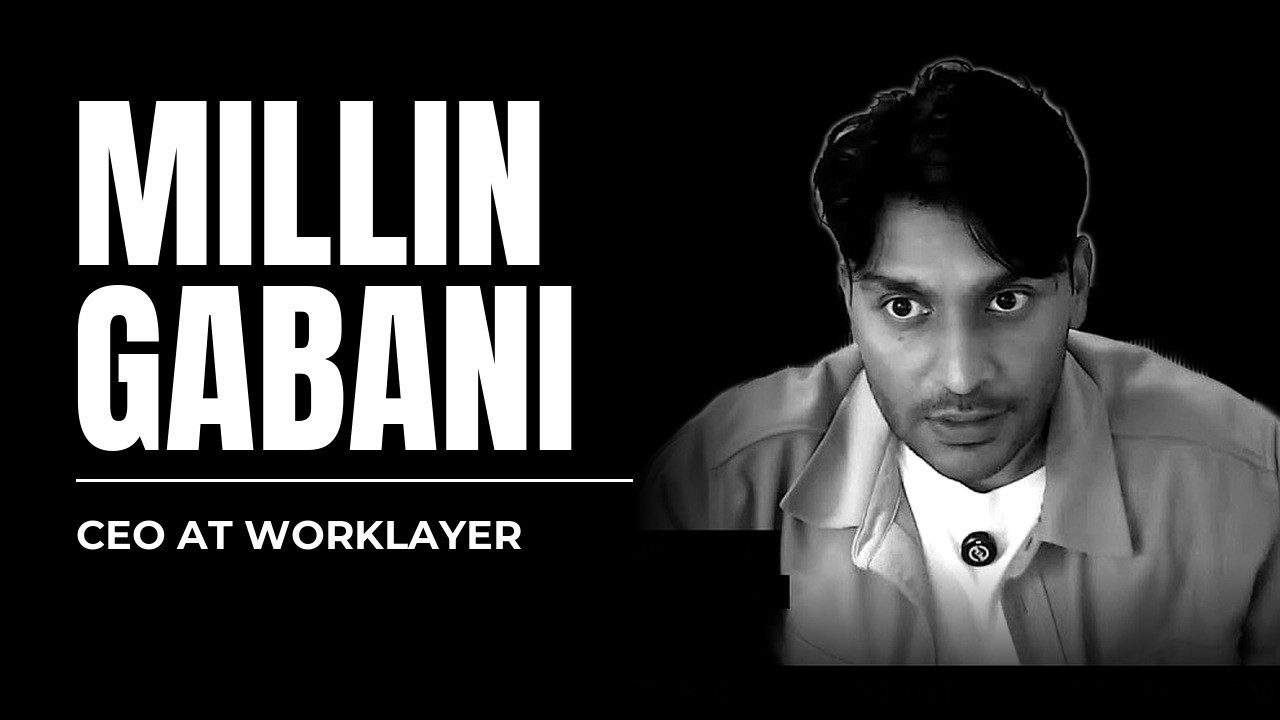
Milind Gabani built Worklayer, a platform that manages credentials and orchestrates AI agents for non-technical users. The product cuts token consumption by 77% and speeds up knowledge work 18 times. He's acquired 700 daily active free users organically and is piloting with three Series-A+ companies.
Chapters
Welcome to another Founder Wisdom pod. We have Milind Gabani with us today. Milind's CEO at Worklayer. It's one password for agents, interesting company. So educated at Waterloo University, worked at a bunch of interesting companies before, Pinterest, Google, and Fathom. So Milind, welcome to the pod. Tell us a bit more about yourself and what you're up to.
Hey Charles, great to be, great to be at this pod. Yeah, so we are building Worklayer, as you already talked about, and it's gotten some iterations of the concept. Like, you— we started building with this idea that agents need environment the same way they need environment for training. They need environment for when they're working as well, and when they're doing inference, basically. So we started with the concept that is the idea behind Worklear. It's the place where agents do the work. And as we talk to more users, the biggest pain point today, as you have also experienced it, we talked about it earlier, which was it's very hard for people to know or figure out what to get these agents to do for them. And that's even when you're working with the agent, but it gets even significantly harder when you're trying to set up background agents. So right now Worklayer's main focus is figuring out a way so that people can set up background agents very, very easily and find out like what work agents can do. So just talk and figure that out. And then second thing is how do you manage the work that agents are doing while you're sleeping, while you are, you know, out there riding a bicycle or in the park. You come back to your computer, you see all this work done, it gets overwhelming. So there is a great product surface there to be explored as well. So at WorkLayer, we're just working on these two ideas a lot recently.
If we start with your background before we talk about WorkLayer, you design and manufacture Formula Motorsport at University of Waterloo. You've started like physical engineering.
I was actually, yeah, I was in a mechanical engineering program. Before, in 2018, I— sorry, 2013, I joined Waterloo as a mechanical engineer. My internship at the Formula Motorsports team made me realize that I don't want to do mechanical. So while I was doing that, I realized that, and then I applied for mechatronics, and then that's how I ended up in AI.
Interesting. And you also interned at Shopify just right before they IPO'd, when they were in their major growth phase?
Yeah, yeah, Shopify was very, very exciting. It was my first, I would say, I had done the Waterloo Formula internship, then I worked at this company called Kik. I don't know if you're familiar with Kik. It was this messaging app, had 200 million users, and it was based out of Waterloo, Ontario, and I was doing UX design research at that company. So it was like very, very wide range, right? Like I went from mechanical, then I went into design, and then I did VR at this other company. And then Shopify felt like the first startup that was like stakes were very real. And because they were just like about to IPO, there was a big push for a bunch of projects. And I got to work on their core payments team as well as their API patterns team. So I interned there twice. It was a great experience there.
And what did you learn from all these companies before you launched your own?
Yeah, that's a good question. So all these companies were of different sizes, right? Pinterest and Google were massive, massive scale. Shopify was, I would say at that time they had 1,000 employees, so it's not small, Oh, sorry, Shopify had about 300 employees, Pinterest had 1,000 when I was interning there. So they weren't small, they were still quite big, but being at different sizes of companies and being able to work on core products for almost most of them, like at Pinterest, I also worked on home feed recommendation. So when you log into Pinterest, the first thing you see is the home feed of all these pins. Was working on machine learning algorithms for that. And then at Google, it was search infrastructure, right? So Google search product, the core product, I was working there. It was very interesting to— as an intern, you get shielded a little bit because you're working on school projects, but you're still working on things that are impacting millions and millions of people. And you realize all the organization structural that exists. And the reason that I decided to join a smaller team was because I wanted to learn a lot and not learn processes. So big companies were great, internships were great to get this experience of big tech, but I really wanted to figure out how do I become a founder? How do I, you know, put on multiple hats? And for that, I had to join something that was seed stage before Series A, and that's where I found Fathom Health, which was doing medical machine learning for medical coding.
Right. And you also experienced an exit firsthand with Phonak, right?
Yes, yes. With Phonak, I was brought in, two of my friends, Mitch and Ferris, were the founders. They went through YC about 9 months to a year later. They reached out while I was a tech lead at Fathom and joined as a product lead there, founding engineer, product lead, and I think about a year later, Phonak got acquired. So experience an exit there working on a product that's growing. Also it was in AI space as well, but this was pre-ChatGPT era, right? So things were very different back then.
And what insight did you experience to be like, oh, agents need a one password?
Very good question. Yeah, we were working on Keyflow before work layer. Keyflow was a workflow automation platform. It was canvas-based. It was very intuitive for our end users. And we were trying to figure out how do you make LLMs generally useful. And with Keyflow, we learned about a lot of problems that customers were facing. They wanted to bring some services where it would be a shared account. Sometimes they would want to bring personal Gmail and connect it to an AI, right? Like LLM model. And when we started thinking about how we connect and we manage our credentials, it was 1Password that most people use or something similar to 1Password. It's either your password manager in Chrome, Safari, whatever that is. And we realized that in the world where agents are going to do work in the background for you, most and more and more of work will be happening that way. It makes a lot of sense to give agents some sort of wallet, some sort of 1Password where they can, based on our grants and permissions, they can go and act on our behalf or on their own behalf if they have their own identity. And that is how we started thinking about Worklear in general. How do we give agents real-world access? Because without access, they can't really do anything. They're just glorified chatbots.. So that's how 1Password concept for agents was something that we doubled down on.
And agents serving business or SaaS, or even if it's not SaaS, but like businesses that serve agents right now, they have lots of potential, but it seems the market, the TAM is still quite small. Are you seeing that on your end as well?
So can you repeat the question a little bit? So you're saying agents that serve—
there's like so few agents, right? I think I read the, the TAM, like right now, for example, if you take like, uh, agents to agent take payments, right? Like building the infra to, um, for, for agents to interact financially, I think it was like $30,000 per day full-time. There's like so few agents, uh, interacting right now. Obviously it's going to be gigantic, right? Like $30 billion per day in like 5, 10 years from now. Are you seeing that you're like too early right now? What's your strategy? And yeah, how do you, how do you view patience on that level?
Yeah, I, that's a good question because I don't think I've experienced this phenomenon of TAM being too small right now. I mean, if we look at Anthropic, right, their run rate of crazy $96 billion annual recurring revenue, that is basically coming from their co-work and Claude code product, which are agent harnesses. So there is a lot of demand in enterprise. Maybe the transactions that agents are doing themselves are maybe very tiny because agents haven't built out— we don't have payment rails for agents to do transactions among themselves that well yet. But enterprises buying agents so agents can be useful for employees at their company is a significantly growing TAM, and it's growing at a crazy, crazy rate. Right now people are actually trying to reduce cost they're spending on tokens as well. Like, that's a big conversation around that. So we don't experience that, that much because our goal is to sell to companies that want to empower their non-development, non-engineering teams to set up background agents for their own work. And for that, we are not charging for data or services that the agents are using. We're mostly charging for giving you the platform. It's a very traditional SaaS platform business model.
Well, give me some stats then. Like, how do you acquire your clients? Who's your ICP, right? How much clients are paying right now? Give me some, a couple of stats.
Yeah, so we launched April 7th, which is the bare core product where we're doing our harness. And this product was supposed to be this one password for agents that you can bring to Claude Code, you can bring to Codex, you can bring to any, any product. That's a free product. The benefit of the product is once you connect your apps to this, you don't need to reconnect every single agent to your apps. You just bring connected to Worklayer. Worklayer gives access to all your agents at one go. You can control what your agents can and cannot do.. And the biggest one was the code mode. So agents can use, uh, write code, execute against our sandbox and do that. All of this was individual level product that is free right now. We have about, uh, 700 users actively using that daily.
How much?
700 users using that, like daily active users on that product. So it's, it's real, it's really good. It's, uh, it's one of those products where We saw a lot of just organic adoption. We didn't market it that much. Our second layer is putting Teams plan on top. So now entire teams can have their own 1Password. And that is where we are working with 3 design partners right now. And our sort of pricing structure is this way. We have a flat platform fee, which is anywhere between $50 to $100 a user a month. That's traditional SaaS market, business model and profit margins. Then we have credits-based if you want to use— if you want us to provide AI inference for you. And if you don't want to do that, if you want to bring your own inference, like let's say some company would say we already give our employees Codex subscriptions, so then they can just connect their Codex subscription. Every employee can connect that and they can just bring AI usage from OpenAI. We don't, you know, do anything in between that. So bringing tokens is a completely different problem that that we solve with a two-layer of pricing, two different ways of pricing. And then our platform fee is like basically how we make money.
Okay. And in the first place, right, if I use you, like, I'll consume— my agents will consume what, like 5x, 10x less tokens? How does that work?
Yeah, uh, the agents consume less token overall because there's three things that happen. So First of all, agents are very good at writing code, right? And let's say if you expose, if you connect your agents to Gmail, what really happens is Gmail connection is gonna give some tools to your agents, send email, draft email, read email, et cetera. Usually agents will call this one at a time until you get your results. With WorkLayer, they can just write a script on your Gmail application, and because Worklear is this 1Password with secure vault and all that, the code and the execution is run very securely. Agents never see your credential. Your credentials are in the vault and only accessed during runtime, right? And they are still encrypted at rest. So there's all this nice stuff about it because now instead of calling 10 tools, your agent only needs to call 1 tool with 1 script. You can already see how, you know, you are, you're reducing the amount of turns agent has to take. So that's like step number 1.. And second is context engineering. So every single tool call, let's say you need agent to find instances of fraud from this massive email database that you have. Now you can get your agents to, you know, keep looking at data and then keep calling your read email tool over and over again and then dump all that data. And that's increasing your context window. But if you are writing a script and you only return the values that you need, then you can— agent's engineering its own context, it's only returning the values it needs. So the token efficiency is much higher that way. So that's like the second benefit. It's like it consumes fewer tokens, which also makes it cheaper to use. So that's cheaper and faster, very simply, how that happens with code mode.
And is it one-fifth of the normal token use? Is it 50%? Like, how much less token in average?
It totally depends on the tasks. Like, let's say you're doing a task that's not using your apps at all, then Worklear is not really valuable, or it's even being used. But let's say if you're doing very heavy search tasks or very heavy, um, uh, research tasks on your apps and on your app's data, Worklear is very beneficial. So I'll give you an example. You want to send out 1,000 emails and you ask agent to draft those 1,000 emails personalized to each user, right? If the agent can just write a script for it, it's gonna be able to do that in 5 minutes instead of 500 minutes. And because of that, you can see that the percentages are very hard to calculate, but in general, we have in our internal benchmark, we saw 77% reduction in token consumption. And about 18 times speed up for tasks that are knowledge work tasks that people have to do day to day in their work.
Right, right. But your ICP is like coders, right? It's developers. It's not like to send emails that are personalized.
No, it is non-development use case.
Okay, non-technical people mostly?
It's knowledge work, yes. It's like work that happens in the office, customer success teams trying to find which customers to pinpoint and talk to, etc.
So, so what's your ICP? Is it a funded startup, founder, CEO? Like, who, who exactly do you target?
Yeah, we are currently focused on tech-enabled companies, companies that are using a bunch of software all over the place, companies that need go-to-market. So if they are setting up their go-to-market systems It's very easy to work with them to set up from scratch with agents. And the demographic that we have been finding a lot of product-market fit recently is customer success teams, because you can set up background agents that work for customer success teams that says, okay, this morning for this particular rep, you need to talk to these 5 people because they have experienced over the last 7 days these kinds of issues within the apps. And then you can go, the customer success rep can go out and improve that customer experience with that customer, right? So that use case, which is proactive customer success agent that helps companies reduce churn has been a very, very successful hit recently.
Got it. And what size of companies, like, because if they have a customer success team is like 200+ employees making $50 mil a year at least, right? Um, and mostly in technology, right? That would be tech companies.
Yeah, so our— we don't, um, do ICP based on revenue, but most of, like, the 3 pilots that we're working with all have over $10 million annual revenue, uh, run rate, and they're all funded, uh, in Series A+. So as we are navigating this landscape, we are trying to pinpoint it and Right now it seems a company that has above 50 people are the ones that actually see value in coordination of agents with their actual teams. The customer success example is where we are just, you know, talking like one— it's working for one pilot, and as we talk to other people, we're getting like people actually signing up for the platform more and more. So for that one, yeah, I would say more than 100 people.
And the 700 free users, how did you get them? Like, what's your preferred go-to-market method? Cold email or—
No, I just posted about it on Twitter. It went viral, and since then just kept posting and posting and posting and sort of built up a following of people who are interested in agent authentication and security. And based on that, it was originally developers, but As people started using more and more product, they recommended to other people and we have this Discord going on. So from there, like things were very easy.
And any other more scalable systems in mind to acquire users? Because posting on Twitter doesn't seem that scalable.
Yeah, I mean, we are not at scale yet. So like, to be fully honest, Worklear is just starting, right? Like we are working on pretty much laying down the foundation and it's still very much an engineering first company right now. We are not at the stage where we are founder-led sales. So we don't have a lot of go-to-market figured out yet. Our go-to-market is basically both founders offering to be forward-deployed engineers and interpersonal connections so far. I think our next step as we set out this new product that we are building right now in stealth, the background agents one, As soon as that launches, we need to go do more scalable things. But right now we are, we're taking Paul Graham's advice and doing things that doesn't scale because right now it's finding that PMF with the new product.
It's the best advice. 700 free users, how much percent should convert into team plans and what's the economics of the team plans?
Yeah, the economics of team plans are pretty good. I would, uh, the platform fee is basically SaaS margins. So SaaS margins are anywhere between 60 to 80% profit margins. So that's really great. We designed the product in a way where we didn't want to compete with labs. So if you think about Codex and Cloud Code and Cursor, Cursor has to compete with those products because their main product is the harness and Luckily, they now have SpaceX and Grok, so they are actually a lab themselves and they, they survived. But any company that's just competing with a product that is going to be with OpenAI or Anthropic don't have margins, right? Because those companies have inference, they have margins. For us, we wanted to be, first of all, find a layer of product development or layer of product that people would be willing to pay for.. So that comes with collaboration. As you have seen with Figma, with a bunch of other products in 2015 to 2025 range, a lot of products started getting popular because people could collaborate on it. And if you look at it today, Claude Code and Codex doesn't really let you collaborate with other people and other agents. It's just you and your agent. So that's the first way, first way of thinking about us, that that's where we can bring like really good, um, economics of, you know, getting that high profit margin as a pure software company. And the inference is something that either you purchase from us separately as usage, which is usually more expensive, or you can bring your subscriptions, which is subsidized by these big labs. And that is where we are not trying to make a lot of money. We are just trying to be this pass-through product where you can just use this in any intelligence that you want. And that's also a feature for a lot of companies because people don't want to get locked in into one or the other platform. They want ability to switch between models without having to worry about it too much. They want to cut down cost by quickly switching to an open-source model when things start working. So those kind of things really help us, um, as well. So I would say in terms of the business model, we see ourselves as a product-first company where we are enabling you to do more with agents. You can completely not use us, but you do miss out on the value of scheduling and orchestrating these background agents and reviewing that work, right? So that's basically where our value add is.
And 10% converting from free to team, is that the economics?
It's like right now, right now the free users, as you said, are more developer-oriented. Our goal, our strategy of offering the product for free initially was so that we could iterate and we could improve the product. We don't really want to convert these free users right now, but these are our lead list basically. As you were saying, like, what is the, what is a go-to-market strategy? One go-to-market strategy is a lot of the 700 users are from prominent tech companies in Silicon Valley, right? They're all people who are from funded startups. They're just testing out the product and they could become our champions. For the enterprise deals later. So our goal is to, as we go down to scaling things, we're just going to reach out to these users, talk to them about it. Hey, now we have a team product. Here's how your whole team can take value about value from it. Who should we meet? That is the, that is the strategy, uh, with these free users. We'll see how that converts, but, but we have a very high— these, these users really love the product, so we have a very good, good chance there.
Are you raising money? What, uh, what does the site look like on the fundraising side of things?
Yeah, we haven't started the process yet. We are not taking any checks at the moment. Uh, we probably will raise in a few weeks or so. We just want to first get this product in hands of our customers, which we have a few, uh, few already using it, and to get that feedback We want to learn what the product is going and not going to do for them, and then based on that, make that decision to raise. Our raising timeline probably looks around like September. If we do raise, that would be around that time.
And what does a day in your life look like, you and your co-founders? It's like full all-in products, like what, what does it look like?
Yeah, so for me, every day is just talking to people every day trying to work with them, what they want to use the product for. A lot of them are using it to build, like they just bring problems to it. So we have a forward deployed engineer, that's the product basically. You talk about your problems to it, it helps you say, okay, let me set this system up for you. And it sets the system up, then you use it for a few days and you review the work that agent is doing. You can give feedback. So you're, you're Basically we are building this employee that you can train over time and it helps you review work easily, right? So that's the core level, core product. What I do is talk to people about how well their problems were solved, where the agent had an issue, take that feedback, work with my co-founder Kush, and we both then, you know, over the evening, try to redefine like what improvements we need to bring in the product. So it's a very much like what people do at accelerators. They just talk to customers, they try to find patterns, they improve the product, and that is a cycle that we are doing day to day.
I love it. Where do you see the company 5, 10 years from now?
5, 10 years from now, I think here's what my vision is. It's very hard to think that far ahead, by the way, I think in terms of like a year, 6 months, because I used to be someone who would have a 5-year plan and then AI came in and it's very hard as you can imagine to even think where things will be. But here's what I know is going to happen in the world. In 10 years or 5 years, let's say 5 years first, a lot of the work that is done today in quote-unquote knowledge work, is going to be done by geniuses in a data center, right? That is something Dario has talked about. That is something people generally believe in who are leading AI, and I truly believe that as well by seeing things that these models can do. The bottleneck is good systems and good infra to make that happen, and good interface so people can check the work that the agents are doing. 'Cause at the end of the day, even in 5 years or 10 years or even 50 years, even if we have all these things doing work for us, you cannot make models responsible for something. Responsibility is going to fall on people, right? Because people are someone who you can make accountable. You cannot make models accountable. So what is going to happen is people will need better and better and better interfaces. To manage all the background agents that is being created, that is being built. So our goal as a company is to be that layer that makes it very easy for people to orchestrate these background systems. It goes from, I have this problem, the machine builds a system for itself, it starts running the system. You can then go and check what the machine is doing. You can inspect it, you can, you can, and you don't need to be The, the, the— if we are not the only company thinking about this, there's a lot of companies trying to do this. The difference that we are trying to bring is this doesn't need to be very engineering-oriented job. Everyone thinks from an engineering perspective. We are thinking from— we're taking lessons from Apple, right? Try to make complex things, package it into simple things so everyone can use it. And that is our core driving factor of how do we make these background systems so easy and so simple for people to understand and manage. And that is where we want to be, is like the simplest way to manage your agents that are doing work for you.
I love it. Milind, where can people find out more about you?
So I'm on Twitter under my username @trillhouse. And I'm also on LinkedIn under the name Milind Gabani, and you can check out Worklayer at myworklayer.com if you're interested. If you want to give your agents access to your tools securely, that's the best way to do it.
How is Milind and Charles Cormier?
More from Charles




Founder Wisdom: the full audiobook (7 hours of quotes and stories from 600+ founders and CEOs)






