Nicholas Loise - Sales Performance Team
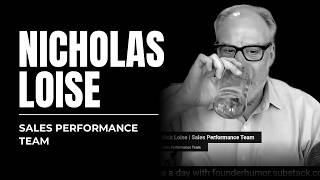
Nicholas Luisi, founder of Sales Performance Team, built his sales expertise through 1990s cold-calling and now coaches founder-led B2B companies. He argues AI can write emails but the real edge is consistency across phone, email, and LinkedIn. Post-COVID, Zoom made virtual deals possible but added more decision-makers, making storytelling essential.
Chapters
Welcome to another Founder Wisdom Podcast. We have Nicolas Loys with us today. He helps business owners create predictable sales performance by installing high-performing sales team and a sales management process at Your Sales Recruiter. Still owns a podcast as well, or did some podcasting, so that got my attention. And also a founder of Sales Performance Team. Team, right? So both of us share a similar background in sales. It's going to be fun. Nick, welcome to the podcast. Tell us a bit more about yourself.
Hey, uh, thanks for having me on, uh, and it's great. I appreciate you doing this. These are a labor of love, right? It's a lot of work, and you're— you've got a great team behind you, and yeah, it's a great show.
Yeah, produce unholy quantities amount of money with the podcast, but yeah, I also love it.
It's amazing, it's amazing, uh, and I got to listen to some of your stuff. You're a great host, so thanks for doing that. Nicholas Luisi, been in business, owning my own shop, working for companies, helping founders, worked in private equity. So all different types of things. Love the business game, always learning, right? Always wanna talk to really smart people like you because you could really figure out what's new and exciting and how to grow. I spend a lot of my time on the growth side. So really focusing on what's working today and especially in the AI world.
Interesting. So you said, uh, private equity. You mentioned sales as well. I see your first sales job here, VP of Biz Dev at Provena Mercy Medical Center, right? So that was stint in sales?
No, no, I sold before that. I probably just kind of edited my, uh, my LinkedIn there. So my first, uh, one was I actually was sold financial services. I was, you know, in a cubicle making phone calls, selling stocks, bonds, mutual funds, insurance, you name it, we sold it to people. So that was it. That was in the rough and tumble '90s. That's probably before you were even born. But that was the first sales job. And just learned a lot and had a lot of fun. And, you know, didn't know any better. I just did what they told me to do. And, and, you know, just, just pounded the phones back in those days. That's all you You know, that was one of the ways that we did it, but we did a lot of different things to get to a lot of different audiences.
It was also my first official job to pound the phone around 2015, right? So not the same days, but that shaped me incredibly, right? Like I was so immature and I don't know, privileged as a kid playing video games and I never had to sell anything to anyone and get out of my comfort zone, right? Had a super big ego as a result. And that just destroyed all of it, right? And it created the shell that I still have to this day when I get in front of people about not giving any, right? Like, if that doesn't work out, doesn't work out, no pressure, but brought unholy amounts of discomfort to me. How did that shape you?
You know, it probably had some of the similar, right? I think you learn to take rejection well. You also learn that people are people, right? And, you know, if you're just good and kind to them, they're gonna be good and kind back. And there's gonna some jerks and assholes, right? Excuse my French. We're live streaming, so I gotta be careful. But, you know, it's really good. I think it also teaches you kind of how to think on your feet. And I knew I wanted to be in sales, so I knew I kind of had to pick up the phone. And I think everybody should do it, even if it's just for a short period of time, because one is it's going to give you appreciation for what the salespeople in your organization have to do. But two is if you want to be a business owner, you got to learn how to do it. Nowadays, I see a lot of really bright people making good money knocking on doors. That would have been interesting, right? We pulled doors to introduce ourselves to business owners. But, you know, I think that would be interesting too. But no, it was— it shaped me. It was fun. I still think of those days. I think of them fondly right now. There was days where that phone stared at me, right? But I knew I had to do it, so I just kind of forced myself. And I think it's the first one is the hardest. The second one's a little easier. The third one, by the fifth one, you're in a rhythm.
It's pretty fascinating that new generations won't ever have to stare at the phone, right? Like, and I feel that also that's been like a nerve-shattering moment for me because a couple of years or months later, I launched my first agency, right? It was my first serious stint in the business world, aka something that generated, I don't know, over 5 figures, right? Per month. And how I got my first clients was realtors, right? Realtors do answer their phones.
Yep.
And their phones is like publicly out there for their clients to call. I would sell Facebook ads to them. And even though I was launching something with no safety net behind, I always knew that I can make money pick up the phone, right? And that's a powerful feeling 'cause a lot of founders nowadays, you know, they raise capital and all, and they're like, yeah, if this goes to shit, we're just bankrupt, everyone loses their money. Their money, and maybe if I'm lucky enough, I'll raise again. But when you have that skill, when you have that know-how to pick up the phone, you're like, no, dude, I can just pick up the phone. If all goes to shit, right, I can just pick up the phone. My case nowadays, more like sending emails and sell something to someone. And that's— that does amazing things for the mind.
I think you're spot on with that. I think it gives you a level of confidence that is bar none. I think you hit on two things. One is this— that ability to pick up the phone. The second one today, 2 is becoming a good copywriter so that your emails capture attention and get people to kind of lean in or do some level of action that you want them to do, right? So nowadays it's easier to send emails, right? You can instantly for $90, right? You're off to the races sending cold emails to, to— So there's a lot of different ways to get in front of people. And I think the skilled marketer, it's still the words you use, right? And how you use them and the way you say things or the way you write things or the the way you communicate things. So, you know, there is a natural, um, instance to— nowadays with AI slop, you know, a lot of emails are really, really bad. A lot of LinkedIn messages are really, really bad. So I think becoming good at that is, is a skill too. And it's interesting that you talk about both sides of that.
It's interesting because there's these things that go back now that AI is there. So emails written by AI are good, but everyone adapted to them and people know that they're AI. Based email and your point is, yeah, if you spend time, maybe prompt an AI to write like you do once you have a formula, but finding that formula takes a lot of time. But yet to your point, I think the market has demand for great email and odd email and great thinkers and copywriters and people that think clearly still do get rewarded a lot. I'm not so sure about the knocking on door thing. I mean— Yeah. Yeah, I know that people can be successful doing that. It's just that it looks incredibly energy inefficient, right? Like people would burn out if they do that enough times, but—
Yeah.
Isn't it fascinating? Like humanity, it's like it ebbs and flows. This technology comes and now people after COVID want people to knock on their door and talk to strangers. It's funny, right?
I think it's amazing. It's funny that you say that too. You know, like the pre-COVID selling world and the post-COVID selling world and, You think about now we're in home office. Hello.
Hi.
Hey, come on in. Yeah. Or, you know, the old days we used to have to go to an office, right? You sat, you know, amongst others and, or the field sales and how I was just on the phone with somebody. We have a recruiting company. So, I was recruiting for, and the guy is driving around, you know, and just about how I guess inefficient that is just, you know, just to be driving around and knocking on doors all day long. Versus, well, let's just figure out a different way to do things. So, you know, I think as the business owner or the person in charge of bringing in the money, you always gotta think about different ways to do it. And then what's the most cost-effective way? What's the fastest way, right? You know, 'cause it's all about speed. And, you know, so I think, you know, it's an interest, the game of business is an interesting game.
I thought about something wild, right? I'm not even sure why I'm sharing this, but like, if you're like this sales guy that, I don't know, wants to find a really good job, you take like the richest postal codes in the US, you knock on doors, you speak to, I don't know, 20 CEOs a day if you're lucky. Maybe some will refuse to speak to you, and then you're like, hey, I'm looking for a job.
Yeah.
What do you think about that approach? Wouldn't that be wild? And like just shortcutting the full recruitment cycle and getting their attention quicker. The challenge would be like to catch them at a time in which they would be at home, right?
You don't have to do it on a Saturday, right? Uh, you know, a Friday night and a Saturday. I think it shows gumption. And like, if you, if you were a business owner, wouldn't you hire that person even if you didn't have a spot?
Get my attention at least. They need to be good and not psychos, right? Yeah, the wine is fine, but, uh, yeah, they would certainly get my attention. And I don't know, if I'm chilling on a Friday night listening to music, I'm like—
I don't know, catch you with a couple cocktails.
I got more private, and I would probably like just close it on them. But most CEOs in their 50s, they would actually appreciate that.
Oh yeah, especially— I, and I think, you know, the CEO, but a business owner, a guy, you know, he's like, this guy's got moxie. This guy or gal, whoever's doing it, it's got moxie. And that's what I had when I started. So I think it, you know, it's, it's, it's anybody out there that's looking, there's an idea for you, right? Uh, and what's the harm? Eventually you're probably going to see some squad car pull up, right? Somebody's going to call on you. So you just got to have, you got to have your pitch prepared.
You pitch a policeman, hey, do you know someone?
Certainly there you pulled somebody over, that's the CEO. Maybe I could, maybe you could introduce me to them.
Oh man. Yeah. It's going to go into a rabbit hole. So you have the recruiting business, uh, You have the sales performance business. I think I want to talk more about the, the latter one, but generally, what have you seen change in sales in the, like, post-COVID, right? And yeah, how are you taking advantage of these, uh, market trends?
So great question. I think, you know, the first thing we talked about is the fact that Zoom, right, is a game changer for the way people sell, where people were doing, you know, now you don't need to be in front, you could really close high-ticket deals or large enterprise deals with a number of people on a video screen. I think that's the first thing. On the flip side of that, what we see post-COVID and especially now is that there's more decision makers on the buyer's side than ever before. And the financial buyer, the financial decision maker has the most amount of weight. And so, the smart sellers are figuring out ways to engage them and build really strong business cases. And sometimes, you know, the larger enterprise B2B companies are better at that. So the small business that's trying to sell to that buyer needs to figure that out. I think that's the first thing. The second thing that we see is that, you know, there's good and bad sales out there. And in this day with so much stuff, the bad sales gets amplified just as equally as the good sales.
Mm-hmm.
And so, you got to be on your game. You have to be good on your communication. The LinkedIn tools, you know, is phenomenal, but you have to be really, really good at that because inboxes are full, mailboxes are full. Nobody's really answering their voicemail, right? So, you got to really be good with your messaging and you got to hit them on all accounts. So, I think that. The third thing is I think if you're a salesperson, you really have to think as a marketer. Right? You got to be thinking about how do I break through and not just use the marketing stuff that my marketing department does. But how do I break through and really communicate and really position myself and my organization vis-à-vis everybody else? And I think the smart ones think about that. How am I different? What's my differentiation? What are my features? Because a lot of times, we're just kind of, you know, how does that relate to the benefits? And just really talk through. And then really be a good storyteller. I think you have to be a great storyteller. Talk about how other people have used your products and services, got success, and just think through all of that. So that's a long answer to a short question.
Yeah, no, stories is great. Who's your ICP? Let's start with that. Like, who do you work with normally?
Me? Yeah, we work with small to mid-sized businesses, probably founder-led, also founder-funded, right? So it's coming out of their paycheck, their pocketbook, their, you know, that type of thing. They built their company. They're all ages, right? So it's probably, you know, 30 to 50 we work with. We're in all different SIC codes by design, right? I never wanted to be, you know, dominant in one. We do service businesses, we do manufacturing businesses, you name it. We do a lot of internet businesses. So we're all over the board by design because we learn from all of our different clients.
Okay, and, uh, so you work with founders, you work with CEOs, uh, small businesses near where you are located geographically?
No, we're, we're, we're, we're international actually, and we have clients. I have clients in Hawaii, I have clients in Alaska, I have clients in New Jersey, so we're across the United States.
Got it. And okay, so the pain points they face most of the time, what are they?
Well, I say the problem we solve is most business owners do not wanna manage a sales team. They just don't have the time, they don't wanna deal with it, and they know they should. And so we help them by solving that problem.
Okay, and how do you fix these problems? Do you actually implement stuff for them or is mostly coaching?
No, we implement stuff first, right? So we try to put together a pretty solid playbook. Playbook is gonna get adjusted, right? Because the one you create on day 1 is not the one you're going to end up on day 90, right? So we kind of have to have real-time feedback from the team on what's working, what's not working. We listen to a lot of calls. We do a lot of coaching, right? Because that's really driving— that drives the sales needle. But you need a really good, strong playbook. You need a good, strong tech stack, right? So you got to really think about that. You got to have KPIs. You got to manage the sales process. You got to manage the sales system. And you got to constantly coach, right? Just like it's a sports team.
Got it. Is it purely B2B or B2C as well?
We do a lot of— most of our work, 90% of our work is in B2B. We do do some B2C, but that's usually we got referred in. I prefer B2B because it's easy. Usually their tickets are bigger and it's easier to add a zero to them.
What's your preferred playbook? Is it cold email?
No, it's everything, right? It just depends. Cold— we're phone first, right? So I do like the phone to be definitely be part of the playbook. I do think email is very, very important. I do think crafting really good messages on LinkedIn is also extremely important. So you need to have the entire cadence.
Okay. Um, the counter to that is like, if you do like a bunch of things at the same time, how can you do like one thing that's great, right? Like, that's a counter to omnichannel marketing. So what What do you have to say about that?
So I think that's BS, right? I think you have a solid message in a LinkedIn post is the same solid message you're gonna have in an email if it's really targeted to the right ICP, which is the same targeted message that you're gonna have in through the phone. Or even if you're in a booth at a trade show grabbing people in or the messaging in the booth to get 'em to come have a conversation with you. How do you grab 'em in 30 seconds? How do you grab the next 30 seconds? How do you grab the next minute? I think that's all about really having a solid value proposition that you can articulate to the right person at the right time. I don't mean— no disrespect to anybody that thinks you only do one channel properly, but I think a really good multichannel message is going to be the best way to bring it through. Now, there are those that are excellent at how to get deliverability, and I agree with that. You go to somebody that specializes in that. What's working today to get deliverability? What's working today to get the phones to pick up? What's working today on LinkedIn? There's different methodologies, of course, different tech, yes. But messaging is messaging in my opinion.
Right. How do you measure success in your clients? Do they come to you and like, "Nick, hey, I need 20 leads per month." What do you do if they—
Yeah, some of it's on the lead side, some of it's on the revenue side, right? Some of it's on deal flow. Some, you know, in the beginning of it's a long enterprise sale, it's really what is pipeline? How can we build pipeline? How do we accelerate, i.e., the sales velocity? Did we move things through the pipeline faster? Um, and what's our close rate, right? Those are usually the metrics that we're looking at. So what are we putting in top of the funnel? What are we putting in from a pipeline perspective? And what are we closing?
Got it. And is that like why they keep you around? Uh, your contract is at 3 months because you need to factor in the sales cycle, right? So how do you make sure to keep your clients around?
Yeah, well, we got to prove, right? So we say we buy, we buy your, we buy your loyalty and your business every 30 days. Uh, Just that. So that's how we do it. Usually the first 90 days you got to keep us around because it's going to take some time to build things out. And then after that, you know, it's a handshake deal.
What do you think about the podcast funnel in terms of sales and to use as a relationship engine?
I love podcasts. I love the funnel. I think everybody should be doing it. I— there's business development podcasts and then there's podcasts in general. The clients that I have that have really robust podcast channels or YouTube stations, those leads are the best because people will come in saying, I love you guys. I know I've listened to 5 of your podcasts. I know exactly what you do. So I think anybody listening to this should have that as part of their funnel, bar none. It's— In the old days, we used to write books, right? Now it's a really good podcast and a really good YouTube station or podcast channel. Couple that with a book. I think it's all about positioning and trust.
So books, there's a lot of them. Podcasts, there's a lot of them as well. I guess your point's like books on the closing and authority side of things. Like if people see you have a book, they'll give you attention.
Yeah, you get a little more credence, right? You get a little more attention. There's a book right behind me that I wrote that's over my shoulder. It's what I call an airport book, right? An airline book that you could read on a flight. You know, those are those two, right? You got to say, huh? Thin, right?
Yeah. The airport books, most of the time they're like self-help, right? And all that. What books do you read nowadays? What are your favorite books?
Man, it's a great question. I try to read a little bit of everything. So I'm looking at doing some acquisitions to buy other businesses. So I'm listening to some stuff about that and reading some books about that. I'm always reading marketing books and sales books, right? So like, you know, there's always an Amazon being delivered. Just because, you know, even if you get 1 or 2 good ideas out of them, you've made it. In the summertime, I try to flip a little bit more fiction, right? Because of the fact that you got to think differently for a little bit. So fiction talks about the human experience. Plus, a really good book teaches you the power of storytelling. So I'm reading Project Hail Mary, right, which is that famous movie that everybody watching. So I think, you know, it's a little bit of everything.
Interesting. The acquisition side of things, where did that stem from? You told me back then that you did some private equity stuff. Why do you want to—
Yeah, I worked with a private equity company. I kind of saw how they buy one company and then start buying other companies to lop onto it, either in the same field or in tangential fields or complementary fields. So it's a really, really smart business model and it allows you to kind of scale, but also allows you as a business owner to diversify. Because if one business isn't doing that well, or there's a cycle that's taking longer, you may have other businesses. So that's one of the reasons why I'm looking at it. It's one of the reasons why we started the recruiting company. So I'm looking at a couple acquisitions in that field, plus some others.
With your personal money?
Uh, I'll probably use other people's money on that.
What's your tips or tricks or thoughts about raising from people to buy specific companies nowadays?
Yeah, that's a great question. I think that founders, especially if you go to first wave angel investors, you know, those type of things, they're betting on you as the entrepreneur. So one is you wanna show that you have the ability to do that. Two is you gotta show that you have the moxie that you will succeed or at least try everything possible. You know, you said something when we first started, well, oh, there's people, I could bankrupt the company, I'll start again, right? They don't wanna see that because that's their money. So you gotta show them that you have that. A lot of times they're banking on the horse, right? So it's you, um, what's your success rate, how good are you building a team, how good are you at taking advice, all that good stuff.
It's a quick side note, isn't it funny that in Silicon Valley it sort of became acceptable to just have your stuff go to shit and not return the money to the investors?
I think it's a little different in the Midwest, right, in Main Street businesses versus that.
I think, you know, human being, right? Like, imagine, like, yeah, I would not go have my company go to shit and have someone lose $2 million on me. Like, I wouldn't be able to live with myself doing that.
Yeah, yeah, yeah. I think, you know, I think in Silicon Valley, especially when you talk about venture capital, they're making bets, right? So they're looking for one or two, one or two 8-baggers, and they know that some are gonna, some are gonna fall out.
Yeah. And to them, the counter is like there's no bad blood, right? Like, they can invest in founder, the founder can have a second streak and be extremely successful, right?
Oh, sure. Yeah.
And they don't have energy to spend to be like, hey, give me my money back or whatever, or I'm pissed at you because of XYZ. That's a, that's a fair point. Um, Nick, where can people find out more about you?
Yeah, they go to salesperformanceteam.com, right? They could hit me up on LinkedIn, Nicholas Luisi, or Nicholas Nick Luisi. Um, they could email me at nick @salesperformanceteam.com.
Now, is Nick and Charles Cormier
More from Charles




Founder Wisdom: the full audiobook (7 hours of quotes and stories from 600+ founders and CEOs)






