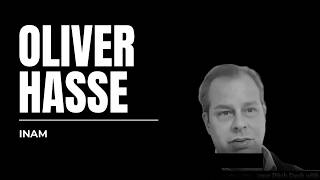
Oliver Haas runs ENAM, a Berlin accelerator for deep-tech materials startups funded by corporate members rather than venture capital. Alumni include Traceless, which makes biodegradable plastics, and a semiconductor company. The biggest problem for startups isn't raising money but scaling production with consistent quality.
Chapters
Welcome to another VC Wisdom podcast. We have Oliver Haas with us today. He's a managing director. He's about deep growth, deep tech growth and capital strategies, scaling startups and innovation ecosystem in Munich, Germany at Enam. Gonna talk about Enam and his background today. So Oliver, I'm glad to have you on. Can you tell us a bit more about yourself and what you've been up to?
Sure, absolutely, Charles. It's a pleasure to be on your show today. This shouldn't be so much about myself, but of course I'm happy to share a couple of, a couple of insights and a couple of details about my biography. So I work in a high-tech field without being a technically trained person, but I've always been intrigued and inspired by innovation and high-tech, or these days we say deep tech. All through my career. So I trained as an economist and also got an MBA along the way, but ended up in consulting, mostly high-tech enterprises in the field of IT, energy, automotive, etc., etc. The typical subjects you have in Germany. And at a certain point in time, I wanted to dig deeper into innovation and started working with startups. That was like a good 10 years ago. And then came across ENAM, the Innovation Network for Advanced Materials, which I'm leading these days, and started collaborating with them as a mentor and trainer for the startups. And I was particularly intrigued by the technologies that ENAM covers, which is advanced materials. Sounds super specific, but actually covers a wide area of things. Ranging from semiconductor to packaging, from applications in life science and healthcare to simple things like, let's say, plastics. So yeah, then I joined the organization a couple of years ago full-time, and I'm quite happy with that choice, obviously.
Nice. And at Inam, so you've been there for a couple of years now, 5 years. You also ran your own companies, you were managing, directing sales at Oceanis Ventures. What, what does a day in your life look like?
Well, I mean, it usually means getting up early, then getting on lots and lots of Zoom calls, particularly since, since the Corona crisis, i.e., since 2020, 2021, meeting lots of interesting people from around the world, both on the corporate side, i.e., which are looking for solutions, new solutions that are coming out of either universities or are developed by startups, and of course founders and researchers that, that work on these great technologies, these oftentimes breakthrough technologies. Yeah, and then of course it also involves a lot of traveling between Germany's two, let's say, leading ecosystems, i.e., Berlin, where ENAM is actually based, and Munich, where I am based. Um, so yeah, it's, uh, you know, no, no day is similar to the previous one on one level or the other.
And is it, uh, Germany-focused, or is it throughout Europe that you guys, uh, find these promising founders?
Even, even beyond, uh, I'd say global. Of course, certain regions are more strongly represented in the startups that we work with, but generally speaking, we have from West Coast US to Japan, from the Nordics in Europe to Africa these days, where quite emerging still, but quite strong deep tech ecosystem is evolving.
Interesting. And why decide to focus on deep tech? Is there like— is it the niche that's unserved right now? Does it have a moat against AGI and potentially superintelligence the next couple of years?
I think even though it might in the individual case not have the longest commercial lever, but in terms of impact, deep tech has much more to offer than the digital technologies that previously I also was focusing on. And looking at— talking about digital technologies, what I found— find as a distinctive feature when looking at deep tech is really that you have, in quotation marks, real innovation, i.e., you have stuff that's been developed for years in the lab and then is being slowly, slowly commercialized, which at a certain point in time also makes it slightly difficult in that you have much longer lead times or go-to-market times, and that means, of course, amortization times and when we talk about VC investments, that for a long time has really hampered the enthusiasm of VCs to invest in startups in our ecosystem, or more generally speaking, deep tech startups.
And what successes have you personally vetted and mentored, scouted? Like, what startups have you worked with that you've seen explode in that niche?
Well, we have a couple, and that also portrays a very nice or portrays very nicely the width of startups that we have in the network. So on the one hand, in terms of fundraising, the most successful one to this date, relying on data from 2025, is a company from Hamburg called Traceless, and they are basically doing a bio-based and biodegradable plastic replacement. Material. So they take agricultural waste, do some magic with it, and out comes more or less a material which is similar or has similar properties like plastics. Then another one, very successful one, a completely different niche, is focusing on atomic layer deposition, i.e., a production technology that you use in the semiconductor, i.e., chip manufacturing space. And they've revolutionized this particular process also by being able to reduce waste, by making the production process much faster and therefore much more economically efficient.
Interesting. And the full Enam program, you guys take a percentage of the company? Is that— no? Tell me what's the dealio.
So it's essentially and has been completely for free. The investment is the opportunity cost that, of course, the founders that participate must make, but we offer it for free. And of course, you know, the benefit is, and this is really also the focus because we are a network, the focus is on making the connections to potential customers, potential investors, of course, and experts that the startups might be needing along the way. So they go out with oftentimes a lot of new contacts to follow up with, but also with new ideas. We usually run a poll after the invest— after the programs, and it's quite a high fraction of startups that say that they are reconsidering the business model. That said, of course, there are not so many options when you deal with advanced materials, but there are quite a number of options and making them, having them rethink their strategy and their business model, of course, is quite an achievement and might also be contributing to their subsequent success.
So the government is in charge of this? Like, who pays for all of this, my question?
So we are a membership organization or association. Meaning we have members that support us who obviously have a keen interest in getting to know interesting startups for their open innovation pipeline. We did receive initial funding from the state government of Berlin. That was very helpful to get operations going in the first years. And occasionally we also work on publicly funded projects. So this is one way to get your projects funded. The largest share of revenue, let's say, comes from, from our members.
And do you believe the public approach to startup growth and fostering a startup ecosystem is the best way to go? If you look at Silicon Valley, pretty much everything is private, pretty much everything is VC funded. It's more cutthroat. It's winner takes all. And I think that gives them a moat. It's really hard to compete against a Silicon Valley company that's one, overfunded, with two savage founders that have thrived in this cutthroat environment. What do you think about that?
Well, I think you have to strike a balance. As for deep tech, there wasn't much, much public money— well, no, not much private money in deep tech a couple of years ago, 10 years ago, let's say, when Enum started. So I think it was very helpful to have some public money in that space to make it more attractive to external investors. That said, of course, an overreliance on public funds won't be helping in the long run, right? So eventually the market has to evolve and stand on its own feet, which in Europe these days is happening. If you look at the number of funds that emerge focusing on deep tech over the last couple of years, it's really impressive. Also looking at the amounts of private investments being funneled into that, let's call it segment. So there has been happening quite a lot. It's always the question, how much state do you want to have and until what point in time does the state need to be involved. And frankly speaking, looking back at the origins of the Valley, it was also actually tax or reduced taxes for investments that initially helped kind of the environment flourish back in the whatever '70s or whenever it was of the last decade.
Right. And tell me about the European ecosystem. Do you feel it has an advantage in the deep tech space of things, yes, the US, like, uh, how can you guys be much more competitive? Is it, uh, on the talent side of things? Um, yeah, tell me about the ecosystem there, because historically the European Union has been quite conservative with a lot of barriers with like compliance and all that. I feel government has been slowing founders, so tell me a bit more about that.
Absolutely. So I think what we, what we're still very good at in Europe is, uh, doing the fundamental research that then could be translated into products. But what we're not so good at is actually this very translation, i.e., due to— and you pointed to some points— regulation, lack of capital for a long time, fragmented markets, lack of, let's say, willingness to experiment on the side of the customers. We still have issues in terms of translating all this great research that's being done at the universities and research institutes into commercial— commercially viable products. And there is, of course, approaches to address many of these issues. For instance, public sector is looking to channel more money through procurement to startups. There is an initiative to have a a single entity that can cover all of Europe, as opposed to having to set up entities in each and every European state these days. And of course, then there is regulation which is actually also creating markets. If we look at, for instance, the Green Deal in the past, which has put a lot of emphasis on essentially fostering technologies that support in the energy transition. And many other aspects that are covered by the Green Deal. And currently, of course, all the government money that's being made available also creates a massive rush in the space of defence. So, and that also trickles down to the environment of startups, or the level of startups and VCs.
Tell me a bit more about the defence side of things. Yeah, with Russia, with Iran now. Are you seeing like more of these startups yet? Like, have you gone— have you had some startups in your program, your portfolio right now? How are they building different stuff than what is happening in the US that has a gigantic funding machine, right? Tell me a bit more.
Yeah, so in terms of startups that we've had in our portfolio, let's say, or in our programs as alumni, I first should say most of these, of course, are B2B and they are not at the system level. they're at the input materials level. So they do conductive inks, they do the biodegradable plastic that I've referred to, etc., etc. So looking at them, many of them at the moment discover the public sector as a potential customer through the defense spending that is available. So they start to target this part of the market. More generally speaking, what we've been seeing in recent years is a massive focus and I think also a massive increase, although I don't have the specific numbers, in the number of drone startups that are operational. And that is what at the moment works really well operating at the systems, i.e., complete product level. Or let's say it might not work best, but that's the most visible development that we are seeing. But of course there's other stuff, um, going on.
And your specific role at Enam, uh, do you do sourcing? Do you do just spending time with founders, coaching them, helping them, uh, with GTM and fundraising? What do you do specifically?
So, I mean, in our programs as well as in our other activities, what we're trying to do is find best matches. I.e., get the right startup together with the right company and the right investor or right expert, whatever the needs of the individual parties are. So we do a lot of scouting and sourcing. We do a lot of talking to startups. We do a lot of talking to our corporate members, of course, to understand their needs, their changing needs. And finally, also, that is kind of, let's say, the overarching role. We're trying to lobby for our particular kind of deep tech and the attention that is needed in that space, which in recent years has obviously become much easier when we look at the question of semiconductor supply chains and the political reactions to that. When we look at also now defence tech, when we look at, as I said before, green technologies in the energy field, It's all areas where advanced materials can play a massive role in the transition. And it might be complicated through the geopolitical situation that we have at the moment, in that again, supply chains are interrupted. Raw materials might not be as readily available as they should be, but that turns the whole discussion towards thinking more about resilience, building resilient supply chains, and that can partly also be done by, you know, finding replacement materials for something that otherwise you would have to dig out in whatever, the Congo or somewhere in China and elsewhere. So if you can grow a similar material in your lab at home, that's of course then making you much more independent than, than with the previously integrated or internationally distributed supply chains.
And your port calls normally, uh, what is the greater challenge? Is it building the product? Is it go-to-market? Is it actually fundraising in Europe? Like, what's the greatest challenge they face?
Usually it's usually the greatest challenge, I would think. So 10 years ago I would have said fundraising. Now I would say getting the product to scale. Because, you know, it's one thing to make something happen in the lab once, it's another thing to make it happen with exactly the same precision 1,000 times, but then it's yet another thing to do it to produce whatever, 50, 60, 100, or whatever, 1,000 tons per year of that very same materials. And then certain industries, certainly also the defense space, but automotive, which is of course also quite an important sector in Germany, and of course semiconductor, the semiconductor industry. They are very, very intolerant to, let's say, variations in quality. So you really have to hit it hard and exact when you produce. And that's something some say that that was actually the point or the reason why Northvolt, the battery startup, at the end of the day failed because they couldn't, they didn't manage to produce on the, on a consistent quality level.
Who's the ideal profile of a deep tech technical founder, right, that you're looking for? And is it a two-person team, one technical, one non-technical, like What type of profile are you looking for?
So the ideal typical founding team, of course, is one technical guy, one, let's say, more commercially minded person. Um, but, but we've seen also teams succeed that completely consisted of technically inclined people, but let's say that's rather the exception. And the, the, the rule book or the playbook generally says that you want to have a good mix of, uh, uh, competencies and, and characters also in your founding team.
What are your goals for the remainder of this year? What do you want to achieve?
So we'll be, uh, looking for startups for our program, which is going to be running in September, um, starting sometime this summer. Before that, we're running a couple of what we call qualifiers, which are essentially starter, uh, small competitions, which we run with partners. Where we're looking for startups in particular areas, and the winners of these qualifiers will then get a wildcard to our general program, the Advanced Materials Competition. So that's the big thing that we are about at the moment. Apart from that, of course, we're always very interested to hear from startups that are involved in anything to do with, from a material science perspective, anything to do with electrification, novel electronics, future of compute, and of course, and that's a new topic for us, AI in the lab for materials discovery or maybe even just characterization. But there's a strong, strong movement in that part of the market also.
Well, Oliver, thanks for being on today. Where can people find out more about you and your company?
Well, I mean, the best thing is to either go to www.enam, or I should say inam.berlin, or else look us up on LinkedIn, where we have a very active channel. And finally, we also publish a podcast where you can hear more about our startups, which is called Startup the Science. So these are, I think, 3 channels which help you to find out more.
Was Oliver and Charles for another
More from Charles




Founder Wisdom: the full audiobook (7 hours of quotes and stories from 600+ founders and CEOs)






