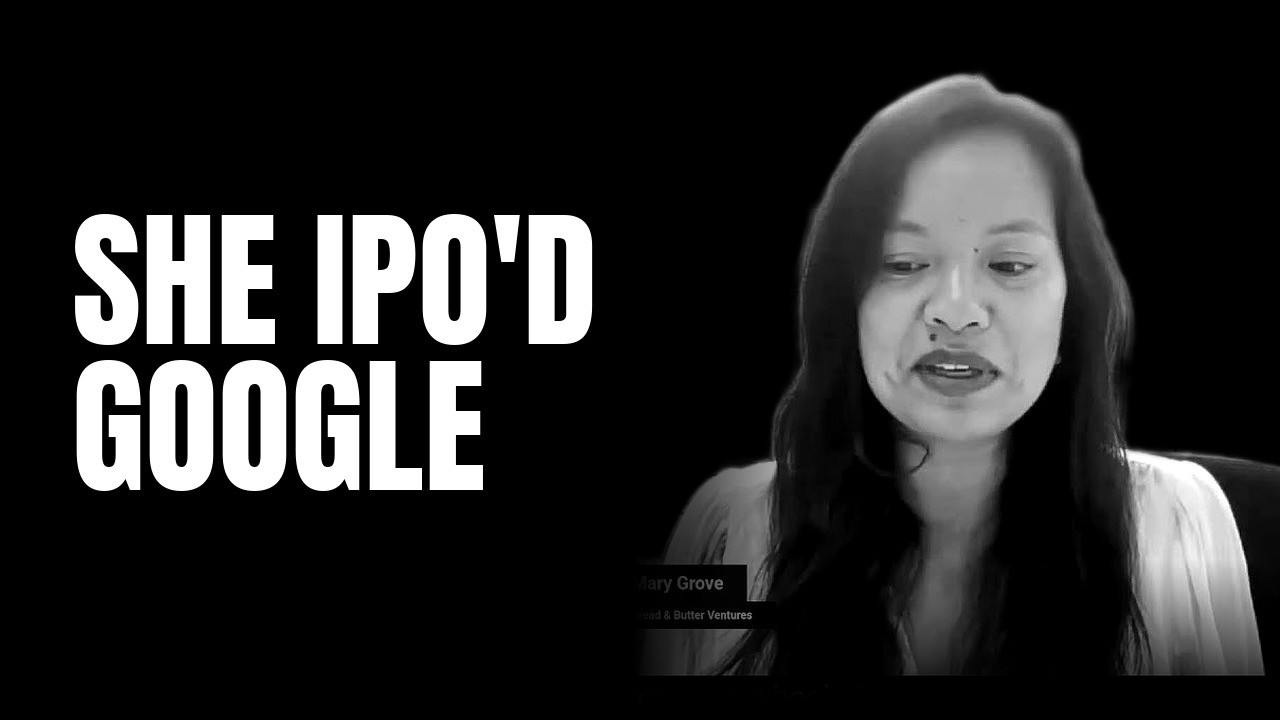
Mary Grove worked on Google's 2004 IPO and spent 14 years building investing infrastructure there before leaving to democratize capital access. Now managing partner at Bread & Butter Ventures, a Minnesota firm with $40 million, she invests nationally in food tech, healthcare, and enterprise B2B, with half her LPs individual investors rather than institutions.
Chapters
Welcome to another Founder Wisdom Pod. We have Mary Grove with us today. She's a managing partner at Bread Butter Ventures that does a lot of interesting things, but amongst others contributed to the Google IPO. That was a long time ago, but what an exciting moment that was. So Mary, welcome to the pod. Tell us a bit more about yourself and what you're up to.
Charles, thanks for having me. Big fan of your show and excited to, to be here and Yes, happy to share more about our work. Just to briefly introduce myself, I've spent my career the last, you know, 20+ years in tech and early-stage investing and absolutely love getting to spend time there. Chapter 1, as you, as you mentioned, was the tech chapter at Google where I got to spend 14 amazing years between working in Silicon Valley, New York, Zurich, back to New York, and back to Silicon Valley, and had a few different roles there, including as you alluded to, working on the IPO deal team when we first went public in, in 2004. And then I spent about 6 years doing early-stage product partnerships and business development with a lot of time in emerging markets and emerging market expansion. And I mentioned that because I am really passionate about go-to-market, biz dev, when working with companies after we invest. And then my last chapter at Google, I got to really help build some of the early investing infrastructure and built a team that is today called Google for Startups, but it was broadly thinking about how do we bring, you know, empower the next generation of Googles, essentially, of startups to be launched, grow, scale. And that included some work in investing, in looking at working with funds and building startup ecosystems in over 100 countries. And so my perspective that I bring is very much about democratizing access to capital to more places and going, you know, working with early-stage companies. So That's chapter 1, and chapter 2 has been still that same through line and that same mission, but through the lens of venture capital specifically. So I've been— I was an investment partner at Revolution, which is the firm started by Steve Case, the founder of AOL, as a partner on the seed fund, which was called Rise of the Rest seed fund. And for the last 6 and a half years, I've been helping build our firm now, Bread Butter Ventures, based in Minnesota investing nationally and leaning into the really core sectors of strength here in our local economy, which is, these are global companies, right? In healthcare, the food system and enterprise B2B tech generally. So excited to chat today.
Yeah, well, let's start with chapter zero. So your parents were Thai immigrants?
They were.
So how, what's their story and how did they come to the US? How did that grit transferred into you?
Oh, I was so privileged to have the parents that I grew up with. And my parents were both from rural villages in Thailand, grew up without electricity, just very, very scrappy immigrant story. They each came to the US separately. My dad via the Vatican where he was studying to be a priest, my mom as a nurse. And she continued to be an operating room nurse for 25 years. But they met in the US. So came separately, married, had 3 children, and the second of 3. And I grew up in this, this scrappy immigrant entrepreneur family where, you know, we always had family businesses, my dad's clinic, um, but the imperative, the scrappy imperative to build and to— for survival, frankly, but also for the purpose of, of improving, um, healthcare and improving lives. And it was really inspirational, and I I have so much gratitude to them. It really catapulted me into who I am. And I just recently lost my— my dad passed away in December and my mom died 11 years ago. So, you know, experiencing this incredible tumultuous world shift of having neither parent here, you know, it's very timely. It just makes me reflect all the more on the work that I'm lucky to get to do and kind of try to carry that legacy for it a little bit.
Priest at the Vatican, that's so wild. It's like first time I—
he wasn't ordained, so he was studying. He was, he was in the seminary in Thailand and then was selected to study in the Vatican and was on watch.
And, um, changed his life.
No, it did, it did. And I, you know, I'm named Mary, my brother is named Joseph. We have the strong, uh, religious foundation there.
Right. How did you get into Stanford? Like, uh, was it Tiger, typical Tiger parents? Were you like always studying and all about the excellence back then?
Or no, my parents were, you know, they deeply valued, I think given their, their own immigrant journey, they deeply valued education as a privilege, not a right. And I, you know, I, I grew up with that certainly, but they never pressured me. Around anything in my life. I was— it was always a joy to know, just to pursue the profession you want, to, you know, marry the person you love. And just, I feel so grateful for that, I can't even express it. But I was lucky to grow up— I have an older sister who's 5 years older, had been a big inspiration. She was, you know, she was a straight-A student, just kind of made it look effortless. And I, um, completely idolized her. So I think that was one, having a good role model. But two, I learned a big lesson early on, which is You know, if at first you don't succeed, try again. I, I did work really hard in high school and I thought things looked pretty good on paper. And I really wanted to go to Stanford because I, I grew up in San Diego. I loved California. Um, I didn't get in and got into a lot of other wonderful schools who maybe were more similar, but I took a bet on doing something different. And I did my freshman year at Fordham University, a Jesuit school in New York. And, you know, I fell in love with New York City and it opened up a whole nother world for me, but I ended up having that dream. I still had that dream. So I applied to transfer as a sophomore to Stanford and I got in. And so I think the life lesson for me is I actually had, I'm convinced, a much more impactful experience as a sophomore transfer than I would have out the gate because I knew how much I wanted it. I knew I wanted the campus life. I knew I wanted the community. Incredibly involved right away, ran for student government the next 2 years. You know, the things that, um, like when you have adversity or you just have a lot of clarity, there are a lot of parallels actually to, uh, to the entrepreneurial world.
Yeah, lots. Um, how did you get into Google? 2004, they were like this young scrappy company. I think they got established in 2000 or something like that. So tell me about that story as a Corporate securities legal assistant.
That's right. So back to Stanford played a big role. I think so many of the best things in my life have been nonlinear and unplanned. And so went to Stanford, studied what I loved. I love international development and I had studied sociology, international policy, just the study of people, of history, of places. But ironically, you know, in the backyard of tech in Silicon Valley, So senior year of college, I'm applying to law school because that was what I thought I would do. I didn't really have a— I hadn't really thought through the why as much as the, this is the path I'm on. And all of my friends were interviewing on campus for, you know, a lot of companies come recruit on campus. And I just got a little FOMO and thought maybe I should be interviewing at least, at least for practice. Let's go, go to the career fairs, do some interviews. And I ended up interviewing with with Google, and it was the first time they had hired a legal assistant cohort, a new program where there were 8 of us all coming fresh out of school, and we were staffed in the different departments of legal. So there were corporate securities, intellectual property, commercial contracts, and I was, you know, enamored by the interview process, got the opportunity. Google was lesser known then, but it was— I remember this, it was the around the time that I was interviewing that Gmail had just launched. And as part of my interview, I got one of the, the early beta invites, and I thought it was just so neat to be able to share that with my family. And long, um, long story short, but ended up taking the leap and thinking, I'll do this for one year on my way to law school, and fell in love with the company and didn't want to leave.
And Larry and Sergey were very active, um, back in these days. Uh, what was the How much was Google making when they IPO'd in 2005? Were they already a billion-dollar valuation or much less?
You know, so the company IPO'd the summer of 2004, and interestingly, nobody really knew how well they were doing. I have to go back and look, but I think it was around a billion or so. I mean, it was, it was quite pretty scaled at the time, but at the time the revenue was was coming from Search and Ads, right? And then you, over the course of the next decade, you came to know all these other products, Maps, Gmail, Google Docs, the whole Google suite of tools. Then you got into the cloud. You know, it's just been this massive evolution where what really drew me to Google was the mission. And the mission, which every employee could recite from heart, was to organize the world's information and make it universally accessible and useful. And what was powerful about that is that's so broad and so encompassing, and it could— it was such a built-to-last mission. And, you know, I've been gone from Google now for almost a decade, but I think that still holds so true as a North Star with all the initiatives today around AI and the future and cloud computing. And so I think that's important, right? Have an expansive vision that stands the test of time.
How big and how successful was the IPO, and, uh, how, uh, instrumental were you in that, uh, IPO of theirs?
Well, I mean, I was thrilled to be a part of the team. I specifically was on the, the legal side and the corporate security side, and I had just a lot of really great memories. I mean, I just started and was— we got to spend, you know, 7 days a week long, long days on site and really got to know a lot of the team pretty well and get into the business. The IPO was remarkable for a few reasons. One is the actual process of the way that Google chose to go public through the Dutch auction model. Again, back to this notion of, could we democratize access to things and let, you know, the idea was we wanted to let the school teacher from the Midwest buy into the IPO alongside all the bankers and institutional investors. And I think that just, that spoke a lot about the approach, but it was successful. It went on to be, you know, has gone on to maintain shareholder value over time. But yeah, some really great stories. My role specifically was on the corporate security side and kind of helping to work on, bring some of the early investors on board, for example, to sell in the IPO itself. And so lots of good memories, but it's, it's been a long time now.
What happened after your 13 years there? 13 years, like, so much time to work at a company, but you're probably the second or third person I speak to this week that spent that long at Google, of all places, right? Because I think Google was genius level at retaining employees, or so good. By fostering entrepreneurship, taking care of them. And I don't think they had competition back then. There was no companies like treating employees as good as that. What prompted you to leave?
That's a great question. You know, I never, I never felt— it was a very hard, hard decision to leave. I never felt like I was running, seeking something else, or running away from something, so to speak, as much as it was time for it to approach things from a different chapter. And so I was We had been living in Silicon Valley for, I'd been back in my last chapter there from 2010 to '18, but a lot had happened. And like you said, I think one of the reasons why a lot of Googlers, as we call ourselves, stay is because you can really have such distinct career chapters within the same company. And you know, it's, there's a lot of growth opportunity for people. So at the end of my time there, I, you know, I had been thinking about a shift And that could have been within Google for all that I knew, but I was really getting more and more immersed in the venture side and the investing side and working with early-stage companies. I knew I wanted to do that. And candidly, so my husband and I got married. We also met through Google. He was early at YouTube and then built a team at Google called the Google News Lab. But we had a wonderful life out in Silicon Valley, and we just had our son and daughter. I have twins. Who are now 9. And Steve, my husband, is from Minnesota, and so we have on his side a massive family footprint in the Midwest, dozens of people. It is really— it's just such a fun, special thing. And as I shared with you earlier, my, my parents being immigrants, I have an enormous family as well, but in Thailand. And so the, the intrigue of, is there a chapter for us in the Midwest geographically at some point? Maybe. And we thought, okay, maybe now is the time to try classic tech though. We thought, let's do a pilot experiment and we'll tell ourselves, you know, we're going to move for 2 years. We'll test it out and we'll see. And it's been almost a decade now. And so the decision was driven both by personal, but also professional interest in when I thought about venture and going full-time into venture, I did want to approach it a little differently, Charles. And that's why Steve Case and the vision of Rise of the Rest, right, of democratizing access to capital. 75% of venture capital dollars in the US today go to 3 places: Silicon Valley, New York, and Boston. And what about the opportunity set in the middle? And that's what really drove me to choose volitionally to uproot and move to, move to the Midwest.
Interesting. And you've done SF, you've done New York as well. Do you miss these places sometime? How do they compare?
I love them all. I think, I think I've been collecting, collecting homes, and I'm a big believer that, you know, home is where you, where you choose, and you can really make it everywhere. But sometimes people ask where am I from, and I feel like the answer could be San Diego, the Bay Area, New York, Thailand, and now Minnesota. I love, I love the coast. I do. I think there's something very special about the density, the serendipity, the concentration, the pace, the energy, the community. And some of these communities are— feel more transient because you have a lot of people moving from other places. Transplants, right? Transplant community. But I appreciate them so much for what they are. And now being in Minnesota and choosing a home and building community here is also very meaningful. So I feel like I, uh, I feel grateful to have both. And I, I don't— I think with us too, with what we're doing at Bread and Butter, we're not trying to replicate Silicon Valley in Minnesota. We're trying to harness the untapped potential that exists here because of all the special things about any given place, but specifically, you know, Minnesota, which is the giant enterprise backbone of Fortune 500 companies. So I think they're all home now.
And you mostly invest in Midwest founders. What is your thesis?
We invest broadly, so we invest broadly across the US, a US focus coast to coast. And our thesis is we want to leverage, you know, invest nationally and leverage what we call the Minnesota home field advantage to help companies succeed. And what that means to us is Minnesota is home to the highest concentration of Fortune 500 companies. Per capita in the nation, especially strong in the food system and healthcare. So think about General Mills, Hormel, Ecolab, Cargill, Schwann's Food Company, Mayo Clinic, Medtronic, 3M, Target, Securian. These are all companies headquartered here who we're formally working with as part of our, our, we call the bread and butter innovation circle. And so our thesis areas are 3 verticals: food tech, healthcare, in enterprise tech, B2B software. And you think of that as, you know, how we— the future of how we feed ourselves, how we care for one another, what the future of work looks like. Those are all the things that we focus on. So we invest nationally. And that said, we are— we want to be the front door to our region. So 30, roughly 32% of our portfolio are based in the Midwest. Uh, the rest though, you know, everywhere from coast to coast. We just issued a term sheet this week to a company based in Boston. As an example, in the food tech space. So we are, we are national in scope, right?
What trends do you see in the fundraising market side of things? You see more winner-takes-all, there's all these AI companies. Does that mean more funding for hardware and stuff that is not AI? What are you seeing from a trends perspective? Yes.
Yeah, we, you know, it's such an interesting time to be, it's always an interesting time to be in venture capital, but I do think that there we're seeing a little bit of a, uh, well, it's an understatement to say we're seeing a shift in the AI revolution right now. It is, it is here. It is across all industries. Our approach is, you know, we're, we're leaning in. We are trying to embrace, um, utilizing it as a firm, utilizing it as individuals, investing in it, helping our companies figure out where are they in the AI continuum, what is their strategy. And from a fundraising perspective, this is really important, right, to understand what's the profile of investor that you want to pitch for the next round. And so I think we're— we are definitely bullish, and we're also really bullish on AI within our categories. I'll speak to healthcare, which is the vertical I spend the most time in. I really believe that the applications of AI to healthcare will be the most transformative of our lifetime. And it is a highly complex regulated industry where, you know, change can be slow. Adoption can be slow. We're going to, it's actually for many reasons, a relatively stable playground to deploy AI for that reason. And I, so I think these are built to last. We feel calm and steady and excited, but also, you know, with caution because the The stakes are very high in these environments.
And who do you raise from? Any strategy on the LP fundraising side?
Yeah, so we are fortunate. We work with a number of— so our current breakdown, we're about half our capital are from institutional investors, half are from individuals. And, you know, on the institutional side, we have a lot of partners who are strategic in our verticals, corporations, for example, in the the food space, in healthcare, um, general financial return-focused organizations like banks. We also have foundations and fund of funds, lots of family offices. And then on the individual side, a lot of phenomenal senior executive leaders from the corporations I mentioned, right, from big companies who are investing in this flywheel of innovation. Coming from Google, we've got, you know, lots of current and former Google folks or tech folks who've been part of that. Of entrepreneurs who've exited. So it's a mix, but I'd say we are so much stronger in our work because of our LPs specifically and their expertise.
And isn't like the main gameplay like raised from ex-Google colleagues or ex-Stanfords? Isn't that the low-hanging fruit on your side?
I don't think of it as, I mean, I think we appreciate that. We know, appreciate those friendships and that expertise, and we're for sure lucky to to have them help us with diligence. I think being anchored in the middle of the country too, we're thinking about the long-term future of Bread Butter as a platform, as a generational platform that we hope, you know, to build here from the middle of the country. And so that means that we're gonna continue to grow through institutional investors as well. And that's kind of imperative to increase fund size. Our current fund is $40 million. We're deploying out of our fourth fund, you know, The vision is to continue to grow that platform. We love kind of sub-$100 million fund sizes personally, just from a pure returns perspective. It allows us to maintain our agility to deploy at the early stage where we like to be. So it's great to also have to sit on this side of the table as a fund manager and be out in market every 3 to 4 years raising a new fund where we have complete solidarity and empathy, I think, for the founder experience too when they're raising.
What's, what's your main focus and priority for this year, your top 3?
We, you know, I'd say the 3, the big 3 areas for us are: one is just continuing to really lean in to move the needle for current portfolio where we can, and we've specialized in 3 areas: fundraising support for for future rounds, biz dev, so commercial introductions, which I think is— those are the two kind of money levers of the business. And then additional, you know, PR marketing, kind of helping to amplify and raise the profiles. That's on the operational side. New investing, we're incredibly bullish on our, our verticals and thinking about, um, so many different areas right now in healthcare. I'll just pick a couple. We're leaning into new payment models, fintech, the insurtech layer of healthcare, in addition to the things that we currently do, which are AI infrastructure, tech-enabled care delivery, AI applications to the health system. Thinking about the, the financial layer is really exciting. In foodtech, we've been spending a lot of time right now thinking about the protein space, the protein movement, the intersection of food and medicine, food as medicine, right? Cardiometabolic health is really big. Circular economy and sustainability. So those are kind of new investments. And then long-term future, we are, you know, preparing to think about next fund and growing the platform. And what does that look like in the current market? So it's busy. It's a busy year for us across the team.
Thanks for being here, Mary. Where can people find out more about you?
Yes, thank you for the opportunity. We'd love to meet. We'd love to connect two ways. Our website is breadandbutterventures.com, but specifically on our website on the community page, you are welcome to also book time directly. Every partner on our team does open office hours every week, and these are just quick virtual coffee chats where we can connect, you know, learn more about each other. So I would encourage you, would love to hear from you, and appreciate the time, Charles.
More from Charles




Founder Wisdom: the full audiobook (7 hours of quotes and stories from 600+ founders and CEOs)






