She works with Google, Ebay, Activision, Hyundai, YouTube, Waymo...
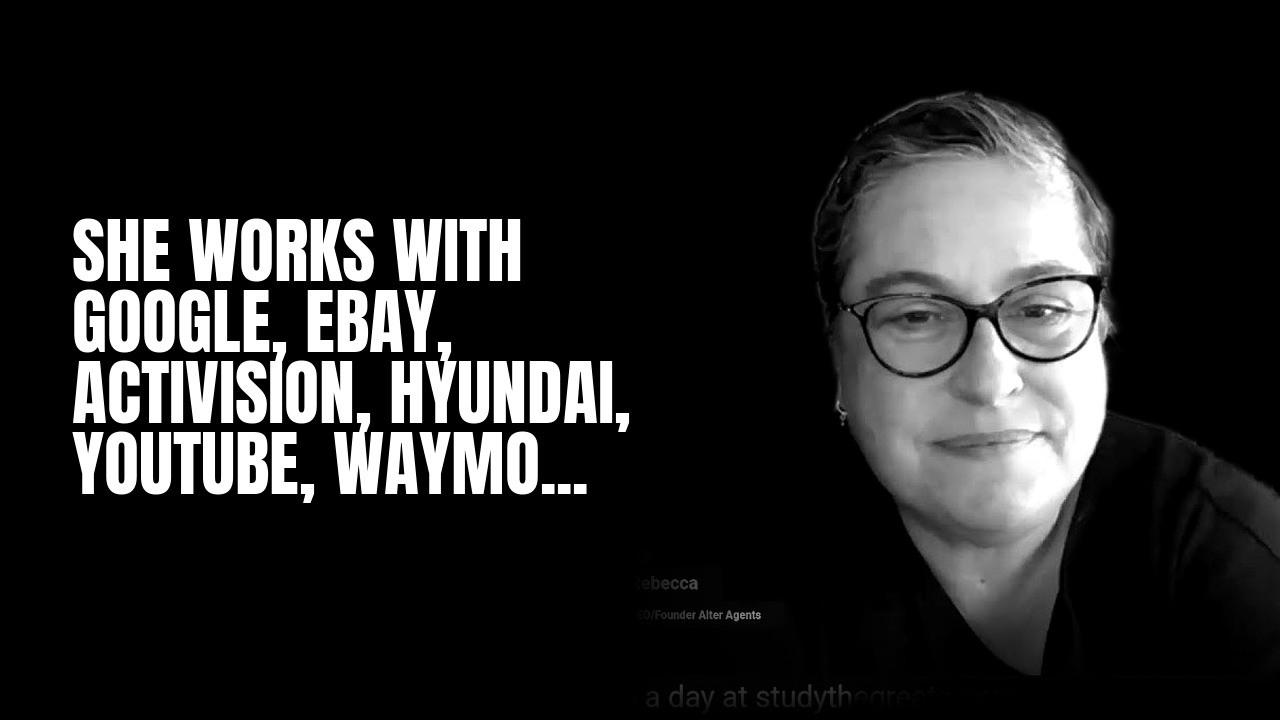
Rebecca Brooks, founder and CEO of Alter Agents, talks about building a market research firm that works with Google, YouTube, Waymo, and Activision. She explains how the company combines qualitative research, ethnography, and neuroscience to help brands make product decisions, and why she built the company around an employee-first culture.
Chapters
Welcome to another CEO Wisdom Pod. We have Rebecca Brooks with us today. Rebecca is founder and CEO at Alter Agents in Los Angeles, California. And yeah, today we're going to talk about what you've built there. I'm not sure if it was always called Alter Agents, right? Because we're in the AI age right now and you started this 16 years ago where agents weren't even a thing. But yeah, Reb, welcome to the podcast. Tell us a bit more about yourself.
Thank you. Thank you. Yeah, we started in 2010, um, and back then we were a company called Dialog, um, which was, you know, about the conversation between shoppers and brands. Um, and then in 2015, we felt that the— really what our company was trying to do was not just facilitate a conversation but make change, really create new ways of looking at the world and how people are shopping and the decisions that they're making. We felt that a lot of traditional market research had become very outdated and was built on old systems that made sense when the only advertising happened in magazines and ad breaks on, you know, 3 network stations, and didn't make sense today. So we played around with it. I'm a fan of alliteration, so we came up with Alter Agents. But now, yeah, it's kind of been co-opted, that term, a little bit by AI. So I don't know, maybe that makes it sound more relevant or not.
But yeah, tell me about some of the clients you've unlocked, because last time we spoke, we talked about like these big accounts, right? Google, Snap, Hyundai, Nespresso. Shout out to Nespresso. How did you get all of these guys? That's pretty impressive.
Yeah, thank you. I, you know, it really is a situation of opportunity meeting preparation, right? I had been in industry for about 15 years working for other companies and making connections with clients and building relationships. And then when I started out on my own, I really had, you know, prepared those relationships and prepared sort of my personal brand and built a reputation. But then the opportunity of opening up my own business gave me that. But that was the start, really. I think what has kept us on this sort of Fortune 50 brand list has been through referral and word of mouth, which really comes from the way that we conduct our business. Um, we are very much a, um, senior-led organization. Uh, there are senior people on every project from beginning to end, which our clients really appreciate and feel. Um, we focus a lot on being team members for our clients. So, uh, making sure that at the end of the day they look amazing in their jobs because of the work we did to support them. So a lot of what happens is that our clients move on to new companies and they'll bring us with them, um, or they'll refer us to friends they have at other brands. And that's really how we've built our network. In addition to, we also present a lot of our own research. Um, one of the challenges with market research is that you are paid to do work that you deliver to a client, and that data belongs to them. And so you're telling these amazing stories and you have these great insights, but you can't share it. Um, and so we do a lot of our own research, um, some of which we'll probably talk about today around consumer sentiment and decision-making. And so that also allows us to, um, get ourselves out there so that when that referral comes through, uh, from a friend that has been working with us for a while, the new person has material they can go look at online and see evidence of our work to back that up.
And these clients, um, they're paying for insights. Tell us about like a typical, uh, client contracts. How does it start? So like NDA for sure, uh, then onboarding, asking them a bunch of questions. How do you gather that data? How do you give them the insights? Typically what insights are they looking for? Give us a broader portrait.
Yeah, um, so yes, NDAs always, uh, usually in the proposal process as we're pulling things together. Um, we do a tremendous amount of custom work, so we don't have kind of off-the-shelf tools that we then squeeze our, our partners into. Um, so that really begins with a lot of conversations. What are their business objectives? What are the questions they need answered to meet those objectives? And then from there, we build a methodology we think is going to support that, to give them the best possible information. We use a lot of mixed methodologies, so we'll do qualitative focus groups, ethnographies, in-home shop-along, a lot of hands-on with our researchers there with the customer in person or virtually. We also do quantitative, which are, you know, online surveys that I'm sure everybody's run across. And we also have been adding to that two methodologies that have really, I think, elevated the work we've done. One of those is neuroscience, so using technology developed out of DARPA to understand how engaged consumers are at the moment. So whether they're watching an ad or they're shopping online or in the store, really understanding what they're paying attention to and what they're engaged in. A great case study for that is that we did work with a streaming platform where we did that neuroscience work while their customers were going through the menu trying to figure out what to watch and how were they using that and how are they emotionally engaging with it. And then the fourth piece that we do is called mirroring, which is really intense secondary research that we do partly with the help of AI now, but before that we were doing, you know, really hands-on desk research. So not every project necessitates all of those methodologies, but putting together some combination of them gives our clients the sort of statistical reliability and confidence that they need to move forward, as well as the flavor of those in-person conversations to explain why people do what they do. So yeah, just a typical engagement would be, um, like a client trying to move into a new product category, an adjacency, and they wanna understand how do consumers feel about them in that product category. And we would go out and do this mixed modal methodology work and come back with a story that they would be able to tell to get people interested and kind of identify what product opportunities there are.
Okay, so new products, right? Because I, I'm thinking of Google and YouTube, for example, these guys have like so much data. So much digital data and they, I mean, they would need you to go out in person and ask these people questions. And also you have that expertise to make it scientifically relevant. It wouldn't be existing data, it would be to launch a new product and interview new people that maybe are not customers of theirs. How does that work?
Yeah, so at Canby, we absolutely do work with clients existing data. One of the challenges of having that big data set, though, is often it doesn't tell you why people are doing what they're doing. It tells you what they're doing, but you don't know the motivations for it or how to get them to change that behavior. And the other problem is synthesizing it. How do you put that information into the bigger context? So those are the two things that we provide. And it's new products, it could be new ways of engaging with them. It could be trying to get them to stay longer. So, you know, you mentioned Google, like with, with YouTube, for instance, we've done work on how to keep people engaged and moving on to the next video and, you know, staying with the product or choosing to watch something on YouTube before they go to some other platform where that content may be available. How do we get YouTube up to the top of their minds when they think about, if I want to go see something, I'm going to YouTube. So we do a lot of work around, I would say, like how people are making their decisions and helping brands understand what's driving that, both emotionally, logistically, practically, and then how to best take advantage of— take advantage sounds wrong— but how best to maximize that decision-making process for themselves.
And why wouldn't they do it internally? Don't they have access to the best talent in the world invisibly, every possible role? Uh, what they would— why would they hire you?
It's such a good qu— I never get asked that question. I'm really glad that you did because I think it, I think it really matters. Um, and I'm going to answer that in two ways. The first is, in a normal stable economy, um, where you've got a full staff and you, you know, you're able to hire the best talent. Um, the reason to go outside is because you often don't want to evaluate yourself. Um, it— there can be internal stakeholders that have objectives, that have opinions, that can filter consciously or unconsciously the insights that they're given, um, to, you know, to make a case for it. I'll give you a classic example, which is a cruise ship that we worked for that was debating about having casinos on board. And the owner was adamant, no casinos. And the talent there was like, we need casinos on board. Um, that isn't a decision you can make internally because the politics of it and the emotions behind it were so high. So they came to us and we did that research. Turns out you shouldn't have casinos on board. That particular brand, right? Just that.
Ethically, I can understand, but it seems like a no-brainer from a money perspective. And most cruises were bleeding money. Most of them were dying, especially during COVID So why?
Yeah, this particular brand does not attract a traditional cruise person. Um, they attract a more highly educated constituency that is there.
Even highly educated people are degenerates.
Yes, yes, I love, I love playing poker, right? And I, first thing I do on a cruise is go to a casino. But they attract people that are there for— they would rather have guest lectures by local experts about the place that they're going to. Sure. It's a different kind of clientele.
And so, or sports, right?
Sports. You start to lose that core clientele when you make that decision. So number one, you would come to a company like ours for that outside outside objective perspective. But the other thing that I would add that's been changing is that the world has been so volatile— layoffs, reorgs, budgets being shifted away from other areas into AI. There's a lot of, uh, inconsistency. So actually, a lot of our, uh, clients and, and brands that work with a company like ours have actually been losing talent because of those layoffs and reorgs, or they've been moved into other areas of business. Research is becoming a bit decentralized, um, and moving into strategy and marketing and product development. And, um, so there are challenges to building a research function internally that can withstand tight times, right? Research is something that you can outsource. So when you need to drop your budget, when you need to cut your margins, the internal research team can go because there are external partners that can help you.
I should have asked that before we started, but how did you get there? Hall Partners, I see, I see Dialog. How did you get to Alter?
It's a very personal story, which is that I loved the work I was doing. I was very ambitious. I wanted to run a business one day. Um, but I had noticed that there was a majority of female talent at the bottom and a minority of female talent at the top. Um, and the intersection seemed to be when women hit their mid-30s and were starting families. And the research companies that I had worked at, and the whole ecosystem really, not just the ones I had worked at, was a very kind of sweatshop environment, you know, 80-hour work weeks, put bodies in seats. It was a very difficult work environment. And so a lot of the women in that situation had to make a choice that I didn't want to have to make, which was choosing between ambition and family. And I was at a point where I felt like I had built up enough of a reputation and enough credentials to justify going out on my own. I had a few people that wanted to come with me and a few clients that were ready to take a chance. Um, and so that was really the impetus for starting it. Um, and then after I had my kids, which wasn't as easy as I thought it would be, but after I had my kids and they were old enough and independent enough, I started thinking, you know, I've got this great thing that I was able to do for myself But we should be doing this for everybody. And so I really sort of changed the mission around 2019 to be focused on an employee-first culture and really trying to prove to the industry at large that you can have a highly successful company that makes money, that has a great reputation, that works with excellent clients, and treat your employees well enough that they can also live their lives and show up to work happy and engaged. Um, and that's, that's what we've been trying to do since.
I love this story. It's interesting looking at you, it's like this calm ambition, right? It's like boiling under the surface. You look really calm on the surface, you have like candles burning in the background, but then you unlock like 50 or hundreds of the world's biggest logo, like big deals, right? How would you describe yourself and why, why are you that way? Where does the ambition come from?
You know, I think I've always had a bit of a chip on my shoulder, um, wanting to prove that I can do a lot more than people think I can. Um, that was— I just came out that way, just born that way. Um, I really wanted— my mom was a bit of an entrepreneur. She ran a division within the hospital system. She started off as a nurse, pursued her, uh, higher education, got a master's in night school. I watched her do all of that and then take on this leadership role. I really admired her as a leader. She was a very, uh, generous and kind but fair and made hard decisions. Um, but I also saw her struggling against the people at at the top. And so I was thinking, like, I want to be her. I want to be in that kind of world where I have the authority and the ability to run things the way that I want to run them, but I don't want to be, um, indebted to or, or in service to people above me that have a different agenda. So I had always known that I wanted to be on my own at some point, um, and so that's, that's the more ambition side. The You know, the calmness, I don't know. Again, I think that's just something that I was born with. I've always been—
or that you need to deal with all these big corporations sometimes because it can get political, right?
It can, yeah. And I've never seen anyone succeed by bringing, you know, deep emotion into the room. Maybe they'll succeed in the short term, maybe they'll scare people in the short term, but in the long term, I think you earn a lot more trust and respect by being level-headed, by being reasonable. So it's just kind of always the, the way that I've adopted, um, you know, my, my approach. Um, and I, I think the reason that that has unlocked so many clients, like you're saying, is that there are a lot of clients that find our kind of— and I say our because it's not just me, like, they're— everyone around me sort of shares. We all share the same philosophy, we all share the same approach, and our clients really appreciate it because they know they're going to get honesty from us, they're going to get collaboration and partnership, um, they're, you know, they're going to get our commitment to excellence, um, and our ambition to be the best team they've ever worked with. And I think that gives them a lot of confidence in moving forward with us. So that's, that's why we've succeeded.
But also, it's a dichotomy because starting your own company, yes, you have full power, but it's also difficulty 10x, right? And you were, I guess, a new mom back then. Like, how did you survive that chaos?
Oh gosh, um, you do what you have to do, you know. I think there is no— there is no path that is easier. It's just the challenges that you're more willing to take on. Um, and I was willing to take on those kinds of challenges. The idea of being able to— you know, I've always said that I'm allergic to authority. Um, the idea to be able to call my own shots, even if they're mistakes, even if I mess it up— I would rather be in the situation of repairing my own mistakes than living under someone else's mistakes. And so I, you know, I think for me it was easier actually to take that path than it was to work for other people. I just, I just found that, that restriction challenging, right?
These contracts, are they, are there, are they yearly, or are they one shot, one kill, or do they pay pay once, uh, it's a one-time, and then they come back because they're happy later? How does that work?
It's a combination. Um, traditional research tends to be more contract-oriented, and we don't do a ton of that. Um, so like ongoing brand tracking studies, copy testing studies, we do that work. Um, but it's, uh, we kind of tend to get the work where it's a, it's a question that can't easily be answered. When clients don't have an immediate, like, oh, I'll go to this company because they're known for, uh, this, and I just want something quick turn and boilerplate. Um, when it's more complicated, when they need more insights and analysis, they come to us. That tends to be more custom projects that are one-off. But we have, you know, you had mentioned Snap, Google, uh, you know, we've got these really great clients that keep coming back to us year after year for that work. So we have some contracts, but we also have these, you know, sort of deep embedded relationships where we are the go-to research company for them regardless of the project that comes up.
And the projects, let's say like the most basic projects, multi-six figures, and if it's a multi-stage projects is like seven figures, how does that work?
Yeah, so the, the way that we price is we first look at how much it's going to cost us because we only have analysts in-house, and that's by design. I didn't want to invest in operations, fieldwork, technology, because I think those things change so much. I wanted to be able to kind of float above those changes and pick the vendor partners that fit the project best. So I would be able to sort of craft the perfect team for the project. So everything costs us money to go out and do. So the first thing we look at is how much is it going to cost us? And then we look at our time and labor and overhead and figure all of that out. I would say on average, our projects are, you know, low six figures. Some of them have gone up to seven figures depending on the level of engagement. But we don't really do stuff under like, I don't think we've done a project under like $50,000 in some time unless it's a favor for a client just because things are so expensive these days.
And with AI, have these costs reduced? Like leveraging AI for research and agents to go out there and do the work instead of expensive humans?
Ja, ja. So yes and no. I think it's made us more efficient in the work that we do, and that's reduced costs for sure. We are highly skeptical of what is called synthetic data or digital twins, anything where an AI is mimicking consumer behavior. And the reason for that is because AI can only work off of what is known and what is out there. And a lot of our work is about sort of getting under the psychology of why people are making the decisions that they make. And that's not readily available information for AI to pull from and gather, nor is it the way that AI thinks about a decision. So for instance, if I were to ask a synthetic respondent, you know, uh, which brand of bread are you likely to buy, the AI agent's going to go out and look at market share and come come back and tell me the brand they're likely to buy. They're not going to tell me the consumer that has a nostalgic memory of an experience with their grandmother that leads them to buy this other brand. So we are— we don't feel like AI is ready for that yet. So replacing real people with AI data to us feels, at this stage anyway, like you're just, you're just flushing that money down the drain because you're not gonna get actual insights there. It has saved us money though in terms of time analysis, being able to move more quickly through analysis tools and get synthesizing done that way. But yeah, we're, we're pretty clear that the AI respondent is not ready for primetime yet.
How does your brain handle research and insights differently than, uh, I don't know, a CEO that would hire you to do the work, like my brain?
I think that the essence of a good researcher is curiosity, um, and continuing to follow the story. Um, oh, that, you know, this person said that, I wonder why, what made them want to do it that way, what made them think that way, and continuing to follow the data and pull those insights out. And I think that a lot of the decision makers we work with at these large companies have to take those insights and make quick decisions. And curiosity isn't necessarily— the time to spend being curious and digging into things isn't necessarily an asset at that level. You want to have confidence that the people giving you the information have already done that work for you. And so I think that's what our group, the way that we think, the way that we approach things, is an asset to a decision maker within a company who has to move more quickly and has to think more broadly about the business they're in.
Okay, hmm, I mean, I'm curious, but sometimes I may not ask the right questions and I may have too much emotions, even if I tend to fancy myself as someone that's in the control of their emotions. Uh, the research would say otherwise. Um, so, and that's what I noticed about you, you know, that calm demeanor, or like, uh, not emotionless, but like more, um, analytical and laid back. Um, maybe I don't have that, and I think most CEOs are, are like guilty of that, right? Most of the time they're super biased, and that's a good reason to to hire you, right? Someone that would sit back impartially and, and filter through that data calmly while not letting themselves distract themselves by their biases. What would you say about that?
I would agree. I think that, you know, a lot of CEOs are successful because they're really opinionated and they stick to their guns, and if they're right and they make the right bets, they succeed. That's not necessarily an insights person, right? And I— this conversation is making me think about— I heard, uh, I was at a conference where Barack Obama was speaking and he was being asked about the healthcare.gov fiasco. If you remember, they were launching Obamacare, the ACA, and they were going to put out this huge website that was supposed to take care of everything. And they asked him what went wrong. You know, it came out and it was a disaster. And he said that he was asking every day for like 18 months, he was asking the team, are we going to launch on time? And is it going to work? And they kept saying yes. And he realized after the fact that what he never asked them was, why are you confident that we're going to launch on time and it's going to work? Because if he had asked that question, he would have seen that they were saying yes because they wanted that to be true. True. They wanted to deliver that for him, but the reality was they were scrambling under the surface. And so to me, that's a CEO who, um, learned a lesson that you've got to get a little bit more curious in order to understand something. You can't just take the, you know, the top answer and move forward. And so I think that what we're able to provide is to be an agent for those CEOs go out and say, tell me why. Why do we think this is going to work? What do you think is going to be successful here? So we can report that back to them when they don't have the time to get into the weeds like we do.
And when you interview very biased humans, right, like, as you usually do, how do you take the bias out of it? How do you make sure to take what they say with a grain of salt and/or dissect it and try to bring sense into it when there's pretty much only emotions?
Yeah, when— so my background is in anthropology, I started there, and one of my favorite books that I reference all the time is an anthropology, uh, cultural anthropology book that came out in the '80s called Garbage, where researchers had went to people's homes and asked them, what do you buy, right? How many cigarettes do you smoke? How much alcohol do you drink? How many cookies do you buy? Like, whatever, just a whole thing. And and then they took their garbage and brought it back to the lab and actually counted what they bought. And the discrepancy between what people said they did and what they actually did, of course we can imagine, is huge, right? People didn't want to admit that they were drinking every day, but the garbage proved that they were, or that they were smoking as much or eating as many cookies. Um, they overemphasized vegetables, and there's nothing in the trash that indicated that they were actually home cooking you're doing vegetables, right? So that was a wake-up call for me as a researcher to be like, you have to combine methodologies. If we had just taken the survey data, we wouldn't have understood all of these other things and contradictions and the miraculous complexity of the human brain. So that's why a lot of the work that we do is mixed modal. We're doing neuroscience, qualitative, quantitative, muraling, like ways that we can sort of get at that 360 perspective so that we don't rely on just the consumer and assuming that they're telling us the truth. Because reality is consumers don't even know sometimes why they do what they do.
Um, so yeah, I love that. Thanks for being on, Rebecca. Where can people find out more about you?
Uh, alteragents.com. Um, we have a lot of, uh, proprietary leadership, like, like thought leadership and information about consumers out there. I also wrote a book in 2022 about shopper decision-making. So we have a lot of resources out there. You don't even need to hire us to get good insights from us, but of course we'd love to have that conversation as well.
More from Charles




Founder Wisdom: the full audiobook (7 hours of quotes and stories from 600+ founders and CEOs)






