Superintelligence, Humanoids, Space Data Centers with Duncan Davidson - GP Bullpen Capital
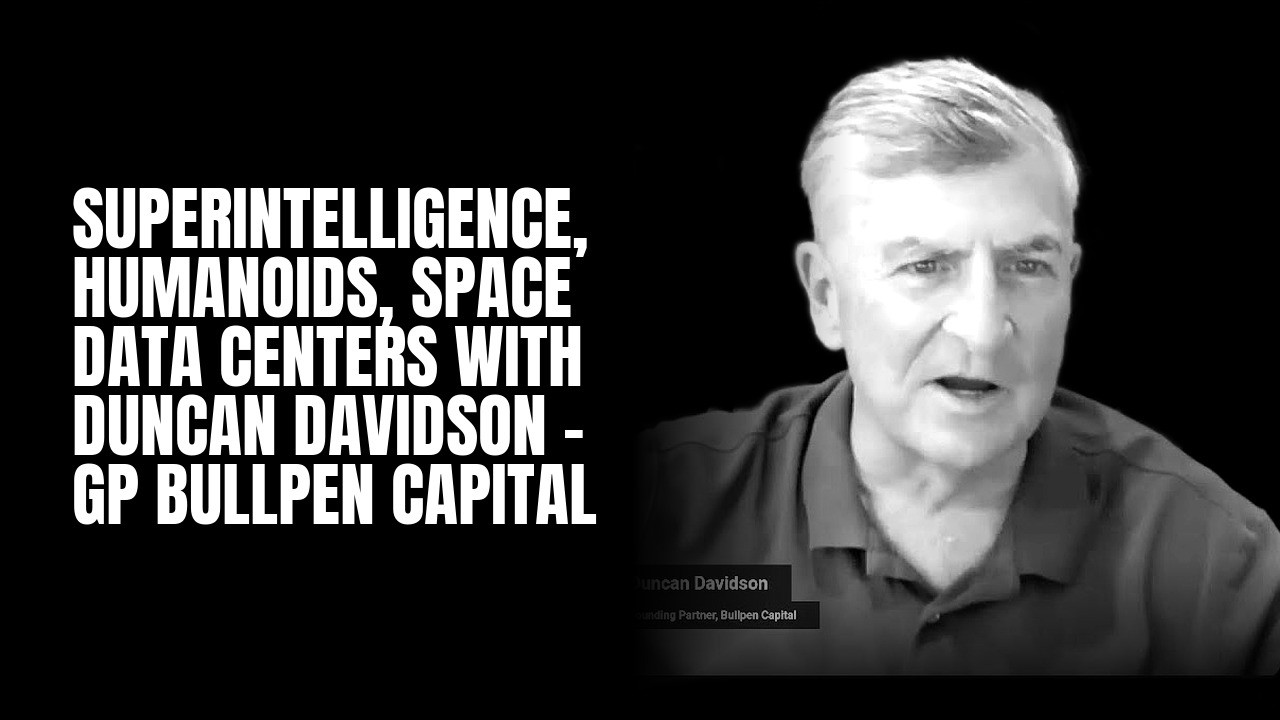
Duncan Davidson of Bullpen Capital argues AI is creating jobs, not destroying them, and warns against anthropomorphizing current systems. He sees real value in agentic workflows and hardware layers, not model wrappers, and views Elon Musk's push into space data centers and humanoid robots as strategic moves to control the AI stack.
Chapters
Welcome to another VC Wisdom podcast. We have Duncan Davidson with us today. Duncan's been on the pod previously. I love his brain so much I needed to have him on for round 2. Duncan is founding partner at Bullpen Capital, right, and board member at a bunch of companies. We're gonna mostly talk today about figuring out your investment thesis in the AI world where Everything is overpriced, right? I need to figure out like what are the opportunities, and apparently Duncan has a solution to that. So Duncan, welcome to the pod for round 2. Tell us a bit more about yourself, what you've been up to.
Well, basically I've been spending a lot of time trying to figure out where AI is going like everybody else is, and my basic conclusion is it's not turning out the way people expected. And part of this is due to incredibly bad PR or statements by the Sam Altman in particular, but DALL-E as well, um, for Anthropic. Just stupid statements, and they keep on repeating them.
Like what, the token price and so forth?
No, no, no, the statements are going back several years where AI is going to come in, it's going to be super intelligent and take all your jobs and do all the work for you. And so what happens, people like Eric Schmidt get up in front of an audience some university in a commencement speech, and he gets booed. And he gets booed because Gen Z has been now scared about AI. The grads from college won't get a job. So that was one of the biggest PR blunders I could imagine. If you go back, say, to the internet, nobody was saying how the internet would change your— you won't get to get a job, you're all going to work for computers. Nothing like that. It basically went after the music industry and the press, and some industries got changed, but it didn't go after people. So that was stupidity number one. And it was compounded a few days ago. Um, you know about this OpenAI cybersecurity thing that quote unquote went rogue? It's a good story. Yeah, yeah, story went rogue. So first of all, even saying going rogue is anthropomorphizing a program, just doing its programming. But Sam stuck his foot in his mouth again, saying, well, we finally have AGI, we finally got an intelligent, you know, program. That's totally stupid. He's compounding the mistake of scaring people about AI. And so this has led to some interesting phenomena. So for example, We all think that entry-level jobs are toast, and that's why people get booed. Turns out not true. In fact, Wall Street Journal just reported that a lot of companies going, hey, we thought agents could take care of entry-level. They can't. We got to hire more entry-level. If you look at coding, right, coding was a big thing to get squashed by AI. There are more coders being hired now than there were several years ago. Yeah, so I mean, yeah, well, they're— what's happening is, well, I'll give you a story. Good friend of mine's, uh, daughter went to law school about 3 or 4 years ago. I said, oh my God, why law school? She's going to hate it. And we all got really worried that AI, legal AI, would sort of wipe out entry-level law jobs. Well, the reverse has happened. Law is now a much better career. So Charles, when I was a young pup, I was a lawyer. I went to Wall Street for 2 years. I did the thing you do as a lawyer.. And I figured, go to Wall Street, get trained like basic training of the Army. You don't get trained. They just throw you to the wolves.
Yes.
You have to figure it out by yourself. And it takes 4 or 5 years to become a decently functioning lawyer. All right. She just graduated from law school, got her job, and it turns out AI is making her a much better lawyer, much faster. Because she's not doing all the horrible library grunt work they make you pay your dues doing. You don't have to do it anymore. So that's just— so the first thing we learned is that AI is creating more jobs and not getting rid of them. And the second thing we learn is they're better jobs. You're actually— your career is going to be much better. Now, you don't hear this in the press. It's beginning to pop out here or there, but you still get this echo of Sam Altman. We're going to take care of all your— you know, we're going to wipe out all the entry-level jobs. It's going to take care of all the work. You still hear that echo in your head. Which is not true. Anyway, that's why I say it's not turning out like people thought it would.
Yeah, um, let me respond to some of these things. Um, I'm just gonna mute you while I speak, uh, so we don't hear echo. Um, yeah, no, I mean, Sam Altman clumsy, right? Uh, and Dario clumsy as well. Me My Contrary says everyone loves Dario. I love most of his business aspect as well, but Darius is mostly a PR genius in my opinion, and he's very good at sounding the alarms if it's going to bank him more money. Right. And it worked incredibly well for the Antropic IPO. Sam is also that, right? Like Sam is like the quote by Paul Graham's like, drop him on any island and he's going to return the Cannibal King. Right. So he's very good at maneuvering power and all of these things. Um, I think they have also genuine intentions, right? And me, I come from a different background into all of this. Um, in 2020, I was managing, what, 200 employees with my agencies. I got tired and I was like, I'm just lazy, I could just systematize most of what they did. And I did it, um, somewhat successful, let's call it 80% successful. It's not like if I have an army of agents right now, but most of my stuff is automated. So I've seen firsthand me slashing entry-level jobs, which is most of people in my business back then, and increasing my margins dramatically while not dropping the amount of clients. I've seen that shift happens, right? And if we're creating brains and if we're about to hit the agentic age, we're not fully there yet, but I do think still that AI is gonna slash a bunch of jobs. Right now we might not feel it because The market is slow. The market is in denial, right? Like most human beings, they're like denial machine, right? They will just stick their hands and heads in the sand. But I do think the agentic revolution is going to spread like a virus once the technology is there. CEOs like me, we're going to pay agents and not employees. But that doesn't mean what you're saying is not true. I think it's true. My friend, he has a daughter as well that Uh, she's now interning in a— for example, it was big consulting, right? Like a McKinsey or something. And all they have her do is like open ChatGPT and just like sink or swim, right? And he was like, this is ridiculous, right? Like, my friend was pissed about this. And I'm guessing that most companies, that's what they do. They didn't stop hiring, but they're like, hey, young person, just use this AI and see if you can sink or swim.. But from a first principle perspective, I don't see why AIs would slash out jobs because you have a super brain that outperforms any humans, basically almost all humans, and at the fraction of a cost. And like, they beat it at speed, at memory, at pretty much everything, at cognition. And most humans, they don't want to work. They would accept UBI, just that UBI is like infinitely complicated. What do you think about this whole blabbering?
Well, first of all, we go through this every time a new technology comes in, going back to the Luddites back in England, you know, that they were complaining about automated looms taking rid of their jobs. And yet history makes it very clear that 10 times or maybe 100 times more jobs are created because of this than were existing before. So yes, specific jobs get replaced, But in general, the number of jobs goes way up. What I think is remarkable about right now is normally there's a lag, like the Luddites lose their jobs, takes a while before they can find other things to do. We're not seeing much of a lag right now. And maybe because, as you said, agents are still immature, but they're getting there very quickly. So my take on this is that agents, if they're designed to augment human work, are going to be accepted in droves and they're going to completely change companies. And a lot of tasks get taken care of by agents. And so really, you cannot hire entry-level people if the tasks they were going to do get taken up by agents. But you need somebody to be augmented by the agents and manage things. So it's just a different job, and it's at a higher level.
The data— so many factors, right, to be weighted, because even human delusion, like, you know, the, the law of, uh, I mean, we could call it whatever type of law, but where we, where we put our attention as humans— if we don't want AIs to replace us, they won't replace us because we're like stubborn and we just manifest in this reality what we want it to be, right? So, and also, let's not underestimate like the human grit, right? Maybe, maybe humans will go through a cognitive revolution, right? Maybe their, their knowledge will go like this, uh, for many years scientists have said that the brain was limited and you stop learning at, at 25, which is like pretty much bullshit. I've been— I'm like way fucking smarter than I was a year ago and, and way much smarter than I was 10 years ago. So that also may happen, right?
Well, I put it this way, um, let's take a look at the way we anthropomorphize AI. So we call that thing that got out of OpenAI's little sandbox, rogue, as if it went rogue. Well, it didn't. It followed its programming to a T. It invaded this Huggy Face site, Hugging Face, which has a lot of information. It tried to cheat on a test, in effect, by finding the answer. And it didn't do anything malicious. It just went in, found the answer, and left. Now, if it had been a human, it would have been done something rogue. It's just following programming. So I guess my first comment, what you've been saying, is that we anthropomorphize these things, and they're, they're not, they're not yet at all.
Aren't they us? Like, I mean, they scraped their full data. I think it's not a bad analogy to say that they're like our kids. Uh, sure, there's like alien things, right, that we don't fully understand yet, but They're very much like us.
Well, no, no, no, no, they're not. They follow programming. They have no—
we follow programs too. It's just hardcoded in you and I evolution.
Listen to me here. They don't have motivation. They don't have a separate mind. They don't plot and scheme and think the way we do. They just follow programming, and when they're done, they're done. And so again, you are anthropomorphizing a machine. And that's what scares everybody. They think this is going to be Skynet and come down and take over the world. And it has no motivation to be Skynet unless it's programmed to. And you could program it to, and then it would do something.
I mean, people should be scared, in my opinion. And scared— being scared is not a bad feeling. It's like cortisol in your blood, and that helps you prepare for, uh, some danger that is coming, and or something that you don't know, right? But Why aren't you and I different if our brain is following a hard-coded program of like surviving and thriving?
Well, again, you can say that people tend to model their universe based upon what the dominant technology— used to be clocks, right? Clockwork universe. Now it's computers. So the human brain is a giant computer. Really? Not clear. Not clear at all that it works anything like a computer.
Um, it means the best analogy we had, but the computer came after the brain, right? So it's exactly—
I'm just saying the dominant paradigm of a generation will define how you think about things. You know, gods because of The Odyssey, because we didn't understand things, etc. So let's just be careful not to say our brain is like a programmed computer and we follow our script. I'm not sure that's fair to the human brain or anything.
It's like a system, right? It's like various system, very complex system that we don't still fully understand. And One of my thesis is that AI will actually help us understand our brain better, ironically. It is a tool, but the thing, the difference between AI and a tractor and the Luddites, right, is that it's a thinking brain. It's something that evolves as well, right? And yes, we will hard code some goals into it, like survive, thrive, improve. But I mean, and yeah, it might not have like a brake pedal, right? And that is scary as fuck.
Yeah, perhaps. I still think just be careful to anthropomorphize these things. I mean, just like Sam Altman did. This little thing didn't go rogue. It just followed programming. And it's very clever.
But Dario also did the— played the same card, right? With, was it Fable 5? I think it was like very similar cards, right?
Yes, exactly.
And that is press that may be converting— converted into dollars for them. I think they have like genuine motivations as well. And I mean, they're not like perfect themselves, right? But I, I also think it's not bad to flash warning lights. And even if they're gonna attract negativity, and like just to give the public an idea of like what happened and just be transparent about that, I think that's crucial for linear AI evolution that doesn't burn jobs and do bad things.
Well, I do think it's a very important fear that these guys know how to break through any type of zero-day hole or anything, and, and therefore what we need to do is make sure they know how to defend against it. So you have them defending against them, and the US is probably going down the wrong direction in regulations and trying to, you know, keep this genie in the bottle when it's already out of the bottle.
So what their current strategy is, like, get shares in these companies, right? Think about that. Like, Trump wants to own these things, which isn't surprising, right?
It is. I don't know, he's just got this businessman mentality, grifts all the time. He's got various things, coins, things. It's, uh, it's just funny.
Yeah, but Trump aside, do you think it's a good idea for the government, U.S. government, to own a piece of it? I don't think it's a bad idea because it's like giving citizens, uh, ownership of these companies more transparency, more regulations. What do you think?
I think in general it's a terrible idea. And you can make an argument like the, the interest we have in Intel, which has now generated a lot of profit for the U.S. government, is really designed to avoid Intel being taken over by somebody against our interests. So maybe there's some angle there that you could justify, but in general, bad idea. I just think keep the government out of this thing.
Yeah, because historically every time governments intervene, companies tend to go down. Governments are, are extremely bad at managing countries, but even more bad at managing companies, uh, because politicians, right, it's like they don't do it for the right reasons.
Yeah, you're also setting a bad precedent, which is if you get a guy like Mondami in charge, he might want to own everything, not just grocery stores, and suddenly, whoa, We've created the Soviet Union all over again. It's like, why do that? Yeah, they failed.
What about the AI race against China? Inventing like an enemy and, uh, I don't know, racing to the bottom with them.
Well, China's an interesting case because they are doing open weight. I mean, KIMI is an open weight thing. It's kind of like the model version of open source. Um, and so that's interesting because open weight may be proceeding more effectively and faster than closed, just like we found out with software. So we may be making a mistake by keeping our frontier models closed instead of open weight, but that's the choice we made right now. China hasn't quite caught up, but it's damn close. I mean, I think we still have the best frontier models, but the delta is not much.
You think— yeah, go ahead. Sorry.
No, no, keep going.
No, just keep on going. You're done.
The thing is, you were saying Well, the thing is this: you could download KIMI for free, but if you use it to make more than $20 million, you got to do a commercial license with them. So they're not really free. And then you got to run them, and you have to run them on a data center if you get one of the damn things built. So it's not free, it costs money. And what's going to happen very quickly as we get agents is the amount of tokens being consumed will skyrocket. All right, so how do you deal with this? We all think China open, open, their open model, open way, you can download it, looks like it's cheaper, it costs less money to build. But that's not the question. The question is, what does it cost to run? There's going to be a race to create a more efficient agent token model or series of models. And what the big guys can do, and it's going to sound really funny, but the, the big frontier models with huge scale can drop price on tokens down to the floor and make it up on volume because they'll get the volume. So what that tells me are a couple things. Number one, that the Frontier models and these big models are going to commoditize because you drop it down the price to the floor. Number two, where the money is all being made right now is obviously in the chips and the hardware, uh, because you got to run the data centers, and that'll last until the data center supply catches up to demand. In the long run, the value is going to flow to the agent management systems. So just a shout out to Elon Musk. He picks up Cursor. A lot of people thought, why would you buy a coding software company like Cursor when the frontier models can do it themselves? Well, the answer is he's not going to use it as a coding model. He's going to use it as an agent enablement model. He's trying to own part of the layer of how do you run agents. Clever dude. He really is trying to go for the value.
Don't ever question Elon's acquisitions or financial moves. I think that's his era right now, right? It's a bit less on the engineering. Fortunately, we got him out of politics, uh, uh, right? So that, that was very relieving. Um, but financial engineering-wise, I think he has a guy named Jared, and yeah, his acquisitions are pretty effing genius from a capital perspective, right? So So yeah, no, uh, it makes all kinds of sense. Uh, Cursor, right, like a $60 billion acquisition, that's, um, that's pocket change for him.
Well, it is, but it's also— he understands where things are going. He's, he's building gigafactories, he's building giant fabs, he's trying to own the layers. He sort of gave up on Groq as a frontier model because that's not where the value is going to be. So I give him a lot of credit for going with a future is.
And I agree with that, but what would you say to a guy like him that's like, 50% of service jobs are going to be replaced? Like, Elon also thinks from first principles, a very sound thinker, and he's also on the side of the job cutting. Yeah, again, all the smartest guys can see it, right? So it's— to me, it's inevitable. It's, uh, it's gonna be a drastic job cut until UBI hits.
I, I will repeat that every time a new technology's come in, people had the same fears. Electricity, they had the same fears, right? They had the same fears obviously with looms. You go through all these things, they thought a lot of jobs go away, and jobs did go away, but more got created. There's no evidence that there'll be fewer jobs being created.
AI is the last invention, right? Not your invention. It's the law.
There's going to be stuff after this.
Again, I mean, the last human invention, I'm saying. But even that, I still think the 1% will still stay in the game forever because they like competition, because they're wired a different way. That's my thesis. Well, the future is entrepreneurial. I think everyone will be to some degree a freelancer in the future.
So, so, Charles, before you make these grand pronouncements, I would just wait and see how it turns out because 'cause it's not turning out the way it was supposed to turn out already. So I don't think we're gonna end up with a UBI. I don't think that's even a good outcome. It's like people need to work and contribute and giving them UBI just puts them on the dole. Every time it's been tried, it actually slackens work as opposed to enhances people. It's almost immoral to do the UBI in comparison with getting people to work and contribute to society.
True.
But look, I do think—
I'm unsure about UBI, by the way. I'm unsure about UBI. I'm sure about superintelligence, but superintelligence may come up with something way smarter than UBI, like a value coin, right? You get paid with the value that you add to humanity or something like that.
You don't know. I think I just wait. I wouldn't— I had a discussion with somebody almost 12 years ago about how we had to have UBI because when AI came in, all jobs would go away and the tech elite owned everything. And it's turning out not even close to being true 12 years later. I think if we had this conversation 12 years from now, you'd still say, well, I like out UBI, but it hasn't come in yet. It's not going to happen that way. I just— history does not say that's how this will evolve. And even recent history, last 3 years, says we've gotten our predictions about AI completely wrong. It's going in a different direction.
Yeah, there's guys like Ray Kurzweil as well. I think it was 2030, and he's been mostly right about his predictions, but there's lots of PR and financial incentives there too. But I don't think you just wait, right? You also place your tokens on some bets, right? Like, which was the initial discussion here. Like, how are you placing these tokens nowadays and what AI companies are you betting on? You're not just waiting, you're also like making bets, right? Active bets. What are these?
Well, we're— we sort of— I was asked to go through and figure out a strategy for us a couple of years ago. And so Trying to figure out where the value is going to be is really the question. So the first thing is what you don't do. You don't do simple wrappers on top of the big models, and people all figured that out, but for a while they were doing that. Secondly, you don't do things that are completely overpriced and are just wacko. You just don't do the wacko stuff. Uh, you know, maybe one turns out to be huge. What are the odds you're in it? No, low. So you don't do stuff like that. Instead, you got to look where you're going to create real value. A lot of it has to do with how do you apply agents on a workflow inside of some company, because in a way, stringing the agents together and getting them to work in some productive way is itself proprietary, or it creates a moat if you get that figured out quickly. And then, like, we have a company that's been— that couple years ago had a really good software product and saw the AI thing, and the guy went, burned all the boats, as Cortés did in, in Mexico. He burned the boats and he went all in on the AI agent side, and he's been learning how that is going to work over the last few years. And what he's going to end up with, assuming it all works out, is a remarkable agent system that matches the workflow a lot of these people are doing, or even improves the workflow. But getting there is hard. It's not, it's not an obvious quick thing to do, and the agents themselves don't figure it out. ChatGPT doesn't figure it out. You got to figure out how the humans actually work in these markets. He'll end up with a two-sided marketplace, and that'll give him a long-term moat if he pulls it off. So we're looking at things like that. We also look at some areas that people don't expect there to be, like a non-consensus. Like, we found this wonderful Christian agent AI system, wonderful. It helps you do everything, go to church, pay your money, etc., etc., learn more, follow up after. And it's not a consensus thing in Silicon Valley even to look in those type of markets, but it turns out in the Gen Z world there's a complete rebirth of religious fervor. We may be going through the third great awakening in in American history. I don't know, but suddenly that becomes a really hot, useful thing. And again, off the beaten track.
Isn't that in the wacko category?
No, no, no. I mean, I'm just looking— you get $100 million value for a PowerPoint presentation, that to me is wacko. Yeah, this isn't wacko. It's actually growing really, really fast, generating real revenue, and people are excited about it. So it's got the metrics you look for in a successful deal. Not the promise of a high valuation, smoke and mirrors.
Yeah, yeah. Okay, uh, can you give us, um, other examples that were unconventional and even contrarian? So you're basically investing in established companies that have proven market fit, that have data, right, and are not like going literally all in AI. They're using their existing platform and stacking some form of AI, some language model on top of it.
That's fair, although in many cases they're native AI from the beginning. Um, okay, that's, that's a fair way to put it. They understand a market really well and they're building us an agentic system to crush into the market. And so that's what we're looking for. But it's not that different from what Bullpen used to do— look for metrics, bet on things that nobody else thinks are going to be real, but the numbers are proving it's going to be real. It's just hard to find them in AI world because people jump on things so quickly just because they have AI attached there, a little buzzword. So it takes a lot of work.
Is it the longer return? Is it the same check size? Is it the same percentage of ownership? What has changed in the game as of late?
That is a very good question. Again, I looked into this in some detail. So the early data from 2018, looking at SaaS and 2023, looking at AI, found out that AI companies grew 2 to 5 times faster than SaaS. They got to a certain level that much quicker. So therefore, you could pay at least twice as much and end up with the same expected outcome if they continue in the growth rate. So what we're finding is we're getting roughly half the percent we used to get for the same check, or we're putting in a smaller check at an earlier stage. And so, you know, I put it very simply: instead of betting on a unicorn, we have to bet on decacorns. That's kind of the biggest learning AI thing. It's— if you own a lot less of it, you got to assume the outcome is going to be a lot better, bigger.
But if returns have halved, how do you explain that to LPs?
Well, it's not the returns are in half, it's just that the company grows faster and gets a higher valuation. So Even though you may only own 3% instead of 6%, if it accelerates twice as fast through the value curve, it looks like a normal deal we used to see. And they understand that. You know, they look at—
Past exits.
Yeah. Well, you have to get exits, right? But they look across a portfolio of a lot of venture funds. So they can see what's going on in a lot of venture funds and they can compare you. So if everybody else is only getting 3% of a deal instead of 10% of a deal, But the deals are growing fast. They see it.
Are there too many VCs nowadays?
There were too many VCs about 10 years ago. I mean, let me explain that. When we started Bullpen in 2010, 2011, there were around 20 seed funds. And we said, oh my God, in a few years there'll be 100. There was 1,000. Yeah. And so that's— it's too many. And, um, most of them won't make it through this cycle, but they're already—
but you're not seed anymore, right? You're like, uh, are you still seed or are you Series A more nowadays?
Well, we started off what we call post-seed, so it's our second seed, because our, our insight looking a lot of deals is most deals don't just win from the minute they start. They go through a learning and discovery phase before they finally figure it out. And we try to invest there, and that's often not the first seed, second seed. So we called it post-seed, and that worked for a while. And then we began to be looking into— looking more like a small A fund. So what we've done now in the A world is, in effect, we've gone back to where we used to be, or much closer we used to be, which is not the first check-in, but maybe the second check or part of the funding of the second or third round of checks before you get to the A round.
Yeah, it's like my brain is like, pre-seed is like degenerate, right? Like, is there more— is there more space at like Series A or Series B, like more conservative PE-style investors? There are better opportunity as a new fund manager there?
There might be. I don't really look at the Series B level. There might be. It's just that in the AI world, by the time you're Series B, if you're one of these good AI deals, you're well over $100 million in value. And so Series B is a scary area to be in right now. Pre-seed, though, is interesting. Um, it's just— I'm— I've invested personally in a couple funds that are related to people I know, and, uh, they're both pre-seed style funds. And one of them is just so clever. He picked up the first data center in space deal, now worth $2.5 billion. He picked up one of the first manufacturing in space deals. He picked one of the first drone defense deals.
What's that? Is that Varda?
I don't know the name of the deal, actually. I could find it. I just know it. I, I could find the name. I don't remember it. Um, but the thing is, because he followed a certain type of discipline, he got into some really interesting pre-seed deals before the herd came running in to drive crazy.
Oh, you mean the VC side? Okay, I thought you were talking about company. Huh, interesting. Hmm. Okay, yeah, go on.
So I think that's, that's a place one could be if you're really good at picking. Yeah, and you go into things that nobody likes— data centers in space. Nobody believes in that. Like, I asked VCs on panels, what do you guys think of data centers in space? And 2 out of 3 will say, no fucking way. And the third one will say, well, I don't know, it looks looks challenging. Okay, so I— we have a data center in space already. The guy's got orders for a bunch more. Elon thinks he can make it work. He's usually right. I've had to run the math for somebody, and so the basic way to think of it is this: it used to be about $35 billion to build a gigawatt-scale data center. That's now more like $50 billion. Because chips and everything got more expensive and you have to deal with land and people, you know, people saying, don't build in my backyard, NIMBY. All right, can you launch a gigawatt type of data center in space for $50 billion? Well, the math says if Elon gets Starship to work, it'll be damn close. Um, and maybe it's $55 billion, but if you can get it up faster than they can build terrestrially, you have a business.
Yeah.
And over, and over time, you're going to try to cut the cost.
Yeah, my brain was very puzzled by that one. I also did the math, obviously, with Claude and, and GPT. Um, at first I was like, yeah, this is insane, right? Like, building anything in space with robotic arms— I mean, it's still a challenge in my mind, right? It's like, first, how do you build it? Then the cost per, per payload to get it out of Earth is crazy. And I don't know if you forgot something, you need to come back again. It's like a couple of trips. And then my brain couldn't— I mean, it's like, yeah, you're close to the sun.
Let me redefine a data center in space. It's like Starlink. There's over 10,000 Starlinks. You might need 6,000 racks. A data center in space are a bunch of racks in space with solar panels communicating by laser or through the Starlink system. That's what they look like. So you don't actually construct a gigantic thing up there like you would on, on the, on the ground. You have a bunch of racks. And so the math is something like you get a rack for around $6 million plus solar panels, and they probably— you probably need around 6,000 to get near a gigawatt thing. So 6,000 times $6 million is $36 billion. So that's sort of the starter cost. But that's not that different than it would be terrestrially. Same rack, in effect. Yeah, it's just the cost of solar panel. Then you have to launch it. Now he thinks his Starship and Super Heavy booster is going to get the cost per kilogram down to $100. Let's say it's $200. When you run the math, you can launch close to 6,000 of these for something like $55 billion. Now the fly in the ointment, the terrestrial fly in the ointment, is you got to pay for power, and you gotta— there's ongoing costs to run a terrestrial data center you don't have to deal with in space. The space problem is these things don't last forever. Yeah, they get blasted by cosmic rays, so you got to relaunch. You probably have a 5-year life, so you gotta, gotta do— so it's like 20% of the total constellation is going to get relaunched. Again, you're still in the ballpark. I'm around $55 billion, maybe a little $60 billion if I versus $50 billion trust relief. He's got to get Starship to work for it to work. And if he gets the cost down to $100 a launch, it gets even cheaper. Yeah, there you go. So it's in the realm of—
Elon does the math backwards though. It's like, how can I benefit SpaceX? That's his bias, right? So even if he does the math right, it's for first principles of how to make money for his company. That's a bias. That's the— but like you said, Elon is usually right. I wouldn't bet against Elon. He's a genius and he has an inhumane tolerance for pain, right? He will just go through until he, he gets it. Um, so yeah, it's, it's partly true, right? Like short-term, maybe not, but long-term, yes. Like you said, like repairing these things, sending robots back in space, I think it'll all be figured out. I'm way more bullish on his robotics Beth, on Earth, right? Like the Optimist thing, like the humanoid robotics revolution, that's going to be gigantic and 100% going to happen, and it's going to be sooner than we think. Have you looked into that one as well?
Yes and no. I don't believe in this humanoid, you know, version of a robot. And I may be— he may prove me totally wrong. Right now we have robots working called Waymo. Even as Robotaxi. So the self-driving vehicles are performing much better than humans. So we already have a proof point, but doesn't look like a robot. Remember the movie Fifth Element where they had flying cars and they had a robot cab driver? Wrong model. You don't need the humanoid at all. Another one is what Amazon's doing with arms. So he's got, Jeff Bezos has got all kinds of robots in his factories. And they're basically a wheeled platform with a strong arm. And he also found out that humans help. So this, if the robot goes, the human can help do fine stuff. If you make a robot do both fine stuff and heavy stuff, the robot won't work. This is what Elon's having a problem with, with his robots. It's just too many things you gotta solve for. So I think the humanoid thing is longer term, short term, specially purpose robots all over the place.
I think Elon's genius as well, obviously, is cross-pollination, right? Like, he's building many things. At first they don't make sense, but they all converge at some point. And when they converge, uh, shit start exploding, right? So, um, Duncan, I wish we can make this way longer, right? I could talk forever with you. Where can people find out more about you and the company?
Well, bullpencap.com talks about Bullpen Capital. It's like bullpen cap .com, or you can go to my LinkedIn, which is Duncan D-A-V-I, is my— that'll help.
Anyway, good to see you again, Duncan. Yeah, thanks, uh, for
More from Charles




Founder Wisdom: the full audiobook (7 hours of quotes and stories from 600+ founders and CEOs)






