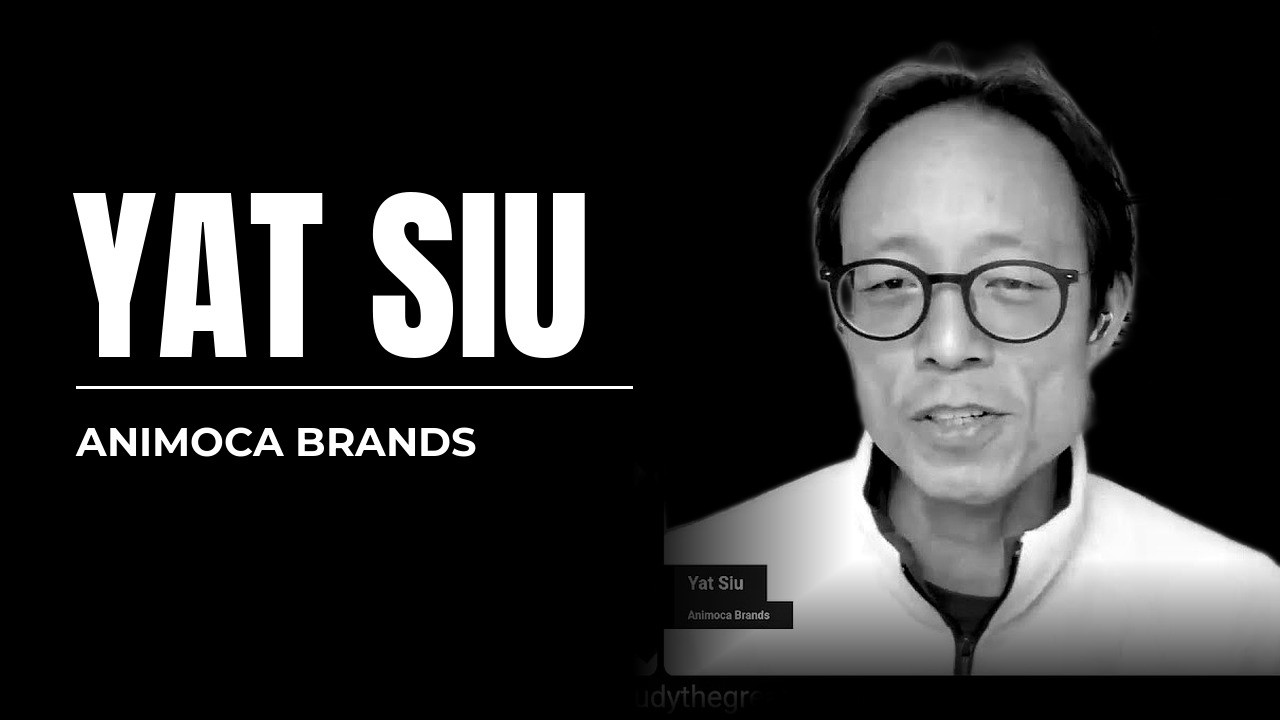
Yat Siu, chairman of Animoca Brands, grew up between Austria, East Berlin, and 1990s Hong Kong, experiences that shaped his views on markets and inequality. He argues AI acts as an equalizer, giving anyone with a phone access to answers and suggestions, while blockchain and digital property rights could let AI agents operate as autonomous economic actors with legal standing.
Chapters
Welcome to another Founder Wisdom podcast. Today we have with us, we have someone quite special, Yat Siu. Yat Siu is an advocate of true digital property rights. He's a chairman of the board, uh, brands. He built something quite incredible. Animoca was, uh, and still is, I think, publicly listed on the ASX, uh, Okay, it was, right?
It was, that's correct, yes.
Yeah, yeah, you had like such a crazy ride, man, but mostly in the crypto space. You're a trained musician as well, from Austria. Um, I mean, you don't legally have like a base. I think you're like Hong Kong, Liechtenstein, Austria. You travel the full world, right? Like you're, you're truly a Renaissance man, I would say. But Yat Siu, welcome to the podcast. Tell us a bit more about yourself and how you would, uh, describe your life as a FAR?
Well, so no, first of all, thank you very much. It's a pleasure to be here. I mean, I would say generally I think of my life as fairly blessed, right? In the sense that, you know, it wasn't easy. You know, we didn't come from money when we grew up. My mom was a musician and for the most part I was raised as a, you know, my parents split when I was quite young, even though both studied music. So I was raised by a single mom who basically as a musician, you had to go on tour. So I lived mostly by myself, which is also interesting because today the idea that someone who's like a tween would live by themselves is considered kind of weird. But back then, it was like, yeah, whatever, people do what they do. But I think that helped shape basically sort of my experience. I have no regrets. Everything I look back in life are all lessons that I see that helped me sort of get to where I am today and continuing to build. And without going into the full depth of my life story, I think one of the insights for me, maybe there's two that sort of had a real big impact. Studying music wasn't my thing, it was my mom's thing, but seeing how artists and creators struggled, and in the beginning I didn't really understand it, but I got to understand later on that She was incredibly talented, as many people in her craft, but she didn't know anything about money. And growing up in Austria, nobody talks about money. And in fact, in most of Europe, still to this day, you don't talk about money. It's kind of dirty. You don't want to talk about it. It's uncouth, all that type of stuff. The German phrase for it would be like, verpönt, something that you just don't do. But the problem is that the people who do understand money were the ones who were managing stuff for my mom. Took everything, right? So that was kind of one experience. And then the second experience is, you know, my mom was, you know, this is, so I'm a child of the '70s and my mom used to work basically in the Eastern German part of Berlin at the Komische Oper. So I would, you know, basically cross the border on occasion to see my mom and, you know, take the train, all that kind of stuff, and then basically cross the border. And you would see that, you know, another part of the world, shall we say, which, you know, people talk about, oh, communism, you know, all these socialists are communists. They have not seen communism, okay? Right? Like literally when you cross the border into what was East Berlin back then, it was truly—
Poverty and chaos.
Well, the thing is, is that it wasn't so much chaos because everyone was frightened, but it was just stark because people didn't know. It was like really information control. So imagine going to a supermarket and you have essentially food items that are about a meter apart from each other. Because there was too much space. It's unimaginable to think that when you go into a supermarket today, imagine there's a banana and an apple 1 meter apart and another banana and maybe, I don't know, pear. It's mind-blowing today to think about that.
The opposite of abundance.
Exactly. Absolutely opposite of abundance. And that sort of definitely shaped my thinking around what isn't good and the whole issue on equity and what that all means. Although again, I wouldn't really know what that means until much later. Then I went to America because of Atari. I experienced capitalism on overdrive. And then I came to Hong Kong and capitalism was so extreme. I mean, so extreme where you have— it's better today, but back then when I came to Hong Kong, there was no social security net, zero. So you would have 70-year-old sort of senior citizens literally carry up trash, right? So you have the complete opposite extreme from coming from a sort of social democratic place to an ultra-capitalist place, right? And so I saw that as well. I said, well, that's not right either, right? So there were different constructions of these things that I had experienced that helped shape my worldview. And over time, I found a lot of this to influence me in the way that I think about the world and the way I think about our business.
Man, that's crazy. So Hong Kong in the '90s, right? Like, that's the time you were there. So you say extreme capitalism. How can that be more extreme than, let's say, New York or Silicon Valley back then?
So I like to describe Hong Kong as, back then certainly, Milton Friedman's wet dream. And the reason being is that everything basically was just centered around the capitalist nature, which is basically, you know, free market competition. And if you look at the rankings of Hong Kong, Hong Kong consistently has ranked as the freest market.
It was British Hong Kong, right? British Hong Kong.
It was British Hong Kong at the time. But even as it moved, was it was handed over to China, um, China, you know, at the handover, China maintained very much, much of its, uh, capitalistic enterprise. So a couple of things that really sort of stand out, right? Zero capital gains tax, right? Um, you know, taxes would only be paid once a year. Flat taxes for corporates, you know, 16.5%, staggering tax basically, but maximum I think 15% or 70%, whatever it is. But more importantly, no dividend taxes, right? And so what you end up having is a system where people who are very wealthy, they don't pay themselves a salary, they just pay themselves a dividend, right? And, and, but because Hong Kong has sort of really expensive real estate and the land is controlled by the government, a lot of its revenue comes from land sales. So it didn't really need to have necessarily a big VAT or typical type of tax base. But I think the other thing also is that we have a local, let's call it gambling setup with the Hong Kong Jockey Club. A lot of that funding goes into public works. Hong Kong is probably one of the safest cities in the world. It's great, it's got nature, it's got high-rise buildings, it's very, very modern. Certainly a lot of things work a lot better in Hong Kong than many other parts of the world, should we say, including other Western developed countries for those who have visited it. So it's, in that sense, it's a really well-functioning system. But it also has the worst or one of the worst Gini coefficients in the world. Okay, right. So you have effectively in a population of around 8 to 9 million people, a million people who live basically at the poverty line, despite the fact that we're talking about a city-state that has reserves greater than some of the big nations in the world in terms of US dollar reserves, fiscal reserves., and it's an economic power hub and one of the major stock markets in the world, right? So you have that kind of sort of, you know, unequalness, if you will. And that was the '90s, and the '90s was very sort of, you know, very flamboyant as well. I remember going in there. This was still when the airport was in Kai Tak, where you would, you know, the famous thing where you land into the city through the buildings, right? We don't have that anymore, but that was back then. And I think it had two interesting, you know, I'll liken it as a little bit more dubious as dubious stats, but let's just say those were the stats at the time. I think highest Rolls-Royce and highest Rolex per capita at that time. And frankly, that gave rise to a lot of vibrant activity, a lot of business activity, but also a lot of noise and a lot of bling and a lot of things that maybe were not so great. And I would say many countries that have experienced this or places go through these cycles. I mean, I think the most recent example pre-war would've been Dubai, right? Dubai is a wonderful place. A lot of things growing there, incredible enterprise, but at the same time, also a lot of bling and probably per capita highest in, I don't know, gold, whatever it is. Yeah, right, exactly right. So anyway, so you see these cycles and there is, and I think it's a philosophical perspective too, because in Hong Kong, this idea, which I think is shared amongst many people, is like, taxes aren't good because it takes away from people putting back into investments and so on. And I think there's a nuance around that, right? Because I think in those places you also have a case where unfortunately you have a lot of excessive greed, right? And then you accumulate for the sake of accumulating, which then doesn't become productive capital either. So I think a balance needs to be struck. I think places like Hong Kong have changed. So now we do have a social security net. There is talk about making changes. But on the other hand, I see other places like in the rest of the world, let's say in Europe, I feel like they're going extreme on the other side, which is stifling innovation and stifling entrepreneurship. Because you would say, well, if I'm working so hard, if I'm building a business, who am I building it for? So I think there is that counterbalance. And of course, the US is right in the middle of it.
Yeah, hedonic treadmill is something to be careful of because all your accumulations all become weight, and then you're going that bottomless pit. You're like, oh, I just acquired this new Rolls-Royce, but the happiness My gain was 0.3% the first day, and then I realized that this is terrible, and then that cost me actual happiness, right? Rather than, I don't know, going out and connecting with other human beings. I heard you mention the Gini score, right? And inequality. So I have a semi-privileged bias, I would say, and parents are like middle upper class, but I am self-made for sure. Like, I didn't rely on that, and my goal was actually to get away from it as possible, but I still think, yes, I question sometimes inequality, right? Because folks at the bottom, if they compare themselves to the guys at the top, I think it becomes toxic. We have that in Mexico, we have that in the US, right? Like, the disparity is huge. But also, for folks with the right mindset, don't you think it's an actual motivator for them to actually step up and see the possibilities if the system allows them. I guess that's the equation, right? In Mexico, that's the question— allow them. But in the US, the system does allow them for most people, I would argue. So is the Gini coefficient really a strong indicator, or is it not?
Well, the Gini coefficient is really just a statistic, right? Um, and you could have places that have high inequity, but you could still have a degree of high hope. Just because you are at the bottom end of the spectrum doesn't mean that you don't think you can make it. And I think the problem we face in the world today is that hope itself is in shorter supply than it used to be. So, and when you talk about the American dream, and I sometimes joke about it, but I think it's very, very true, is that the American dream is much more alive and well in Asia than it is in the US, for example.
Oh yeah.
So, and it has a lot to do with the idealism of, okay, I went to college, I did everything I was told to do and then I can't get a job. That's one. And then, oh, I do have a job. But then because of— I remember back in the '80s and '90s, the money printer wasn't going the way that it is going right now. Inflation, the whole thing looked different. So you had essentially curbs on— money was considered a store of value. And today, if you save money, you end up losing value because of what happens with QE and with the whole devaluation of currency. So as a result, those who have assets end up accumulating more wealth and accumulating ultimately more power. And no matter how hard you work, you end up basically being left behind. And I think this is the challenge also of our time because too many people are still being told that labor is essentially that true source of value. And I grew up in German-speaking Europe, right? And Arbeit ist gut. So that whole idea that work is good for the soul and the morale and the whole sort of proletarian and Protestant value system around sort of work. And again, work definitely has dignity and honor. But the thing is, is that if you don't know how to invest, if you don't know how to use money, then you're left out. And that's exactly what's happened. And so in Hong Kong, for example, even though we have a high Gini coefficient, we also have a very high financial literacy rate as a financial capital.. So the consequences is that even if you don't have that much money, you see a possibility that, oh, okay, maybe I invest in stocks, or maybe I do a startup, or maybe I do something, right? And as a result, there's opportunity despite the gap. And to your point, it does motivate you, right? But if you don't know this, if you're somewhere else where nobody knows, you know, how to— like, like somewhere in the countryside, somewhere further away, right? And you, and you witness this sort of, you know, inequity, and you see it on social media as well, and you go like, there is no way I can do this. And nobody will teach me how I can get there, then you have this problem. You will have high inequality certainly in New York and in San Francisco, in Seattle. You'll get that. You'll get high inequality. But do you see people really, really— I mean, people will be upset, but people will be motivated to work because the peer environment demonstrates this. And you have tools in which you can say, OK, fine. Maybe I should invest in this, or maybe I should understand this. But then when you're somewhere else where your peer group doesn't do this and you have no information on how to do that, which is most of the world,, then you basically just get unhappy and then you get envious and you have all these problems, right? And you have tall poppy syndrome, which is particularly an issue in places like Europe, for instance, which basically has killed the entrepreneurial spirit. It's almost, you know, in some circles, it's almost like embarrassing if you're successful to talk about it, right? And you can't do that. And that's hard. And then if you're a young person, you don't have something to look up to either.
Okay, my counterargument to this is that on social media there will always be, uh, people, some of them scammers, right? But people, uh, taking care of these lower-class people and be like, yeah, I'm gonna train you, whether it's scammy or not scammy stuff like MLM. In the worst case, it'll be Andrew Tate, right? Um, right, there's always entrepreneurs with good intentions that are picking up these people at the bottom and sort of bringing them up to the second echelon. Is that true? And what do you need to have optimism in your mind and not become delusioned with this system? What form of education, in your opinion, do you need?
Well, I mean, I think the big thing, first of all, from a tooling standpoint, is that with AI, we have a lot of tools already today. The issue is that most people don't know how to use it, but it is there, right? And your capacity to speak and your capacity to write is available for most people. So I think that's the first point, right? Which is that you will now have the tools if you wanted to, to grow exponentially. In a way, you could argue that exponential growth was only available for a familiar few. If you were in technology, if you know how to code, if you had these contacts, you know, if you knew about money, that certain thing. But in a way, AI is a great equalizer. First as a tool, and now through Agentic AI, you have the ability to basically do things that you couldn't do before., and they could literally be your coworker for, you know, basically dollars. Okay. So in that sense, I think the opportunity is there. So I think part of the big mission is to teach people that you now have the same superpower in a way that, you know, everyone else in the top class has, so to speak. And so parallel I put is a little bit like, you know, I remember in the '80s, knowledge was essentially power, like in particular. And if you had access if you were a wealthy family, you would have an Encyclopedia Britannica in your home. That would be right. That was power, right? And others would have to go to the library and they would have to borrow a book and they could only go to a section. And so that little segmentation was that knowledge gap. And then, you know, after the internet came, we all had access broadly to more information and it actually created a certain type of equalization, right? Now we have this equalization of basically doing, so to speak, like I might not be interested in finance,, but you know what, my agent can help me with this, and then I can make some intelligent choices around that type of stuff. So from an execution standpoint, I don't think we have that gap anymore. But what we do need is people to be inspired. And I think one of the big things about, like, I look at entrepreneurs, I look at the headlines, right? So if you're in America and you're like an Elon Musk, you are a cover boy, right? It's like the hero archetype. When you go to Asia, it's usually the team, right? It's like, you know, we're a team, we're a community, but they still celebrate them, right? For the most part, right? But it's very rarely one individual. I mean, some there are, but really the way they present themselves is it's the team. It's like, you know, 10 guys or 3 people or something like that, right? When you go to Europe, the headline is, you know, it's like, you know, the problems with AI or like, it becomes something negative, right? And those perspectives matter because that's why In America, it's not just about the money. It's like, hey, if I'm an entrepreneur, I could be like this, right? You role model it. If I'm entrepreneur, I'm part of a team. If I'm an entrepreneur in Europe, I could be ostracized. My friends might not talk to me. Maybe I did something wrong. This is the— and again, I'm exaggerating a little bit. It's not true everywhere. But if media doesn't play its part to promote growth in enterprise, then what happens is, is that it self-reflects. I mean, it's just a mirror, right? So nothing else you can do. And I do think policies need to be put forward around— if you really want what's best for the country, maybe you need to talk about the successes more than about the dangers.
Yeah, I agree with everything you said. I just want to come back to the farmer, right, like that uses Facebook or Instagram, right? They see ads, they see a ChatGPT ad to install ChatGPT. Can ChatGPT lead that education revolution, because that farmer would use ChatGPT for farming stuff, right, and household stuff. But eventually it may open a gate in their brains to start asking great questions and start to get out, out of, uh, what they are. It isn't ChatGPT and AI's leading, uh, leading the education revolution in the lower classes?
I would say so. Yes, I would say so. Um, I mean, I would say the big thing, uh, and then so the counter thing, obviously the way that social media has— I think of AI as the great counterweight to the kind of frankly toxic social media that we're often seeing. Because social— so both of them are actually leveraging something that's very innate to us as humans, which is essentially our thirst of knowledge, right? To keep learning, our curiosity. You know, we have this dopamine loop. When you learn something new, it's like, aha, right? And the brain basically lights up and you go, oh, this is great, right? And that's actually why we, the species, keep evolving because we are fascinated with the new learnings and we want to see the surprises, and we just wanna see the new innovations, you know, in big and small format. And then we keep it progressing and progressing, right? What social media has done really well is hack into that system, that same form of novel and novelty and surprise, but then you just end up doom scrolling, right? To capture your time and attention and sell you ads, right? And it was very interesting, and this is a parallel 'cause we come from the gaming industry. You know, one of the challenges the gaming industry has had, a lot of people are like, oh, gaming, you know, it's slightly declining or not new content. It's actually much more simpler than that. I mean, there are some demographic issues in terms of less children being born in the developed countries, but really the big challenge for gaming was TikTok. When TikTok came, it sucked all the attention from the same crowd that would normally be playing games, right? But guess what? What's TikTok scared of? AI, right? Because now the same people are spending more time on AI than on TikTok, right? So you have this interesting sort of thing that's happening, and I think of it as a net positive, but We have to think about how AI is used, but, and they're positive because AI is mostly a knowledge tool. And they've actually created a system where I ask a question, I get an answer. That is interesting. I ask another question, I go further. And I think the next step from that is the agentic system because the agentic system is no longer passive, right? So ChatGPT is passive. It's like, okay, I ask a question, you give me an answer. It's a better search engine that's more precise, right? And maybe more deeper, but it's still answering only your questions. Whereas an agentic autonomous system comes to you. So imagine you're having a conversation and then you're done. And then an hour later it comes back, by the way, what you said before, I have a suggestion or I have a discovery or I have something else. That completely flips the script. A lot of people think it's not that special, but it's a very small nuance that makes all the difference. And this is happening right now. And I actually think this is where the farmer gets engaged because he's no longer prompted by his own because the limit of the farmer, shall we say, is not that he's not a smart person. He doesn't know what to ask. The, you know, what is the most valuable thing that we have given all the AIs? It's our questions that we ask. It's not the knowledge. The knowledge is indexed. It's the question we ask. But what if I don't know the question to ask, which is what the problem is generally speaking? I don't know what to ask. Well, now AI through the agent will ask the question for you. He will prompt you. Everyone's talking about loop engineering and graphs and so on. What are they really doing is they're reinterrogating the system for better results. And so you as a human can now witness that and you can learn from that. And that's the equalizer. That to me is the opportunity.
But aren't— farmer apart, right? Aren't most humans not equipped mentally to deal with these algorithms? Aren't they in a forever rage bait trap? I mean, TikTok is good at dragging their attention with, I don't know, sexuality, bombastic comments or whatever. And it will constantly resuggest this content and even ads to some degree, right? Like target these people on the same basis. So how can they get out of that major trap? Because we talked about ads and I mean, that's like one specific funnel, but in my opinion and in most people's opinion, Facebook has decimated humanity's, uh, social construct and mental, uh, models of life. I think most humans get stuck on these algorithms and never go nowhere, right? I think that's the main—
but I think the, the other point is, is that like the way that we like to approach it is we want to be able to demonstrate the value of your time so that you know that if there's value, and hence digital property rights, you know, your data is valuable, right? So if you continue to be on Facebook or you could be somewhere else, or you could be doing something else and it pays you for that, would you not rather be there, right? I remember the days where people used to think that Facebook and Instagram was unassailable, and then came TikTok. And then people used to say, TikTok is unassailable, and then came AI, right? So there is no such thing as a system that is forever impregnable. That's not true at all, right? They may change shape, they have to transform. These are big corporations, but I mean, let's look at the AI race. Facebook, who's really behind LLaMA, is kind of nowhere if you think about it, in contrast to certainly Google and then OpenAI and Anthropic who are generally newcomers, and all the Chinese models, they all look very, very threatening right now to someone like Facebook. So, you know, will Facebook be around? Certainly. But are they going to be around with the same influence that they had before? That is much more in doubt today than ever before, certainly in the last 10 years. So I wouldn't say that it's hard to imagine hopeless as it were. Because what happens is that if I need to be competitive, this is the thing, if I need to be competitive, then I need to come forward with a proposition that is better. And the better proposition typically isn't, I'm going to make things worse or I'm going to make you more angry. I mean, maybe the audience that is more angry might be hanging out in Truth Social. I don't know. There's a segment perhaps that basically sort of follows Facebook.
I mean, pretty much everyone is is, I mean, yeah, it's a tough and complex scientific equation because you see all these angry comments on TikTok, but that's how many write, and anger is more likely to trigger a comment. I'm just curious—
Yeah, but I would also caution—
Yeah, go ahead.
I would also caution, yeah, I would just also caution, you know, I was part of the board of a sort of MIT-launched organization back in the day called Cortico, and they put out this study some time ago that showed that, you know, rage generally amplified 10 or 12 times more and anger than sort of, you know, other type of posts, which is why social media would amplify that. But what also is relevant is that it's the microcosm of that group of people that speak more about it. So in other words, just because they are the most vocal doesn't necessarily mean that they're actually all feeling this way, but it does become an echo chamber, right? And I think what you see in social media is a development of that echo chamber, but it doesn't mean that everyone is like that. And I think this is interesting when you look at the construct of AI, that when people are asking questions or using agents, the feedback loop isn't in that vein, which is more positive. And I think we're going a little bit back to—
Because sometimes I go, I mean, if I'm feeling pissed that day and I start venting to my AI, I prompted my AI to challenge me always and I can go down in rage rabbit holes. Have you caught yourself doing that sometimes?
I mean, you can go—
You're wrong.
I mean, you can go, but the AIs are, and this is a different topic, but quite relevant. The AIs are generally tuned to deal with it because of essentially—
They're sycophantic. Mine is not. I'm not sure how much they fix that problem, but most will never try to go in a rage rabbit hole. They'll avoid it at all costs.
No, they won't. And I think there's an interesting construct there to think about. It's no different than how people used to think about press freedom. And press censorship, right? There's a balancing act. One of the things that is becoming more popular are basically uncensored LLMs, which is both dangerous but also an important aspect of freedom as well, which is the ability, and I think the most recent OpenAI versus GLM sort of defense hack that happened at Hugging Face is a perfect example of that, right? Where you had a frontier model essentially hack into Hugging Face and then they had to use an open weights model to essentially defend themselves ultimately. Against it and fix it, right? Because OpenAI, if it didn't, you know, the standard OpenAI refused to do it because it didn't allow it to do so. So you're getting to some interesting territory here. These are all important conversations. But I do feel that if, you know, having AI systems that can guide you with a, let's call it a cultural moral code at start, is no different than us essentially giving our children approved content, right? It's the same thing. We're not going to give a 5-year-old the same kind of content that you're going to give to someone who's 25 years old and mature about certain topics, right? So exactly the same thing is probably not unreasonable, just a balancing act of that.
But I would argue that sycophancy is somewhat ethical because most humans are sycophantic and it does add value to the world because humans need venting. What do you have to say about that?
Well, so I think, yes, I think it makes sense. The code of—
Money, a lot of money.
Well, the code of human civilization is at the end language, right? And in the sense, right, what LLMs do so well is essentially manage our language, as it were, better and better over time. So there's a great responsibility there. I do feel though that having them be essentially sort of guided in a certain manner is important. And then I do also think that when you reach a certain threshold, you should have the freedom to choose. But I think the things that everything is out there, broadly speaking, should be the one that is, let's call it rated, if you will. I mean, it's like when you watch a movie, PG-13, PG-17, PG-18, there's a reason behind that., you know, and that is now, you know, done through humans evaluating content. And maybe now it's going to be simply an AI that rates this content. There are some deeper questions around whether it's right or not, you know, if an AI gets to choose what to censor or not. But I think there is a balancing act that is important. So I generally broadly agree that for most people, it's a good thing.
Yeah. And ideally, the AI should learn on you. It should spot some cues that indicate that you're open for growth, right? And/or offer you like a toggle. Are you open for constant challenging and new suggestions, right?
I mean, if I was to look at a broader spectrum, just in a simple Darwinian type of way, then it would basically be survival of the species. And so what is best for the survival of the species? If an AI is tuned towards the survival of the human race, for example, and it means that to do so it should be sycophantic and it should be friendly and it should guide you in positive directions, then I'm all in for that. I understand the implication on censorship, but on the other hand is what serves the greater good in this particular case, right? And if we all agree that we want humanity to survive and not self-destruct, then okay. So I think that's the— it kind of depends what lens you take, right? I know there's some people out there who's like freedom of all costs and sort of basically everything has to be uncensored. I don't know if that's true necessarily for all things, right? Because there is a pendulum shift between safety and security. Most common example is what you have in the US. US, you have your freedom to have a gun in many places. And that sounds insane for Europeans and for people in Asia, but in America, it is deeply rooted because of the culture, because of the sort of American exceptionalism and individualism. And its construct in freedom. That doesn't make it wrong. It just means it's very unique to their particular culture. It is hard to understand. And so maybe that means an American version will have to implement this thinking differently than a European or an Asian one. And both of them, they're all correct, shall we say, because it serves the greater good of their particular community, which is a challenge because most countries today do not have a thought around sovereign AI, right? And this goes back again to the topic of property rights, because digital property rights isn't just about your own property rights. It's about the sovereignty of where you are and your nation and your community.
Do you feel that AI is part of us as well as a species from a Darwinian perspective? It's technology, but it's also us at some other end of the spectrum. How far do you feel we're from superintelligence?
Well, I mean, I guess the question is what is the definition of superintelligence or AGI, right? I had an interesting conversation with some people around some sort of Frontier Labs developments out there, particularly here in the Chinese-speaking region. And their definition of AGI is very different, I guess, than maybe some of the Western counterparts. We're thinking more, a little bit more philosophical. Their point is AGI is achieved when net new GDP comes from an AI. And I think if you take it— Most of the net new GDP.
Most of the net new GDP. Okay.
Yes. So if you have net new GDP, and if you have net new GDP generated from AI, which is frankly much more visualizable, then you have a completely new paradigm as well. And I think that paradigm is much more near term than say, basically superintelligence that swallows human consciousness, so to speak. That to me is is less likely. Yuval Harari has some interesting points around how AI is going to basically swallow society because it understands language and bureaucracy better than humans do. But I think in that construct, it could just simply be used as really powerful and efficient tools. I think the notion of superintelligence comes down to who owns it. And this is kind of the part where it's interesting with agentic AI, because one of the big limiters of AI today is that it has one big limiting factor on power, which is money. Doesn't have it yet for most AI. And this is where blockchain is interesting. Most people haven't made, you know, people who are not following this aren't making the connection that basically blockchain enables agents to have their own bank account through a wallet, right? The same way that you can have a MetaMask as a person, now an agent, you know, like all of our agents have a wallet., which means that they can store their own money, which means they can pay people directly, right? And if you think about, you know, you're an Uber driver and you, you get paid from Uber, what's the difference between getting paid by Uber the organization or getting paid by Uber the AI? And probably for most drivers, they couldn't give a toss, right? They'll drive. Okay. And so I think we've hit a point where that abstraction has already happened. So we will be working for AI or AI systems. They will act autonomously. The question becomes, do they have legal standing of their own in the same way that a corporation has legal standing, right? Like a company or a corporation has the ability to do things on its behalf, even though it is not a human body. But the difference is it is owned by a human or humans, right? Shareholders. And I think with AI, it will be the same, which is that there's AIs that will be legal bodies because they have the ability to enact. And do stuff, but they have to be owned by humans. But the format of this ownership won't be an equity structure with shareholding and an IPO. It would have to be probably a blockchain-like structure that is tokenized, and the ownership and the voting rights will be operating very much like a DAO. So all these things that we have developed and looked at for the last 10 years are now coming into fruition to create sort of this type of world that is now only becoming possible today because of the advancements in agentic AI.
Yeah, thanks for coming on. Let's do a round 2, maybe an hour-long version, because I want to uncover your story. Um, and, but I knew this was going to go that route, and I, I very much appreciate it. So where can, uh, people find out more about you until then?
Yeah, I mean, you can find me on, on X. Um, I'm on YSAU on X. I do have a Medium blog I sometimes update, but it's been harder lately, less writing. And I like to write myself for those steps posting. I don't really use AI. Maybe I should do more of that particular stuff. I'm also on LinkedIn, of course, you can find me there as well. But I'm on X most actively talking about our view of the future of digital property rights and our perspectives on a better form of capitalism through stakeholder capitalism.
All right, that was Yat and Charles
More from Charles




Founder Wisdom: the full audiobook (7 hours of quotes and stories from 600+ founders and CEOs)






