EP01: Intelligence Augmentation: Who Do Leaders Need to Become? Jeff Beringer | Golin Ketchum
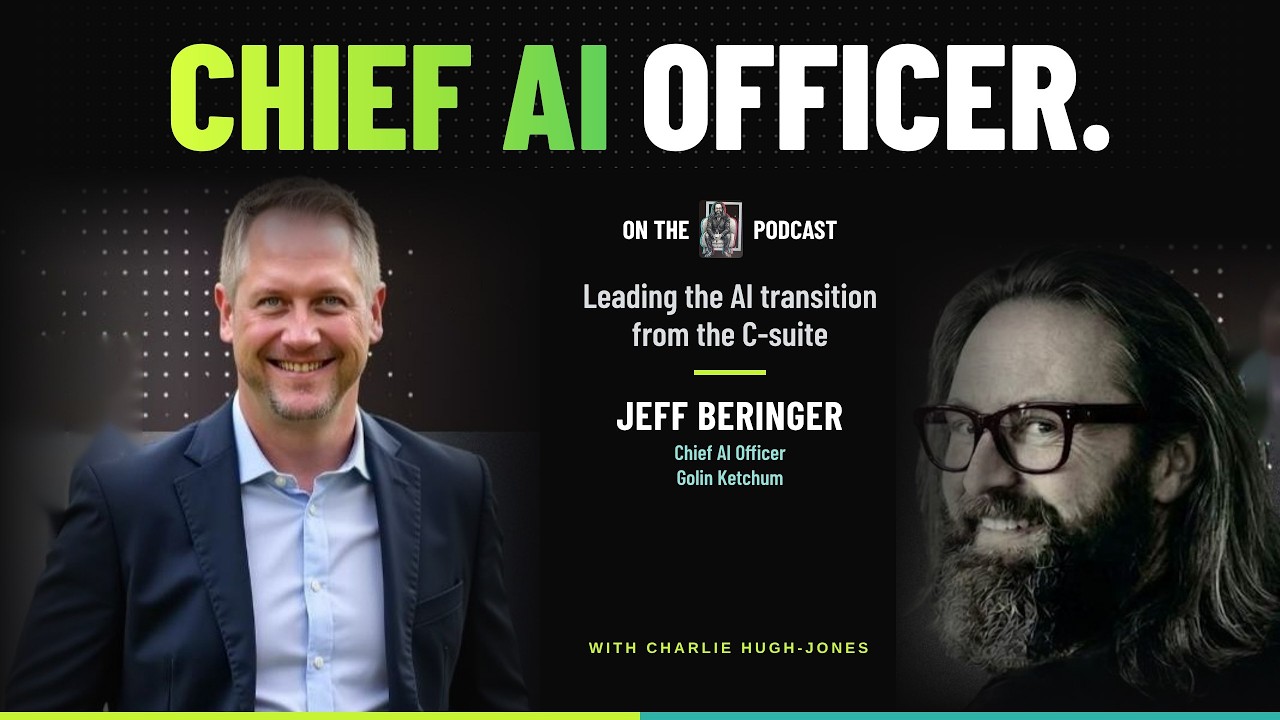
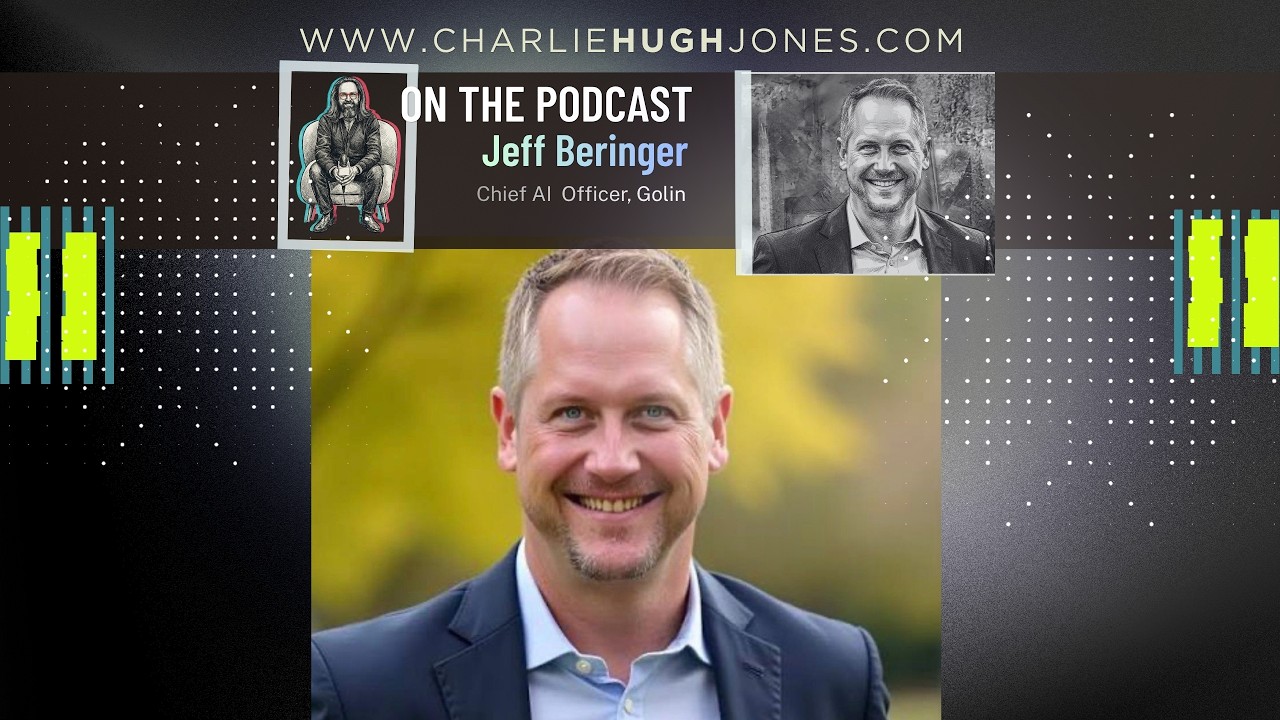
In this episode of the "Intelligence Augmentation" podcast, host Charlie Hugh-Jones interviews Jeff (Geoff) Beringer, Golin’s first Chief AI Officer, about the agency’s two‑year journey to become the world’s first fully AI‑integrated global PR firm. Beringer explains that the transformation is not a technology rollout but a human‑centric change effort focused on intelligence augmentation—using AI to make people more capable rather than replace them. He describes the development of an AI maturity model that maps each employee’s learning stage, the personalized coaching system built from two years of usage data, and the high participation rates (97% training completion, 95% of staff now using AI daily). The conversation highlights the leadership behaviors required for such change: modeling desired behaviors, showing humility and vulnerability, and fostering psychological safety. Trust is built through transparent communication about AI’s role, leading to record low turnover and continued business growth despite industry headwinds. Beringer shares his personal hope that AI can empower humans to reach their full potential, positioning the agency for adaptable, future‑focused success.
Chapters
Over 100 interviews, nearly 1,000 leadership reflections, just under 200,000 words of sensemaking, and I keep arriving at the same question. Who do leaders need to become to lead this AI transition with wisdom? I have my own view, but this podcast is me exploring that question with those living it. I'm Charlie Hugh-Jones.
Welcome.
My guest today has spent nearly 2 years doing something most AI leaders are still only talking about: actually transforming a global organization from the inside out. As Gold's first-ever Chief AI Officer, he has been leading 1,500 people across 50 offices to become what he believes will be the world's first fully AI-integrated global PR agency. His framing is distinctive. He doesn't talk about automation. He talks about intelligence augmentation, the idea that the most powerful thing AI can do is make the humans it works alongside more capable, not less necessary. Geoff Beringer, welcome.
Thanks, Charlie. It's great to be with you.
Oh, thank you for coming on the show. Appreciate it. We'll dive right in because I want to be respectful of your time. Jeff, about 2 years ago, you set out to transform an entire agency from the inside out. And I kind of want to start not with the strategy there, but with what you've actually learned. What do you know now that you didn't when you started?
Wow, that's a great, great question, Charlie. You know, I think as we started our transformation journey, our suspicion was that this was largely about a technology rollout, and it's not. It's not. And the, the, the real gains that you may make in a business and with your people is not by focusing entirely on technology, but it's truly on the human beings that are using that technology and thinking about things like their relationship with work and how that evolves. Because if you don't get the people side of it right, and the people that are part of these transformations and these organizations don't believe in what we're all trying to accomplish, Then you never get anywhere. You buy tools and they sit on the shelves and so on. And so I think what we've learned is that transformation is not just a technology rollout. It is about helping people adapt. And when you think about adaptation and people and technology together, that's when the real change that matters happens.
Wow.
The real change that matters happens. Can I just dive into that? What, What's change that matters? Could you gimme an example of change that matters?
What we communicated to our colleagues around the world is a very simple premise that our goal in becoming an AI-integrated agency wasn't about replacing our people with machines. Fundamentally, from the get-go, when we started writing our plan, this was about making our people better and the best in the industry at what they do. And the farther we've gone through this journey, the more that we, we really realize just how important that focus on human beings is.
I'm curious, you gave an answer. I want to go deeper, but let's stick with that.
We wrote a plan, a transformation plan with our executive leadership team 2 years ago. And while a lot of that plan still holds true today, what has helped us achieve the progress that, in the gains that we've made so far, is really more Because we have been willing to adapt along the way, course correct, and so on. I think a lot of leaders go in very confidently into transformation, and sometimes that confidence can be a crutch, and that crutch prevents you from moving in different directions to get to what you ultimately hope to accomplish.
There's something interesting. You know, one of the things that you reported was that you kind of hit 97% of AI training participation within 12 months. I mean, that's just remarkable. And I see you nodding there. It's like, wow, yes. But training participation and that genuine cultural change are kind of different things. You know, is there a gap you're still trying to close there, particularly in the context of the merger, I imagine?
We've had great participation from our people in the things that we're doing to help them upskill. One of the first things we did, we developed an AI maturity model. And we started to work with our employees to understand where everybody was at in their AI learning journey. Everybody's starting in a different place. A couple years ago, roughly 15% of our employee population had used AI at all. Today, that number is, is north of 95%, and most people are using it in their day-to-day work. But we didn't start there.
You know, culturally, I was, I was just looking at the piece that you've got 97 of AI training participation. People got involved and that was pretty amazing. There's engagement, there's people doing things, they get involved. But now you're going on a whole nother journey. You know, that gap between genuine change, you know, and participation, they might be using the tools.
We do.
Yeah.
So one important thing that we've learned along the way is that everybody is truly at a different point in their learning journey. And as an organization and as leaders, we've got to support people no matter where they are. So we spend a lot of time talking with our employees, doing a number of surveys over the years, looking at data on how people are using to understand where everybody's at in their, in their AI journey so that we can help them with whatever they need to get to the next level. So, so you may have people that are beginners that are doing very basic things all the way to people who are experts in our organization who are building their own agents for their team, themselves, their clients, and others, and, and others look to them as, as models. What's been helpful to us is to really understand where everybody is at. and personalize the support that we give them as much as we can. So, you know, as an example of that, one of the things that we did recently is we have the benefit now being 2 years into our transformation journey of having 2 years of organizational data on how people are actually using technology really well in the context of their work and sometimes when they're not using it very well.
Yeah.
And recently, one of my colleagues helped us build a solution to take all of that information. And when an employee raises her or his hand and says, I want you to help coach me to get to the next maturity level, what, what can I be doing a little bit better? What are some tweaks? Now we have the ability to go in and work with that employee and literally pull information on how they're using tools in the context of their specific role. And we can provide tailored coaching to them. To me, that That's kind of the last mile in getting everybody to expert level. Just recognizing everybody's job is different. Everybody's relationship with work is different. Their fears about AI are different. And we have to be able to adapt as leaders and as organizations to help people no matter where they are. So personalization and personalizing the learning journey for us has been really, really important.
Yeah, no, I can see that. The results kind of speak for themselves from what, what You know, Golan, and you've been able to share. There's a phrase you use, and I mentioned it in the intro, you use intelligence augmentation rather than automation. And, you know, I get the sense that's a very deliberate choice. What does it actually require of a leader to make that real inside an organization, not just framing or fluffy words?
For a leader, to me, one of the most important things, and I'm blessed with this in my organization, is leaders who will model the behaviors we wish to see in the organization. And also having the humility to say when you don't understand something, when you don't have all the answers. And I think a lot of us have grown up building our careers and, and our credibility on expertise. And expertise still matters. But in the world of AI, when our jobs are changing very quickly, your expertise can't just be your title or what you knew 6 months ago, because those things may not be as valuable 6 months from now. So I think leaders definitely have to model the right behaviors and they have to have humility so that others in the organization can feel comfortable to learn because sometimes with learning comes failure. When we rolled out our learning and development program, it's called Go Learn. One of the things, 2 things that were really valuable. One is our senior leaders in the organization, they were participating in those trainings the same way that an intern or someone that just started, you know, their first full-time job out of college were doing. Leaders were involved in it too. The other thing that made a real difference is when we built training content for our employees to show them how to use AI in the context of their jobs, we didn't go out and license a bunch of content from third-party organizations or even others inside of our holding company. There's a lot of great training content out there on AI. The problem is sometimes the message bearers aren't the right people, people you trust. And so we were very fortunate when we were developing our, our learning and development strategy and content. That we had our most trusted, most experienced people in the organization. They were the ones that were leading the charge. They were the ones appearing in trainings and leading exercises and literally showing people how they were learning to use these tools and new techniques in their work. And sometimes that means them showing when things didn't go so well, when they failed, when they didn't know how to use a tool the right way or something happened when they were using a technology that they didn't really expect. And I think that kind of vulnerability is really important, especially for leaders, because it shows people we're all in this together, we're all learning, and it gives people psychological safety to say, you know what, I'm going to try this and I may go into it with the best intentions, but things may not go well. They may go sideways, and that's okay, because so long as we're working together toward a common goal, then we can achieve it. So humility and leadership modeling are 2 really important, I think, pieces of the puzzle.
Yeah, vital. It's really encouraging to hear that. Hey, do you mind if I could just go deeper one second? This is on your leadership now because you're the Chief AI Officer. So there's a degree of expectation that has been forming and arriving around that. And I'm just wondering, given what you were saying about the vulnerability and, and being in a space where You might show your learning as you go along. There's a question here around, you know, was there a moment for you across this time where you had to choose between performing certainty and being genuinely present with uncertainty, the not knowing? And if so, what happened?
I don't know if there was a single, single moment, Charlie. Probably not just one moment, but over, over time, what I, what I realized is that, you know, in previous jobs, leadership roles, my job was often to be the person who had the right answer most of the time. And I think what I've realized in this role is my job is less about having all the right answers every day, but creating conditions in which our organization and people at all levels can go find those answers together. And that's, that's a very different role. You know, in past leadership roles I've had outside of AI, generally the expectation is the senior-most person is always the smartest person in the room. That's not true with AI. It can't be true with AI because we're all learning. And so much of what we can put into practice in our organization doesn't always come from leaders. It's coming from people at various levels inside the organization. And if you create those conditions where you're less occupied with making sure you're showing up to every meeting with all of the right answers, and you're more concerned that the systems are in place and the environment is in place where, as a group, you can find those answers together, That's, I think, where change can happen more quickly.
That sounds like there's a lot of being with uncertainty and cultivating curiosity, because if you don't have the answers and you're looking for an organization, there's also a trust level to the next layer of that you're building as you're building out this ability to surface the answers. Trust that they will come through the system you're building. Yeah, yeah, yeah.
I mean, the trust piece is big, and this is, you know, people have a lot of fears going into AI. People are worried about their jobs, and I get that. Our jobs are going to change, and we've been very upfront with all of our colleagues that yes, our jobs are going to change, but we've also been very upfront that our goal is not to replace human beings with a bunch of machines. And, you know, that is That is culturally very much in line with who we are as an organization. But it's also— there's a business reason for that, because we realized very early on in our transformation journey is that the best results do not come from machines working alone in isolation and humans working in isolation. If the two of them can work together and leverage their strengths, that's when you get to the best outputs. We've tried to be very clear with people on what our goals are. And what our goals are not. And I think that has helped us build some degree of trust over time so that people have the freedom and security to be able to experiment and learn and grow together.
Wow. That's cultivating some environment for people to operate in. So yeah, I imagine if I asked people throughout the organization, the stories of that will be uniquely their own, but yet consistent about the And they are. Yeah, they are.
And it's, and it's interesting because you've seen the last few years a lot of organizations that have been focused on the technology side and not enough on their people. They've been treating this as a technology rollout, and oftentimes organizations have mistakenly been using AI as an excuse to shed human talent really fast. And they may get to some short-term financial gains in that, thinning out headcount, but I think longer term, It creates challenges for those businesses because when your most brilliant people walk out the door because you're not investing in them to make them better, your ability to even use AI to its fullest potential is also leaving. The technology can only do what the human beings can help it do and point it in the right direction, right? And one thing we were very pleasantly surprised about in the last year, our business has been in existence for almost 70 years. And last year we had our lowest turnover rate in our entire company's history. One of the major PR publications does the Best Place to Work survey every year of all the major agencies, and they ask our employees, what's it like to work? So this is not us saying it, it's our employees. And what I was really heartened to hear in the feedback that we saw from employees is employees have decided to continue building their careers with us in part because they know We really want them to be the best in the industry at what they do, and we're investing to make them as capable as they can be as practitioners. And, and I think, you know, that trust goes a long way. It certainly helps from a business perspective when you don't have 30% turnover rates and you have 5% turnover rates, but it also, it also helps, you know, those human beings feel secure, learn new things, and that's when the real business value is created. When people are learning how to use AI in new ways, that's when innovation happens. That's when new products and services are developed that create new revenue streams for businesses. And so, you know, when a lot of businesses have been contracting in our industry in the last few years, ours has been growing. When lots of businesses have been laying off lots of people in, in recent years, we've added headcount despite the fact that we've been in some of our deepest phases, our most active phases of transformation. Those should be unsettling times where people, you know, get anxious and maybe decide to leave. But the opposite has happened. And so I think creating those conditions where people feel safe, they learn, they're growing as practitioners, they have the ability to create new things that then creates value for the business that allows you to invest even more in those people and add new talent to the organization that can help you do more with AI and without it.
I was going to say, that sounds like it really matters to you, Jeff.
It does. It does. I think there's a narrative that's false out there that AI has to mean job losses. I don't think it does. I think when organizations and people inside the organizations work together, invest in one another, and they trust one another, and you put people first, you get what you're looking for in terms of things like efficiency. You get the business gains in terms of innovation and new revenue streams, but you also have a workforce that is happy, that stays, that trusts one another, and that, you know, it's a system that works together. And what we're really trying to do is build a system for the future. We don't know what our agency will look like 5 years from now, but what we're trying to do is to create and cultivate a culture that makes adaptability possible. That we can continue to grow and change and evolve and, and be the agency 5 years from now that is leading the industry. And again, I don't know exactly what that looks like. Nobody probably does. If we create the right environment that our people can continue to grow as our business grows, those things work together and we will continue to lead the industry. At least that's our hope.
Wow. I was, I was about to ask you the question, what gives you hope? Not optimism, but genuine hope about where this is heading? And that's probably a little bit wider than just Golem. But yeah, that question, given that you've touched on hope, might be very relevant right now.
Yeah, I'm blessed to have a job that I love. And I get to go to work every day and help people discover what they are capable of as human beings. What we're doing in AI enablement is, is very much about helping people achieve their very best. And that's, that is super rewarding. It gives me hope every day to see somebody discover something new or to unlock a capability that they had inside, but because of time pressures and complexity of work and things like that, haven't been able to fully utilize the talent they have. Now, as we're working to integrate AI and make it safe and easy for people to use in their day-to-day work, I get to see people achieving their whole potential and succeeding as individuals as our organization as a whole succeeds and grows. And that, that gives me a lot of hope for the future because it Again, it comes back to this belief: AI integration doesn't have to come at the cost of human beings. It can actually do the opposite. It can actually empower and equip and help your human beings grow and thrive. And, and we've seen that in our own world.
Well, Jeff, this has been an absolute pleasure. What you've been able to share about the experience of those at Golin, those within the orbit and under the influence of your leadership, Seems like a real case study for proving out what you believe. So it's, it's, it's been marvelous to be able to share this time with you and ask these questions of you, and you so generously share the answers. So, Jeff, thank you very much for being on the pod today. I look forward to further conversations with you, but very grateful for your time.
Thanks, Charlie. I appreciate it.
Somewhere more exciting, somewhere more meaningful, somewhere more unexpected. Well, if you're curious about switching direction and creating change that matters, then let's go. Because our destination is clear: to be the defining agency of the decade. Which means sometimes we need to go to unexpected places to find the right answers.
Let's go!
Our curiosity has taken us from delivery rooms.
Listen up, Mom.
It seems to be Grubhub is celebrating you by giving out your first meal post-delivery.
To the bleachers at Shea.
The Grimace Effect is in full swing.
From incubators.
Save the Children is turning incubators into the world's tiniest rental rooms and listing them on real estate marketplaces.
To finding love in the aisle.
This isn't a typical rom-com, it's rom-commerce.
We've gone to hell and back.
Mountain Dew Flamin' Hot. Hot, the official drink of health.
We've strutted the croissant, hit the surf.
These pups are competing in the 28th annual Purina Pro Plan Incredible Dog Challenge.
And traveled across time zones.
Do a company sponsoring a time zone.
We even went back to the '80s so more people could hear us. And that gave us a one-way ticket to Cannes.
Grand Prix winners, roll it!
There are no breaks on the journey to do work. I love fruit. Unless that break can get the attention of the World Health Organization. The journey has been rewarded and well documented, all driven by a global network of people who are fiercely ambitious yet fundamentally kind. So if you're ready to go someplace new with a partner that is recognized for going above and beyond, then let's go all in.
More from Charlie




Intelligence Augmentation (IA) It’s not just a phrase. It’s the human dimension.