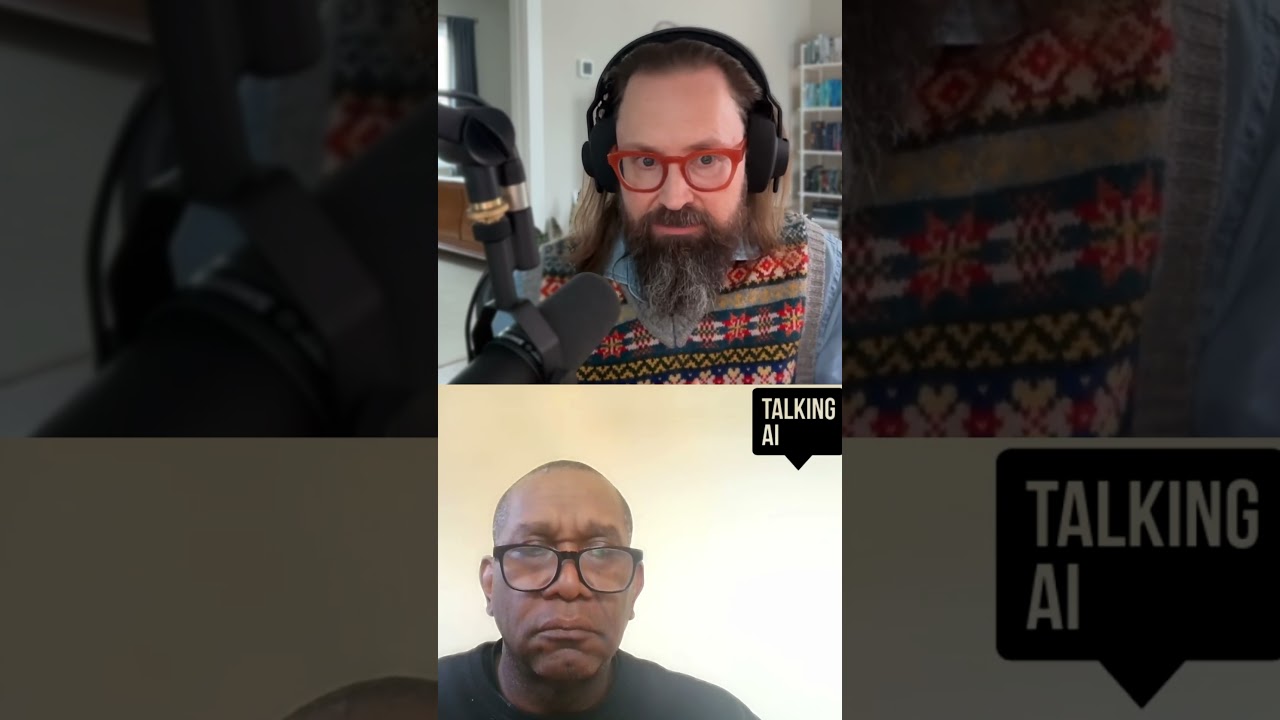
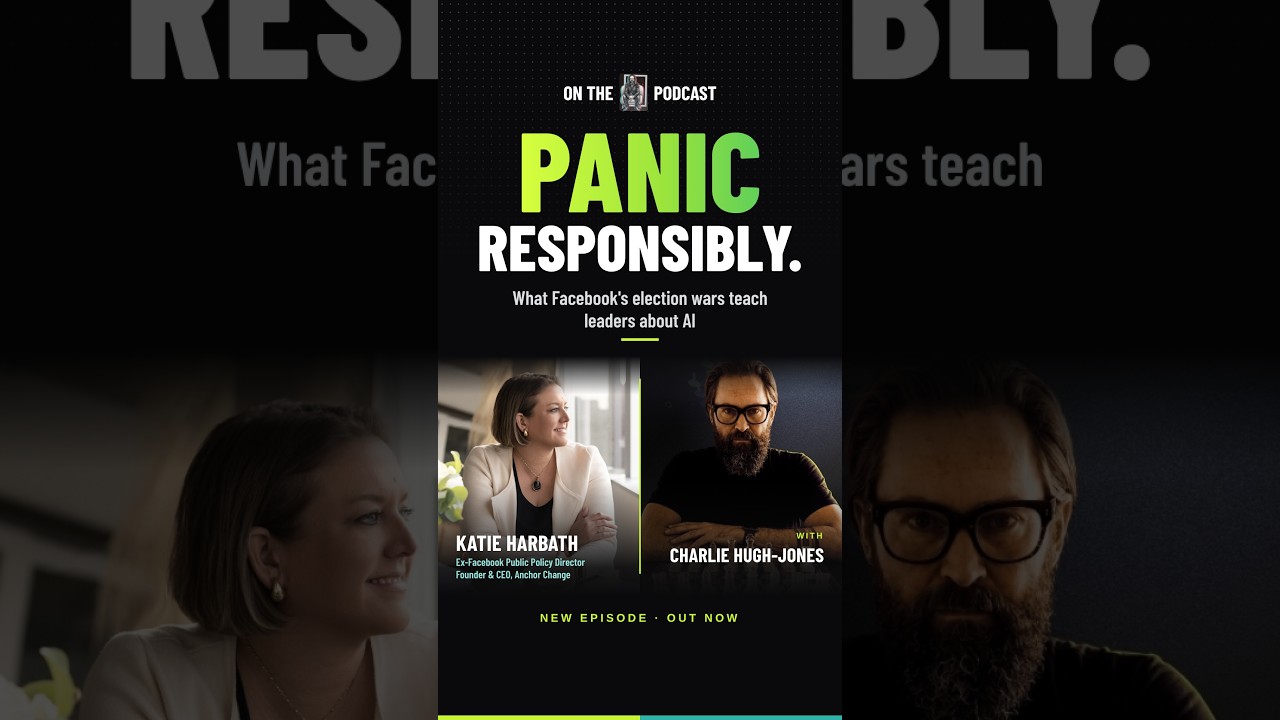
Panic Responsibly: What Facebook’s Election Wars Teach Leaders About AI

Katie Harbath, who led elections policy at Facebook, discusses the 2016 fallout and what it taught her about AI governance. She introduces a "traffic-light" risk matrix for decision-making and the concept of "panicking responsibly," a disciplined pause that weighs rapid reaction against values. AI will reshape every sector, she argues, requiring ethical guardrails and community-building.
Chapters
I learned over the years that it comes with the trade-off and the need to be able to not only withstand criticism, but engage with criticism. If a leader were coming to me being like, I wanna have a lot of impact, but I don't wanna be— I don't wanna get bad news stories, I don't wanna be called— hauled in front of Congress, it's almost like saying, I don't wanna be held account for my decisions that led to that impact.
Oh, Breathe.
Over 100 interviews, nearly 1,000 leadership reflections, just under 200,000 words of sensemaking, and I keep arriving at the same question: who do leaders need to become to lead this AI transition with wisdom? I have my own view, but this podcast is me exploring that question with those living it. I'm Charlie Hugh-Jones. Welcome. Hi. My guest today spent close to a decade inside the rooms where Facebook and electoral politics collided. Credited with helping win an election one year, treated as radioactive within the same company 2 years later for the same resume. She left in 2021 to found AnchorChange, and her book, Disrupting Politics, out October 6th, is her account from inside that machine. This podcast today isn't a Facebook retrospective and it isn't another AI doom conversation. It's an hour of the choices that remain even inside forces that we didn't fully choose. Katie Harbath, welcome.
Thank you for having me.
Oh, you're very welcome. I've been looking forward to this conversation, Katie. So thank you very much for joining us here today. I want to get right into it, if we may, if you're okay with that.
Of course.
Okay. So your book, it opens with you sitting through a green light on Constitution Avenue the morning after the 2016 election, not moving, not even with the radio on. What did you actually understand in that moment that you didn't the night before?
Oh, that I think that our politics and our world had changed in a way. It hadn't changed overnight. It felt overnight. There, in looking back, you can see a lot of different things that led up to Donald Trump winning. But it was, especially for me at Facebook, I was like, this is gonna completely change how particularly this town, Washington, DC, views us as a company.
That's something, the change in view. Now, I kind of wanna get into that, but there's a little point about judgment that I wanna explore first. You, you've written that judgment always comes with blame. And that no system can actually resolve that. A person still has to decide.
Yeah.
Now, most of the leaders I talk to want a framework that removes that kind of exposure. You said that that night or that day after the election, you could see that the view of people would change. What advice would you say to leaders who want a framework that removes their exposure to that judgment?
If you have a framework that removes that judgment or that exposure, that oftentimes means you're gonna have a less impact.
Yeah.
And that's really one of what I call an impossible trade-off that you have. If you want to have scale and impact on the world, that means exposing yourself to a wide range of opinions, a wide range of viewpoints about what is or isn't— what you should or should not do, how things should go. And so that, I've learned, comes with the territory. And so if a leader were coming to me being like, I wanna have a lot of impact, but I don't wanna be, I don't wanna get bad news stories. I don't wanna be called, hauled in front of Congress. It's almost like saying, I don't wanna be held account for my decisions that led to that impact. And I oftentimes try to reframe that because I think that if you wanna have a large amount of impact, you should expect and almost welcome scrutiny and be able to think and be thinking critically about what it is you're trying to do. Because that's one of the things I think we didn't do in the early social media days. We were like, we just wanna connect everybody, right? That seems like a good thing. And we didn't think through, okay, what is that actually going to, what is that actually gonna do? And what might be the unintended consequences from that?
Yeah. And, and, and I think, you know, I kind of got ahead of myself there talking about other people's judgment, 'cause actually I wanted to talk about your judgment. 'Cause within your own telling, You are credited to some degree with winning the 2016, with the win in 2016. And then within a very short period of time in corporate life, recast as radioactive. Yeah. You know, for the same Republican background. I think what I wanted to ask you before we got into the question, and I got myself mixed up, but this is how it happens sometimes. What does that do to someone's ability to trust their own judgment going forward?
It is really hard to Because you have to start, and I, this is still a skill I continue to try to perfect. And I think us as humans never get to a point where you're 100% perfect at this, but there comes a point in time where you have to trust your own intuition.
Yeah.
And you have to trust that, and you think through what are the values that I'm wanting to operate off of? What is my theory of change in the world? Mm-hmm. Don't be so stubborn that you're not willing to pivot and change. Of course. Mm-hmm. I don't want people nor myself, like, cuz there's, it gets very easy to be frozen, right? Mm-hmm. That fear can make you be like, maybe it's just better if I don't do anything and I just sit here quietly and hope that nobody comes after me and that I can just have this nice little life. And that's great for some people, but again, if you're wanting to have impact like I was and wanting to do these unique new things, I learned over the years that it comes with the trade-off and the need to be able to not only withstand criticism, but engage with criticism.
Yeah.
Engage with it and have those conversations so that not only can you understand other people's perspectives, but this is a big reason I wrote the book too. was to help them to understand at least my perspective of how we were trying to approach these decisions.
I'm picking up on one point in the middle of that. You talked about engaging with criticism. How do you resource yourself to do that? How do you expand your capacity to, you know, we talked about leaders before wanting to seek frameworks that release them from exposure. Actually, when you are engaging with criticism, aren't you opening yourself? You're deliberately, intensely becoming more exposed. How do you do that? Or how do you do that, Katie?
I mean, I have to say it came for me a little bit of how I was raised.
Okay.
My dad, you know, he worked at a paper mill and he oftentimes took me hunting. I'd be in rooms with, with these, oftentimes the only woman as a teenager in this room with these, you know, guys and learning how to kind of hold my own and have that conversation. But then it really was college. I went to University of Wisconsin-Madison. That is a much more liberal campus. And I worked at the, the conservative student newspaper, the Badger Herald. We have 2 on campus. And I remember us, we would like the student, the student government and us on the paper, we'd be like writing editorials disagreeing with what the student government was doing. The student government, it wouldn't be happy with what we were reporting or what we were putting in our editorials. And during the day, we might be on opposite sides, but then we would find ourselves at the local bar in the booth together, having a very friendly debate about what was happening. And I think that exposure for me at UW-Madison put me on a path of sort of understanding and learning how to engage in those situations. And then I think too, over time, going into politics, particularly digital campaigning in the early 2000s, one of the things I loved about that was that it actually brought Republicans and Democrats together because we both had the same goal of wanting to get our elected officials and candidates using digital more. So I naturally made a lot of friends across the, across the aisle and was having— and a place like D.C. is very regular to be encountering people who disagree with you, and it's very much a norm to be having those conversations out loud. Now, during the Facebook years, they definitely got harder and harder and harder. But one of the things I discovered as well is that even if people disagreed with me, there was— I'm gonna use the word respect, and maybe it's not the right one. Yeah. But there was a respect that came from that, that I was willing to show up in front of them. Listen, really listen to them, and then also share like my— and, or it was usually the company's opinion about this. Many times companies wouldn't engage and that would build up resentment even more with these outside groups and stuff that were wanting to talk to us. Mm-hmm. And so since it was mine and my team's job to be building up these relationships, I was like, they may not like what we have to say, but the pure act of just showing up, is sometimes half the battle with them. And that's why it was important to continue to— and it's still important for me to this day to be able to have those types of conversations.
Yeah, yeah. Important to have those kind of conversations. Again, I'm jumping ahead of myself, but that's because of where you're taking us, which I love. When we get to the back end of the book, you start talking about sort of the agency and what we can do. Yeah. Individually irrespective. You just described when I asked you about the engaging with criticism, your upbringing, your values, the way you were tested and tried. And that was related to a question of how do we encourage, inspire, equip, help leaders who are coming up to learn that? Because you said friendly debate. Now debate feels anything but friendly in a lot of the town halls and town squares and things that we currently are experiencing. You know, how do we help young leaders, emerging leaders do that better?
I think there's a couple of things. One, when I talk to a lot of college students, I'll start with college students right now, I get this sense that there's a lot of fear of failure, right? They were kind of brought up of like, you gotta do what you can to get to the next grade so you get into a good college, do what you can to get into a good job. And I oftentimes remind people, I worked 10 years at a company that didn't exist the day I graduated college in 2003. Because our educational system is like a ladder, you just keep going up it, and then it feels like the minute you graduate, your career then actually is zigzaggy, kind of all over the place. You're not really quite prepared— It's brutal. Quite prepared for that. And, you know, it's hard to change all of society, but it's like, okay, how do we help provide environments where it's okay to fail? It's okay to think through a problem. Like when I go and talk to college students, I oftentimes have this interactive exercise where I make them be a content moderator. Mm-hmm. And I make them think through how they would handle these tough pieces of content. And then we talk it through at the end of sort of like how to think through that. But I find it helps take 'em outta the theoretical into the practical around, around a lot of that. The other thing too is just purely, this is what I try to do. Is just demonstrate it. Yeah. Demonstrate what it can look like. I had, when back in 2023, when there was the big debate of whether or not Donald Trump should be let back on the platforms, particularly Facebook, my former colleague and good friend Crystal Patterson and I, Crystal came from Democratic politics. I came from Republican politics. She was on my team at Facebook for many years, but we went on CNN and had a conversation when we had differing views. About what that should happen. And part of the reason her and I wanted to do that was to demonstrate to people that 2 people can be friends. They can have different political viewpoints. They can have these conversations. And here's how you might be able to both talk and listen. Listening's very— a big part of this, right? Yep. Like, we oftentimes think it's just about the talking. It's actually the listening is more important around all of that. And so It's, it's, for me, it's really kind of at that grassroots level of helping to put them in situations where they can practice it too, right? Like, this is not something you just wake up one day and are able to do. I've taken everything from the Crucial Conversations course, which, if people aren't familiar, that's a great book. It's a great course. You know, there's books like Radical Candor and stuff like that that have really helped me over the years to kind of, Continue to hone my skill in doing that.
Yes. Great recommendations, both of those. I think there's something interesting that happens when the ability to listen deeply, to hear, to be present with someone often comes when we release our identity from our position. I.e., you know, you were saying you could go on CNN with Crystal because you were friends, even though you had different opinions. So your judgment, your view of each other's identity wasn't, you are your opinion. It was, you are who you are and you hold an opinion. This leads me onto an interesting point because you described in the book, you know, part of the cost of building your identity around an institution. So this is separate from the Friends Institution. And I kind of, I'm really interested in what breaks when the institution changes And you don't, you know, and I see that pattern constantly with leaders who are trying to navigate this AI moment right now. You know, what actually got you through the choice to change rather than break?
Ah, that's a really good question. I think there were a couple of things. One, talking to friends who had left the company already. There were a lot of them that was like, there's life after Facebook. And they were really instrumental in helping me to think through it. Also that to take my time, that like it would take time to separate my identity from the company. And that definitely was the case. Like I would probably say like probably from 2019 to when I finally left in March of '21 was sort of that journey, part of that journey for me. And frankly, like it's still a part of my identity. It always is, but it's not the only part of it. Mm-hmm. I think too that I had, I had kind of grown up in this world where, you know, it was loyalty to whether it was the Republican Party at the time when I was working for them, then it was kind of loyalty to Facebook. And especially in the tech world, it was all about like the company is your family. They're providing everything for you. You're spending more time with the people at your company than you might be with your own friends and family. And so it's really easy to blur those 2 things of who you are as a person and who the, who the company is. I realized for me there is one moment, and it was after I got taken off the elections work in 2019, and my new manager at the company was like, well, maybe you just stop doing election stuff and you move to a different topic, like maybe privacy. Yeah, I had the same reaction that was just on your face.
Was, was that Molly who said that? Was it?
No, this is a different woman named Delphine.
Oh.
But she was just trying to help me like think through, cuz it was after Molly had kicked me off of everything. And, and I was like, but elections is my jam. Like, this is my, this is my thing. But I actually took a moment. I'm like, well, let me think about this for a minute. Like, am I just too, am I just too attached to this? Am I thinking about this wrong, et cetera? And I did give myself a week to like journal and think about it. And I real— I was like, no, this is, this is what drives me. This is the topic that drives me. And I don't want to just give that up because somebody, one person or this company, no longer wants me to do that. And so now it's up to me to figure out how do I continue to do this work, whether it's at the company or outside of the company. But that was a really big turning moment for myself where I actually took a moment in time to sit with it and think about it. Because far too often we can let inertia just continue to drive us, right?
Yeah.
Like, I got this job, I got this project, it leads to this thing, and you could all of a sudden end up a couple, you know, decades later being like, wait a second, I don't even know if I really like this anymore. So I'm glad that I took that moment to, to think about that and understand that of what that looks like. The last thing I want to say in all this too, that I I didn't realize until I was getting really close to leaving, and that was about allowing for a grieving process. Hmm. And I— because a lot of times we will think if, if the organization changes and you don't and you're no longer a fit, that that's somehow a failure on either, either person's part. And it's not necessarily a failure, it's that things change. And that should be okay. But also to grieve for what you're losing, be thankful for what you had. And it was really hard during COVID because I couldn't do that with other people. Right? So I was doing this a lot on my own. So I was making goodbye breakup playlists on Spotify around all the things. I think I talk about it in that part of the book. I want to hit that part of the book. But I really did. But I found that it was really cathartic. Hmm. And something about the ceremony, I, and I actually even did a little ceremony that was like thanking Facebook for the time that we had, for all that it gave me, and then celebrating me going into this next chapter that I was going into. And I think that that's really important and we oftentimes overlook that when we're leaving jobs.
It would be very easy for me to just skate forward into the next thing, but I want to, I want to dig into that, if I may.
Yeah.
Because you established a ritual for almost the goodbye, the grieving process, the celebrating, the moving forward. Can you remember what prompted you to do that? Who it was, or what you read, or the moment, you know, maybe you were reading, drinking Green Dot, I don't know, and you went, There's something about a practice that will help me process so that I can move on.
I honestly don't remember exactly what, I don't remember exactly what it was, but there was something about reading about ritual, reading about, I was also working with a coach at the time about these sort of life transitions. Yeah. And adult stage development and stuff like that. And I think some of it might have come from there. I was also reading Glennon Doyle's book Untamed. It just helped me a lot during that, that time period. This was definitely a journey of getting through this. It's not like I sat down one night and I was like, I need to grieve, I need to do this. It was sort of like a realization over time that I was like, this is kind of like a funeral, like, you know, and you want it to be that mix that you're sad but a mix of celebration.
I think you've articulated something important there around time, that sometimes this takes time to become, to evolve, to surface, to be there. And I think working with a lot of leaders, you know, they want to fix, they want a framework, they want to think that if I do this one thing, this will work, which is why I wanted to pick up on the ritual thing because it took you time to get there. Yeah. And then obviously you're processing afterwards. And I think One of the things in our absolutely accelerated world at the moment that just become doubly exponentially accelerated, or our sense of it through AI, actually taking time for things is important to process, to grieve, to celebrate. So—
Also to plan. So because as we went into COVID, I was no longer traveling the 275+ days a year that I was traveling. I didn't have my job as I knew it. And so I'm sitting at home with my cat who's like, why are you home all the time now? Like, what are you doing? I remember consciously making the decision of like, okay, I am going— like, I'm not gonna be able to leave during this year of COVID And if they're not gonna get rid of me, I'm not going to, cuz the job market, I don't know what this is gonna look like, but I can take this time to contribute where I can inside the company. but also to really think about what is it that I wanna do next. Hmm. I made color-coded charts. And in fact, on my, my newsletter anchorchange.substack.com, I have a bunch of different pieces where I talk about how I mapped out my post-Facebook journey around all of that. And taking that to your point there, taking the time, and this is a year like of, wow, like mapping some stuff out, thinking about it, having conversations like, different things unfolding, listening to my intuition versus necessarily what everybody else thought that I should do, et cetera. I am really, really, really glad that I took that time because then it made— when I made the decision to leave and to start my company, I had a really good solid foundation of why I was doing it and what I was going to measure, I guess, all of my actions up against and being like, okay, is starting— okay, starting a newsletter goes with the voice pillar. Doing this thing goes with the mentorship pillar. Doing this thing goes— I have these pillars like build. And it just really helped me to be intentional in terms of what I was then trying to build next.
That intentionality as opposed to reactivity sounds very powerful in your situation.
Yes. And it gave me, it helped me out of coming out of a situation where I felt like I had absolutely no control to then being like, okay, the only thing I can control is me and how I react and what I do. And the other thing too that was really important to me, and I can't remember, this has been said in many different leadership books and stuff like that too, but right, like people remember how you leave. They remember more how you made them feel. And so I was like, okay, if I'm leaving this institution, sure, I could burn it all down. And the same thing with this book. I could have burned— if I wanted to, I could have written it in a way that was burning it all down. That's not what I wanted to do. And so there was an intentionality too of how I wanted to leave.
Wow. And how did you want to leave?
I wanted to leave in a way that was— I was going into something that was as much on— well, me getting pulled off elections was not on my terms. I wanted to leave and go into the next thing that was on my terms as much as possible. There were— I had so many— I wanted to make sure everybody on my team was okay as much as I could make them okay. I couldn't take everyone's burden onto me, Mm-hmm. But what I could do is be like, I'm happy to help. And I do this to this day, happy to help make reference, like references, keep an eye out for jobs, be a sounding board, be a mentor, et cetera. I wanted to help the teams, the trust and safety teams see their way through the 2020 election as much as I possibly, as much as I possibly could. I didn't want any to leave anybody in any sort of lurch or, you know, hard spot as part of this. And I didn't want people seeing me as being like, I'm going to say sore loser. That might be the wrong term too. But like, but I didn't, you know, there's— I just wanted it to be something where it was like, I can be sad about how things went down, but I'm going to leave in a respectful way. Yeah.
Yeah. That's meaningful. Leave in a respectful way whilst also feeling the pain of leaving. Okay.
I think the thing too is that especially now, what I call the Facebook diaspora is quite spread out all over Silicon Valley, lots of places. And I have been able to maintain relationships with many, many, many of those people. And I think a lot of that again is if somebody wants to now hire me as a consultant, They don't remember me as, again, the person that burned it all down.
Yeah.
They remember me as the person that helped them to do this thing, or that, you know, managed, managed a very tough situation in a very professional way, and thus makes me somebody they want to work with again.
Yeah. Katie, thank you for talking about these things because I wanted to get to how you processed, how you operated, how you made decisions, the intention behind the behaviors.
Yeah.
Because we said this wasn't going to be a Facebook retrospective. We talked quite a bit because naturally that would be the case. But I want to kind of look forward now, you know, because you talk about the current time that it's an adaption era, not the platform, not a post-truth one. And you talk, and I love this because you started it in response to the AI dilemma, I think. You talk about panicking responsibly. And I absolutely, I came late to that party. I did see it in Anchor Change a while back. And then kind of when we talk about helping leaders see adaptive challenges, we talk about staying in productive discomfort, which is very similar to panic responsibly. Yeah. Most of the leaders that I work with, that I interview, experience the pace of change kind of as paralysis dressed up as caution. What's the actual difference for you between panicking responsibly and just panicking?
Panicking? So I think when you're just panicking, you tend to be, you're very reactive. Everything is coming at you like a fire hose and your instinct is to stick your head in the ground. Yeah. Either to hide or you tend to make rash decisions. So it's like, what do I need to do in this exact moment to make the pain go away? Not thinking about, okay, what pain might that decision be causing me a couple, like a couple weeks down the road, couple months down the road, et cetera. It's, it tends not to be rooted in values. It tends to be rooted in the pain of just that moment, which may not be the right, the right decision. Panicking responsibly, I still recommend a pause, but it is not, you're not frozen. And what I mean by that is it's like assessing the situation, understanding, okay, what are the, what are the criteria or values I want to weigh whatever decision I need to make? And even doing nothing is a decision, right?
Yep.
So, okay, if I do these, you know, let's say you have 5 different options in front of you. What are the criteria? And I actually have this traffic light document that like helps people kind of, I learned this from Facebook, of how do you help weigh these decisions in sort of a visual way? Because then, and you have to understand that there is going to be risk. I oftentimes get people being like, hey, what should, what decisions should we make? What policy, like should we allow political ads or not? For instance. Mm-hmm. Right? And I'll be like, okay, what, level of risk is your leadership willing to tolerate? What level of pain are they willing to tolerate? Because there is no decision that gets you out of any sort of criticism. And so it's more of like, where are you willing to, willing to make those trade-offs? And I think then it is like taking the next best right step for you and being able to constantly evaluate, like, are the steps we're taking still the ones that are going to help us? You may end up— there are many decisions we made in the Facebook era and even before that, that today, knowing what we know today, I don't know if we'd make those same decisions. Hmm. But at that moment in time, with the information that we had, with what was happening in the world, we were trying to make the best decision that we, that we could. And I think that's one of the— if you're, again, going to be a leader that has impact on the world, You are going to have to be willing to live with those decisions.
Yeah. Yeah. We often talk about the imperfect information environment. So coming back to the best decision with the information you have, imperfect data. Fascinating. You know, it's amazing how the lived experience, your lived experience of this maps so clearly for what's coming. And when I say that, this is one of the reasons I want to have this conversation with you, Katie, was because When I look at people who are trying to lead through the uncertainty and unknowability of what's next, there's the paralysis of, I don't know how to make the decision because I don't have data. We don't know what the metrics are going to be. We don't know what this looks like. And yet you have to make a decision. Yeah. So you have to decide which are the trade-offs you're making because of values and intent, and which are the impossible trade-offs, the ones that there's no way. And discerning those two is a skill that has to be Learned. I was gonna say, what do I wanna ask this? Yeah. Yeah. I think this moment reveals a lot about all of us, the way we relate to one another, the way we, we have, have shifted in culture and society and politics. You, you, I think when you say you argue, you, you pretty clearly make the case that the internet didn't break politics, but it revealed what was already cracked.
Yeah.
Now, it's arguable that AI is going to do the same or is doing the same.
Yep.
You know, where does that parallel hold for you and where does it not hold?
So I think on one hand, AI is going to be impacting a lot more in our lives than just what social media did.
Yeah.
Social media was just about our information environment and AI is certainly going to impact that, but it's also going to impact our healthcare, our transportation. Like, every company is now a tech company. Every company is now an AI company and having to figure out— and every company has trust and safety questions.
Yes.
They are going to have to figure out, even if it's just for their employees, but everybody kind of needs to figure out where are our ethical guardrails in all of this and how do we want to be introducing this into our industry? How do we want to be preparing our people for that? How do we do change management? Right? Like, I think a lot of folks were just like, we're going to institute AI, and then didn't really think about how do you help people understand not only how to use it, but to be— it's a real mind— mental mind shift that we are going to in all of this. And, and so I think that that is in many ways it's a bigger, it's a bigger moment than just social media. It reminds me a bit, we didn't know it at the time, but when the iPhone was introduced.
Yes.
Just how big of a change that was going to be for us. And I feel like AI is going to be, is going to be similar with that. And we're not putting the genie back in the bottle. And so it's now a matter of, How do we— and I think about this of like, this is a 10-year-plus journey that we're about to be going on, and I have no idea what the world's gonna look like. Like, for me as a consultant, my work has changed so much in just the last 3 months.
Yeah.
So don't ask me to make a 5-year— like, I kind of have a general North Star of 5 years from now where I wanna be, but like, there's gonna be a lot of twists and turns in between that, and I think that's gonna be a thing too for leaders. And going back to what we were talking about earlier about new leaders too, sometimes new leaders are almost like they provide a different fresh perspective than those of us who've been doing it for a long time. This is something I try to keep in mind too, a lot of like, where am I just kind of set in my ways? Mm-hmm. And might need to think about, you know, and even sometimes too, somebody, we all have this where somebody comes and is like, you know, it'd be great if we do X, Y, and Z. And someone's like, oh my God, Every year somebody new comes in and says that we should do this, and we've tried it and it didn't work. But there's that question of like, is it worth trying it again? Is it worth trying doing it differently? You know, something like that. And so I do think I am excited about how as we get some of these newer, newer leaders and folks like into the fold, how can we help to get their fresh perspective on how we might handle things combined with the wisdom of people who have been been through different versions of this before.
That's a beautiful and challenging integration task. Yeah, the wisdom of experience and the, you know, the new perspective. Yes, fabulous. Oh well, Katie, this has been wonderful. I'm sure you and I could talk for a very, very long time. Yes, but I want to ask you one closing question. It's the same question that I ask everybody, and that is this. What gives you genuine hope? Not optimism, but real hope about where this goes next.
What gives me real hope? It comes back down to us as people.
Yeah.
I think like I go to everything from TrustCon, which is a conference for trust and safety professionals who are inside these companies trying to think through these hard problems. I think about the folks that I work with at think tanks, civil society, but then I also think about when I go home and politics doesn't come up. You are in an environment with people where they are very conservative to very liberal. And I think that it's helpful to be reminded that communities still exist, that people want that community. Mm-hmm. And that they want, they want this to be a better world, not just for themselves, but for everybody that's coming after to us. And so while we're gonna be going into hard moments, and our country has lived through many hard moments before, if I can plug a book that I love, it's called The Fourth Turning Is Here by Neil Howe. That has given me a ton of hope about we have been through this before as a country, as humanity. And I'm, that, that's what gives me hope that I think we can navigate our way through this again.
Wow. Wonderful. I definitely need to get a hold of that book.
Oh, it's great. If you haven't read it, it's fantastic. Very brief. It talks about how in American history there are these 4 turnings. And so you go through and the 4th turning tends to— the last ones were the American Revolution, Civil War, and World War II. And so we have gone through and then you go back into another phase. And so each turning's about Wow.
Okay. But the hope is posited fundamentally in human connection, community for you. Yes. Then that is what we shall all continue to build. Katie, thank you so much for your time today. Really appreciate you sharing that with me, with those who are watching, listening this, for writing this book. Looking forward to it coming out in hardback, softback, every version. Thank you again for your time today. Appreciate it.
Thank you for having me.
You're welcome. Over 100 interviews, nearly 1,000 leadership reflections, just under 200,000 words of sensemaking. And I keep arriving at the same question: who do leaders need to become to lead this AI transition with wisdom? I have my own view, but this podcast is me exploring that question with those living it. I'm Charlie Hugh-Jones. Welcome.
More from Charlie


EP01: Intelligence Augmentation: Who Do Leaders Need to Become? Jeff Beringer | Golin Ketchum

Intelligence Augmentation (IA) It’s not just a phrase. It’s the human dimension.