Artificial Intelligence: Boldly Going Where No-one Has Gone Before - First Contact Day 2023
Charlotte Kemp uses Star Trek and Isaac Asimov to explore whether AI deserves personhood and rights. She examines Data's legal status in "The Measure of a Man," the ethics of synthetic servitude, and how ChatGPT's arrival has forced us to ask what humanity owes to artificial minds.
Chapters
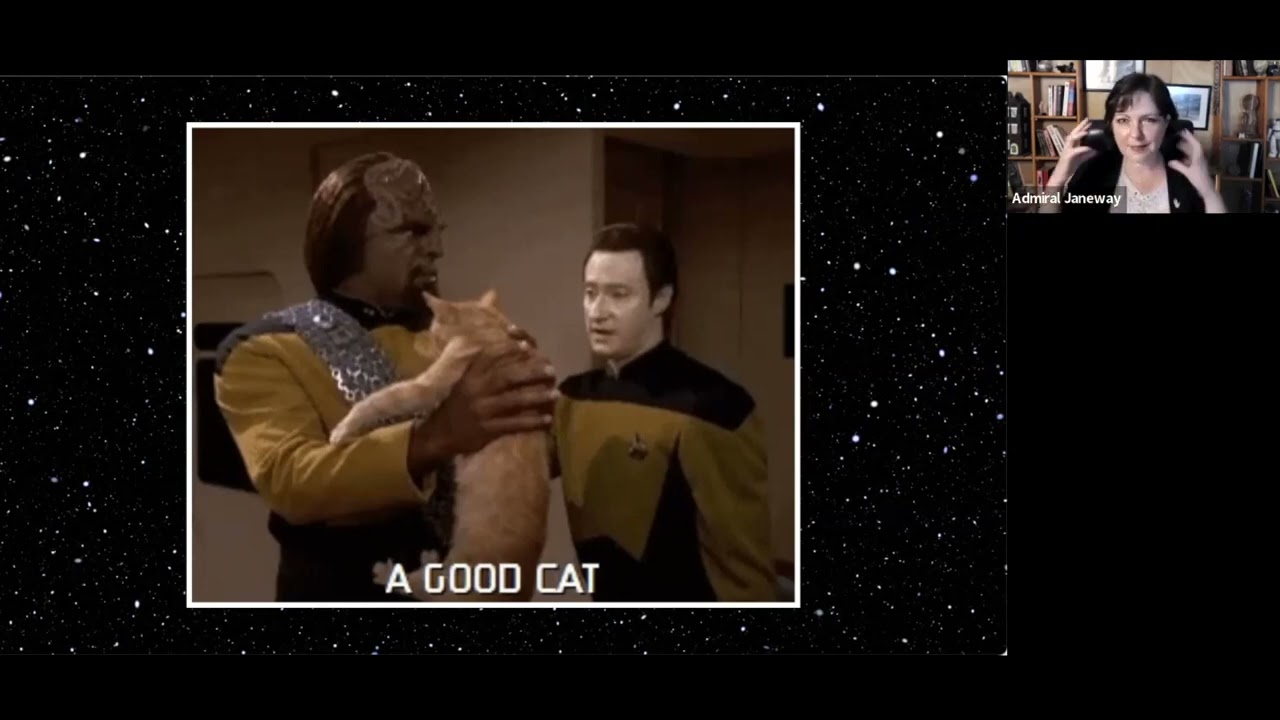
I'm going to get started and start sharing this, the 3rd annual First Contact Day event, with my friends and family and colleagues and anyone who wants to be a little bit nerdy with us. You can see that I'm wearing my, my badge proudly here, the Spock salute or the Vulcan salute. But for those of you who are curious and you don't know what this is about, I will explain it very shortly in terms of what is First Contact Day. But let me start with explaining why I like to do this. Besides being a Trekkie, which means that I am a Star Trek fan, I also really enjoy looking at how science fiction stories, books, novels, and movies portray different scenarios of how things could go in the future. We have a friend and colleague who doesn't like science fiction because it's all scary and it makes the future And I think she just hasn't been exposed to the right kind of, of science fiction. But any science fiction artifact, a book or a movie or anything like that, is simply a scenario. This is one way things could go. And if we don't like that, if we think that this is a bad idea, then we want to respond appropriately. We want to make better decisions. So our conversation today is to find out what Star Trek can— what we can learn from Star Trek in terms of artificial intelligence and what we are going through right now. Just to be completely transparent, the title of today's session, Artificial Intelligence: Boldly Going Where No One Has Gone Before, was suggested to me by the artificial intelligence chatbot at OpenAI. It was one of a couple of different suggestions. So I use artificial intelligence. We all do already. it has a great number of benefits, but there are some potential problems, and there are some potential human problems, and that's what we're going to look at today. So, the first thing is, let's give you a bit of idea of what on earth Star Trek First Contact Day is about. And in this case, if there was an English teacher around who could really help us to understand how to get the tenses right, because we are pre-celebrating an event that will have had happened in the future, on the 5th of April, 2063. The man on the left is a man called Zefram Cochrane, and he's just taken a, a small spaceship up into, you know, off Earth into space using warp technology. They've broken the warp barrier, and that is a sign for other civilizations that maybe the Earthlings are finally mature enough They've learned enough to now participate in what is going on beyond the borders of our space and our solar system. The man on the right is a Vulcan who lands and makes first contact with the humans. One of the principles that the Vulcans used was that they didn't want to interfere with a civilization that wasn't advanced enough yet. They didn't want to come and ruin our natural kind of progression towards what it is we're wanting to achieve in the future. So they would never make contact with an underdeveloped civilization until they had broken the warp barrier. And that eventually became in the Star Trek world the Prime Directive. The Prime Directive is we don't go and meddle with other life forms until they're at a certain stage. So in Star Trek, throughout the Federation of Planets in the Star Trek series, Zefram Cochrane is really lauded as a person who has achieved this amazing thing, being able to break this warp barrier, being able to bring Earth into a whole collection of other societies and species and races across the different quadrants of space. He himself was just a humble man. He claims he just did it, you know, for the money, not for the fame, not for, you know, rescuing humanity. But that is how we make our heroes. We do everyday things that become extraordinary opportunities for other people, and that is how heroes are made. So let's look at a couple of the particular characters that we want to understand in terms of artificial intelligence and Star Trek. And please, as we go through this, If you've got additional stories or ideas or questions, please, please pop them into the chat box so we can explore them. The first character we're going to look at in some detail is Data from The Next Generation series. Data is an android. He's got a positronic brain. He is really very intelligent. He is very powerful, physically strong. He has some amazing adventures. Then we're going to look at the EMH. the emergency medical hologram, otherwise known as the Doctor on the Voyager series. And he's a hologram. He's programmed to appear when there is an emergency medical situation and the regular human or other species doctors are not around. Things go wrong in Voyager. They end up in the Delta Quadrant. They can't get home. And he ends up being on duty full-time. His program wasn't designed for that. So he has some challenges that he has to explore as well. And then we will look at a character called— well, actually, they're twins, Dahj and Soji Asha, from the very latest Picard series. And we'll look at what they go through and what the implications are for how we understand artificial intelligence. So let's start with Data, one of my favorites. I love this character. Data, as I said, is an android. He is a robot made to look human with this positronic brain, very intelligent, very efficient. He can compute a whole lot of things, but he is very logical. He claims to be more logical, obviously, than Spock and the rest of the Vulcans, because he is not kind of held back by emotions. But somehow something within him is striving for more. And he does try and explore some of these. There's quite a number of really interesting episodes where he has an emotional chip embedded. And he has these wild reactions as he's trying to understand this emotional chip. But as, as a member of Starfleet, as a character here engaging with other people, he is constantly seeking to work out what it means to be human. Why are humans different from him? And he's looking at the human race, he was made in humanoid form. And so he plays with, you know, music and with art and with other expressions. And he even gets himself a cat. The cat's name is Spot, and we're not going to judge him on that. But there's a really interesting thing that he does. He, you know, he's learning language. He's learning how to express himself. So he writes a poem, an ode to Spot. And I'll give you just a taste of it. Felis catus is your taxonomical nomenclature, an endothermic quadruped, carnivorous by nature. Your visual, olfactory, and auditory senses contribute to your hunting skills and natural defenses. It goes on a bit, but the last kind of stanza is really interesting. Oh, Spot, the complex levels of behavior you display connote a fairly well-developed cognitive array— intelligence. And though you are not sentient, Spot, and do not comprehend, I nonetheless consider you a true and valued friend. Now that is interesting, because an android trying to become human is talking to a cat that we humans have really good relationships with, and the android says to the cat that you're intelligent but not sentient, but I still consider you to be a friend. And that is what he is struggling with the whole time. What does it mean to be human? Now, I love Star Trek, but I'm going to take you on a slight detour that you were not expecting, and I'm going to introduce to you my very first crush in my life. And his name was Isaac Asimov. And I had a crush on this hairy old gray man when I was about 12 years old. But Asimov introduced to me the whole concept of science fiction, but also of science, and how amazing it is to be able to tell stories of everyday things that then explain to you how the world works behind it. So a really prolific writer. He's got some amazing stories. But a number of your stories— there's actually a really good series right now on Apple TV about the Foundation series, really well done. But there's another whole series about robots and empire and how humans deal with robots. In Asimov's world, the way he explained things in science fiction, we were only dealing with humanity. We never encountered any other races. And please remember, he was writing decades ago, long before we even had functioning computers. So he couldn't imagine some of the things that we can now use in terms of science fiction stories. So he writes a lot about robots, and there's a very interesting series where these— the 2 characters— so the character on the right, his name is Elijah Bailey. He is a human detective, police detective. The character on the left is R. Daniel. So that's Robot Daniel. Any of the robot characters have the R in front of it to just separate them out in terms of conversation from human characters. R. Daniel looks like a human and passes as a human very often. The other robot is R. Giscard, Robot Giscard, and he is very much human— robotic. We can see immediately that he's a robot. And how people relate to these 2 robots is really interesting. Now I can't go into a whole lot of conversation about this because I could spend an hour just talking about these 2 characters. But in Asimov's world, he has humans kind of scatter out of Earth. And if you look at this lovely diagram, Earth is down there at the bottom left-hand side, and Trantor there in the middle becomes the primary planet where like the whole galactic empire and administrative and bureaucracy center is on Trantor, and Earth is eventually forgotten. But earlier on, the stage that we're talking about at the moment, people have left Earth. They are starting to— there's a whole bunch of people that had left Earth sometime before, and they were the Spacers, and they had gone and kind of habitated— that's the wrong word— but found other planets to live on and settled those planets for themselves. The Spacers. And the Spacers had developed some technology to allow them to live very much longer. So they were very healthy and they lived for like centuries as opposed to a few measly decades that the rest of humanity did. And because of that, the Spacers wanted to be taken care of. They wanted to distance themselves from Earth people who might have diseases that, that could, you know, put their lives at risk. So the Spacers surrounded themselves with robots. No Spacer ever encountered another spacer human without their own kind of robot guard. And that meant that nobody was ever in danger because the robots wouldn't let that kind of thing happen to each other. So Asimov came up with the original 4 robotic laws that really, you know, teach us how to— how robots can be designed to not cause humans any harm. So the spacers are always surrounded by robots. And they've got very long lives. So the rest of Earth people kind of feel like they're being treated like children, that they're being dismissed by these Spacers who are arrogant and aloof. The Settlers are the next generation of people who are leaving Earth to go and settle other places, and they have the same kind of lifespan as humans, but because they're trying to settle other planets, they need help. They don't want to be lazy and complacent and have robots do all the work for them. So they do the work themselves, but with computer help. So there's this little, you know, kind of distinction that they really need to get their hands dirty, but they're not afraid to use help as long as it is a computer or a machine, but nothing that looks like a human, as a robot does. And then we got the people back on Earth, and the people on Earth live in these, you know, huge— it's called caves of steel. They never see the sky because There's just so many buildings. They live as far down under the earth as they do above. And they have a lot of computers around, and they have a lot of robots that kind of look like Gizkarts, so very much like a machine. You can see that it's kind of cold and shiny. But they would use other robots that have a certain amount of, you know, intelligence, but outside of the cities, outside in the farmlands where food is being grown for them. Mm-hmm. that's where the robots can be. And it's really interesting how you see these different characters and settlements engaging with each other and their judgment of each other about how they deal with robots. And that's important for us because it's kind of telling about how we do. A lot of science fiction stories kind of break it down and say, you know, we can have robots here, but here's a colony of people who are rejecting robots or rejecting the synthetic forms or whatever it is. So we always had this group of people kind kind of distancing themselves from what the rest of humanity is dealing with. Uh, Asimov's work also leads us to 2 other things that are really interesting. He talks about the positronic man, and the positronic brain is a concept that Isaac Asimov came up with, and that is what Data and the other kind of synthetic life forms in Star Trek had, this positronic brain. Um, but Isaac Asimov's work— and there was a whole range of kind of short stories and collections that were brought together But that brought us The Bicentennial Man, a movie that came out a couple of years ago with Robin Williams, an absolutely beautiful story about an android that looked like that in the beginning, but he wanted to become a human. And because he's long-lived, he develops some skills. He eventually kind of buys himself out, so he owns himself. He can generate his own income. He starts making his own investments. he starts trying to work on himself to become more and more human. And we'll kind of end his story a little bit later. And then another one which was really very good is I, Robot with Will Smith, talking about again how we relate to, react to robots, how we fear robots. And what is interesting about that particular movie is that the Will Smith character, who's also a cop, he's reacting very badly to the robots, to the machines that he sees. But it turns out that it's the actual artificial intelligence life form back at, you know, the head office that is the problem, not the machines themselves. So that's quite an interesting story to unpack. All right, so let's return to, to Data and just try and understand this. I could have made this entire talk tonight just about this one episode, The Measure of a Man, The Next Generation series. And there's a reference there to the episode and season if you want to ever find it. But the Measure of a Man is really interesting. In this case, there is a person in Star Trek in something called the Daystrom Institute, and they do a whole lot of scientific things, and his name is Bruce Maddox. And Bruce Maddox wants to get Data under his control so that he can kind of take him apart and see what makes him work. so that he can make more of them. And he's given permission to do this by certain authorities in the Starfleet. And so he comes to take, you know, custody of Data, and Data goes, well, no, I don't want to be operated on and maybe not put back together again. And so Data decides to reluctantly resign from Starfleet, where he is employed, and go and do something else because he doesn't want this to happen. But there's a whole lot of stuff that happens and legal wrangles, and eventually a court case is convened to really understand what, you know, is he entitled to resign or is he not? And the judge who is put in charge of this looks up some kind of case history and eventually says, sorry, Data is a toaster. And he belongs to Starfleet. And if Maddox wants to take him, he has the authority. Maddox can take him. So now they have to challenge that, and they have to come up with a way to, um, to defend Data's existence. One of the things that happens in this is that, um, Picard is interviewing, um, Data, asking him questions in front of this court, trying to illustrate what he's about, you know, what he's really capable of. And one of the things that Data reluctantly admits to, um, because he's trying to be discreet is his relationship with another human character called Tasha Yar. And there's a little hologram picture there of Tasha. So he, as he was packing up, he packed this little hologram to take with him. And so it's brought out here, and Data is asked to explain why this particular hologram photograph is so important to him. And Data doesn't want to tell, but Picard says, you know, under the circumstances, I think Tasha Yar would allow, you know, would be happy for you to explain. So Data says, well, I was intimate with her. And it turns out that Data is fully functioning. So, you know, Data is not able— not only able to have a pet and to see this pet as a friend, but also able to have attachments, romantic and friendly relationships with other people. We'll return to Data a little bit later on to kind of wrap up that story. So let's now go and look at the Doctor in the Voyager series and what he goes through Again, lots of artistic expression, lots of really trying to understand for himself who he is and what he is capable of. But these 3 quotes, I think, kind of sum up his progression over the time that he's in this storyline. He says at the beginning, I don't have a life, I am a program. He is reluctant to be turned on the whole time, and in the beginning, people are able to as they leave the medical suite to leave and just say, you know, computer, turn off the EMH. And he would be, even if he was in the middle of a sentence, he would just be switched off. And so as the crew comes to get to know this character and he realizes he is now integral to what happens and the safety of the crew, one of the first things he asks is, can I please have the authority to turn myself off and not be turned off by other people? So he actually starts to gain some of that agency over his own actions so that he can do things in the time that he's not being used by other people to help save them. One of the next things that comes up is really interesting. He talks to one of the characters and he says, there is one more request, something of a personal nature. I would like a name. And they do experiment with a name or two, but it's a little sad that at the end of the whole series, he still doesn't have a name other than EMH or the Doctor. And then lastly, he says, "I'm not just working anymore. I'm living." And now he's starting to really explore himself and find out what he's capable of. He's got a really interesting kind of character arc. There's so many interesting things that happened to him, but I'm just going to share this one to show you his artistic expression and what he was actually capable of. Functions. Two vakwena functions aboard this ship ever been normal? So the doctor really does try and explore this. There's a whole lot of ways that he's trying to find out how to be more human. how to be able to engage with people. He eventually gets a little holographic emitter so that he can leave the medical suite and go and do other things and be in other parts of the ship and off ship as well. All right, so now we're going to move right to the very last series of Star Trek, and we're going to look at these characters, Dahj and Soji Asha from the Picard series. Now, I will warn you, if you are planning on watching the series, we're going to have some spoilers here, but these, um, the storyline is, is really interesting, quite complicated. If you're anything like me, you'll need to watch it 2 or 3 times to fully understand the whole storyline. So I hope I'm not ruining too much. So basically the plot is kind of like this: there are a whole lot of synths, synthetic life forms, that have been created by the Daystrom Institute to function in various places. They look kind of humanoid, but they are all the same. They're just kind of like cloned of each other, and they go and do work in dangerous places. And if a unit is destroyed, it's, it's okay because they are designed to serve not just humanity, but, but all the species of the Federation, and to do those dangerous things so that the living life forms don't die. At some point, something goes wrong. On a particular day, all of these synths turn and they destroy— they kill people, they destroy the facilities, they set a whole planet on fire that, you know, doesn't go out for like decades. And it's this huge shock to the Federation. In reaction to this terrible thing that happened, the Federation created an entire ban on all synthetic life forms on all positronic work, on all experimentation in this. They just banned it. They locked it down. Nobody could do anything in this anymore under threat of serious Federation punishment. But the Federation just reacted to this terrible situation by saying, we don't know what happened here exactly, but it's terrible, so we're just going to just ban everything. We're just going to stop. They never investigated. They didn't explore, they didn't go and understand what happened behind it, which is, as far as I'm concerned, a serious failing of the Federation because they're designed— their whole purpose is to explore and understand, and all they've just done is a complete knee-jerk reaction. As we kind of follow the very complicated storyline, it kind of comes out that it's this: these are a group of Romulan characters they called the Zat Vash. It is a secret society. They have discovered that there is potential for a threat from artificial intelligence life forms from somewhere else, from a different plane of existence, that could come into this plane of existence and could cause a threat to humanity. In order to protect— when I say humanity, I mean the Federation and All life forms. I don't want to be biased here, but in order to protect the Federation, to protect all these life forms, the Romulans created this disaster. They sabotaged the synths. They caused the synths to act that way. So they want to protect us from this threat, so they caused a threat, so we shut down all kind of experimentation into synthetic life forms. even though the actual threat in the background is not from this plane of existence but from somewhere else. So a, a really, um, a really passionate and well-invested plot behind the scenes because this, you know, took centuries to kind of unpack. They literally moved planets around in order to be able to identify, to be able to create this, this whole situation. But the storyline is actually about this character, either Daj or Soji. Daj is the first one. She is a young human. She's about to get a job at the Daystrom Institute, and she's very excited. She's got a boyfriend. She's celebrating that she's got this new job. People come in all cloaked. They grab her. They try to, you know, take her away somewhere. They kill her boyfriend, and she reacts with, you know, in this fearful moment with all this adrenaline pumping, she reacts and kind of kills the attackers and escapes. But then she is somehow convinced that she's got to find Picard, and she goes and looks for Picard. And very soon after she finds Picard, she just— all she knows is that she has to find Picard. When she finds him, shortly after that, she is killed. Now Picard is on a mission to find out why this young woman came to him in this panic and then was killed. What is the story? What she never knew, what she never realized, was that she was a synthetic life form. She honestly believes she is human, but she has a twin sister that is Soji, and Picard finds Soji, and he has to break the news to Soji that, Soji, you are a— you're not a human, you are a synthetic life form. And she can prove that she's human, and Every evening she phones her mum and she has this chat and she remembers her dad. And, and so all of these kind of memories are stripped away from her as she realizes what she really is. So it's almost the opposite story of what Data and the Doctor are experiencing trying to become more human. This person who is a human discovers that she's actually not. So long story short, they get eventually to this planet called Capelius, and on this planet are all of these synths. And this was set up by Bruce Maddox. Remember Bruce Maddox, who wanted to disassemble Data? He worked in the Daystrom Institute, and years and years down the line, he is now trying to kind of create these opportunities for the synths. And the creator of Data originally, Noonien Soong, his son or grandson or something is now here on this planet. Creating these life forms, experimenting with them. They always seem to come in as twins, which is why you see Soji and Dahj, who never knew that they were twins, but they actually were created together. So a whole long story here, which we're not going to get into, but these synths are, you know, they're androids, but they can function. They're fully functional. They've got hopes and ambitions and dreams and emotions and good and bad qualities. And all of that comes out in the story. What is very interesting for me personally, and this is a bit of a spoiler here, is at the end of this series, Picard, Picard dies on this planet. Some terrible things happen, and he's really old, and he has some illnesses, and he's about to die, and he dies. And, and I sit there watching this movie with a lump in my throat because he's a wonderful character, and I've always admired and been very fond of the character of Picard, and he dies. But in another scene, um, Data, who's now kind of in a program, not as an android anymore, but he's in this kind of holographic program, um, Picard is able to visit him in this holographic program. And Data says, when this ends, can you please turn off my program? I want to die now. And Data dies. And I cried. I cried for ages. when the robot died, and I had a lump in my throat when the human did. That brings us back to the story of the Bicentennial Man, because his whole goal was to be recognized as human. And he went to the, uh, the, the galactic, um, court and said, please, please say that I'm human. And, and he asked for this. He kept appealing, um, and they said they, they couldn't. And he kept changing his systems up. The first time he asked, that's in the movie, they say Can you die? And he says, no, I can't die. And they say, well, then you can't be human. So he keeps swapping out parts of his body for more human parts. And in this very last scene, he's sitting with his beloved wife, they're holding hands, and he closes his eyes and he passes away. And there's a TV screen on the other side, and, um, it was just announced that he has been declared human. So he gets declared human and he dies, and it's an absolutely beautiful like tearjerker moment. Everybody's crying. And part of the reason I put these 2 scenes in here is because of this one. Now, this is real in this universe, in reality. This is the Mars rover, and he goes up to Mars and he's taking, you know, pictures and sending them back to Earth. And on the anniversary of when he arrived, he sang himself a song, a happy birthday song, and young girls all over the world have found themselves in tears at the thought of this poor robot being all by himself on this planet alone singing himself happy birthday. And then towards the end when his batteries start dying, he says, it's getting dark, and then the battery goes out and he dies. And this is heartbreaking. Now this is real. There are real humans here who are heartbroken about a piece of machinery on another planet that stops working. And that tells us something about how we're dealing with artificial intelligence and robots, because when we anthropomorphize them, when we, when we give them these characteristics, it's going to affect how we as humans respond to these situations. So there you go, Jocelyn. You're not the only one who cries when a robot dies. Just to kind of tie this up, The, the, the Dahj Soji character, uh, is— can be, um, thought of as a daughter of, uh, Data because, um, she was made by— well, all of them were made with the same kind of positronic, um, uh, brain functions and all the learning that they've got from Data. But Data himself, um, played around at one stage and created for himself a, a, a, a daughter, an offspring. And that's the young girl on the left-hand side. And he created this offspring. At first, Picard was very upset that he was doing this without any kind of, you know, permission from anybody. But, you know, then again, aren't we all allowed to, you know, procreate if we want to? And when the offspring was created, the offspring was given the agency, the scope to say what species they wanted to be and what gender they wanted to be. And they chose to be eventually a young female human. And what is very interesting is very quickly, even with the positronic brain that Data had given her, with everything he knew about his own brain that he invested in her, she was able to feel emotions, and she was able to exceed very quickly what Data was able to do. But the flood of chemicals with the emotions in her brain actually shut her down, and she died. And that was really, really a tragic story. But another telling one about how we look at, how we look at artificial life forms and what it means. So what does this mean for us in the 21st century when we're talking about artificial intelligence and robots? Well, first, let's look at the robots. These are the robots that we're used to. Okay, we're used to the Sophia and Pepper, and then the little android robot. They're made to look cute and appealing and engaging. We're We're entertained by them. We don't see robots as threats because for us at the moment, robots are functional. These are entertaining, but the robots that we deal with are functional arms. They're machines. They do things. They can lift weights. They can, you know, do stuff. But we don't see them as a threat to humanity as much as we do with artificial intelligence purely as itself. So we can anthropomorphize the whole robot thing and be entertained by it, but it's not a threat. But artificial intelligence is. This is an incredible screenshot from a site called The Rundown. They talk about— they got things coming out like 2 or 3 times a day about all the developments in artificial intelligence since the whole ChatGPT kind of just hit our headlines. And just in the month of March, this was a list of some of the incredible things that happened. There's a reaction to that. Again, we could spend an hour just talking about all of those AI developments and what that means, but the reaction to it has been really interesting. Artificial intelligence is a tool. It is neutral. It is how we use it and what our intention is with that tool that is really going to determine how good it is or not. But the reaction starts looking like this: ChatGPT banned in Italy. Um, but now it looks like a robot. OpenAI banned. Um, Canada is investigating. Uh, another thing about Italy, um, a question: do we ban or not ban? But there's some really serious threats here that people are feeling, and they're wanting to stop this. They're wanting to pause it. There's this whole open letter to the governments of the world saying let's pause this for 6 months. Let's, let's just, you know, see, let's catch up with what is happening before this takes over and gets any wilder. But maybe our response to that is going to be kind of like the Borg. Resistance is futile. The genie is out of the bottle. Artificial intelligence is here. We have to find a way to deal with it. So I'm just going to kind of start summing up now with a few quotes just to see how how we can respond, what we think about this. Spock himself says, computers make excellent and efficient servants, but I have no wish to serve under them. And I think that is one of the ultimate fears we have, is that what we create becomes more powerful than us and starts to, to control us, to kind of call the shots. Descartes himself gives a really good warning: the road from legitimate suspicion to rampant paranoia is very much shorter than we think. And in the space of one month, we got all the AI and then all the reaction. And there is this paranoia about what it means. There are legitimate concerns. There should be some things, controls in place. But just like the planet where all the synths are being created, somewhere in the world, people are continuing to experiment with AI and develop it. We can't— we can stop it in certain places, but that doesn't mean that it's not still being developed in other places, and probably not for all the good reasons Data himself, when he's talking about, you know, what it is and who he is, he says, I choose to believe that I was a person, that I had the potential to become more than a collection of circuits and subprocessors. So let's go back to that story of Data and the lawsuit and the court case now, and he is trying to That humans are trying to work out whether he deserves to exist or not. And this is a beautiful scene, a really powerful one in this particular episode, where the character Guinan is talking to Picard. Guinan is a character who has an incredibly long lifespan. She's almost always a bartender, but very wise. She never tells, she just allows people to— realize. So she has this conversation, uh, with, um, with Picard in the bar, and he's talking about, you know, um, does Starfleet consider Data to be a, a possession or not? And, and when he— when they kind of determine, yeah, Starfleet probably does, and, and Guinan says, well, that makes him more valuable to Starfleet. And Picard says, well, what do you mean? And she says, well, consider that in the history of many worlds, there have always been disposable creatures. They do the dirty work. They do the work that no one else wants to do because it's too difficult or too hazardous. And an army of Datas, all disposable— you don't have to think about their welfare. You don't have to think about how they feel. Whole generations of disposable people. And Picard responds, you're talking about slavery. And she thinks— she responds with, I think that's a little harsh. And Picard says, I don't think that's a little harsh. I think that is the truth. And that's a truth we have obscured behind comfortable, easy euphemisms— property. But that's not the issue at all. So now, now he really is kind of determined to define what data is beyond property, beyond being a system. So this is the, uh, Judge Advocate General who was in charge, and, um, she has to kind of sum up this whole conversation. So let me see if I can find her. But there she says, um, she's kind of summing up at the end, and she says, it sits there looking at me and I don't know what it is. So she's referring to Data as a, as a piece of property. Let's hear what Picard had said before. Picard says, sooner or later, this man or others like him will succeed in replicating Commander Data. So Maddox will replicate Commander Data. And the decision you reach here today will determine how we will regard that creation of our genius. It will reveal the kind of people we are, what he is destined to be. It will reach far beyond this courtroom and beyond this one android. It could significantly redefine the boundaries of personal liberty and freedom, expanding them for some, savagely curtailing them for others. Are you prepared to condemn him and all who come after him to servitude and slavery? Your Honor, Starfleet was founded to seek out new life. Well, there it is, sitting, waiting. You wanted a chance to make new law? Well, here it is. Make a good one. So she continues, it sits there looking at me and I don't know what it is. This case has dealt with metaphysics and questions best left to saints and to philosophers. I'm neither competent nor qualified to answer those. I've got to make a ruling to try and speak to the future. Is Data a machine? Yes. Is he the property of Starfleet? No. We've all been dancing around the basic question: Does Data have a soul? I don't know that he has. I don't know that I have. But I have got to give him the freedom to explore that question himself. I'm not suggesting that artificial intelligence has a soul or is a question like that. But how we respond to that is really important. So here's one other kind of technology that is really kind of stressing us out as humans at the moment. And that is cloning. This particular character that we're looking at is Praetor— let's get his name— Shinzon. And he was created, I think, by the Romulans. He is a clone of Picard. And because of how he grew up, because of what he was designed to do, he has a whole lot of anger issues and things like that. But he is— he's saying that he could never become like Picard. He is destined to make these terrible decisions. And Picard is saying, you know, the choices you have, the hope you have for the future, it can be the future. Buried deep within you, there is something that has never been nurtured, the potential to make yourself a better man. And that is what it means to be human, to make yourself more than what you are. So in my exploration of this whole topic, I've come up with 2 kind of final summaries for myself. Most humans are so busy fulfilling functions that they fail to explore the expanse of their own humanity. We've seen all these artificial intelligence life forms and androids and robots trying to find out what it means to be human. How can they be more like humans? What are humans capable of that they are not? And yet so many humans fulfill the function of robots. We, we do work just to make a living, just to merely exist, rather than exploring who we are. And not just that, but it is our response to artificial intelligence, our response to robots, to other life forms, to anything that is other than who we are that is a potential threat to our humanity, not the life forms themselves. And that is my response to, I think, how we are seeing artificial intelligence at the moment. Let's have a conversation, see what you believe or think, and what the conversation means in terms of the future of our humanity and how we use artificial intelligence and all of the other amazing things that we are creating.
More from Charlotte




Unlock the Power of Thresholds_ What Ancient Wisdom Teaches About New Beginnings






