Crafting Positive Futures for Africa with Somaya El Sherbini
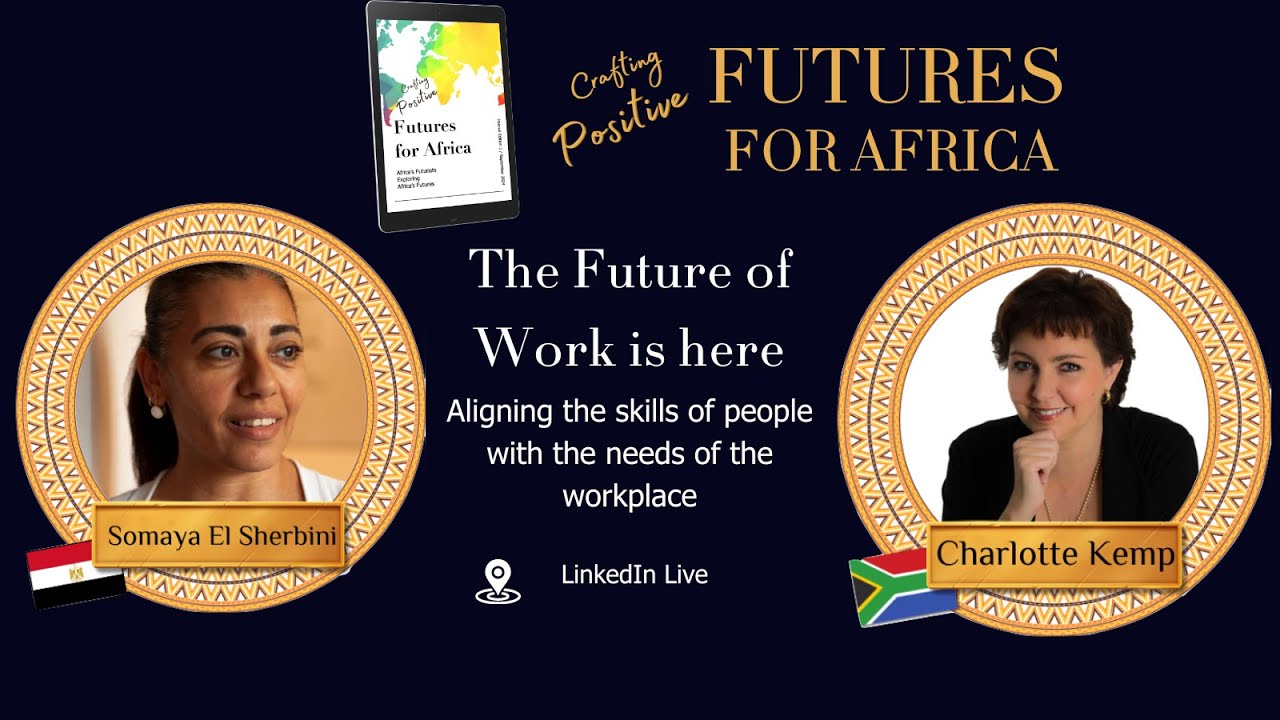
In this interview, former Microsoft leader and founder of a people‑management consultancy, Somaya El Sherbini, discusses how data, AI, and human‑centred skill development can unlock Africa’s economic potential. She explains her transition from Microsoft to a consultancy that combines management advice with people‑data analytics, and describes work with governments in Kenya and Rwanda to collect workforce data that can attract foreign direct investment. Drawing on a 2023 research report that flags $8.5 trillion of at‑risk profit and 85 million jobs that will be reshaped globally, she argues that Africa’s young population makes the continent a strategic talent source for aging economies. Somaya stresses that only non‑replaceable core skills—creativity, complex problem‑solving, and emotional intelligence—will remain valuable as AI automates routine tasks. She offers practical steps for small businesses: eliminate repetitive work with AI tools, invest in the three core skills, and build capacity for collaborative problem‑solving. The conversation also covers the evolution of learning and development toward personalised, job‑centric upskilling, the ethical and regulatory challenges of AI (e.g., labeling, fairness), and the need for robust education systems and a vibrant entrepreneurship ecosystem. Finally, she highlights emerging sectors such as green energy and cross‑border logistics as growth engines for the next five to ten years, urging coordinated public‑private action to uplift education and nurture startups.
Chapters
Yes, it took time, but more profoundly, I'm very proud of the kind of point in time that we're at right now. I've always been super passionate about Africa. My career started in, actually in Egypt. I worked for Microsoft. And then I moved with Microsoft from Egypt and I, I was responsible for Africa in addition to other responsibilities, other geos. But Africa really has, has kind of a soft spot in my heart for a lot of different reasons. There's just huge potential. And in that context, when I started my own venture in 2017, when I left Microsoft, The onus on me was to make sure that every single thing that I did, I wanted to make sure that there was an opportunity to really help craft some of the potential of countries like some of the very interesting countries in Africa. And I say some because there's just so much potential, but for the relevance of who I am and what I do, I'm a consultant, I'm a management consultant with a focus on people management, human capital. And so that's what we do. We also do that. We have a tech side of business that kind of complements our management consultancy, and we focus on people data analytics. And so some of the really, really interesting things we're going to be talking about today are around how do we capitalize and how do we use some of the information that's just super scattered across all the different geos that we're a part of, and how do we make it an enabler? How do we enable countries using data?
Wow. Okay, that's huge. Give me a bit of a taste of what that looks like. So, so what countries have you been working with? How has that progressed in Africa?
Yeah. So, so I'll just give an example of a country like Kenya or a country like Rwanda. where there's just super potential and super— a lot of appetite around wanting to use data to, to help differentiate and attract foreign direct investment because the— because of either the notion that Kenya is becoming a very, very unique place for entrepreneurship, um, and Rwanda, um, from a digital, uh, competitiveness, wants to position itself that way. So how do you ensure that able to help governments collect data, but more profoundly, when they get the data around the workforce, understand skill sets, understand competitiveness of the digital skills that are available in country, understand the pitfalls, really ready themselves with how they can use all these elements to become more competitive, to be able to attract foreign direct investment even more profoundly.
Good. Let's just explore a little bit about— I know we want to talk about AI, but just in terms of the countries in Africa in comparison to other parts of the world, what does it look like in terms of the trends that are happening? I'll explain why. Very often in the work that I do, and I'm here in Southern Africa, so it's the, you know, the southern half of the globe, and there's very often opportunities that I have to remind people in the Northern Hemisphere that there's an entire other part of the globe where the seasons are reversed. And time zones are, you know, different from, from the Americas. But, you know, very often we're saying that what, what is happening in, in Southern Africa or in Africa is different from the trends that are happening in other parts of the world. And we can't just automatically assume that because something is a trend in one part of the world that it reflects here in this country, in this place. So we need to look very contextually at what is what is happening elsewhere and what is happening locally. But maybe you, from your perspective, can give that kind of comparison in terms of how do we respond to the trends? What does it look like in Africa in comparison to the rest of the world in terms of work? Yeah.
Cool. Okay. So, so first of all, to, to put some context to the word trends and what the world kind of really hone in on some of the trends that are super relevant to, to today's discussion. One very important piece of research was done probably in 2023, to be exact. And the research wanted to really understand why the world is going to be different and what that means for businesses, given the big, big dilemma around the talent wars. What does that mean? And so the analysis or the research was basically saying that after a lot of looking globally across the board, the opportunity is that $8.5 trillion worth of profits are at risk globally. And the reason for that is that equates up to 85 million jobs globally that will either look different.
Mm-hmm.
Or that will be new, or that will be replaced and augmented with some kind of technology, which would mean that these people would need to find alternatives to be employed. So when you think of this big, huge global number and you try to kind of replicate and you think about it in the context of Africa, the impact of that on Africa, and what it translates into. The first thing is Africa, um, is becoming a very, very lucrative opportunity for, um, a lot of countries globally, um, especially the developed countries, because of the aging population in developed countries. And so a lot of these countries are looking, uh, and utilizing, um, a talent in Africa, specifically in areas like the outsourcing space as an example, or the agriculture and mining space as examples, um, using, um, African talent to augment their needs, um, either remotely and more profoundly remotely, so at a distance, so hybrid, um, in that context, or as freelancers. Um, the— so that represents the opportunity of, okay, if this is happening right now, How can we continue to build on that, given the fact that we've got a very young population in Africa? So how do we continually become competitive with skills that, that continue to make us not only relevant and, and, and, you know, for others to want to, to have to keep an eye on Africa, but more profoundly, how do we competitively increase the skill sets of people to add more jobs, to add more opportunities. And, and so, um, when, when we think in the context of me as an individual, what do I do? What do I need to do to continuously, um, build my skills to be relevant in the coming 3, 5, X number of years? Um, I need to be very aware that the skills that are required or will continuously be required and will never be replaced by something like AI are things around dealing with complexity, are things around problem solving, are things around innovation and being creative. And so with, with, if I'm talking about me as a person, I need to be aware of that. And how do I utilize tools that help me continuously, you know, do away with those simple routine things, but focus on my personal skills that will help me stay competitive. If I am a business owner or an entrepreneur, how do I make sure that the people that I— that are delivering on our mandate as a venture or as a small business, how am I taking care of these people in terms of building their capacity and building their skills? Because as I build that, I become more competitive. I become much more relevant, not only in the country that I'm operating in, but as I venture to expand multi-country or even regions or even globally. And then more profoundly, and I think this is very, very important for bigger businesses, multinationals, and if you are employed or if you're seeking employment by a bigger business, a family business or so forth, How are you really making sure that, that as a business you're taking care of those people and you're making them relevant? Because you will not be able to capture that $8.5 trillion or your share of that $8.5 trillion unless you do something and it starts from today.
Yeah, absolutely. I know this can sound kind of small in comparison to the big data that you're talking about. But what would be those practical steps if you're looking for— looking at a small business and they've got a good team of talented young people? What do they need to be doing practically so that they can stay relevant in the future job market?
I think one really important thing is do away with the routine simple things that can be replaced by tools. There are tons of AI tools that are rising up. The rise of AI tools or these elements that collect data or the— that help you become more informed to be able to make decisions because you don't have information at hand and you, you still rely on things like spreadsheets and so forth. Just do away with routine work and make sure that you build your people's capacity in the areas that are non-replaceable. And those are the 3 examples that I was giving, you know, the focus on creativity and innovation, problem solving, and really helping people solve complex problems collaboratively. So if I'm a business owner, I should really put my attention to these things and really building jobs in my institution, in my venture around those skill sets so that I really, you know, drive efficiency. And we hear that word a lot. Ventures need to drive efficiency because money is tight, right? So those are some of the examples really.
Yeah, I love looking at the World Economic Forum list of the top 10 jobs for the next 5 years and it changes ever so slightly every time they put the report out. But when you look at them, they kind of go into 2 broad categories. And one is about thinking. So it's about creativity, innovation, complex, you know, problem solving, systems thinking, all that kind of stuff. And the other part is all about people. So how do you deal with people? What's your emotional intelligence? How would you be coaching people? And, and those are the things that we can't just give to AI. They're not the routine tasks. They You can get a form of that kind of response coming out of AI, but it's not as— it's not as human as what the humans would do. So those would be, you know, I'm imagining the kind of skills that, that we should be spending more time on, and they aren't always at the top of the list of skill sets that have been developed in a large corporation's learning and development department, for example.
Yeah, yeah, no, totally, totally. And I think one of the important things around that point is the way learning and development was done in the last iteration of time versus now. Learning and development is very different. Learning and development starts with me because I know myself. I know what I'm good at, but I don't need you to get for me a list and then I pick and choose with my—
Yeah.
Really, really, it needs to be carved out around the job and it needs to— you need to be cognizant that it is going to evolve faster than you think. So to your point around the World Economic Forum and the changes that are happening almost, you know, I see that report, it goes out twice a year with every iteration of the report. And now, you know, there are other institutions like the Big 4 Um, you know, the Accentures, the Deloites, the PwCs, they issue iterations of those. And you look at those and everyone is saying pretty much the same thing. The softer side, the coachable side, the growth mindset, the emotional intelligence, the collaborative essence of how we do work. Those are some of the things that we really, really need to prioritize. And those are becoming the differentiators.
Yeah, yeah. I always get hung up on names and terms. And whenever people say soft skills, there's almost this apology that goes with it. Like, I'm sorry, but these soft skills are so important. And we just change those to the core skills. If we refer to these core coachable skills, it would be a very different conversation because it doesn't matter how savvy you are about, you know, numbers or technology or coding. But if you don't have those core skills, you're still not going to be a valuable employee. You're still not going to be relevant in the future because because people can't work with you, uh, or you can't work unsupervised remotely. So those core skills are pretty, uh, pretty valuable.
Yeah, absolutely. And that's, that's a good use of the word because technically, if you're a person in, uh, in management or in consulting, the use of core is used more progressively. I think, you know, we're, we're gonna, we're, we're trying to change our mindset, right? So as things are changing, we're even changing the way we talk and we express ourselves. So, so I'm happy that you, you actually mentioned Thank you. All right.
So you mentioned artificial intelligence. Let's just talk about the evolution of that. Every time you turn around, somebody's got their own version of, you know, an introduction to AI. Even I have a course that I do from time to time. But there is so much potential. And it's— I experience 2 things at the same time. Like, my mind is blown by the fact that I start to do something and AI knows how to finish off my task. That's brilliant. And then I do something else. And I can't like see what I'm doing and I get very frustrated. But it certainly is something that we need to be more literate around. We need to be more experienced around it, even if we're not necessarily using it every day intentionally. AI is kind of starting to be baked into so many of the applications and platforms we use. We need to get a handle on it and address some of that anxiety people have. But again, from, from your perspective, what does this evolution of AI look like in terms of the future of work?
Yeah. So, you know, for me, I touch AI in so many different ways and I think I'm gonna talk about the way that it has blown my mind away, but also the way that it has taught me things that, you know, there are limitations. Okay. So we have a data analytics business like I mentioned in the beginning and some of the work that started on the engineering side when we started a couple of years ago. I think we started in 2021. Our job was to try to find patterns in data that sits across organizations. And that's a very, very hard thing to do because it looks different, because people, you know, interpret meanings of data. So they put headers. So if you say name, you can sometimes instead of um, a name, you can put a name-first name. So that's a very, very simple example of how it is— was so, so complex. And we, we worked for, for, for months and months and actually for more than a year and a half trying to do workarounds to be able to understand, um, how to, how to get around things. And then suddenly 2023 comes and something called OpenAI blows our mind away and suddenly all these new tools are coming and hopping and ChatGPT is helping us write an article or ChatGPT is helping us complete a task like you just said. The flip side of that is all of that needs human inputs.
Yeah.
So if you are not able to describe your question in the right context, the output that you will get won't be, won't be justifiable. It won't be relevant.
Yeah.
So I, I think the smartness and how we work with tools like this is, number one, stay absolutely literate. Understand which tools can help you do what. So which tools can help you bridge? If you're in digital marketing, how do you use AI tools to help you in the creative elements of the work? But, but then more profoundly, if there is a piece of work that you will need to do, which is really, really write interesting, intriguing things, even if you give the interesting, intriguing thing to a ChatGPT to edit and refine the input, the initial input is still yours.
Yeah.
So, so we still need to really embrace and, and use to do the routine. Get out of the things that we used to waste time and to try to edit and, you know, word check and do all that. But more importantly, put the emphasis on the core, and I'll use that nice word, the core of what we're supposed to be doing, what the job really is, what the job requires.
Yeah, no, I love it. I often use examples of an analogy of this being a tool. And I've got a story about, you know, how we can use our tools to create a mess, create a masterpiece, or somebody can use the same tools to threaten or hurt someone. So the tool itself is neutral. AI is neutral. But how do we use it? Yes, some people will use it poorly. Some people will use it dangerously, but others can, you know, can really do something quite amazing. And as an independent consultant and coach, and I love writing and I speak about various topics, I found various AI tools, the generative tools, to be really essential now in getting to the depth of my own topic. So I've got a crazy angle that I want to talk about, like being a conscious futurist, for example. And when I use the AI to explore my topic and my concept and my model, I discover things I didn't know. I discover angles. And I did this one exercise, worked all the way through, had some really good solid data to work with. with now. And then I said, is there something I haven't asked yet? And AI just introduced me to a whole angle that I had never considered. So I almost see it as being irresponsible to not use the tools that are available to create better, deeper work if that is your space to work in.
Absolutely. Absolutely. And, you know, and this consciousness and this danger also has the flip side of it, right?
Yes.
So I'm from the school where I truly believe the human elements of how we express ourselves, how we use our body language, how we use our, you know, our facial expressions are still way, way too far for technology to interpret and put labels on us. And so I like the fact that the EU, as an example, is really trying to build a playbook that says, how do we make sure that new tools or new technologies that are coming to market are not putting those labels on humans? So it makes finding a job unfair or makes you a person that is— anything that you said can be manipulated in some sort of way. For a different meaning. So there is that ethical practice that's still far-fetched, and we still have a long way to go.
Yeah, yeah. And we also see that kind of, um, that lag behind technologies that, that, you know, um, smart people can come up with new AI tools, or they can create drones, or whatever it is, and, and society wants to play with it. And then we get the legislation coming in to say how we can now use it, but that all has to be framed around what is actually happening with the tools. And I know some people kind of resist that, but, but it is responsible to say artificial intelligence is a powerful tool and here are some responsible borders about what you can or can't do with it. And if you do it wrong, then you're actually breaking a law somewhere. So those things are required when there are these new approaches and new technologies.
Absolutely. So good.
So, Samaya, what does it look like in the next 5 to 10 years in terms of, you know, the future of work? and Africa in relation to the rest of the world and the potential that is here?
Yeah. So Africa is very interesting. I think I said we're probably, we have the youngest population in terms of the continents in the world. And the interesting thing is that we've got new technologies or new industries that are coming and playing a very, very big part in transforming the landscape of Africa. And some of those are green energy. as an example.
Okay.
Others are logistics and crossing borders with how logistics are being done, whether you're shipping things across countries or using different methods of transportation to allow for that to happen. And so those are just 2 examples, right? But if we think within the context of what we talked about around how are we going to be better prepared to be able to create those opportunities, those, you know, catch those low-hanging fruits, but create newer opportunities for the continent. And I think, you know, the traditional way of how we used to be thought about, or we still are thought about in terms of we're great in outsourcing, you want some great outsourcing teams or, you know, engineering team, customer support team and so forth. That is, that should be going away slowly but surely, you know, with the, with the context of, you know, the tools that we just talked about. How do we, how do we jump in? And, and for me, for us to be able to, to do that, there are 2 things we need to be very, very cognizant of. Education and the education systems in our countries need to be uplifted. So there is a role— public and private sector in people in the education space to really, really prepare us. And second of all is the entrepreneurship scene. We've got a very, very vibrant entrepreneurship scene across a lot of geographies in Africa. And those are— they're coming up with amazing technologies in things like travel, in things like— I talked about renewable energy and things like self-driving cars, the EVs and so forth, and in payments, in payment methods. And so how do we make sure that between the education piece and between the entrepreneurship piece, that those 2 things are really helping us to drive the future of Africa in the coming 5 to 10 years?
Yeah, no, that's incredible. I do a little bit of work with an entrepreneur group in Zambia, And, and they're all young people. Many of them have some form of a job, but they're building up their own entrepreneurial skills. And the one example that was put out on the WhatsApp group one day was there was a census happening in the country and there was an opportunity for X number of people to get a short-term job to, to handle the census. And the number of people that pitched up to the stadium to apply was like 12 times the number of positions that there were. So these young people are going, we have got to be entrepreneurs, we have to find our own work, we cannot rely on getting a job somewhere. And that mindset and taking that ownership and then looking for, for, for learning, for education, that is what's, you know, going to give them opportunities in the future. We can't rely on, on jobs that don't exist anymore because of so many changes in technology.
Yeah, yeah, I totally agree. I think the word a job, in my view, is going to, is going to be very, very different. I mean, I, for me, you know, at some point in time we used to say a career, but now it's really, it's, it's, it's different. It's, I don't know what it's going to be called, but it will certainly not be something that is 9 to 5.
No, not at all. My daughters, one is still learning, one has a job, but whenever I'm speaking to them, I'm kind of getting them to think about their career as their responsibility, you know, throughout their career. So when you have a job, think of it as you're selling your service to this client for one month, and at the end of the month, they'll pay you for that work, and then they will decide whether they will renew the contract for a month, and you can decide whether you want to work with that client for another month or not. And that could go on for 12 or 24 months. But if you had that in the back of your mind the whole time, this is a 1-month contract, then you don't get complacent, you don't stop learning, you don't stop developing yourself because you have to be prepared and equipped with the right skills for the next client, whether that's, you know, freelance client or actually the next job client. But that's the kind of mindset that we need to really reinforce in this conversation.
Absolutely. Absolutely. Good.
Samaya, thank you very much. I really enjoyed reading your article. The journal, for anybody who's interested, is on the website futuresforafrica.online, and there'll be recordings there and information about the contributors. And we'll look at another journal at some point to look at some other elements of the future of Africa. But Samaya, thank you for your participation in this. I know you're also in another group that I'm loosely affiliated with about the future of work. So I know that there's some really great work going on out there. And just thank you for sharing your ideas and insights with us. Thank you.
Thank you so much for the opportunity. I really loved the discussion. Thanks so much.
Thank you very much.
More from Charlotte




Unlock the Power of Thresholds_ What Ancient Wisdom Teaches About New Beginnings






