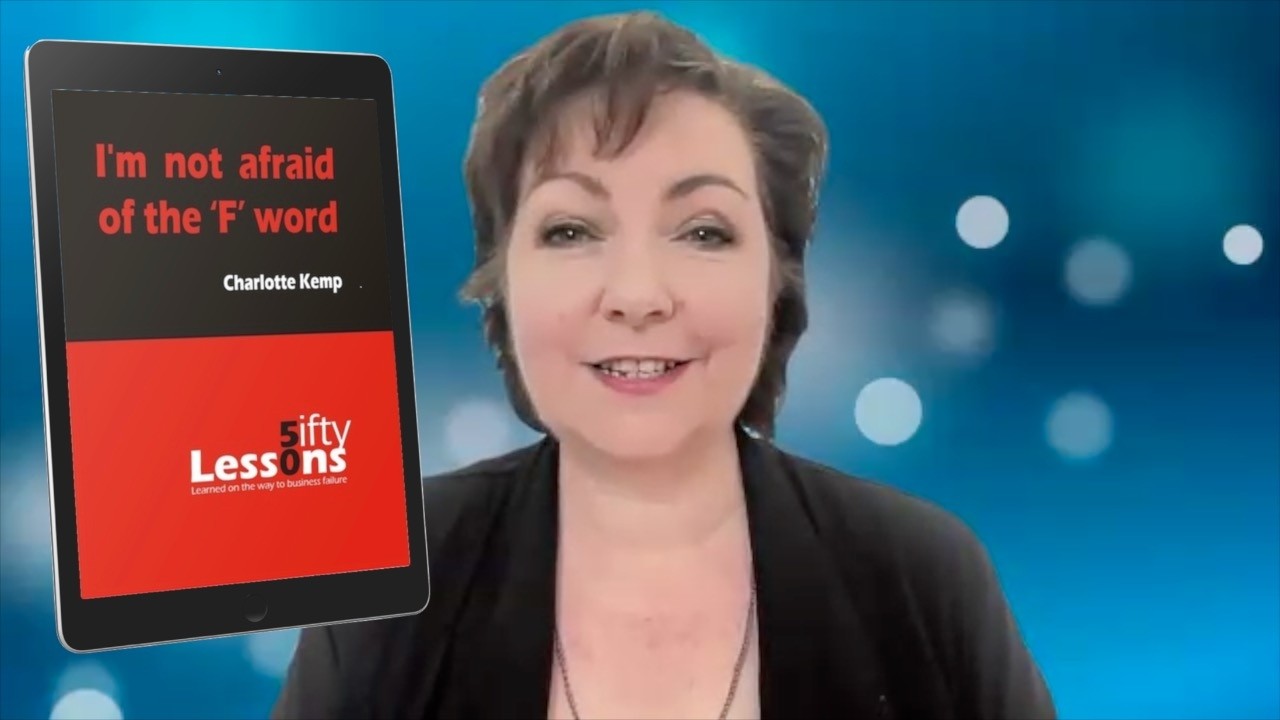
In this promotional monologue, Charlotte Kemp recounts the creation and purpose of two of her books: I'm Not Afraid of the F Word: 50 Lessons Learned on the Way to Business Failure and Future's Alchemist. She explains that the first book was written as a therapeutic exercise for herself, her children, and anyone else grappling with entrepreneurial collapse, and shares how listeners of her story often needed simply to be heard. A pivotal conversation with a colleague—who compared their problems only by the number of zeros—underscored the universality of failure. Kemp then describes her evolution into a professional speaker and futurist, culminating in the manifesto‑style novel Future's Alchemist, which explores futures thinking through a corporate‑to‑startup narrative. She details a recent pitch to a company that once supported her own failed venture, using both books as tangible proof of her experience and solutions, which secured new business. Throughout, she stresses the bleak statistics of startup failure, the cultural taboo around discussing financial loss in South Africa, and the importance of learning from others’ mistakes. Kemp also reflects on a second, less damaging business failure, illustrating how earlier lessons mitigated impact. She concludes by inviting listeners to visit her website, encouraging them to approach future challenges with grace, self‑compassion, and a willingness to learn.
Chapters
I wrote a book a very long time ago called I'm Not Afraid of the F Word: 50 Lessons Learned on the Way to Business Failure, and it recounts all of the lessons that I learned, positive and mostly negative, the mistakes that I'd made on the way that led to this, this business failure. And I wrote it as a therapy. I wrote it as an account that my children would one day be able to read and to be able to reframe what the family had been going through during that particular time of their young lives. And, and I wrote it for anybody else where it might resonate. And, and it does. During the time when I was actively marketing that book, I would have lots of people contact me and want to tell me their stories. And in the beginning, I, I imagined that they wanted me to weigh in with my wisdom or to give them solace or give them direction. But I recognized that at least, at least half of them were not wanting anything from me other than to hear them. They needed to tell somebody what they had gone through with their business failure. And one particular conversation was so powerful. When I recognized what was happening, I leaned back in my chair, I put my feet up on the windowsill, and I just listened. It was actually a colleague of mine who had their own business, and it was a big business and it employed lots of people. And from the outside it looked really good, but clearly there wasn't, uh, things were going wrong on the inside. And at some point this colleague of mine said to me, you know, Charlotte, the only difference between your problems and my problems is the number of zeros on the end. And that was really powerful for me to, to remember. Anyway, years passed and I wrote another book. I, I became a professional speaker. I spoke on many topics, and then I moved into the space of becoming a futurist. And there was a long process of learning how to do that. And part of that was for me to essentially write my manifesto, what I believe about the future. And that was when I wrote this book called Future's Alchemist. And it's a narrative of a young person who works in a corporate and then goes to work in a kind of financial startup as she learns about futures thinking. So it was a way for me to explore this topic for myself, to work out what I believed about the future, to kind of to stake my, my claim for what I believe we should be doing with futures thinking. And at some point in my life in the last couple of years, I've had the opportunity to, to speak to a particular company that works with other startup businesses, entrepreneurs, and small business owners, and, and this company provides support for them. And I went to speak to them because they had played a part in supporting my first business. They had nothing to do with the business failure, but they had supported it. And here was an opportunity for me now to do some business with them and in a way to kind of close the loop in my own brain. And I took a copy of each book, the F Word book and the Futures Alchemist book. And as I'm speaking to these 2 people, telling them what I do and what I could possibly offer to their clients, when they ask certain questions, I just put my hand on the F Word book and pushed it forward, or put my hand on the Futures Alchemist book and pushed it forward. And it was a demonstration that I have experienced this, I've learned from this, and I have an answer, a response, a model, a way of dealing with whatever that question is. And I got the business, that was nice, but the most important thing was me sitting there and realizing for myself that I had really learned something, that I had something to share, and that I had grown from the business failure book to becoming a futurist and looking at different ways to explore the future. And it was quite a poignant moment for myself, but I let myself experience that later, not in front of them. But that is why I wrote these books. That's why I'm still talking about the F Word book, because people are still experiencing those business failures, entrepreneurial failures. The statistics are still as bleak as they ever were about how many people optimistically go and start their own business and then it doesn't work. And I don't want to squash anybody's dreams, but I'd love people to, to pause and learn from others. look at other people's mistakes and work out how to, how to do their business a little bit better. Because a business failure is no joke. The implications, the spillover into family and friends and opportunities and future and your own children or other people who need opportunities in the future and all of that kind of gets squashed when a business failure happens or when a business failure happens badly because some businesses can fail, um, and, and not have that huge impact. Uh, and I'll confess that I, I have lost another business subsequent to the very first one, but the implications of the second business loss was nothing in comparison to the first one because I took the right steps, I took the right actions earlier, uh, so the implications were a lot less. So there you go. That's why I wrote both of these books, and that's why I'm, I'm really proud of them and, and for sharing, um, a public story that many people didn't want to hear. The reason I called it The F Word was that it was such a taboo at the time. You know, we weren't looking at entrepreneurs learning from failure. We were, especially in the culture that I was in, in South Africa, in the kind of people that I mixed with, this was not something you talked about. You do not talk about financial problems in front of other people. And there I was confessing. So if that will help you or anybody you know, you can find the website, the You can find the books on my website, charlottekemp.co.za. And I hope that whatever challenges you have in the future, that you can, can take them with a huge dose of grace to yourself, because we all make mistakes and we sometimes make those same mistakes again because we're human and, and because we do. So don't beat yourself up about it. Just take a deep breath. Learn from what you've done, make a plan going forward, and then trust yourself. You'll make it. It's okay.