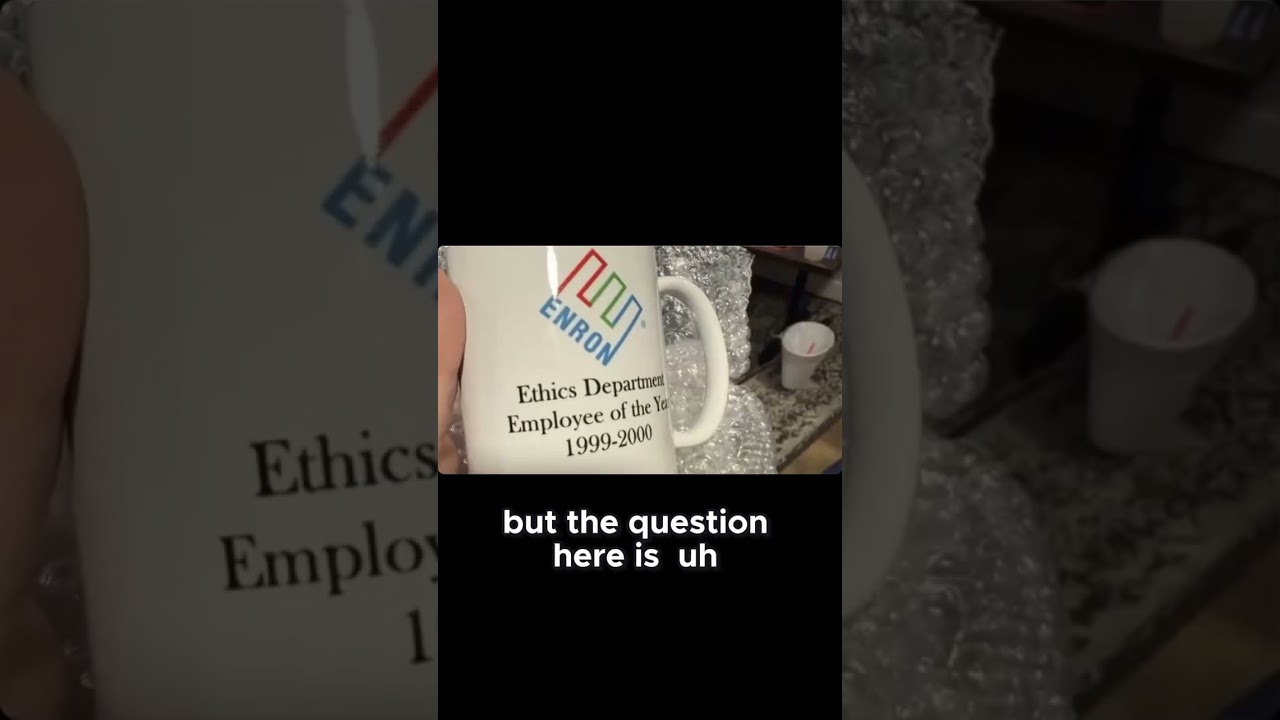
In this talk, the speaker uses the Enron scandal as a shorthand illustration of corporate ethical failure to prompt listeners to examine moments when a decision may be commercially rational yet ethically unsettling. She highlights the current ethical landscape as messy, with clear wrongs coexisting alongside gray‑area rationalizations that allow some actors to justify harmful behavior. The speaker argues that those who aim to shape a preferred future must first negotiate what "better" means, emphasizing inclusivity, intergenerational responsibility, and avoidance of value extraction for a narrow in‑group. She urges listeners to consider the long‑term environmental and social consequences of profit‑driven choices—such as polluting rivers or impoverishing communities—and frames this reflective practice as the "7th competency" in future‑oriented ethical decision‑making.
Chapters
All right, this brings me to the most amusing little picture I found online. I'm sure we all know what Enron is, that big energy company that was involved in a huge scandal a couple years ago. It's one of those shortcut memes, so, you know, we immediately know what Enron is. The question is, have you ever made a decision that made sense commercially, made sense in the moment, but didn't sit didn't sit entirely comfortably with you? Have you made decisions, have you had to make decisions that just made you feel uncomfortable and you weren't sure why? Have you thought about something as how it might unfold in the future and wondered what that might mean in terms of ethics? Our ethical questions in the future are incredibly difficult to deal with. Mostly because the ethical problems we're dealing with right now are so bizarre. There are things that we know to be wrong. We know them to be wrong, and other people are happily doing them and flaunting them. And that means that other people who have a bit of a gray line when it comes to ethics are saying, if some people can get away with this, why can't I? And then other people who are holding a fast line to some kind of ethical standard then look like old stick-in-the-muds. and they don't really know what's going on in the world. So it's a very messy space. But the question here is, and I ask this question, I'll show some kind of personas in a moment. I ask this question because I believe people who would be engaging with this conversation would be people who intend to create a more preferred future. a better future. How we define better is something we all need to negotiate. But if we want a better future, it would be more inclusive. It would be, it would be better for more people. It would be more ethical. It wouldn't be a future that extracts and steals value from others for the sake of only one small in-group. Those people are not creating a strategic future. They're just protecting their own interests. So when we look at this, we need to sit with those uncomfortable questions. We say, when we're making this decision, what will it mean for the future? What are the implications for generations to come? Are we stealing from the next generation of people who will live on this planet? Are we creating something that will be very profitable right now, but in about 5 years' time, we would've poisoned the rivers, destroyed the soil and left with our profits and left a whole community of people here destitute because the business has moved on. That is that ethical decision-making that we need to be exploring for the future. That was the 7th competency.