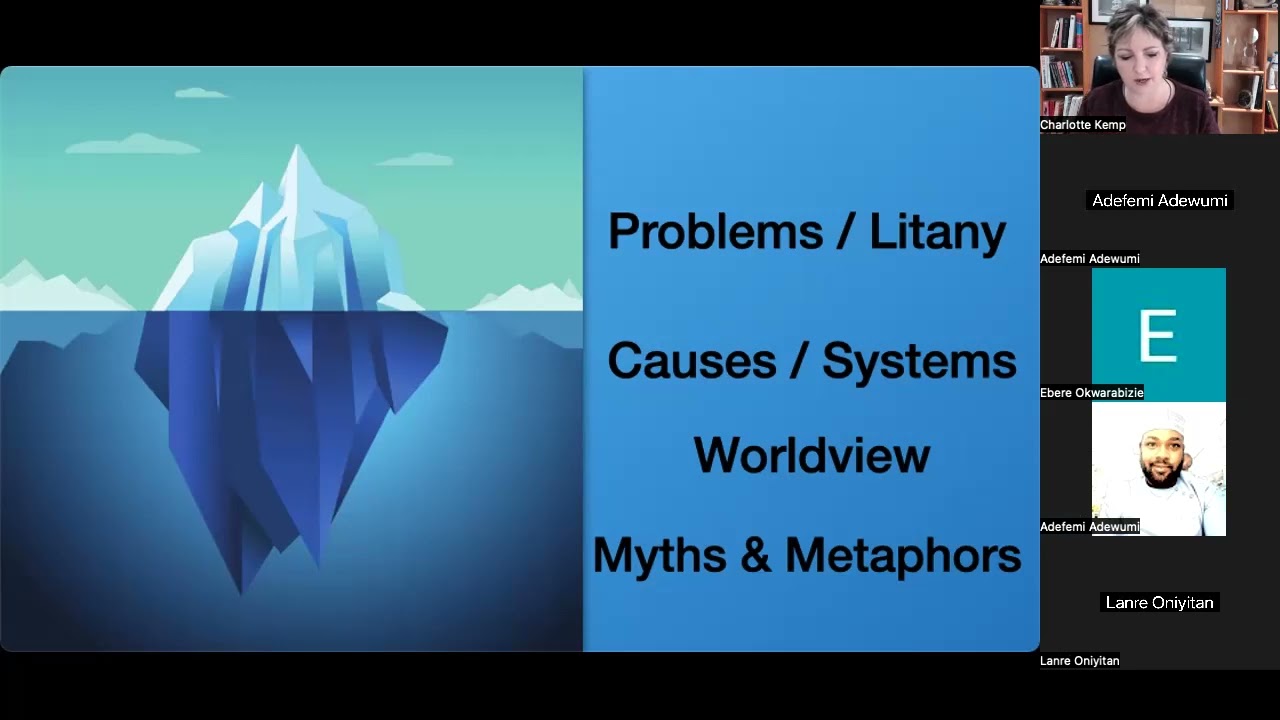
Futurist Charlotte Kemp introduces the Causal Layered Analysis framework for reshaping how we solve problems, then walks through Africa's youthful population boom and the jobs crisis it creates. She's launching a book called Africa on the Cusp of an Economic Miracle and organizing a Pan-African Speaker Summit to build networks across the continent.
Chapters
Good. All right, so I want to thank you very much for joining me in this conversation today, and it shows an element of trust because you're not entirely sure what it is that I'm going to be sharing with you. And this is not a sales pitch. I want to tell you about the projects that my colleagues and I are working on. I'd love to know if you have anything to contribute in terms of stories or introductions to people. And of course, at the end, there is an actual project that I'll be running later on in the year, which I'll tell you about, but it's just in order to create this awareness so that we can start to support the work that various organizations are doing on this continent in different ways. So let me launch into this. I'm not sure how well you know me or the work that I'm doing, so I'm going to kind of unpack a little bit of that for you. And the first thing we're going to start with here is just our introduction. So I would love it if, in a moment I'll ask, but in the chat box, just explain who you are and where you're from. Etc. So we're just going to talk about that. Then I want to explain what futures thinking is to you because it is really powerful. And then we will look at one particular futures thinking tool that really is at the core of a lot of the work that we're doing. Then I'm going to introduce a book to you that I'm writing with a colleague, which is very exciting. Then talking about building our networks and narratives and how we're trying to connect with everyone, including professional speaking. And then specifically the project I'm running at the end of the year, Crafting Positive African Futures. Welcome to, to Lanre joining us. Very welcome. All right, so the first part in the chat box, if you could just let me know who you are and what you do, um, specifically if you are a futurist or a professional speaker or trainer or coach, put that into the chat box, um, so that we can see who is, who is involved. Um, and if you like, please put in your LinkedIn profile so that people can connect with you on LinkedIn if you want to build your network. Uh, it's really important for us to, to be connected And to be able to share. Welcome to Injadeka. Welcome to you. So in the chat box, who are you? What is what is it that you do? Are you a futurist or a speaker? And your LinkedIn profile, and then we can share some insight around that. So let me explain what is futures thinking because that is the work that I do. I I am a futurist, and I am a keynote speaker, a speaking a a futures thinking coach and also a futures thinking workshop leader. So I help people to learn how to use futures thinking so that they can make better decisions. And there's various ways we can describe it. Essentially, it is a mindset where we look at the future with hope, with optimism, with realism, but we actually feel like we have some agency over the future. The actions we take actually influence our future, and we can do something about that. Just being positive though doesn't really help us. Like, you know, what are we going to do just because we think we can do something in the future? That's why we need a toolset. And the toolset is really good academic and business models. So not things that we just kind of, you know, dreamt up or made alliterative to be attractive and given it to you as a model. These are real models that come from academia, come from business, have been tested. They really work. I'll show you one in a moment. Um, but we can use them. And a lot of my work is to, to try and make those tool sets, those tools, um, scalable. So I know that they have been used by military organizations around the world. I know that they've been used by multinational organizations. I know that they've been used by governments. But how do we use them as individuals? How do we use them as coaches for our clients? How do we use them in our organizations and our teams? And I want to make sure that those are accessible to us. So we've got the toolset, and then the skillset comes from intentionally thinking about the future and not just being a victim, not waiting for things to happen to us, but making a difference in the world. Futures thinking can also be a language for discussing the future. So one of the programs that we run is about futures literacy. How do you begin to think about the future? What are, what are the words? You know, for example, you'll see a lot of my work talks about futures thinking with a plural S. Um, it's not just one future. There are multiple futures that we could look at. And how do we, how do we explain that and understand that? And I'm not talking about like multiple timelines or any science fiction stuff, just literally multiple scenarios of how we can look at the future. And it's also sometimes called strategic foresight. So we do a lot of strategic planning in companies, but strategic planning is, is good. It's really necessary. But strategic foresight takes that planning to the next level, really helps us to think about the future in a more holistic way so that we have more powerful scenarios and plans for the future. So that's kind of like what futures thinking is about. There's nothing— this is not like a— people keep using the expression woo-woo. This is not motivational talk. This is not positive thinking. These are practical tools to actually craft a different future. So let me introduce you to one of them, which is quite interesting. It's called causal layered analysis, which sounds like quite a mouthful. It was developed by a futurist called Sohail Inyatullah, and causal layered analysis means we're analyzing the cause of things. Why are things the way they are? But we want to go down those layers so that we can understand. So the top layer is an iceberg. Icebergs are great metaphors for most things in, in business, but at iceberg, at the top of this iceberg, we see the litany of problems. And these are the things we talk about in Africa where we say, oh, corruption, unemployment, and too many youth who aren't employed, um, you know, colonialism, um, resources being taken from Africa, uh, rubbish being dumped in Africa. All we talk about, all of these problems, and they are there, they are a reality. But we can't— if we want to fix anything, what we often do is we look at those problems and we try and change the problems right there. We try and just shift something at that level, and we can never do that. We can never make a real substantial change just by addressing the litany of problems, just by addressing the data set at the top. So think practically about if you had a company with a sales team and the sales team isn't making enough sales. So you just look at the data, how many sales have been made? Well, let's change that. And people will just go in there and go, make more sales, make more sales. And all we're doing is addressing that top layer and nothing gets changed, nothing is addressed. And that is because beneath that litany, beneath that layer is a whole iceberg. And that is where everything else is. So the layer below that is what we call causes or systems. Think about your sales team. What is the system that they use to get leads, to go after clients, to close sales? Are they on the telephone? Are they on LinkedIn? Are they door-to-door? What is the system? And maybe the system doesn't work. So some people get to that and say, well, we'll change the system. We'll throw out the system and bring in a new system. If we're talking about things in Africa, we go, well, this doesn't work. We'll throw out that government and bring in a new government. We'll throw out that politician and bring in a new politician. And all we're doing is changing the system, but it's still a problem because below below the system is the worldview. And the worldview is what we think the world should be like, what we, what we expect the world to be like. And our worldviews are really fundamental to ourselves, to our centers. You know, we believe we are on this planet for a particular reason, and we make sense of our existence because of our worldview. So I know that it's a really delicate place to look at. But beneath that worldview are our myths and metaphors, the narratives, the stories we tell about the world, and that forms our worldview. Now, if you do this analysis, how this is normally done in an organization is that we take a lot of time to really hear everybody sharing their stories, sharing the problems, talking about the systems, everything. And we hear all of that, we gather all that information, and then we kind of explain it in these layers, and we get down to these are the stories that are told about this organization, about this country. And if these are not the myths or metaphors, if these are not the stories we want to be telling, then we need new stories. So in South Africa, we can talk about corruption, we can talk about Eskom, we can talk about load shedding, we can talk about the floods, and we can talk about all of these things. And our myths and metaphors are just kind of reinforcing that. We expect South Africa to be like this because these are the stories we've always told about You know, the country. So we can change that. How do we how do we do that? So we what we do is we start right there at the bottom, and we say, what is a better metaphor? What is a better narrative? What are the better stories to be telling about why why we exist? Why what the world is like? What could this country be like? What could your country be like? What what could be you know? And we really kind of rework that. And once we got those new narratives, we create new new stories, new myths, new values right at the bottom, and that creates. a new worldview. And very often, if you've done this exercise, you go from being— having a negative worldview, like things here always are bad because that is just the way the world is. And now you go, wow, things are tough, but look at all of these exciting things that are happening. There is so much potential, so much hope, so much optimism, so many exciting innovations happening. And we have a new worldview about Nigeria, a new worldview about Africa. And from that, we create new systems, new ways to communicate, new ways to market, new ways to tell stories, new ways to connect and engage with each other. And then the problems and litany go away, and we get new data just automatically. There is new evidence of things. There are new ways that people respond. So that is very powerful. I know I'm kind of just touched on the surface of what that could mean, but that is one of the the tools that we can use, this tool called causal layered analysis. And I've used it for our organization. Njideka and I are both members of the Professional Speakers Association of Southern Africa. And we looked at where our association was 5 or 6 years ago, and we didn't like it. And we explored all of this, and we came up with new myths to tell, new metaphors for what we were about. So instead of being exclusive, instead of being restricted, we were open and generous. Instead of having there was this concept called pay to play. So you couldn't be involved in anything unless you put money down first. And now we're saying, now we're generous. Like, there's so much you can engage with our association long before you have to pay money. You don't need to pay for this. You don't need to pay for that. Can we share these things with you? And that generosity created this whole new wave of, wow, this, this community is so supportive, so encouraging. And more and more people were drawn into it just because we changed the metaphors at the bottom of, of how we were communicating. And now we've got a totally different association. We've got new, new, like, areas of leadership. We've got people from all around the world actually talking about our association because we did this exercise. And it was very simple. We didn't even do it in a big complicated way. It was just a very subtle thing. So I really want to, to encourage you to, you know, if you haven't engaged with me before, there are— I have open webinars. I have lots of communications about different things, and I want to be able to teach people that these tools are available and accessible to them so that you can use them yourself in the situations where you're working on. Okay, so what we are doing, my colleagues and I, and Jideka is one of them, we worked together on a project which I'll mention in a moment, but we're finding new ways to tell these stories. And one of the first projects is this book. It is called Africa on the Cusp of an Economic Miracle. I'm in the middle of writing it right now with the original author, Yelang Prujinka. She came up with this as a white paper. She presented it a few years ago. A few times. It is— I fell in love with her content because it is intentionally optimistic about the opportunities for Africa. We know that there are problems. We don't even need to talk about the problems. We don't need to put them onto a slide because we know about them. But how can we find and tell the stories about the things that could give us those opportunities? If we leaned into these things, we could find more opportunities in the future. We could change the way people see the world, see the continent, and what we're talking about. So we're working on that book, and that book forms a foundation of quite a bit of work that I'm doing, and it'll be out soon. I'm writing, co-writing another book with some other colleagues, and these are futurists in Africa. And this is part of what I'd love to hear from you is, do you know of any futurists, you know, in Nigeria or anywhere else in Africa? Please help me to connect with them. But in this particular one, we've got different futurists in Africa talking about the futures work that they're doing in Africa. And the reason for this is very often in Africa, we, we feel like we have to import wisdom or models or ideas or things from other parts of the world, from North America, from Europe, from Asia. And it's time we stopped importing. It's time we started looking at what we were doing and started to export those ideas and those values to other organizations. Other parts of the world. So for me, this, this personally happened, um, in a speaking engagement. My husband and I traveled from South Africa to Tanzania to do a speaking engagement. There was a conference, and we traveled early so we'd get there a few days before so we could meet with the, the organizer. Traveling with us was a speaker from Nigeria who was living in South Africa at the moment. And so we arrived there We connected with the, with the organizer, with the clients, with the sponsors. We were at some of the pre-conference events. We were available to them to do various things so that they could put on a good event for their clients and the delegates. We stayed afterwards and we had an absolutely superb time having some social events afterwards. But the main speaker, the keynote speaker for this conference, was a speaker from America, and there was this big billboard with his picture on it, and at the bottom all of our little pictures But he was the main event. Now, I know a lot of people in the speaking world, and I didn't even know his name. I'd never heard of him before or after. But at the last minute, like 36 hours before the conference, he sends a message going, no, I don't think I'm going to come and do this conference. It's not, it's not big enough for me. And he just dropped the conference organizer just like that at the last minute. And for me, that was like, we are here, we're invested in Africa, we're sharing. But an American gets the headline and the American drops us. And we've got to stop that. We've got to stop that narrative of, oh, it's okay, it's just Africa, it doesn't matter if I don't go. He would never do that to anybody in America because his reputation would suffer. But in Africa, he didn't care. That is what we're challenging with all of these stories in, in the speaking world and in the futures world. So now let's talk a little bit about Nigeria specifically. I could have a slide here that talks about all of the problems in Nigeria, but you probably know them better than I do. And then we would have to compare, like, are your problems better or worse than our problems in South Africa? But it's not about that. Let's look at the things that are going well. And this is a brief, quick look. I mean, I have not dived into any of these things. And this is part of what we're looking for here is if you've got these success stories, give them to us, please, so that we can talk about them, that we can use them as evidence in our book and in our presentations so that we can shine a light on the successes in Nigeria. area. Agriculture and agribusiness, renewable energies, your incredible creative industries, and your film sector is absolutely brilliant. Telecommunications and digital economy, like, you rate high, you know, in the world, not just in Africa. You're like, I think it was like number 11 in the world in terms of your telecommunications and digital economy positioning. And then entrepreneurship and innovation, which is so important because It really is that entrepreneurship and innovative mindset that drives economies to do better. So these are some of the successes. You would have others. We'd love to hear from you what they are so that we can, we can engage with them. But now I want to look at something more specific, and this is about the people in Nigeria and something that we call the population pyramid. And I love using this particular kind of modeling to talk about people because it is such a mind-blowing picture. So this This is the world population, and I don't have the numbers in here, but we're just around or shy of 8 billion or just over 8 billion. But what this particular graphic shows is obviously pink is for girls and blue is for boys, and that's just, you know, an old kind of definition which actually doesn't even work anymore, but that's beside the point. And they got the percentage of your entire population is made up of people at different ages. So at the right at the bottom, 0 to 4 years old, then 5 to 9 years old. So for example, Right at the bottom, not to four years old. Four percent of the population is female under the age of four around the world. Okay. And when you look at something like that, you see those younger generations growing up, and they're going to become older and older, etc. Very broadly, this is the Asian population, which looks fairly similar as well. But you can see there's just slightly fewer children at the bottom there. Okay. So that means that as they kind of get older, that little smaller percentage is going to age and it's going to kind of go up that graph as we go along. This is the population pyramid in Europe. So under the age of 30, there are far fewer people being born who are, you know, currently under the age of 30 and a population that is a lot older. What that means for Europe broadly is that they are not replacing their domestic populations at the correct rate. They are actually having shrinking populations in certain parts of Europe. It means that as those younger children start to get into the age where they're going to be earning money and paying taxes, there's going to be less tax income because there are fewer people in the population in that age group. The older group will then be retired and they'll be living on state pensions, but not actually, you know, creating any value for the economy. So when they look at a picture like that, that is a very serious problem for Europe. And there are lots of initiatives being kind of created to address that population pyramid problem. Fewer younger generations coming in and not replacing their population, they're going to have a tax problem, they're going to have an aging problem, they're going to have fewer people at the, you know, younger people having to take care of more and more older people. As it— because if you look right at the top there, you can see that 0.1% of the population are females over the age of 95 years old. Okay, they're not producing any value for the economy, but they have to be taken care of. And as health improves in Europe, that situation gets more dire for them. What are they going to do? They're going to rely on technology, artificial intelligence, automation, robotics to replace the workers that they do not have at the bottom. Now hold on to your seats because if that is Europe, this is Africa. This is Africa's population across the whole continent. Far, far fewer people at the top and so many children at the bottom. 7.2% of the population in Africa being children, girl children under the age of 4 years old. That is a fundamental difference. Let me just show you again, just in case you missed that. That's Europe, that's Africa, and that's Nigeria, which is a very, very similar picture. Okay, so Nigeria tracks very similar to, um, to Africa in terms of that, and many of our countries in Africa do. Now, that has implications. When you're looking at that, you're going, they have to be educated, they're going to have to find jobs, we don't have enough jobs as there are, you know, we've got unemployment, what are we going to do? But there are opportunities to respond to that if we can find ways to respond to it, if we can actually think about this proactively as opposed to not even being aware of how extreme this particular situation is. Just because I love these particular graphs, I'm going to show you a few others to give you some perspective. So that's Nigeria, this pyramid, okay, this site is called populationpyramid.net. Just Google population pyramid and you'll find the site. But this is a true pyramid, okay, where your base is bigger than it is at the top. And that's what we always talked about with population pyramids. This is China's, and it's not a pyramid at all, okay? It's just kind of wonky thing. Obviously, China has been very seriously affected by the one-child policy, by the really trying to have more boys than girls, and different regions in China. When you look at that, you see it's skewed more towards the boys. But they have a very serious problem right down at the bottom, ages 0 to 4, just 2% and 2.3%. That is a very serious problem for that entire population because those children are going to bear the burden of the economy going forward. And China is now doing a lot of things to try and address their one-child policy. They also just have these like kind of family trees that just go straight up and down like a pine tree. There's no kind of branching out and connection. So there's a lot of issues that they have to deal with because they they tried to manipulate their population growth as opposed to trying to address it in certain ways, and things that they expected now haven't worked out. So their economies are actually being affected. They have built cities for children that have just— were not born, just have not been born. The culture in China is moving away from traditional concepts of marriage and childhood. People go, I just— I'll have a career or just have a job, but I don't want to have that burden Of children because I have to take care of my parents. So why would I want to have children as well? So huge issues in China. Then just because we can be extreme, let's look at the United Arab Emirates. Hold on for this one. That is what it looks like. I'm not entirely sure how they did that. I don't know what they've done with all the women. I don't necessarily want to know what they've done with all the women, but that is skewed. That is very, very skewed. So if you do go and play on populationpyramid.net, get yourself a cup of coffee, give yourself an hour, play around. These screenshots that I've shown you are screenshots for now, the current data. But that site also has these other— you can kind of like project forward and go 5, 10, 15 years forward, and you can see how these population pyramids change. You can see how a small number of children at the bottom kind of moves up that pyramid and affects things into the future. South Korea, another similar situation. So many more people in the bulge in the middle and fewer children at the bottom. Germany, similar situation. So these countries these parts of the world are having a problem because they do not have enough children, where Nigeria, where Africa has this huge youth contingent. It is typically called a demographic dividend, which means that there is a demographic thing that will pay off in the future. This demographic group of children will pay off when they become income earners and taxpayers and producers in the economy. That's what they're looking at. But if our economies cannot absorb them, if our economies cannot educate them, it becomes a disaster, not a dividend. So we need to find ways to address that. And that is what futures thinking teaches us. Futures thinking helps us, first of all, to gather this intelligence, to look at something like that, to play around with it, to understand the implications, and then to look at other trends that are happening. To compare Africa, Nigeria, to other parts of the world, to see what we can learn and what we can do about things, and then find ways to respond, to actually craft scenarios for the future that give us options about how we can respond. That's the work that I do with organizations. But I do other work as well. So now I just want to introduce you to some of the other projects we're working on. And one of them is called Voices into Africa, and Njideka and I are partners in this. Voices into Africa is a kind of an events company focused on Africa. We come from the speaking world, so the idea is to build up the capacity of development speakers. So younger people or newer people who want to become professional speakers, trainers, public speakers, coaches even, and they've got knowledge and insight and they want to share them. We need that across Africa. We need that skills development. So we want to be able to support those people many of whom are independent or who work for a company doing a day job but want to become a full-time trainer or a full-time speaker. And our organization, our company Voices into Africa, deals with that and supports those people. But one of the things we want to do is we, we want to collaborate. We want to raise these voices. So we've got a, a new, um, just a little section on our website called Associated Organizations. And again, this is what I'd love to hear from you. Are there organizations that you know of who are doing this kind of development work in Africa? When we finish, I'll send you an email with some links. You can have a look at this site, and on there is that, this one page, which we only have 2 entries for at the moment, but just saying these are organizations we admire. One is Leading Women for Africa, where they're specifically developing women entrepreneurs across the continent. They've got programs and training and women-only trade delegations that go around the continent. That's the kind of work that they do. And then the other one is AFSEA. It's the Association for— Society for African Association Executives. So all the people who help to run associations, those executives, it's a society for them to build their capacity, to teach them, to help them to grow and develop so that their associations that serve different industry sectors in your countries can develop. So that's the kind of thing we'd love to hear. We'd love to be introduced to them so that we can support them, even if it's just a little bit of shining a light on them as well. Professional speaking is really important to us, like I've mentioned before. So here are some organizations here in South Africa. We've got the Professional Speakers Association of Southern Africa. I'm a past president there, and it's an association for speakers, trainers, etc. But it's designed for Southern Africa. So Namibia, Botswana, Zimbabwe, etc., down here. There are a few other fledgling associations across the continent, and we are working with them in a project that Interdeca is the convener for called the Pan-African Speaker Summit. And we want to find those speakers. We want to connect with them and build them, you know, connect them to each other. There isn't to our awareness an association in Nigeria yet for professional speakers, but we are in conversation with a woman who has said she will help to set it up. So she's trying to build that network. And again, we'd love to know who the speakers are so we can help to build a kind of coagulated group of people around her to form something that will serve those members. Around the world, there are a number of these regional or national speaker professional speaking associations. And at a certain stage of maturity, they apply for membership of the Global Speakers Federation, and that gives a kind of global reciprocity and support to these organizations around the world. I am the president-elect of the Global Speakers Federation, and for me, it is heartbreaking that only PSA on the whole continent of Africa, only PSA SA is a member of GSF. So that's why we're really trying to pour our effort into finding these speakers. When we find them, we can help to support them and to grow them and develop them, um, to give their career a boost. But that it means in your countries that you have access to world-renowned, recognized professional speakers who can serve your economy. You don't have to import people from other parts of the world. That's what we're looking for. So those are 2 associations. An association is like a professional body for, for an area. Red Jacket Speaker Bureau is more of a commercial organization. That's a project that I'm running with, and that is just putting those speakers on once we're connected with them and they're at a certain level, putting them onto Red Jacket, giving them some exposure around the world with social media and things like that so people can see the work that they're doing. So let me show you what it is that, that we're looking for. We want to hear your stories of success and projects and achievements. We'd love connections with professional speakers. I'd love introductions to futurists that you know of in Nigeria, and introductions to other organizations working in Africa. We're not trying to sell to each other. We, we, you know, we're all doing the right kind of work. There's no competition. But if we can see each other and collaborate and support each other, then we can get more progress in the work that we're doing. And we want to have more conversations about the future, the positive future of Africa. So this is the project that I'm running at the end of the in October. It's a 3-day conference and workshop. The purpose: to demonstrate futures thinking for Africa. So what I'm trying to do is, is teach organizations, leaders to use these tools and to take them back and to craft new futures for their organization. So that is the purpose, to teach those tools, to pass them on, to transmit them. But the theme is that we are crafting positive futures for Africa. If you can think of any company who might want more of exposure, who might want to sponsor this in any way, I'd love to hear. And if you'd like information about the conference yourself to see if you want to send anybody, I can send you that information. But I'm really quite excited about what we can do with that particular conference. And then the work that I personally do is that I am a futures coach and I run workshops. So I talk about that mindset toolset and skillset. We talk about all the, the the kind of areas of futures thinking, gathering intelligence, managing change, describing the future in better, more helpful ways, and then testing strategy. And some of the serious things that we look at is innovation, agility, and sustainable futures and resilience to the challenges we have. So that's work that I do. So what comes next? We're going to have a bit of a time to have some conversation. If you have anything to share, I'd love to hear from you. If you've got any questions, we can discuss that. But I'll send you an email after this call and give you some information. And if you could subscribe to my site and to Voices into Africa to see what is coming up, to see those events and things, it would be really helpful to be able to communicate with you that way. Um, if you've got stories to share that you'd like to send, I'd love to hear your stories, even if we can't use them in one of the books. When we're doing the marketing for the books, we're trying to promote them, to have those stories as additional evidence for all the amazing things happening here. That is what we're looking for. And if you do want to set up an appointment to talk to me, to, to discuss any of this, I'll give you a link to my diary and then introduce us to each other and to people in the network. So thank you very much for, for letting me share that with you. I really am enthusiastic about some of these projects, but I would love to hear now if there is anything from you, any questions, any comments, anything that you want to share right Hello, hello, hello, hello, Charlotte.
More from Charlotte




Unlock the Power of Thresholds_ What Ancient Wisdom Teaches About New Beginnings






