Hosting Virtual Events with Tomas Hoyos and Airsubs | The Food Blogger Pro Podcast
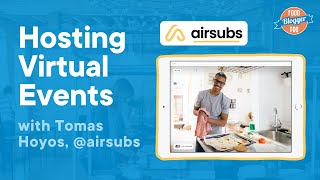
Tomas Hoyos built Airsubs in 72 hours when his startup lost 70% of users in March 2020. The platform bundles ticketing, payments, and Zoom automation so creators can host virtual classes. A fitness instructor with 25,000 Instagram followers made over $50,000 in the first week charging $25-$50 per seat to 1,000 attendees.
Questions this video answers
June 9, 2021.
About a 70% decline in users.
Approximately 25,000 followers.
Over $50,000 in the first week.
Common class sizes: 100–200 attendees; Typical price per attendee: $25–$50.
Chapters
Thomas, welcome to the podcast.
Thanks so much for having me. Bjork.
Yeah, this is. This is one of those podcasts where I feel like we could do. It could be like we shoot for an hour usually, but it could be like a five hour conversation. So I'll try and get through. I'll try and get through the like, top 20% of what I want to talk to you, but we won't be able to hit everything because your story is one that's really interesting for me personally, kind of overlaps with a lot of areas of interest, so I know that I'm going to learn a lot as well. And just as a little tease, before we press record, you know, you had shared a couple stories of users of Air Subs who are making multiple thousands of dollars a month with the product. But we're going to use that. We're going to bury the lead and we're going to talk about first the story of Air Subs, because I think your story of pivoting during global pandemic, which a lot of people have had to do, is an interesting one to talk about because I think a lot of people think have this question of, like, when do I continue to grind on the idea that I think might be successful versus shifting depending on what I see happening within the world. So rewind me back to, let's say, January 2020, when life was a little bit more normal than what it is now. At that point, what were you working on and what was the focus from a business perspective for you?
Yeah, definitely. So, first, thanks so much for having me. What did life look like before the pandemic? So, yeah, hard to remember. Yeah, exactly. The Airsoft story starts like about a year ago right now, in the beginning of the pandemic. And so at the time I was working on a startup and like many other businesses in the pandemic, we were deeply affected. So almost overnight, we went from having tens of thousands of users who really needed our product to a lot less. And I remember it was during that one week in March when the pandemic really took hold in New York City.
And you were in New York at the time?
Yeah, I was in New York City. And the news was coming in waves and it kind of felt like a big line of dominoes. So first was, you know, there's news coming from all over the world. There's this coronavirus that not many people know about. And then I felt like the first shoe dropped when Tom Hanks tested positive for Covid.
Yeah, totally.
In Australia, because it was Just like this big figure that everyone knows, and they're like, oh, man, if Tom Hanks.
Can get it, if Tom Hanks can get it, I'm in trouble.
Yeah, exactly. And so then, like, the NBA canceled their season, and the number of cases.
In your travel from China was. Was closed off. It was all in the same night, wasn't it?
Yeah, it was crazy. It was just sort of like this one night when everyone was kind of like, glued to the TV or glued to the morning, checking Twitter. And so at the same time, like, in the next couple days, I remember looking at a chart, and I saw a 70% decline in our business in the main metric that we tracked, which was users. And so we were not alone. Businesses across the economy were affected, and there were obvious ones that lost out, like restaurants. And then there were obvious winners, like grocery stores and E commerce. And like many other people who were in our shoes, you know, we pivoted because we had to. And we launched a side project that's taken off and become Air Subs. And Air Subs helps people host live virtual events and earn money. And so, you know, really, like, the first thing that we noticed that led us to the idea was that everything was shifting to be virtual. And so anything that you were doing in person was now virtual. So if you were going to the office and not an essential worker, you're now working from home, you were going to the gym, you're now working out at home on Zoom, you're going to a restaurant, you're now buying groceries, and you're cooking at home. And so we started to see this make its way into the world of creators, just generally, and then specifically food bloggers. And so people were going live on Instagram and they were teaching things and getting people together in a way that was pretty cool, but it was also still really hard. And so we saw a food blogger teaching cooking classes on Instagram, and she was asking people to Venmo her with a donation for a ticket.
Sure. Yeah. Yeah.
And so we figured that there had to be a better way to get your community together virtually and then also create a way for people to make money at a time when a lot of people were having a really tough go of it. And so, you know, we hacked together a product that made it really simple to host virtual events and earn money. And we launched it. And so we didn't know what. How it was going to go.
Yeah.
And we found someone who, you know, she was already teaching some virtual classes and kind of like hacking it together manually doing A lot of Instagram live and stuff. And she would get, like, you know, 20, 30 people together on a Zoom. And we told her, hey, we think we can help you scale this thing. We think we can help you grow it up. And so we built this tool. We gave ourselves 72 hours to pull it together, and we launched it really quickly. And then in the first week, she hosted a class with a thousand people together on Zoom, which totally blew our mind. We were looking at it and just constantly streaming through the pages of Zoom. And in her first week, she made over $50,000 doing virtual events, which was many times more than anything you'd ever made in a week ever before.
And at that point, for you guys as a business, you're like, there's definitely something here. Like, if this one person can do it, then there's probably 100,000 people who can do it. We just need to get this in front of them.
Yeah, exactly. And so, you know, your question before was about, like, when do you know, know when to grind and when to pivot? And so one of our investors was, you know, he's seen a bunch of pivots. He was one of the first investors in Twitter, which was a pivot. He's one of the first investors in Lyft, which was also a pivot.
Yeah.
And also one of the first investors in Twitch, which is a pivot. Yeah.
And can you talk about each one of those? Because I think those even, like, Instagram is a story where it was. I forget what it was like Bourbon, I think, originally. But the idea being these companies start as something. Slack being another example, start as something. And then you realize they're not going to actually be the thing that you thought they were going to be when you first start and you go in a different direction for each one of those. I think people would be curious to know you had said Twitter Lyft, and what was the last one?
Yeah, last one was Twitch. So. So. And I. So I'll share each one of them, what I know about it. And I'm sure other people have, like, you know, better versions of more accurate versions of the story. But as I understand it, you know, Twitch, which is now a platform that helps people stream themselves as they're doing something. And a lot of video gamers use it, like, they'll stream their screen as they're playing a game with other people on Twitch so that everyone can watch it. So that originally started as just in TV and socialcam. So the original concept was a live TV show that never ended. So so someone was walking around and they had a camera on their head.
Justin. And his name was Justin and it was Justin tv.
Yeah, yeah. And he would. He would walk around and it was. It was like a live show all the time. And I think they realized at some point that, you know, there's a reason that shows are, you know, however long they are.
30 minutes. As opposed to 24 hours.
Yeah, exactly. Cause, like, all the in between moments are a little boring. Super boring.
You realize like how boring your life is when you live stream it 24 7.
Yeah, exactly. So I think they shifted from Justin TV to something called Socialcam. I don't actually know exactly what Socialcam was, but I think both of those weren't working great. And then someone on their team, I.
Think it was like a social network, like a video social network. Almost like a Vine almost, if I remember right.
Yeah.
So kind of in a similar space, but then eventually shifted. I didn't realize Social Cam then eventually shifted into Twitch.
Yeah, Or I think they like carved out, like, they started working on Twitch on the side, and then at some point they carved it out and they sold Social Cam. But long story short, you know, they saw the things that they were working on weren't going to be very successful in the long run and they found something that was really working. And they were constantly experimenting on the side and they found one thing and ran with it. And then as far as Lyft goes, I think, you know, they started as essentially like a ride sharing. So it would be. I think it started at a college in upstate New York and it was a Cornell. And. And the founders conceived with the idea of people getting together to hop in a car and drive down to New York City. Yeah.
Hey, we're all going to Boston or something. Like, let's all take a trip together if we're all going to the same place.
Yeah, exactly. And then I think they shifted it to be more of a concept of ride hailing, which everyone's familiar with. It's like what Uber and Lyft do today. So it's sort of like a derivative of what they were already doing that they. That they shifted to. And then Twitter. I think Odeo was the original concept and I think.
Oh, yeah, that's right.
It had, you know, had something to do with. With audio, but they also had this concept of like micro blogging and then shifted into. Into Twitter, which has had kind of this, like, amazing evolution. So, yeah, to the question of, you know, whether you should keep grinding or whether you should launch something and work on something new. It's a really hard question, and it's a really personal question because you hear both stories, you hear people really persevere, and they were just on the other side, right on the cusp of something amazing. And it was like, that last little bit of effort that got them there. And then there's also folks who they let themselves follow know path, which is, like, really pulling them in that direction. And so I think the way that I think about it is, you know, if you really are getting, like, pulled in a certain direction, where it's the only thing you can think about, or it's just like, so obviously, you know, more interesting or better or more helpful than what you're already doing.
Yep.
Like, I definitely. I'd probably lean into it. That's how I think about it.
That's great. Yeah. There really is. There's not a science to it. Right. You can. There's not like an equation that you can apply to it that spits out the answer of if you should keep going or not. But I think some of the things that I'm guessing you'll talk about here can be indicators as to whether you should continue moving forward or not. Like, is the thing you're doing resonating with people? Like, in its simplest form, whether it's content or a product, are you creating something that people are responding to positively or actually have positive outcomes from it? So I think helpful to kind of frame up the conversation, moving into talking about air subs. But also, I think a lot of people are thinking about that if they've been working on something for a really long time, do I continue to do this and hope that, like, eventually I get that breakthrough moment, or do I shift and pivot? And what I hear you saying is there isn't really a good answer. And it partly depends on the product and the thing you're working on, and it partly depends on who you are and what you want to be working on. Like, is it a good fit for you? Are you able to continue to do that for a long period of time? And are you getting kind of a response from people that indicates, hey, this is something that I'm kind of interested in. So eventually you pivot. You were healthcare kind of focused before healthcare world really changes, and now you say, wait, there might be an opportunity here for us to work with creators. Everybody that listens to this podcast is in some way a creator. Tell me about that first initial success for somebody to create $50,000, you said in the first week, is that Right. What did that look like? Kind of start to finish? Is it somebody who's really good at marketing who. Who had, like, a huge audience and then what was it that they're selling and how much did they sell it for?
Yeah, so first, it was a natural extension of what she was already doing. So she was actually. Our first user, was actually a fitness instructor. And we've now seen the product evolve in such a way that it's really, like, taken hold in the community of food. And tons of food bloggers, recipe developers, food photographers are using the product. And that's sort of the a use case that's going incredibly well for us. But the first user ever was a fitness instructor. And so, you know, she had a big, but not massive following. And she had 25,000 Instagram followers, and she was already teaching fitness classes as part of a larger studio, which I think was Equinox. And so she had been teaching at Equinox for a little while, but had also been doing these classes on the side and had a little bit of a following on Instagram. And so, you know, I think what. What really drove her to be successful, at least in the beginning, is that she was. She was early. And then she was offering a product that people really loved.
People early, like in the pandemic. Meaning, like, hey, this was a unique offering related to the timing of when people needed to work out and they didn't have a solution.
Exactly. So she was early in the sense that saw, hey, gyms are shutting down. I'm getting furloughed or laid off.
People have been sitting on their couch for a couple weeks and are starting to think, I need to exercise.
Yeah, exactly. And this is probably going to shift to Zoom, and that's going to be the default, at least for a while. So I'm going to lean into it. And so it was also a product that people loved. It was a really good workout. And then also the way that you made people feel in class, feeling super motivated, really focused on community, it was just sort of like a really great product. One of the magic moments for her was realizing that virtual can actually be like, a much better business for a bunch of reasons than in person than in person. So a core component of that is that you don't have to be limited by physical space. So if you were teaching a cooking class or if you're teaching a fitness class, if you're doing it in person, you're limited by the physical space that you can. That you have. So you're limited to 20, 30, 40, people at max. And what she realized is that not only shifting to digital lets you serve a larger audience, but it really doesn't matter where they are. So they can anywhere in the country or around the world. And the quality of the experience does not degrade that much with each person that you add. And so it actually ends up just being more fun if you're in a class with 60 people versus 50 or 100, like, Peloton.
Like when you. When you go on a run and there's 300 people and you're getting, like, random high fives, it's like, oh, this is really cool. And then like, I've had it before where the Internet cuts out, I'm like, really quickly it becomes not fun. Like when. When it's just me on a treadmill running, I'm like, oh, yeah, this isn't very fun, is it? But when you have other people, there's an energy, even if it's digital.
Yeah. And there was something to being in. In that zoom where there was a thousand other people and you're all seeing each other and, you know, you're in your home working out, and you see this sea of faces and everyone doing the same thing. It's kind of this really, like, crazy social experience where you feel like you're in the future and you're in the movie that you're working out, literally. And so. So that was really interesting. And I think the other thing that really clicked for her, you know, and just in thinking about this and, like, what we've seen is that the business is just much more profitable in the sense that you don't have to pay rent, you don't have to overhead. You don't have overhead. Like, you essentially be like, you know, a person who is also a company or like, has. That's also a company with a limited set of tools. You know, the problem that she was running into is that she was hacking together all these tools, and it was just like making her life hell. Pull this off.
So she becomes essentially the tech department for a virtual class that she's running, which is where Air subs kind of fits in.
Exactly. So, you know, she has to build a website where people can. Can go to the event. She has to integrate signups, she has to integrate payment processing process. She has to, you know, create zoom links and meeting links, and she has to distribute them via email.
And 10% of the people are like, my connection is fuzzy. What do I do? And it's like, she's working out and she's like, sorry, can't help you.
Yeah, exactly. And so what we saw is that there's a way to build a product that solves those problems and makes it much easier to host a virtual event and earn money. But where it's fun, you can focus on the things that matter, which are doing a fun class or doing a fun event and earning money, and not worry about the technology or the payments or some of the business stuff. Kind of make it incredibly simple to do this. So, like, what is Air Subs? It basically helps creators, but a lot of food creators host virtual events and earn money. And the most common thing we're seeing is food creators hosting Zoom cooking classes and baking classes. And we've seen people get creative with virtual cookbook tours and other events, and we just kind of make it. Make it easy to get started so you can focus on. On that fun stuff. And again, it lets you set up a page, sell spots, handle ticketing, confirmation emails, reminder emails, automatically create Zoom links, you know, sell in different ways. You can sell a membership, you can sell a package of classes, you can sell gift cards. It helps you build up an email list and then market the classes. It's essentially like a virtual event business in a box.
Yeah. So is that. Is it built on top of Zoom in a way where, like, you sign up for your own Zoom account, you enter in your credentials for Zoom, and then through API access, Air Subs kind of does what it needs to do. So then you essentially are going in and pressing, like, start on a Zoom event, and then people show up. Or how. How much do you have to be involved in kind of the setup process with it?
Yeah, it's super simple. So our goal is to make it incredibly easy and have it so you can set this up in less than five minutes. So, you know, with Zoom specifically, you click one button and you. It hooks up your Zoom account, and then you never have to worry about anything else again. Like, you will add a class that you want to teach, and it'll automatically create the Zoom link, and when people sign up, they'll automatically get the confirmation email. The confirmation email has the right Zoom link, and so it just kind of takes all that stuff off, off your plate. But yeah, you know, with. With cooking classes specifically, there's like, a few big picture themes that. That we're seeing. So the first is that, like, this is the perfect moment to run virtual cooking classes. Yeah. Because they're super fun. And if you imagine what the pandemic's been like, it's just been really isolating for A lot of people, like, no matter where you are in the country or where you are in the world, at one point you were in some version of isolation, distancing lock.
Yeah.
Like, there's just so much human connection missing. And so it's a great way to get together and learn something and make something delicious. And people are cooking so much more than they ever have. Right. And in talking to so many folks like in and around food, it's just interesting to see, like, there's just this huge surge in interest and demand. I mean, like a lot of folks who are really having. Having some very successful bread making classes and really crushing it with sourdough. And like. Sourdough, yeah, yeah, Totally had its moment in the last year. And so it's just brought people so much joy where if you're stuck in your house and you haven't seen someone in so long, it's like really refreshing to get together and be able to cook something with a room full of people and also with someone who you admire and you look up to and whose recipes you've been making for a long time. And then, you know, for the people who are teaching the classes, it's also really fun. Alexander Stafford, Ali Stafford was one of the first people to start teaching on air subs. And what she told me was that she feels like it. It's like a party that she. That she's a digital party.
Yeah.
But it's kind of nice. And that she doesn't have to get all the stuff there and like cook for a million people. And so, you know, it's just kind of brought people a lot of joy. And then, you know, the other thing that, that we're seeing is that it's also just been like scale really well and it's pretty lucrative. So we talked about a little bit with why a virtual class is better than an in person class. We're seeing people consistently host these zoom cooking classes with 100, 200 people in them, and they're charging usually somewhere between $25 and $50 a head. And so it just ends up kind of being this really lucrative thing where the price point is still really accessible for people who want to take the classes and the experience, the quality is really high. But when you get that many people together and it's at that accessible price point and you aren't limited by scale, it can just be really lucrative. And then I think the other thing that we're seeing is that people are charging for these events in a different way. In the old world, if you were going to do a cooking class, like, a lot of it would just be like individual tickets. So you pay 25 or 50 bucks and you'd show up for class. And not that many people would do cooking classes that often. So many people have done in person cooking classes like I've done Sur La Table in New York, it feels like more of a special occasion, but when it's virtual, it's just so much easier that the frequency with which people want to take the classes and like the fun, casual atmosphere of doing the classes makes it so that people want to do it more and more consistently. And so we have folks who are teaching like two to four classes a month.
Sure.
And when you. When you are doing it at that level of frequency, that is amenable to building it into a community.
Recurring.
Yeah, with a membership.
Yeah, yeah, yeah. So people pay $25 a month and you just get access to the premium cooking class that. That is going to happen once a week at Wednesday, Wednesdays at noon, or whatever.
Yeah, exactly. And so you save yourself a spot in every cooking class. And then the other really creative thing that folks have done that a bunch of the creators we're working with have done, is they're essentially recording all of these live classes, and so they're building up this big video library of all these classes they've taught previously. And so when someone signs up for membership, they do save themselves a spot in all the live classes, but then also get to go back and watch all the classes that have been taught previously. And every time that you teach a class, you're essentially adding to this big library of classes you've taught previously. And so it's sort of this concept of, you know, make money while you sleep or, you know, spend time.
People could sign up and they could join and be a part of part of that and immediately have access. Kind of on demand.
Exactly right. So, like, you teach it once and then you continue to sell it over a really long period of time. And the memberships that people have launched have been really interesting just because it's created this recurring revenue for people. And then there's a bunch of reasons. I mean, you know, Food Blogger Pro, like, I think you understand the power of subscriptions and memberships. It's just like a really interesting business model where you're deeply aligned with your customer, where they have an incentive to use the product more and more over time. And then it's really great to have that steady recurring revenue where you can predict how much revenue is going to come in per month, and you can count on it, and you can start to understand it. And it grows over time. And you have this really big, you know, sort of asset that's growing over time, and it gives you just enormous freedom and peace of mind to know that you have this consistent revenue.
More from ChatFBP

One more reminder to tune in here to the latest podcast! https://pod.link/1014116331









One more reminder to tune into this week’s podcast! https://pod.link/1014116331

A glimpse at our October coaching call all about returning to your blog. Replay on FBP!