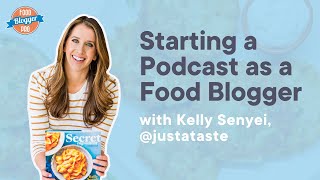
Kelly Senyei launched a food podcast in four months while having her third baby, working with producer Elizabeth Evans. She uses descriptive storytelling to make food work on audio and interviews guests to share concrete tips and notable voices.
Questions this video answers
About four months (fast-tracked launch).
Elizabeth Evans.
She had her third baby around the launch period.
Season two.
Chapters
So you've done a lot of things. It's not just blogging, right? We all know it's blogging, it's social media, it's, you know, video. But you've also done cookbooks, you have a podcast, you've done tv. Like, there's a lot of different elements that you're juggling. I'm curious to know, how do you go about decisions when you're saying, hey, I think I'm going to do this new thing, podcasting. I'm going to start a podcast. How do you go about the decision making process? And how do you not get spread thin? So you're like kind of doing stuff in a lot of different places, but know that you can actually go deep and do stuff well, even if you're doing a lot of different things.
And I think that's exactly it is. I don't want to be, you know, jack of all trades, master of none. That's never been the goal. But at the same time, I have this big ethos about, like, not going the way of the dinosaurs. So could I stay the steady path that I was on five or six years ago, rely on ad income and sponsored content and just continue to grow? The site, which is really, I just consider just a taste, is like my base. That is my home. That is where like all of my great readership is. That's where all the recipes live. But from that, how can we kind of build upon it? And so anytime I'm going to take on a really big new project, the podcast being one of them, most recently the cookbook, which comes out soon, all of these things, it's like, how can I dedicate? I try and like every couple of months dedicate myself to one new major idea or project. And yes, there's a million balls in the air at all times. But, like, the podcast is a perfect example. I saw a lot of people having success with podcasts, but they weren't necessarily in the, like, hardcore food space. So I spent about four months. I fast tracked my launch because I was about to have my third baby. So I signed on a wonderful producer by the name of Elizabeth Evans. We fast tracked launch. She basically gave me the, like, masterclass of what podcasting was, what it entailed. I have a journalism background, I went to journalism school. So I knew the kind of interviewing aspect of it, but the tech part of it, I was like, I didn't know what this was I'm wearing currently, which we were talking about. I'm like, Elizabeth, what do we record on, like, what do I. What do I wear? What microphone do we need? Like, there are so many things. She's like, well, your show notes page. And then we put it in the Libsyn. I'm like, what? I don't know what any of this is. So I basically got this, like, hardcore master class in podcasting. Over the course of four months, we launched I had a baby. Then we, like, continued, and we're about to launch season two. So it's one of those things. I'm just. I am very like a dog with a bone. Like, you put something in front of me that you're like, you might have success at this. I'm going to go at it 110%. It's just kind of the way I am.
Yeah. What do you feel like success looks like for the podcast?
Definitely growing the readership, but also I think the guests that you can book. And honestly, I was very surprised when we first went out, when we started pitching guests. We got some really big names, and I was kind of, like. My first reaction was, like, shocked.
And then just so you know, I'm just starting.
Yeah, I know. You want to be like, you're the first episode.
Yeah.
Yeah. I had no idea. So the fact that we got so many yeses across the board, I was like, wow, this might. And our guests for season two are, like, epic. They're amazing. And these. These. The whole goal of doing the podcast was I wanted to share other people's stories who have had success, food and in the tech spaces. Because I think talking to people that have success, I always feel that you can learn so much more by listening than by talking. So by me being a host on a podcast, I have to shut my mouth, which is very hard for me to do, but I shut my mouth and I listen, and you absorb so much more.
Yeah. I think the other thing that I really like about podcasts is it's a type of medium, especially for food, that's unique in that people can consume it kind of asynchronously. Maybe that's not the right word, but, like, they don't need to be sitting looking at their phone and scrolling through Instagram. They don't need to be Googling something that they want to make that night. They can just be doing dishes or driving.
Exactly. This is what I say. It's always on in the background for me. I have podcasts on in the background at all times. You know, not necessarily when I'm driving my kids to school, because we're probably doing some, like, epic dance to ABBA or something crazy. But it's something that I always have on. Like, once the kids are in bed, it's like, put a podcast on, start doing the dishes, get the bottles washed, like, all of that sort of stuff. But I think one other thing too, about food specific podcasts, which, you know, I mean, you've been doing this for a long time now. Food is such a visual medium. So it really took a change in my brain to be able to say, okay, now we can't show people. You know, you can record the video, which is great, but most of the time your audience is going to be listening. So how do you descriptively get them tuned into food without having a gorgeous photo or video to do that?
And how do you do that?
So much description. So I always say with my podcast interviews that I do, I say it's going to seem kind of awkward, but I'm going to describe literally everything that you're doing, every gesture you're making, like, pulling people into that scene and making them feel like, okay, you're sitting here with me now. Like, I would say, okay, looking at you now, like, you know, you talked about this dish. Well, like, you know that apron that you wore? Like, walk us through it. Does something splatter on the stove? Like, what sound did that pasta make? Like, you know what, what color was it? Like, a vibrant green. And really getting people to get, like, uber descriptive, I think transforms and, like, takes the podcast, like, so much more personal. And it makes it way more relatable, too.
Yeah. Why do you think it's. Why do you think it's easier to get access to people? That's one of the things that's so interesting about interviews is, like, you'll reach out and be like, hey, would love to interview you for an hour. And might have a decent amount of success with that. I think part of it is you've proven yourself in the work that you've done. You've proven that you'll actually do a podcast. When you do it, you have a history that it builds credibility and trust when you do reach out. But there's also a piece of it where it's like, somebody could take an hour to, like, write a written response to questions in an email, and it's like, you know, one in a thousand people will actually do that. Whereas if you reach out and you're like, hey, I would love to interview for podcasts, the success rate with that seems to be so much higher. It is. Do you have thoughts around why that.
Is the only thing? And it's so funny you say that, because I feel the exact same way. Again, being shocked at people who have, like, agreed to be on the podcast. I think it's because there's so much. There's a much lower bar, like, of entry. So, like, for people to do this, like, I'm just sitting here, I've got my iced coffee next to me. This is like, you know, I'm in my zone right now. I don't have to sit down and write for two hours. I can just have a. We're talking, we're having a very casual conversation. And that's what I always say too, when I'm doing my podcast, is like, this is very casual. This is meant to be like a window into your success. What tangible takeaways can. Our readers have interviewed a food stylist the other day for my podcast and she had so many great tips for how people can make their home cooking look so much more Instagram worthy. And that's the kind of content that I want to provide is like tangible tips about how other people have been successful. So we can kind of all share that information. But yeah, I'm surprised that people have said yes, but I think it's just because it's easy. It's easy to just jump on here, listen, talk. This is not like a very intensive.
Right. You know, it's a different type of thinking, like, exactly. To sit down and write a report technically. Which it kind of feels like if you're going to be, you know, doing some type of written interview feels different than just sitting and having a conversation.
It's more casual. Yeah, I'm having a, I'm having a coffee. Like we're hanging out. Like we're on different sides of the country. Doesn't matter, you know, La.