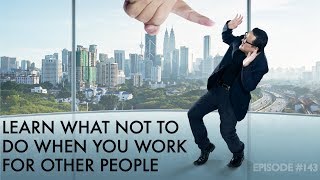
Chris Haroun argues that corporate jobs suppress your authentic self and trap you through fear and social pressure. He learned what not to do from a negative experience with an associate partner at Accenture, and says starting side ventures and accepting failure is how you build toward something real.
Chapters
I want to know how to overcome or face the social pressure and fear of leaving. The classic career, 9 to 5 job to follow your passion and go for it yourself. That's a great question. We weren't meant to work for somebody else our entire lives. We were born free. And then what happens is you get to an age where you start working for somebody else. It almost lobotomizes you to the extent. That's harsh. Sorry, I'm trying to make a point. It lobotomizes you to the extent that you stop being yourself. You know, you stop laughing as much as you used to. Like, I remember when I was a kid, I used to laugh so much until it hurt and I fell down, right? And my kids are like that now, too. This is comfortable teaching here. Why don't we do that anymore? You know, we change. We change. We start working for people. It sucks the life out of you. We weren't meant to be this way. You know, we weren't meant to be this way. And I don't know, in little things, I remember my career, like going to the corporate picnic and in the car when Andrew was really, really young. I remember saying to him, andrew, please be good. And I felt like, this is so stupid, man. I gotta tell my kids how to act. I have to act a different way. If I get in an elevator with a senior executive, I'm silent. Or I say, top of the morning, sir, nice weather, whatever. I can't be myself. It's ridiculous. It's kind of like I had a nightmare once where I was kind of. I was in a car in the backseat with my kids, and I was telling them, okay, be on your best behavior because we're going to the corporate picnic now, right? Like, what kind of a jerk company makes you go away on a weekend, Right? You know what I mean? Like, do I really want to. I want to spend time with my family, right? And it's kind of like forced family fun. That's what those things are. And I know there's exceptions. A lot of us work with wonderful people that are friends. In that case, it's cool. And I remember telling him in that nightmare, you got to behave yourself. And I'm like, I just want to. I just want to be me. I just want. I don't want to be somebody else. I just want to be who I am. I don't have to analyze every word I say. You know, when somebody senior is around, like, gosh, did I make a good first impression? Did I say the right thing? Did I sound nervous? I felt nervous, you know, I just didn't want that anymore. I didn't want that. So anyway, I'm sorry I'm going on and on and on about this, but. But. But I think it's really important to break away, break free. Those chains did one day. And you don't have to do it right away, man. You don't do it right away. Like, I think it's cool to work for a couple companies before you start your own, because you can learn what to do and what not to do. Like, when I worked at Accenture, there's this one associate partner from the Orange county office that was in Toronto, and I can't name his name, but I'm tempted to. He was such a jerk to me. Such a jerk. And he treated me so poorly. And I told myself, you know what, Chris? My takeaway? The positive is I always try to the glass half full the positives that I'm learning what not to do. I will never treat anybody that way. Right? So anyway. But you got to work for a couple companies first. Or you might have to in order to learn business, learn what to do and what not to do. But on the side, I want you all to start your own company. And I want to empower you. I want to empower the empowerers. I want to inspire you, if I humbly can, to. To break free and do your own thing. So write that business plan, please. But you know what, though, dude, it's gonna be like for every. You think Steve Jobs was successful overnight and so was Bill Gates. They weren't. They had failed companies before. You just don't hear of them. You only hear the successes. So maybe you have to write 20 business plans before you start a company. I mean, I started so many companies on the sides over the years, and I used to advertise in foreign markets or in Middle of America because a lot of people know me in San Francisco and New York, and I remember even once I had a Facebook advertising campaign in Pakistan. I just picked another country, but I used to test everywhere. I've started a lot of companies that have done well, but a lot of them failed. But you just don't know about them because I quietly built them on the side while I was working for other people, and I want you to do the same.