Forget Dropshipping. Be The Middleman For $800+/Job (Drop-Servicing)
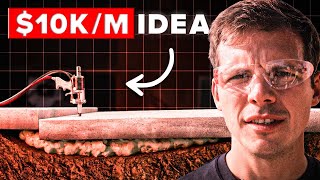
Chris Koerner and Jeff discuss drop-servicing, where you take concrete leveling jobs and subcontract them out. Jeff charges customers $800 to $1,200 per job while paying contractors $300 to $400, keeping the difference as profit without doing the work himself.
Chapters
This might look like a curb that's not a curb. That concrete is supposed to be level. But what you're looking at is a $9,000 job with 40% profit margins. Brand new to the industry. In the first six months, you expect to do $100,000 of profit.
We are just shy of $20,000.
Not just that, but you can make eight. Sorry, it needs to be leveled. You can make $800 per job.
Babe, this is too easy. I'm doing something wrong.
Don't quit your job. No employees. Subcontract out all the work and have a $10,000 a month cash flowing business. We're talking today, guys. I'm meeting with Jeff. He's doing exactly that. He has a W2, he has a wife and two kids, and he has a business that pays him very handsomely. So we're going to ask him exactly how do you do it? How do you find customers? How do you fulfill the service? How do you talk about this stuff when you don't even kind of know what you're talking about? Well, let's dive in. So how long ago did you start this business?
I'm a newbie. I've been doing this for a solid 90 days so far.
Okay, beautiful.
Basically an expert.
Yeah. What is your total revenue been so far?
We are just shy of $20,000 and majority of that has come in the past 60 days.
Okay, wow. And how much of that is profit, give or take?
We're seeing anywhere from 30 to 40% gross margin on each job.
What do you think your net profit will end up being once you're more at scale?
We'll try to continue scaling. My goal this year Is to finish 250,000 top line revenue before the end of the year. And if we can do 50 to $100,000 gross dollars as margin, then that would be an outstanding success plan for next year. Is 1 million top line revenue. Anywhere from 20 to 40% margin I'd be extremely happy with.
Wow.
So you're saying brand new to the industry. You didn't work in industry before. In the first six months you expect to do 100,000 of profit.
I hope too.
And you're on track.
We need to win a couple bigger jobs, but we've seen some really good encouragement right out of the gate. And so the market is relatively saturated in the sense that there's a lot of providers. But we have found a good way to differentiate ourselves relative to a lot of the noise. And so my peers are typically solopreneurs who own their Own trailer, work for themselves. And once they hit a certain threshold of either revenue or margin, they just like to coast. Nothing's wrong with that at all. Everything after that is just gravy for them. What I want to do is create a process that is repeatable and can be copy and pasted across mid tier, smaller tier markets across the Texas coast and along the border of Mexico in order to own markets where there is no providers currently operating. So Houston has a couple million people living there. I want to target port A, Brownsville, Corpus Christi, et cetera, where there's no established providers, population of 200 to 300,000 people, and little to no competition.
You kind of go find the solo provider who reached one $200,000 in revenue, and he's cool. And you come in there and say, hey, I can get you to the next level without you having to do any additional work. So any additional jobs you want above that revenue mark, I'll send your way. I'm going to work in my margin and we can work together.
Great.
Okay. Do you have a harder time finding good subcontractors or customers?
It's been a huge blessing. I've been so fortunate to work with the people that I have, and I am lucky on finding those folks. And everybody I've worked with so far has been honest and straightforward. And I look for some common denominators. Hmi, who's the manufacturer of these trailers typically, and the main producer. The raw materials we looked at earlier have a soft spot in their heart for veterans. And so typically you see a lot of veterans that are owning their own trailers that I found are so easy to work with.
What about customer acquisition? How has that gone so far?
We have a number of channels open. I sold my first job June 2025, and it was lead that I found through a Facebook lead. My cost per lead was, you know, $4.60 or something. And I found that lead within an hour or two of the campaign being approved and launched.
Now, this is a Facebook ad campaign, not marketplace or groups.
Facebook ad campaign, yeah.
So within two hours of launch, you had your first $5 lead, which turned into your first customer.
Correct. So you're $2,500 of revenue.
This is so easy.
I looked at my wife.
Revenue.
Yeah. I was like, babe, this is too easy. I'm doing something wrong. What is going on? But obviously there are some lessons learned along the way. You know, didn't make any margin on that job because it was an hour outside of town and I needed to factor in the team's time of driving to the job into the overall cost.
Facebook ads, has that been like the daily driver for your customer acquisition?
I turn those on and off. We've seen nextdoor work well next door.
Ads or organic stuff?
Nextdoor organic. Google search organic. We've had folks refer us. We've had inbound leads just on the website and through our chatbots asking about inquiries. And then I've taken a page out of your own playbook and done some outbound texting campaigns to think HOA managers, property managers, et cetera that are overseeing multiple properties. And so by staying in front of them, that's generated a service slow trickle of volume as well.
And a lot of times you have to like play the long game on that. And it's a little depressing for the first month, but then they start to come back, especially as you follow up.
Right? Yeah. So what we're looking at here, Chris, it's really cool. We just completed leveling this singular slab. As you see, the hole is about the size of a dime. So if the concrete is not stained, the sealant that you use to fill everything with is non noticeable. But for stained items, you can kind of see it a little bit. The cool thing here is that 15 minutes after the work has been done, you're ready for a car to drive over this thing without any sort of influence on the integrity of the lifting that was just completed.
How many inches deep did that drill go?
So there's depending on the job. It depends on how deep it'll go. And so if you drill until you hit the bottom of the cavity that you're trying to fill. And so typically on sidewalks, that's no more than 24 inches. There's obviously exceptions that can be applied. The largest I've ever seen is about 7 or 8ft where a whole river formed underneath a driveway. And so a job that they thought was going to be, you know, $1,500 of cost ended up being $5,000 of cost.
A river underneath the driveway or wherever.
There was a cracked sewer and it was just flowing water downhill. And so additional complications because it was on an incline, which made things less straightforward.
How do you know when you're to the void?
You can feel it. We'll get you to do it in time, but you can push it down, and once you hit the bottom of it, you get resistance.
Okay.
But when you go through the concrete, you're assuming you get it right, then you have the pressure breaks immediately after you break through the concrete. And then you can push through. And so if you are dealing with a longer or a deeper vacuum, there are opportunities to create longer distribution straws, if you will, to achieve the goal. But for these, plug it in right into the cap, which sits between the hole and the gun. And then you saw you tighten it on at the end of the gun and then that acts as the primary location where the chemistry takes place. Okay. And the foams collide.
What are your revenues and costs? Look, on a job like this, about.
This size, on a single job, the cost will start there. We're talking just a few hundred dollars. The revenues depend on what you want to set your minimum project at. And so the scope for this is a little bit bigger. But if we look at this, if.
This were just a standalone job.
It's a standalone job. You can make money charging 600 to $1,000 on this right here. If you own everything vertically. If I'm subbing it out, I'm going to probably pay $600, $700, and I'd look to charge at least $1,000 or something this small. The market has been growing incredibly, especially on the residential focus. And the inability to distinguish yourself among peers within the market, at least in Houston and likely in Dallas Fort Worth area as well, is that you can stack up a lot of small jobs on top of each other. And if you can provide quick value to those homeowners and you can align and triangulate multip within the same area, neighborhood, region, et cetera, then you can have a nice profitable day. But rolling a truck just to do this type of job, after you look at fuel, windshield time, et cetera, it just strains your margin a little bit.
In your case, you're subbing out jobs like this, you'd try to quote 1100, pay the sub 600 and you're done. If you own all the equipment, you're probably going to charge 700 or so and make half of that as profit.
Yeah.
So when you're subbing it out, you make the same amount of gross profit, but you do less work. The trade off being you'll probably close less jobs because you. You're kind of for to be a little more expensive.
Yeah. And so we pride ourselves on two things. We guarantee that we'll provide a quality product and we will provide you with excellent communication. I don't try to get into any bidding wars. Those customers typically to be more of a pain in the butt longer over time. But if you're honest and straightforward with folks up front about the two things that you're really Good at us. We deliver quality work and we can have extraordinary communication with you along the way then. Most folks appreciate that if they're just trying to buy back time or, you know, help source an issue or problem at their home or along their sidewalk, etc.
Listen, I know you're here to learn how to get more customers for this business. And we're going to get there, I promise. Just be patient.
There's a few key components every time you want to level concrete. There's a generator which is going to power this whole trailer. There's an air compressor which helps helps push all the materials through. We have two raw materials, A and B, which create the chemistry reaction which solidifies the foam. There's the reactor, which warms up the materials to the ideal heat. And then the reactor pushes the materials, pulls the materials through the hose, which is connected to our gun. Right here. At the very tip of the gun is where the chemical reaction takes place, where A hits B plus air, which pushes into the void within the hole in the sidewalk or driveway or parking lot.
So you said about 103 for one, 110 for another. They come down the hose. You could warm the hose for cooler climates, right?
This hose is warmed. Yeah. You can turn it on or off.
And then it all kind of comes together at the end, right at the nozzle where the air pushes it all through, combines the two materials. Chemical reaction happens. Foam comes under the concrete and expands and lifts it all up.
And lifts it up good as new. Third of the cost of new concrete by design. Supposed to be pretty easy so that somebody even like myself can't mess it up.
How do you quote jobs if you don' know how big the void is?
So there's some maths you can do based on the size of the differential, but you get upside down on a job if you don't estimate enough foam. You know, the quickest way to lose your tail on a job is by under calculating those forecasts. And so personally, I build in a very conservative approach on how much foam we need to do. And so sometimes you don't know until you get out there, but you do a thousand sidewalks, you do a thousand driveways, there's only so many holes that can reappear, right? So the good news here is that we're not solving cancer. Not rocket scientists by any means, but you get enough reps in and you can anticipate based on surrounding items such as trees. Maybe there's water lines, maybe there's sprinkler systems that are leaking, etc. And so if you ask enough educated questions and you observe the immediately surrounding perimeter, then you can get within a pretty good estimate.
Now, if someone were to not want to sub out all the work, do it themselves, what would a whole setup like this cost?
So this trailer, I think this is a 20 foot trailer. You will start about at $120,000 turnkey, and then your raw material, depending on the count of jobs that you do on a weekly or monthly basis, will be about 2 to 3 grand. That's $2 per pound for each of these 55 gallon drums. And so that's your throughput. Your biggest risk is your gun. Breaking the gun is probably the most expensive product by weight. Within the whole concrete leveling deal, a nicer gun will cost you about $5,000. And so as mentioned before, you don't want to let that clog up and you want to make sure that's clear so that you can continue to work. Without the gun, you can't do any work.
So a whole 55 gallon drum of.
Materials is like a couple thousand dollars. Okay, Chris, this is really exciting. We're going to have you drill a hole here. So it's a powerful drill. You already signed your liability waiver, so thank you for doing that. But we will have you just turn it on, you push it down.
So in your finance meetings when they say, let's drill down on this, this.
Is what they're talking about. Yeah, this is what they say in Texas, drill, baby, drill. This is like a smaller version of it. Your right hand, you have your trigger here and you want to support it with your left hand and you just go for it. Oh, yeah, there you go. Yeah, sweep it up. We like to leave every place cleaner than the way we found it. All right, so you go black side down and you just want to hammer it in. And then the gun we showed you earlier will connect to this. These are single use items, so you run through them based on the size of your job and the kind of holes. So those are discarded afterwards.
What do these cost you?
Quarters or less? Yeah, you buy them by the hundred. Man, I'm so proud of you. Great job. So we have it in neutral right now. This is not turned on. The air is not coming through. You pull it all the way up. That turns the air valve on and pushes air through. You want to go from air on to injecting the foam. What we're going to do here, keep it in neutral. We're going to turn it on, then we're going to shift it all the way down to six o', clock, let it go for two seconds, and we're going to pull it back up to neutral, a bit of an angle, and keep the air coming through at all times.
Okay, so it's coming right back up to top when I'm done?
Yeah. So the last thing we want to do is let the gun clog. That's a. A big problem. Whenever you're ready, ma'. Am.
All right, let's freaking do it. One, two.
That's it. You did it.
How do you know when you're done?
Now? Yeah. Now we're going to watch.
Do you always only want to do it for two counts at a time?
No, it depends on what you're working on. Right now we're working on a small lift. We're not trying to get too much foam in. And you can see the new will start moving. It takes about 15 seconds for the foam to start reacting. Once it starts reacting, you'll start seeing that needle start moving. Now underneath it here, we know we have a big void. So we're filling the void before and pushing ground away and let the foam rise. Once we've filled that void and once that area is full, the foam will start pushing up.
So what are you looking for the gauge to do? Exactly.
It'll start spinning to the right as the concrete's going up. For something this small, we want it to move slow so we don't overload.
How much effort or time did you put into your website or your Google business profile?
I didn't spend too much time. I invested $0. I built it all in repl.it and so my goal is to just have easy, clean landing page. As I've started seeing a little bit more volume come through then I've been playing with the idea of having a professional build out the website, but right now it captures 95% of people that are coming to my website, if they actually are interested, Whether it's through forms, chatbots, or other items that I've set up. Yeah. So I try to differentiate in a few ways. I mentioned the quality of our services and the communication. And another thing I do for residential jobs is I throw in a free power wash on the area. And so I have it structurally written in a way that, hey, you level your driveway with us, we'll power wash your driveway for free. My cost for that is typically 100 or $150 and it covers the entire property. And so that comes two, three days after the leveling is done. And so then I text the owner, especially if they've had a good experience. I say, hey, our power washing guy is going to be there to do the driveway. I told him to throw in your sidewalks as well for free while he's there if you want him to. Do you know your backyard? That'd only be $100. So it's a small upsell to potentially cover the cost. It's already baked into what my top line quote is.
So you just sub that out and eat the cost. You basically work it into the quote and then find another pressure washing company to do that.
Yeah, I want people to see effort and joy in every job that we're doing, and. And a way that we can very easily deliver on that is by leaving something cleaner than the way that we found it. And there's a bunch of power washing folks that will do it for less than $100.
If you're liking this video, which I know you are, I mean, come on, just go ahead and hit subscribe real quickly. It would mean the world to me. Of all the things you could have started, of all the opportunities you saw out there, why did you pick this one?
So one thing that excites me about what we're doing is that if concrete were a crop, then Houston would be the largest farm in North America. If concrete were a standalone entity or country, it would be the third highest carbon emitter globally. Texas alone accounts for roughly 20% of new concrete being poured in the United States. And the two leading markets are Houston and dfw. And so, in an effort to not recreate the wheel, choose a service or a line of work that has already been validated for centuries. That was something that I wanted to bring a new and fresh look.
Well, in Houston and Dallas, we're not geographically constrained. We grow out right, not up. They're massive, sprawling metroplexes. What did you first see that kind of gave you the idea to even start to look into this industry before you knew how big of a market it was?
I had somebody quote my house a year prior, and they quoted me $2,200. And I was like, oh, my gosh, $2,200 to fix 12ft of a walkway, you know, from the street to my house, like that is outrageous.
Why did you want to fix. Were you selling it?
I'm not selling. There's about an inch dip. There still is, I'm embarrassed to say, but there is an inch still tripping hazard that my younger son had stubbed his toe a couple times. And so typically from A residential side, you're trying to remove tripping hazards or a liability standpoint, there's aesthetics or vanity. You want your house to look good or your neighbor just got a new driveway. And you don't want to pay 30 grand for a new driveway, so you'll pay 3 grand to level your current driveway. And those are typical buying levers to poll. Yeah.
Let's talk about job size then. What is your average job size with regards to revenue?
$2,500.
And what's your average profit margin on that?
$1,000.
So 30, 35, 40% profit. And do you quote all the jobs yourself?
Yeah. So one thing that I try to be different about, everybody I'm competing against will roll a truck to go to look at a job site. And there is benefit from building relationships with your potential buyer. But my hypothesis on doing everything remotely and virtually is that I can crank out five or ten quotes. You know, the time it takes me to drive an hour outside of town, spend an hour with the homeowner, then drive an hour back. And so in those three hours, maybe you have a 50 or 60% chance of winning that job. I'm okay quoting it all virtually over the phone. By collecting enough photographs, maybe my win rate goes down to 25%. But if I'm doing 10 in the same time, then I'm winning more gross revenue over time.
What else are you doing in the industry that's kind of progressive? Like how are you trying to change things in this industry?
Yeah, so one thing I'm really excited about, I'm still wrapping my head around it, but I want to provide concrete leveling as a service. So the go to market is going to be commercially focused or industrial focused to property managers, new home builders, maybe folks that own retail properties around town, multiple retail properties around town. And I want to be an insurance like product that gives them up to a certain amount of concrete leveling at each of their properties on an annualized basis. Or maybe you get one free job per property per month or something like that. And I want to sell it as a higher ticket item. That's in the six figures that would have to be budgeted for on an annualized basis for these bigger companies. But that way I can create more predictability in my top line and I also will have higher utilization and justification to own more assets. If I know that I can cover my entire fixed cost based on just this one contract, then that creates a lot more upward mobility for growth. And since real estate and these other folks are going to be Prominent in most cities you go to, that type of thing can be a pathway, if they own equipment in multiple cities, to expand geographies very quickly or to easily target which areas you want to go to next based on relationships that you've been able to build.
I think you'd have an even better easier time selling that if you really played up the liability side of it and if you got some industry facts, talking about trip and fall lawsuits and how much it could cost them and it's prevention is better than the cure, et cetera, et cetera. You play into the fear side of it as opposed to like the aesthetic side of it. I think you can have some success there.
Yeah.
What you're saying, invent the disease, sell the cure.
Yeah.
Starting a business is hard, so don't start it by yourself. But also don't give away a ton of equity to a guy that never pulls his weight. Check out tkowners.com it's my personal private community where we are still starting building and growing businesses all together. So you're a father of two.
Yep.
You have a W2 job.
Yeah.
You have this business and other businesses.
Yes.
Is someone able to run a business like this while doing all these other things or are you just like a superhero, freak of nature?
I don't know about that. A lot of credit goes to my wife. She gets the wife of the year award for sure. I've just been so blessed to have the ability to manage my time in a way that I need to based on whatever's happening. And so by no means is this. Jeff is incredible, but I've just been fortunate to work with great people, be surrounded with a supporting and loving wife, and have two incredible boys that are not a headache, but just a joy to be around.
So if someone wanted to make 10,000amonth of net profit in this business, how many hours a week Ongoing, like, of course, in the beginning there's going to be more, but over time, how many hours a week do you think that would require?
My biggest week was $10,000 top line revenue. And that took three jobs. And I sold three jobs in two days. And so that was just a bit of luck and fortune. And then seeing those through to fulfillment is something that I'm not personally involved in a whole lot. And so what I require with my sales is that we never book jobs the same week. And so we'll take 50% down payment immediately once the sale is done, and then the remainder is due after the job is completed. And so I hold the subs To a higher standard? Not a higher standard, but just to a, hey, we're going to be there at 10 o' clock on Tuesday. And, and they have to send pictures and check ins in order to do that.
Okay, so if your average job is 2,500, you said let's say 800 of profit per job, give or take. You've got to do about 12 jobs a month to make $10,000.
Yeah.
So call it three a week, give or take. What's your close rate on quotes?
On quotes. So in the past 30 days I've done four jobs out of my pipeline. Has about 30 or 35 of those 35 only like 12 or quotes qualified and so I'd say about a third rolling average of a 33%.
Would you consider yourself a killer salesman or average?
It's an area that I need to be better at.
Well that's good. Most people are probably average as well. So let's say 33 close rate. You need to do 12 jobs. That means you need to quote 36 jobs. Yeah. Work back. So you need 36 leads a month to do $10,000 a month in net profit. And how many hours do you think that would take to quote? What's, what's we're calling like 10 quotes.
A week, give or take a quote if you're asking the right questions, only takes an hour. And so from the time that the lead comes in to qualifying it, I try to have no downtime. So Chris calls in. I want to talk to Chris immediately. I want to see what he's trying to solve. I want to understand like what's the pain that he wants to get rid of and help him just come to a decision of this is something I might want to do or not. So I'm trying less to sell you and convince you to do this. I just want to understand the pain that you're trying to avoid. And once you understand that pain, then you can help that person make an educated guess. Yes.
So it's not unreasonable. It's not unreasonable to say that someone with a full time job could run this business if they acquired enough leads. Call it 35, 40 leads a month. In five hours of quoting per week they can make 10,000amonth of profit.
Yeah, if you have the systems in place for sure.
What speaking of systems, what, what is like your tech stack.
So custom software plus my CRM is high level.
Okay, high level is your CRM. You built your website with replit. Any other tools like calendar widgets or apps that you use?
No, I Do a lot of texting. I see a lot great benefit in texting the prospects. And so High Level has a good text chat, AI bot or whatever it is. You can kind of create guardrails around it. And so the ease of a lead coming in and then setting up automations to reach out to that person is pretty low hanging fruit. And it goes a long way. If you get a text right after you complete a form and then ask if they're free to connect and then call them regardless of what they say. If they can't talk, they'll tell you.
What are your ongoing costs in this business and how do you manage insurance?
Yeah, so each sub has to have at least a million dollars of insurance, one to two million dollars. And then the CRM plus replit is less than $500 a month. So I have multiple. I forget what tier it is in High Level, but you have like unlimited sub accounts. So I pay for that one. And replit is probably incremental $100 based on whatever. If I'm trying to build something. Yeah.
So five, six hundred bucks a month here you don't pay for insurance because your subs do. Right. And that's it. And it's remote.
Yeah. If you have a good understanding of what you're trying to fix and you can target low complex jobs, think big parking lot for a commercial building, then those are six figure revenue opportunities that require little to no complexity. And then you just need to plan it out. And so one thing I'm investing time in researching is how do I create more efficient bids and more attractive bids for the city of Houston and other municipalities. But I'd see it as a big win five years from now if I had the Texas Department of Transportation, City of Houston and Harris county potentially as past customers for either one or multiple jobs.
Do you think people should even consider getting their own trailer and doing it all themselves or is subbing it out just the way to go?
Really depends on what you want. I think over time I'd love for this to be a full time gig. Currently there's no need for me in Houston to get my own trailer. Over time. My vision is to expand into some of the smaller markets in Texas where there are no competitors or providers and that at that time it makes sense to buy the equipment, but your entry cost just for a van. So you know, think that van this size or half the size of the trailer that we were in earlier is probably about 60 to $70,000. It's not nothing which creates and prevents some folks from entering into the market. But there's a lot of opportunity on this tail of, you know, smaller cities relative to maybe DFW or Houston that I'm really excited about.
Well, Jeff, thank you for your time today.
Thank you. This has been an absolute treat. I've enjoyed it. Been a long time follower, first time seeing you in person. I think what you're doing is so cool. You're inspiring to not only myself, but other folks that were within your network. And I want to, you know, for whatever it's worth, tell you you're doing a great job and really appreciate the voice that you have in Texas and outside of that, this great state.
Thank you for the kind word. Where should people find you if they want to learn more?
Yeah, website is texaslab guys.com and love to get connect if you're in Texas, if you are within the commercial real estate world, I'd love to pick your brain and figure out how we can better penetrate this industry. And if you're in concrete leveling too, I'd love to just meet more folks either within concrete or concrete leveling. It's a relatively small world and the more folks I can meet either in Texas or outside, I'd love to sharpen my own understanding of the market as well.
Or if you're on the coast of Texas or in greater Houston, you need some concrete level hold.
Texaslabguys.
Com.
Yeah, Port Aransas, Brownsville, Corpus Christi, just to name a few. If you're just looking for names, Chris, thank you so much. I really appreciate it, man.
Absolutely.
Be good.
Was that a banger video or what? So if you like this, YouTube knows you would love one or both of these, so go check them out.










