How Much Do Shaan Puri and Sam Parr Make (My First Million)?
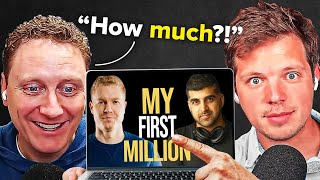
Transcript of an informal Kerner Office podcast episode featuring Chris Koerner and Nick Hulesky. The hosts 'bro down' about recent small-business investments (a commercial kitchen cleaning company and a pet crematorium called Sunbeam Paws), deal mechanics (equity splits, margins, MRR), podcasting and influencer economics, MrBeast's e‑commerce performance, and rollups/home‑services business ideas. The tone is conversational, anecdotal, and advice-oriented.
Chapters
Foreign. This is neither episode 11 of the Kerner Office. Neither is it anything formal. This is me and my best friend just broing down. And so I've got Nick Hulesky on the pod today. He is my best friend of 18 years. He was the person who taught me Hungarian, and he's my 5050 business partner in our holdco called co founders dot com. Nick, welcome to the show.
You're welcome. I just want to say you're welcome to everybody listening. No, man, I'm freaking stoked.
Here we are.
I'm more excited than my wife was on the floor of the ERAS tour to see Taylor Swift. Dude, you're my Taylor Swift. I don't know what else you want me to say.
I want you to say that I'm your Taylor Swift. And you just did. So we're off to a great start.
Dude, I'm so excited for this. We've talked about this for years, and we're finally doing it.
I know. This is awesome. Also, this is a very shameless pitch. Nick has a podcast of his own called Nickonomics, that's Nikonomics. And he's going live here in a couple days, so give that a shot. It's basically like the Kerner office, except for people that want to buy a business or who have recently bought a business and need some help. So you brought some notes to this meeting. Why don't you kick this off? What do you want to talk about today? We bought a van yesterday.
Dude, I was thinking about this. I didn't. And I was going to text you this morning. By next week, we are going to have two additional companies added to our portfolio. We're investing in a commercial cleaning company, Commercial kitchen cleaning company in Tampa. And our pet crematorium, otherwise affectionately known as Burning Dogs, will be open next week, too.
Okay, we're. We don't say that in public. Called Sunbeam Paws.
Sunbeam. I'm. I'm sorry. Yes, Sunbeam Paws. But, dude, I. I was like. Anyways, it was just cool. It was like a cool realization to see that we're going to do that.
That is cool. Yeah, that's. And that one's in Tampa, right? The kitchen cleaning one?
Yeah, the commercial kitchen cleaning ones in Tampa. It's with a searcher that we met off of Twitter. Good business, stable business. I was an idiot. We were first doing the research on it, and I was like, it's a hood cleaning business. And I sent it to Chris, and Chris is like, oh, I know a guy who owns a business. And we Got the information or, like, his perspective on it? He's, yeah, hood cleaning sucks. So I go back to the searcher and I tell him, by the way, the guy we talked to says, hood cleaning sucks. So I don't know if we're gonna do this.
He's.
That's a really small part of our business. Did I not explain this well to you? And I'm sure you'll be surprised. Apparently, I just didn't listen very well to what he was explaining.
Isn't that crazy? But not going on.
It's a commercial kitchen and appliance cleaning business, so the Hoods are a part of it. But anyways, they're in a growing market that we're really excited about. Small business that we're hoping to grow and expand. And at the same time, we have an investment in this company called Sunbeam Paws, which Chris has been spending a ton of time on getting the crematorium set up. And we bought a freaking van yesterday. And I texted Chris and I'm like, did. Was that a personal loan? Yeah, yeah, personal loan. And I just slapped myself in the forehead. I'm like, oh, gosh dang it. Should have been through the business. But Chris doesn't. Wait, Chris is mih's.
I make it happen. MIH equals make it happen. If you're unfamiliar, first of all, first thought before I forget is you should do a whole podcast episode about that deal and just break it down to why you like it. Second thought is, great idea. We were going to put in some cash for Sunbeam Paws. Me, us, you and I and Steven were going to put in 50, 50. And then most of that was for the van. And it was like, it's a $15,000 van. And I have this credit union that I use for an rv, our personal minivan, whatever. And the loans, seven and a quarter, seven and three quarters percent. And I thought, shoot, geez, I can make more than 7 1/3% on my cash. Zero money down. Like, I'll take a loan all day. We'll put that 15 grand into something else.
How did you find it?
Matt the operator found it. Can I just say something the real quick? I got to tell you this. I got to tell you this, okay? The owner of the van is an OB gyn and don't ask me why an OB GYN has a refrigerated van. Her last name is. Yeah, I don't want to say this on air. I don't want people to Google her. But it's just a very funny last name. For someone that's an ob gyn, I'll say that. I'll say it. I'll let your imagination run W on that one. But here's how the unit economics break down on Sunbeam. Pause. So we already have a customer lined up that owns. He owns 5% equity. Also, Nick, I don't even think you know what our equity split is on this business, so I have no idea.
I was literally going to ask.
So we own 15%, 1 5. Stephen owns 15%. And then the veterinarian that will be our first customer that's been our advisor owns 5%, and then the operator owns 65%. And we are outsourcing most of our operations to a competitor about 45 minutes away. And we are going, despite the fact that we don't need to buy a burner, we are going to have 80% gross margins from day one instead of 93% if we owned a burner. So really not in a rush to buy a burner. And we're going to have about 20k MRR on launch day, really, because our 5% equity owner is our first customer and we've got three or four others lined up.
So let's back this up just a minute. What we're talking about is Sunbeam Paws. There has been a huge explosion in pet ownership, especially since the pandemic. And unfortunately, the upside. Excuse me, the downside of the upside of owning more pets is there are going to be more pets dying. And we probably a year ago looked at buying these ABA clinics. And the partner that we looked with buying these ABA clinics, his name is Stephen Hale, he's on Twitter.
Autism clinics. Yep. And he's for those.
I'm excited about aba, which are autism clinics, but what I'm really excited about is burning dogs. And we were like, okay, that's a funny thing to say. What are you talking about? And then it's just morphed over. He just kept talking about it more and more over time about pet crematoriums, the economics of it, how he had a friend, how he knew a veterinarian. It's like all these pieces came together. And so eight months ago or so we said, let's do it. And we found an operator who has experience in the space. And I'm using we very loosely. This is. Chris and Steven have been working most of the time on this. We found an operator in the space who has experience. We got the veterinarian on board and we looked at buying a crematorium, which was like 100 wasn't like $100,000 minimum to buy a pet crematorium. And instead of buying the pet crematorium, Chris worked out an arrangement where we're actually using a competitor. So when he says our gross margins are going from 93% to 85%, what he's saying there is, if we had bought the crematorium, our gross margins would be 93%, but since we're outsourcing to a competitor, they're 85%. But we get in the game and we're starting. But I'm super excited about it. I think it's. I think it's awesome. So we're starting in Dallas, and the plan is. I guess. Yeah.
Talk through.
What's the rest of the plan? For the near future, we're just going.
To start acquiring more customers in the area because our operator used to roll up veterinary clinics here in dfw, so he has a. A bunch of connections with vets. So we already have two or three lined up.
Dude, can I tell you something? I was talking to my wife last.
And I'm glad I have my. I'm glad I have my headphones on, because my puppy's down at my feet right now.
Oh, really? You got that?
What were you talking.
Chris got that dog in him. Chris got that dog in him. I was talking to my wife last night, and I told her about the van. I was like, yeah, we. We had this company because she heard about it. We haven't talked about it in six months, just because there was no, from my perspective, no update to be made. And I was like, yeah, Chris bought this van last night. And she's like, what? Yeah, he went to the credit union, blah, blah. And she was super impressed with that. And then later, we were talking about Twitter. She's, so, what are your plans with XYZ thing? And I'm talking. There's a couple things that we're working on. And I was like, I'm going to get to that this week, and I'm going to talk to this person and do this. And she just looks at me and she's. You really need to get on that. Like, you need to act with as much urgency as Chris does. And I was like, I haven't even told you that. Oh, man. For my wife to pay anybody a compliment, it's. It'd be the equivalent of saying something. I'm not even gonna say it. It's saying something. Thank you, Chris. Thank you. And let's just say I went to bed a happy man.
And when you say that, Stephen And I have been mostly working on it. It's mostly Stephen and Matt working on it. And that was one reason why I was happy to PG on the loan, because I wanted to put some more skin in the game because they've been working hard on it.
Like that business and this commercial, the one that we're closing on next week, again, we have a less than, we have a 10% equity stake, less than 10% equity stake in the Florida business as well. But I'm excited for us to be a part of these businesses to leverage our unique skill sets. I really do think once Brian gets up and running in Florida, for example, your cold calling ability, cold outreach, just ability to grow a customer base is going to be exceptionally valuable and it's going to add another quick whatever arrow in our quiver to home services or commercial services. My ability as well, to help him transition it. Like, I've been through multiple acquisitions. I understand what it takes to, to transition and open new bank accounts and make sure that you've got your employees on the right systems, yada, yada, yada. So that's like going to be the highest use of our unique individual skill sets. And yeah, I'm just, I'm excited to see how that turns out the next couple months. And if we never talk about it again, you'll know that they failed.
There you go.
Not wrong. I think one of the most interesting things that I'm seeing right now, especially as you and I are getting into it more on the content side, going to other platforms, is this proliferation of influencers doing podcasts. And the reason I find it interesting is because it feels like they're all getting into this at the same time. So you and I have had this thesis for a while, which is audiences are incredibly valuable. We don't know how we're going to monetize, we don't know when we're going to monetize. We don't know what it's going to look like, but we know they're infinitely valuable. And we've seen Cody Sanchez start with an audience where she created a community, was making a lot of money. She's now gotten into the podcast game. Huber's had a podcast for a long time, and then a flood of influencers, quote, unquote, have gotten into the podcast game. And the reason I'm finding it interesting now is because all of the research and information that we're learning about podcasts, so it's not only are we seeing it, but we also understand the back end of things. And I Think your research on podcasts has been super fascinating. So walk me through again. How do the economics of a podcast work?
Absolutely. So I recently crunched the numbers on my first million and how much money they're making. And it's actually not that hard. Hard to determine. They publicly state that they get 1.2 million downloads per month. Now podcast, and really any online marketing is measured on a CPM basis, cost per mil. And I don't know who decided to spell thousand as mil, but I don't make the rules. So pod on business podcast, the CPM is about between 40 and $80 per thousand downloads. Listeners, impressions, views, whatever you want to call it. And so that means if you have an hour long podcast and you have three ad spots and that podcast gets 1,000 downloads, it means you can charge, call it 50 bucks per ad slot. So $150 for one podcast, that will get a thousand downloads lifetime and that has three ads. If you take my first million and you take those numbers, that's 150 times it comes out to like over 200 grand a month. If they were to just sell ads, just ads. Now think about it this way, Nick. Companies need to make a 3-10x ROAS return on AD spend on all of their ads. And on Facebook and Google Ads, that's very easily measurable. But on podcasts it's not. And so if let's say Shopify wants to advertise on my first million, they need to get, let's say it's 5x return. And so that means they're getting a million dollars. Let's say they bought out all of my first millions ad space, they would get $1 million worth of value out of that $200,000 ad spend. Cheese Louise. So I think why the Cody Sanchez of the world are getting into podcasting, because they're realizing I could have my own Shopify, I could sell my own stuff. So 200 grand a month is great, but a million dollars a month is better. So why even sell ads when you can launch your own stuff on your own podcast?
So me, I'm pe. I've always thought even the virtual global assistance space, I'm like, oh, it's getting saturated. And you constantly tell me it's not. We're early, we're still early in this game. How do you think about podcasting? Are we still early in podcasting or is this, is it getting saturated? Like we see all these people jumping into it. Is it just more earballs or I should say, sorry, more people competing for less earballs, or is it. Are they taking advantage of a shifting tide? Is it shifting out of radio into podcasting? What do you think about people jumping into it?
I can't compete. I can't disagree with myself. And I like saying that nothing is oversaturated. Right. But you can be oversaturated in a little bubble where if 13 different people are launching a business podcast to the same 10,000 people on Twitter, then that could be an oversaturated niche within that bubble. But it was interesting hearing Sam Parr talk about the podcast stats compared to radio stats, because I was just telling you this a week ago and I want to tweet about this and he's just copying Sam Parr. But no, we were just on the same wavelength podcast. So 41% of Americans listen to a podcast a month and 82% of Americans listen to the radio per month. Exactly.
It's still 82%.
82%. Now we know it's shifting. It's slowly. Podcast is taking market share away from radio. But I don't know, like, why would you be a 35 year old white dude launching a podcast to 41 of people when you could be a 35 year old white dude Launching a podcast to 82% of people?
Yeah. Okay, so we tested this though. When I say we, you we.
We did. I did. Yeah, I did. In Tampa in a local radio station last Friday. And I don't know. See, I don't. That's the hard part about radio, like podcasting, because you just don't know who's listening. So I just learned that radio stations need to pay about $10,000 a month to Nielsen, which is the rating service that's been around for decades. $10,000 a month for a little radio station to know how many people are listening to their podcast. And so the station that I use in Tampa, they don't pay that. She said we broadcast 2 million residents, Western Florida. And I did the numbers. There's 40 podcasts, and if 80% of them listen to a podcast a month, that's 1.6 million. And if there's 50 podcasts, then that's 60 divided by 100. I don't know, it's about 10, 20, 30, 40,000 people. Potential listeners of your station, all else equal at any given time. But I don't know who heard my podcast and who didn't last Friday morning in Tampa Bay.
What I think is interesting is we had a thesis. You bought a prime hour. What was it? It was 9 to 10, right?
In Tampa, 7 to 8 Eastern.
And because they don't do Nielsen, we're like, okay, how do we measure how many people are actually listening? And so you added a Google phone number on the ad to say, hey, if you're listening to this, give me a call. Maybe this is too embarrassing. Do we get any calls?
I have no pride anymore, okay? I'm a 37 year old baby face. I've got no, I got zero calls. But compare that to Twitter, where I'll tweet about my podcast and it'll get 600,000 views. And then I'll link to the type where I'm asking for questions, which is the digital submission version of a phone call. And three people submit out of 600,000 viewers of the tweet. So it doesn't mean no one heard it. It just means people didn't want to call, they didn't have a question.
So back to the podcasting. 81. I still can't believe 82% Americans listen to the radio once a month. That's nuts. But it's 41% for podcasting. And so we're seeing some of these people get into the mix. As you're looking at somebody like Cody Sanchez, let's just use her as an example. She's done a fantastic job of monetizing her audience and her reach. Do you think she's looking at it as, I could spend money to advertise on podcasts or I could start my own podcast. That's one way of her thinking about it. Or do you think she's just, I just want to continue to build my brand and this is another channel and it's not necessarily either or, but which one of those do you think is more of the motivating factor for her?
I. I assume she's extremely calculated, but this was really the only channel she wasn't tackling. So to me, it's probably just a box she had to check.
Dude, what's interesting? I went and was looking at her website. When was it? This week? Last week. Contrarian Investor Investing, Whatever. I clicked and I looked at each one of her portfolio companies. Really good. And by really good. How many times have you clicked on a website where you're like five minutes into scrolling down the page and you still have no idea what this company does? They're using all kinds of buzzwords. They're like, the page looks fantastic, it's got a good ui, but you're like, okay, what do they do exactly? Cody's companies were like, really clear and like, top of the header. It's like, we help payment companies lower their processing fees. Like, it was very clear with what their value proposition was. And I know this is a stupid observation to make, but just seeing that made me just reinforce the fact that she's calculated with stuff. I know she gets a lot of hate on things, but I feel like she's really good about communicating, and that is just a really good branding exercise to go through.
She's a killer. And it's honestly surprising to me because a few months ago, I saw this guy that just ripped into her on Twitter and it was honestly a very unfair take on her. And it just. It broke my heart for her, frankly.
Yeah, agreed. It wasn't me.
That sound familiar?
Was it me? Be honest.
Yes, of course. Oh, gosh.
Look to the ones of people who are.
That's your first viral tweet. How. How are you getting that?
It was my first viral tweet. I thought it was. I thought you going to say was John Gorham because he was like, every chance he gets, he just, like, loves to hate on Cody. I. Yeah, I used to think Cody was a grifter. I really did. I thought she was just an influencer and she was using her audience to grow. And I have gained a whole new appreciation for her. I went back to, like, her 2016 interviews and heard her talk about the way she wants to get people into entrepreneurship. And I was like, dude, that's me. Like, she's me. Ten years ago, she was me. And after listening to those interviews, I just have looked at her in a totally different lens. Like, I understand the criticisms of her. I get that people are saying, oh, she's making it look too easy. Whatever you want to say, but whatever your criticisms are, she's been the gateway drug to a lot of people getting into entrepreneurship. And a lot of people rave about how they just open her, how she opened their eyes to entrepreneurship. And I can't knock her after seeing kind of the impact and effect on people. And she's not super negative. She's not out there just doing clickbait. Her content is incredibly high quality. Like, I look at her compared to Nick Hubert. Nick's just like, engagement bait. As many eyeballs as possible. That's his strategy. He's got a huge funnel and he gets them down and eventually gets. Sells them on something. But Cody's content, I feel like, is consistently high quality, actionable, tailored to entrepreneurs or people looking to get into entrepreneurship. So I was. Honestly, I was wrong on her, and.
I feel bad about really is good content. And I think it's funny how if you've got some guy on Twitter that says, like, it makes a business take and no one really looks at it, it gets 500 views or 5,000 views or whatever, and then you take that same exact take, copy and paste it to someone, and it gets 500,000 views. And it's. You could pick it apart. The math could be wrong. When it gets more views, suddenly all the commenters are like, oh, what a grifter. Oh, what are you doing? Oh, this is. You're just saying that because it got more eyeballs. But what about homeboy saying the same thing thing with 500 views?
You've gone through this.
The same thing. I've gone through this. That happened to me. I posted about pickleball and I guess how much this pickleball place made. And this guy commented. A few people commented. He said, this is the most dangerous type of content on Twitter because he was insinuating that someone was going to go spend $800,000 to open a pickleball club based on my tweet alone without doing any research whatsoever. And so I just thought it was funny because people were jumping on me because that tweet happened to go viral. If I could predict which tweets would go viral, I'd do it all the time.
I don't know.
And. But that one happened to go viral. And so he got on me because my math was wrong when I literally said in the tweet, I'm just guessing, back of the napkin.
Well, in my mind, the thing that makes a tweet go viral is the same thing that makes a tweet a valuable tweet. You leave enough information where people get the gist, but not so much information that you cover every base. And the reason those types of tweets go viral is because you get the people on the one hand who are like, oh, he missed X, Y, and Z, therefore, he's. Or she's posting incorrect things. Or you get people like you and I who look at it and are like, they left out some stuff. I wonder if this could apply in this area or that. Like, it causes you to think. And I used to think it was just, oh, you're leaving stuff out to attract controversy. And now I'm like, no, you leave stuff out to help people fill in the gaps themselves because they're going to learn more if they're actually filling in the gaps versus you filling it in for them. So, anyways, I just thought that was really interesting influencers getting into the podcasting space. And especially since we're getting into podcasting right now.
Yeah, I. We have a. You and I have a mutual friend that went viral last week and we were talking about texting and talking about them and I, this is what I said to her. I said she was dealing with some of the haters and wanted advice. And I said all you can do is delete what you can. Mute the notifications, look down at your left shoulder, plan a big old chip there. Refer to that chip daily to prove the haters wrong by out successing them. I just made that word up. They are saying those things because they hate themselves. You just strive to be the opposite. And then I said nothing would go viral without haters, period. Every time I have thin skin and I'm easily offended, it's not fun. I just mute as early as possible and focus on that follower count going up. Can I tell you about a rabbit hole I went down?
Yes, please. I was just going to ask you.
Mr. Beast, I wanted to know how much money he's making from his websites. So I did a little, I did a little digging. Did a little digging. Okay. I placed orders from his. So he has two kind of flagship websites, MrBeast Store and Feastables dot com.
Okay.
Okay. Feastable selling chocolate. Mr. Beast Store just selling is feastable.
Just chocolate.
I want you to. It's candy.
Okay.
Other candy too. I want you to guess what his annual sales are for each store. Merch and chocolate.
Okay. So we're talking about two different stores. I'm gonna guess chocolate's more than merch. So I'm gonna guess chocolate is somewhere in the fifty million dollar sales range. And I'm gonna guess merch is somewhere in the 30 to 40 million dollar.
Sales range on Feastables. So I used to own a company called Send Eats and we shipped food. And one thing that we learned at Send Eats was that there's not a lot of food shipped compared to basically any other category. And so it's not surprising to me that Feastables is smaller because they probably do 95% of their sales in store. Even in two years, a little over two years, he has had over 420,000 orders on Feastables, which at a $30 average order value, it's about 13 million. Hold on, hold on.
How did you find out his order numbers?
You just place an order, you look at the order number, then you go to the web archive and you look at when his store was first opened. Web archive is basically an archive of the Internet. And so you can see snapshots almost daily of any website.
Okay.
And so I just, I subtracted his order. My order number, 407,604 minus 1 divided by 730 days. Two years it had been open, you got 400,000. And so you have to guess the average order value, but I would imagine it's around 30 bucks. So 12 million in chocolate in two years, which is. Okay, that's impressive. But then merch, right? Are more people buying merch or chocolate? They're buying merch.
Wow. I was way off.
And so his new store. So he used to have an old store that was really ugly. And so I don't know what that one did because I couldn't place an order on it. But his new merch store, hosted on Shopify, of course, had 770,000 orders in its first five months. What? Which merch usually has an AOV, an average order value of $50. $39 million in its. No, I guess it's not its first five months under this new website.
Yeah. $39 million.
So 8. 8 million a month in merch.
Dude, that is nuts. You know what, you didn't calculate in there?
So eight. Yeah.
We have a friend who works at Walmart who is, I want to say high up in the, on the, in the procurement chain. And he manages the feastable sales, the chocolate. So what that number doesn't include. That's just direct to consumer. That's not his Walmart distribution or sales channels. Right. That's just 13 million direct to consumer. He's probably above the 100 million dollar mark.
I said that.
You said that.
I agree. I said it was probably 5%. Yes.
No, you didn't. You can't prove that.
I said it was probably 5% of his total sales. 95% through the stores.
Geez Louise.
He's doing over 10 million a month through two websites plus who knows, what.
Do you think his margins are?
Figures like through.
Okay, let's add both of those. 8. 8 million a month versus plus 1 million a month. So 9. Let's just say 10 million a month between his merch and Feastables. What's his margin? His net margin on that? Because he's probably.
I would think his net.
He's white labeling it. Somebody else is doing the fulfillment. Somebody else is doing the purchasing and procurement and all that other stuff because he's not running it.
I don't think he is. He outsources his chocolate.
Yes.
To, to a factory. So. Yeah. But I think he does his own. I don't know if he does his own fulfillment, but I would think his net margins on chocolate online are 5 to 12%.
Supposedly. Margin chocolate margins are high driving brand awareness. Is that what you think his goal is?
Yeah, but he has free shipping and you got to ship that crap.
You think his goal is just brand awareness with this stuff?
I think that's the bigger goal. I'm sure he's striving to make a profit online, but if you sell a $3 chocolate bar and ship it across the country, there's not really much money to be made there.
All right, let's talk. Let's quit talking about small boy stuff. If you're Mr. Beast, what would you do to monetize your following? You've got billions of YouTube views. I think I heard one in seven people in the world watch a video of his a month, something stupid like that. If you're him, what's your move to monetize? What would you do?
I don't know. That's a good question. It's tough because he has a very low value audience, an extremely low quality audience. Canceled. Mostly international, very young. It's true. Cancel me. Mostly international and very young. So the. So let me put it this way. If you are Cody Sanchez, her YouTube channel, she's probably making eight to twelve dollars, maybe seven to ten dollars for every thousand views she gets on YouTube. Okay. That's a lot Mr. Beast is likely getting. And I know this because I just heard a podcast with Mark Rober, who has a very similar audience as him. He was on How I Built this. Mark Rober makes. He told exactly what his CPM is on YouTube. It's about $2.13. So we're talking a quarter of the value of a business audience. I would think that Mark Rober's audience is even higher value than Mr. Beast. I bet it's. He has only 15, 20% of the followers. I would think that most of them are in the US A lot of the parents that want their kids to learn STEM skills are probably middle to upper middle class. So I would think Mr. Beast makes like a dollar fifty to two bucks per thousand. That really limits what you can sell to your audience.
Here's my question. How old is Mr.
Beast?
26.
26 or 2025?
26. I think what's interesting is what's his audience going to be worth in 10 years or 20 years?
Right, if they're all as they age.
Yeah, exactly. They're all young, they're all international. As those Individuals get to the place where they, where we are in our late 30s and they have more discretionary earnings and income. How easy is it going to be for him to, for example, look at the Rock. I don't remember what the tequila brand is that he owns or Kylie Jenner or Kim Kardashian. Yeah, they're big. And then they pivoted into a brand that their audience could actually monetize. And they're now they're both. All three of them are billionaires. Think about the power that he might have in 10 or 20 years when he's, hey, guys, have you ever heard of whole life insurance? He's not going to go that route. But just like something of that's high value that his audience, that depends on high trust that he can then monetize with his audience. So I think he's being smart. Like he's not poor by any stretch, but he's also got that 30 year mindset. Whereas other people are just, they're just trying to make videos to be funny. He's building an audience for the long term, which is super interesting.
Yeah. You asked me how I would make money if I were him. I don't know if I could do it better than him. When I hear of all the things he's doing, transcribing his YouTube video, like he has channels in every country. I'm exaggerating. He, you know, I'm saying he does all these things. He has beast philanthropy. He's doing so much to spread.
He's a beast.
His footprint. I don't know what I could do better than him.
He's got that dog in him, dude.
He is.
I love it.
All right, so you do love that. You love that.
I do love that. I told Chris, I wake up in the morning and I piss excellence. I tell you what I'm talking about. It's your boy. No, I was telling Chris that in the mornings I wake up and I'm. My kids run in my room and I'm like, I got that dog in me. And they laugh.
Is that a bird or a dog?
You don't get it. You don't get it. All right, I saw this tweet this week. It was from Chris Hoffman, otherwise known as St. Louis Chris. And he had three categories. He said, what's the hardest phase of growth? 0 to 1 million, 1 million to 10 million, or 10 million to 100 million. Now, I do think that each one of those could have like different subcategories. But I gave an answer. I'm curious to get your perspective, what do you think is the hardest phase of growth? 0 to 1,000,000? 1,000,000 to 10,000,000? 10,000,000 to 100?
1 to 10?
Why do you say that?
So it's funny, I don't know if we'll have time to get to this today, but last night I couldn't sleep and for some reason I decided to. I have a Google sheet called every business I've ever started and it was at like 39 or 40 last night. Right now it's at 70. And so I've been to that 0 to 1 million phase set. Yeah, 70 businesses. So we can talk about that later. But my point is I've been to that 0 to 1 million phase 70 times. And so I know it pretty well. So it doesn't seem as hard to me. Yeah, but one to ten, man, that's when everything breaks. You got to be good to get past 10. Yeah, you gotta be really good.
For me, what I answered was, I think it's different for every person. For me, the 0 to 1 million is the hardest. Like, just personally, I could take a business from 1 to 10, but for me, 0 to 1 is the hardest because it requires a different skill set. That's just not innately me. I think you have a skill set that is innately you. But I ended it by say I ended it two ways. I said I would say 0 to 1, my business partner would say 1 to 10. So I called it on you. But I think it's got to objectively be 10 to 100. Right. Because the smallest percentage of businesses are in the 10 to 100 million dollar range. If you're just looking at a filtering mechanism. And you said, okay, what's the smallest statistically speaking, it's got to be the, the 10 to 100. But like, we just haven't played in the 10 to 100 ballpark for that long. Like we're in the middle, we're in that ballpark right now, but it's new to us. Like we're figuring it out. And maybe two years, three years from now we'll have a different perspective. But it's just statistically just got to be that, right?
Yeah, I think I, I like using Mark Zuckerberg as an analogy because to take something from zero to a trillion as how many times has that been done? Sergey and Larry Page didn't do it.
Bezos did it.
How? You have to have all the skills, right? You have to have every single skill and the caliber of employees you need from 0 to 1, from 1 to 10 and to. From 10. Plus the caliber that the founder needs.
Yeah.
Co founders, the executive team, it's completely different. How do you have all of those skills? You just have to learn as you go and be really good at it.
Yeah.
And Zuckerberg has done that.
There's a reason why venture capital companies will invest in a founder and then replace that founder at a certain point to get them to the next level. Dude, that's such an interesting. That's a tweet right there. How many founders have gone from zero to a trillion? Like probably there's only three. I can think of Bezos.
It's mine.
Zuckerberg.
My tweet.
Yeah, I know. Mine, mine, Bezos, Zuckerberg. I wouldn't even say. I wouldn't say Larry and Sergey because like they.
No, I said they. They didn't do it.
Oh, okay. Musk.
They bounced.
Musk. Has Tesla hit a trillion?
Yep. Oh, yeah, they touched it.
Okay.
And then they came back.
Yeah, man, that is. That's a really cool insight. But like you said, different skill sets at different time periods.
This could be 100x difference. Are we talking zero to, let's say a billion market cap or sales? Because if you're Facebook, you can have a billion dollar market cap with $10 million sales.
Right.
So it's like the difference between like Mining syndicate got to 10 million really quick. We didn't have a billion dollar valuation, but I'm pretty sure Facebook did have a billion dollar valuation. They had a billion dollar valuation before. They had a dollar of revenue and it made sense. And looking back, it was the right call.
Yeah, I think that.
But valuation and sales are two very different things.
I think the only other company that comes close to that is. Do you know what LVMH's market cap is? That's Louis Vuitton. That's the only other one that I can think of. But even through that, he didn't go from zero to a trillion. He went from 10 million 50 million to a trillion. Still an incredible run. They are. No, they're only a $430 billion market cap. Never mind. I take it back. I guess Aramco is the only other trillion dollar company I can think of that's not a tech company. I love rollups, specifically roll ups in the private equity space. And I think it'd be fun to talk about on a weekly basis. Just rollup of the week. But before I talk about the roll up of the week that I think is really interesting, I want to take a second to Just explain what roll ups are because I think people talk about them, but I don't know that they actually know what they are. And I've been a part of some roll ups, so I have some experience here.
You got Fruit roll up, you got cheesy Fruit roll ups, Cheesy. What else?
Okay, so first you take a hot dog, wrap it with some jack cheese, put it in a pizza. Now you got Cheesy Blasters. You got cheesy blasters. 30 rock reference there. Anyways, so roll ups work for two reasons. One, the first reason is economies of scale. So like with any business, as you grow you get economies of scale. So think of a, a dental practice by itself. They have one person doing accounts payable and they also do payroll and they also do billing and they also do collections and they do authorization. So they have, who does all the administrative functions. They're not exceptional at any one of them, but they're proficient at all of them, right? Then you roll up 2, 3, 4, 5, 6 dental practices together and you can hire for specialization and you can hire for skill. And at the same time you can lower your administrative costs because you have one person who's able to take on their limit, their max without it being at just one location, right? So there's efficiencies that you realize with economies of scale drives down the administrative overhead. But the second thing that is really good about roll ups is leverage. So for most businesses under a million dollars in EBITDA, they will sell from anywhere between three and five times EBITDA. So you have a, let's just say $500,000 H vac company that's going to sell for anywhere between 1.5 and 2.5 million dollars. With each EBITDA threshold, the number goes up because essentially, effectively what you're saying is below a million dollars, I'm willing to pay or willing to make the bet that within five years I'll pay back my investment. So it's a little bit risky, right? It's like it's only five years, but that's all I'm willing to pay. Once you get above a million, so a million to 2.5 million, then all of a sudden the EBITDA range changes from 3 to 5 to say 4 to 7. So now what they're saying is this is a more established business, I'm willing to, to bet that it'll be around for seven years. It's the Lindy effect in the real world. Then you go to the two and a half to $5 million multiple EBITDA range and you're looking at 10 times EBITDA that business is worth because they think it's going to be around for at least 10 years, they'll be able to get their investment back. So what these companies do, their thesis is in rolling up is they will leverage debt and they'll go buy five $1 million EBITDA agencies or companies. And so each one of them combined is $5 million at 5x. So 5 times 5. They spent $25 million to get 5 companies doing $1 million a piece. Now they've all combined. So The EBITDA is $5 million. So they're in a different multiple range. Now they can go and sell that upstream to a private Equity company for 10 times EBITDA. So they bought all those companies for 25 million, they can now sell it for 50 million and they achieve this thing called multiple arbitrage. Right. It's the difference between those two things. And if you don't believe me, you can go look at the public markets, all these publicly traded companies. You look at the price to earnings ratio, 15 to 20 to 25 for high flying tech companies, it's in the dozens or hundreds. But that multiple is really what drives these roll ups. That's. So that's why you see roll ups quote unquote as being really sexy, especially in the private equity world. Did I explain that okay?
Yeah. And honestly it's the same thing that we're doing in RV parks right now. We're buying RV caps at a 10 to 11 cap. We're adding value to where it's like a 15 cap looking back. And then hopefully one day private equity comes knocking and wants to pay a 5 or 6 cap because they're buying the entire package and it has a nice little bow on it. And it's vertically integrated, it has all the management under one roof.
Yeah.
So I love the roll up space, Nick, because I look at it like home services. There's 500 different home service verticals, people, ones that people have never thought of. Right. You've got gutter install, gutter cleaning, seamless gutters, gutter guards, gutter removal. Like just in gutter guards, just in one little niche. There's 10 different industries. And so I love home services because there are so many industries that there's hundreds of them that no one's even thought of starting yet. And I look at roll ups the same way where it's like, all right, what are we going to roll up? Apartment buildings. Okay, cool. Mobile home parks. Okay. Cool. Dental, hey, everyone goes to the dentist twice a year. Dental practices, doctor's offices. And then it gets more niche like OBGYNs, fertility clinics, in vitro clinics. And it gets more and more niche and there's no end. So there's still hundreds if not thousands of random little verticals like marinas or sheds, like used sheds, new sheds that could be rolled up that no one's even thought of yet.
So the current one that I'm, that I think is really interesting right now. You've met Dev Shah. Dev and I have connected a lot on Twitter. He's going to acquire.com and he's finding SaaS companies in particular educational SaaS, companies that are targeted at college students. So he's got like a very limit, not limited, but like strict criteria. And he is buying those, they're doing less than $10,000 a year usually in ARR. And he's buying them and then he's. What he's been doing is he's rolling them together, realizing some economies of scale and has grown them. So he's bought several of these where beforehand they were doing anywhere, I don't know, $2,000 a month in net income. And now because he's rolled them up, he's doing $7,500 a month in net income to himself. So he's cross sold because they have different customers on each one of the different platforms but they're pretty much the same customer profile that you're going to want to sell to for each of them. So he's cross sold, but he's also through his network sold into different universities and grown the product as well. So is it going to be a billion dollar company? No, I don't think so. But it's been really cool to see him profitably grow and monetize these through the roll up strategy. And I think he'll have an exit someday which obviously will be a lot better than what he paid for them. But he's got like more of a cash flow roll up strategy that I think has been super interesting.
Yeah, I love it because it's just you perfect the model and then you just keep copying pasting and it gets really exciting along the way. So I tweeted about, it's about you. Great golf in stadiums. Just kidding. Of course. It's about. So I tweeted the coolest biz idea I've heard this month. Play rounds of golf inside your favorite stadiums for $80. They're slammed with demand. I'm working on getting the owner on my podcast to Pick his brain, swap out golf with anything else. You've got even more business ideas here. I love this because sports is beloved by all and stadiums hold such a nostalgic feel in our hearts.
Yeah.
And I feel like you could take anything that's just very plain and basic and put it in a stadium. Like the Portlandia episode. You put a bird on it, put it in a stadium, and you'll sell five, ten times the tickets. So I think that someone could crush doing like tough mudders. Maybe not exactly a tough mudder, but that type of a fitness challenge inside of a stadium. You could do like a gourmet food market, like a pop up farmers market inside a stadium every second Saturday or something in the spring. Yeah, you could do. Have you ever seen, like those traveling bounce houses that they'll put up in like a huge parking lot?
Yeah.
And I say bounce house, but it's two acres big and kids just have a field day. You could do one of those inside a stadium. I feel like people think it's harder than it actually is to just get the stadium manager on the phone and say, how much to use your stadium for a few hours. I feel like people don't do this business because it's insurmountable to them, but it's probably just a phone call.
The one thing I thought about as I was looking at your tweet was like, are they. Is there going to be a lot of damage from those golf balls? Because if. If I'm the. If I'm the stadium owner, I'm worried about the turf and I'm worried about the facilities. So is it going to do anything to damage it? That's one potential downside. But then I thought, how cool would it be to have a game of tag? How cool would it be to have a Nerf gun war? There's this place near my house called Nerfed. I thought it was dumb at first before I actually went with my kids, but it's just this big warehouse and you play Nerf and you pick up the bullets that are on the ground. It's the honor system. Right. You got to call yourself out. But like a big game of Nerf, capture the flag, laser tag, like these big events that you could have with people competing in these stadiums, I think would be so fun. Imagine getting 100 of your best friends and renting out the stadium for three hours and you guys just go and play laser tag. Like, it would be incredible. I just don't know if the stadiums want to have that type of liability.
I feel like there's always going to be a business model for charging parents 10 to 20 bucks to drop their kids off somewhere where they have a lot of fun in a unique way. I don't feel like that's ever going away.
And this would be that.
There was this place in Alabama. Yeah, there's this place in Alabama. This is the most Alabama thing ever. There was just this strip mall with this little store that had four bounce houses inside of it. And you just walk in and give some guy an overalls, 5 bucks, and your kids just start bouncing. You come back and pick them up.
Hey, Terry, I'm a drop my kids off to bounce, and then I'm a bounce. I'll see you in two hours, Terry.
You're good. Hey, are you allowed to be this close to a school, Terry?
I'm just going to go ahead and say it. I'm noticing that this is not within 50 yards of an elementary school. Is that purposeful?
What do you think, Nick? Should we call it?
Yeah, let's call it. This is fun. I. I think I'm gonna save my. I'm saving my business ideas now for this once a week conversation that we have. Two birds with one stone.
Let's do it. Let's do it. Yep.
Thank you, Chris.
All right, everyone. Thank you for listening to Chris and Nick Bro down on the Kerner office. Check out Nick's podcast as well. Nickonomics. That's N I K Anomics.
Yeah.
And we'll see you next time.
All right, see you, Chris.










