John McAfee: From $0 to $30M After Knocking on His Door
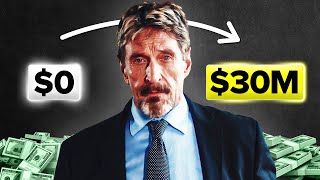
Chris Koerner pitched John McAfee a token prediction model built on market-cap vs. social-hype data. They launched a free airdrop that grew to 60-80k community members and hit a $30 million market cap, but a botched token burn destroyed most of the value.
Questions this video answers
Around $600 (fall of 2017; he says he bought Bitcoin at about $600 and had been in crypto ~1.5 years then).
February 28 (Koerner says "February 28, show up at my house").
About eight or nine hundred thousand followers (Koerner's claim).
He reports tens of thousands of members and later cites ~60,000–80,000 people in the group at one point.
He recalls a peak market cap of about $30 million (not equal to his personal holdings).
Okay, picture this in your head real quick. I walk up to John McAfee's door. Yes, that John McAfee. Yes, the one accused of murder. Palms trembling, hands sweating. And I knocked. And I was about to ask him to be my business partner in a crypto project. Six months later we had a 30 million dollar crypto project.
Project.
That is the story that I want to tell you today. And I think you will find it interesting. Why do I think that? Cuz my mom does and my mom just doesn't. Ms. Buckle in. You're going to love this story, it's one of my favorites. And share with your friends. Here is the story. So When I was seven years ago, 2017, the fall of 2017, I had been in crypto for about a year and a half. I first bought Bitcoin, around $600. And I was just a speculator, I was trying to get rich like everyone in crypto. And the fall of 2017 I had a thesis. And that thesis was there are no fundamentals in these tokens, specifically altcoins. And if you're not familiar, an altcoin is any cryptocurrency outside of Bitcoin and Ethereum. So I thought, huh, how can we predict the price of these altcoins on Reddit and Twitter? Everyone always goes nuts for them. They're always talking about them or they're not talking about them. So there's this website called coinmarketcap.com that will tell you the market cap of every coin, hence the name. And then I was able to find out what the hype level was of a specific cryptocurrency. And I used an API for this and I took all this data and I put it together in a Google sheet. So I actually, I'll tell you where I got all the data from. I got the API from a site called Cryptocompare and they had their own kind of hype score. I took that and altered it a little bit to fit my needs. I imported that to a Google sheet. And then I took the market cap of all these altcoins, over a thousand of them, and I put it in that Google sheet and then I divided the two numbers against each other. And when I say I, I really got a ton of help from my friend Brian, and when I say a ton of help, he basically managed all the smart parts of this process, whereas I was just like, ooh, money go up, money go down, me want more money. Brian was really the smart guy behind all these APIs and math, et cetera, et Cetera. And then I was just the guy pitching it. Anyway, I wanted to give Brian a fair shake because he's a good friend. So Brian and I put these altcoins together in a Google sheet, and we sorted them in groups of 100. So one through 100 was Bitcoin, first by market cap, then ethereum, and then three through 100, whatever they were at the time. And then 200 through 300, 300 through 400, and so on and so forth. And so we got all this together, and then we started watching them. And so the thesis was this. If a crypto had a very high market cap, but very few people were talking about it, then we predicted that it would go down in value. Whereas if a crypto had a low market cap, maybe it was brand new, maybe just no one was talking about it and everyone was talking about it, then the price of the cryptocurrency currency had not yet caught up to the hype. Okay, that was the thesis. So we put this together, then we started watching it, and I even started investing money in it. And it worked, Period. End of the day, it worked. And I was very excited at this because I. I thought, man, I found alpha. I found an edge in the market that no one else can find. So I need to get this out in the world. But hey, one problem. I was a nobody. I didn't have any following. I was not an influencer. I had 200 Twitter followers. If that. And this isn't something you can push paid ads to, because Google and Facebook at the time hated crypto. And so I needed to partner with someone that had a crypto audience. And at the time, that guy was John McAfee. He was by far the biggest crypto influencer on Twitter, and he had eight or nine hundred thousand Twitter followers. But here's the problem with John McAfee. He doesn't want to be found. Hence, McAfee security. He's very secure, and he's kind of psycho, and he's dead now, as we all know. So I started looking for his email address. And I usually have no problem with this. I've cold emailed Mark Cuban, you name it. I've cold emailed half the world, basically. And it's not hard finding the theirs or yours or my email address for that matter. McAfee was hard. I just had to start guessing it. John mcafee.com, jmacafee.com J. McAfee, John M. Like, I tried all of them, and I used software to tell me if these emails were open or not. But my software wasn't even activated because most of these emails just kept bouncing back until it didn't. I don't remember which one it was, but one day I got a notification that my email not only was not bounced back, but that it had been opened. So this was big. I was excited. But he didn't answer. So I kept following up over and over to that same email until finally John McAfee himself responded. And he responded from a. Like a forwarded email. And I'm gonna try to put some pictures or screenshots up of these emails. Cause I still have them saved on my phone. So if you're watching on YouTube, you should see them. But he responded from a forwarded email. It was like johnnybegood7722fourahoo.com or something. And he said something to the effect of. And you'll be able to see the screenshot. Exactly what he said. I don't believe you. This is stupid. Everyone pitches me the same thing. You're no different. You're not special. I don't believe you. This won't work. So I kept persistently following up until finally he said, even if God himself told me that this works, I would not believe him. And I said, john, let me show you in person, okay? Because I knew, or at least I thought that if I could get him in a room, just the personal aspect, and this is just a good business tip, if you ever have a big partnership or a big deal or something, fly across the country and get in front of that person, because it is worth it and it makes all the difference in the world. You're there. You're showing initiative. It's harder to say no to someone's face than a call or an email or even a zoom. It's just a million times better. So I knew that if I could get this in front of him, I could convince him. And it did work. It worked. I was making money on this, and I wanted other people to make money on it, too. And so finally he said, chris, I believe it was February 28 or February 29. He said, February 28, show up at my house. It's in Lexing, Tennessee. Show up at 1:23pm and I will hear your pitch. But if it does not work, I will kick you out of my house. I was like, you got it. Let's go. And so Lexington, Tennessee, was a couple hours from Huntsville, Alabama, where I had good friends at the time. And I flew to Huntsville and I stayed with them and I told them the story. And that morning, the next morning, I had breakfast with a mentor of mine and he loved the story. And I still didn't have John's email. He was paranoid about sharing his address with some rando which, yeah, I can understand that. And so I just started driving toward Lexington and I emailed him and I said, john, I'm coming as promised, here I come, let's go. And he didn't respond. I just kept driving, checking my email, nothing, checking, checking, nothing. Finally, probably around, I don't know, 12:51 o', clock, he responded. He said, here's my address. And so I pulled up to his house around 1:15. I wasn't about to be late. And it was so funny. It was such a funny house because he lived in a very typical southern neighborhood. I grew up in the south, so it looked like any other southern neighborhood. Not super wealthy, but not middle class, definitely upper middle class. Red brick houses, the standard southern style home. But he had a Spanish style home. Of course he did. He's very different. He stands out. He had a Spanish style home and he had a bunch of cars in his driveway. There was a yellow Hummer, there was a beat up Nissan Altima, there was a truck, there were cars out in the street. And I just knew, man, this guy's HOA must hate him. This is John McAfee's house. And I was nervous. I was sitting in like a, like a Toyota Yaris or something, parked right out front, Walked up, hands trembling, knocked on the door and he opened. He himself opened. And I was like, john, how are you? And he just looked at me and you. Who is this peasant? Hey, it's Chris Kerner. I'm the guy that was going to show you those altcoin pics. He just, he was stressed out. He was flustered, annoyed. His wife Janice came to the door. She seemed very pleasant and, and she's. What's going on? Oh, it's this guy from, he emailed me. He says he has this stupid altcoin predictor algorithm. I don't believe him. It doesn't work. But I, I told him I'd give him a shot. Chris, come on in. We're about to go to the liquor store. I was like, oh, okay. So I, I get rushed in and I'll never forget what I see. I see bodyguards, I see guns, I see AR15s, I see cameramen, I see a boom mic. People run in here. Okay, this is what I saw. You've seen Home Alone, the original version. You know, the night before, they're going to Paris in the beginning. All the cousins and all the aunts and uncles are there. They're all running around the house crazy. That's what his house looked like. It was Kevin McAllister's house, John McAfee style. And so he escorted me to the kitchen. He said, do you want a drink? Said, I'm good. The countertop was littered with alcohol. And I'll put a picture in the video. So you can see there was no room for food on the countertops. It was all alcohol. And so he sat me down at the breakfast nook, a small dining room table right off the kitchen. And as soon as he was there, he was gone. And the camera crew followed him. And all he said was, he's going to the liquor store in the bank and that they'd be back. And as soon as I get there, it's just quiet. I'm just sitting there. And I thought at the time that I was there alone. It's weirded me out. So I'm sitting there, and I took a video. I'll include this as well. And I took a video and some pictures, and I texted my wife. Said, here's my address. I love you. In case I don't. In case you don't hear from me again. Because, as you may know, John was accused of murder in Central America. And he probably did it. Can't sue me because he's dead, but that's my guess. But who knows? Who knows? And so I'm sitting there, and I'm just thinking, there are hard drives all over this glass table. And I'm thinking, like, what is going on? Why did he put me in his house alone with these hard drives? They're probably full of cryptocurrency when he's, like, the most secure dude on Earth. So I was just looking around weird, and then I heard, like, a cough like that. And I thought, oh, I guess I'm not here alone. And so stand up, take a right, go around the corner. And there is Jimmy Watson. Jimmy was his, like, main bodyguard. Listen, guys, I don't do ads. Ads are dumb. You hate ads. I hate ads. All I ask is that you subscribe. And like this. That's it. That's it. And maybe share with a friend. Okay, I'm done. Jimmy was his, like, main bodyguard, sitting at the table on a MacBook. And he's. Hey, man. Hey. Who are you? What are you doing here? He was pretty nice. And I was like, hey, I'm Chris Carner. I have this kind of algorithm. Oh, Yeah, I think I heard about you. Yeah, have a seat, man. Super chill. And we just start talking. He's, tell me what your thing does. So I open up my computer and I show it to him. So right there in Google sheets. And he's, okay, okay. And he's, how does it work? Okay. And I spend about a half hour. And finally. Oh, so it, like, predicts the altcoin prices. Because if everyone's talking about it, but there's a low market cap, then it's about to go up in value. No one's talking about it. And it's a high market cap, like Ripple or something, then it's going to go down in value. I was like, exactly. Oh, this is good. Oh, Mr. McAfee will like this. Yeah, Mr. McAfee is going to like this a lot. It's awesome. Hey, like, whatever good word you could put in, I really appreciate it because I think I need it. Yeah, no problem. No problem. So we're sitting there, just brought down, and then they all come back in. And it was an Australian film crew, and it's basically like the 60 Minutes of Australia. And they were filming a documentary that never aired, by the way. I looked it up on YouTube and there's the trailer for it, but it never aired. And I don't know if it's because crypto crashed, and so they didn't want to air it, and crypto wasn't hot anymore. But it's a bummer because they ended up filming me. And so they all come back in, and John's, oh, yeah. He's just so annoyed to see me. And he's, okay, yeah, Chris, what do you got? All right, so we're sitting at the other table now, a bigger table right outside the kitchen. What you got? So I open up my MacBook. I'm like, all right, John got these altcoins. There's no fundamentals, unlike stocks. I just think that if there's a cryptocurrency with a high market cap and no one's talking about it, then it's going to go down in value. And if there's cryptocurrency with a low market cap and everyone's talking about it, it's going to go up in value. What's the time frame exactly? I don't really know yet, but this works. I've been putting my money into it, and it works. And just immediately, he probably cut me off in sentence. And I'll never forget his words. He's, chris, this is brilliant. You're brilliant. He Called me brilliant. I felt so good about myself. He's. Of course this works. This is. Of course it works. Surely people are doing this. This is so obvious. Why haven't I ever thought of this? Of course it works. Is no one doing this? I was like, no, if they do, I. They are. I don't know about it. And he's, yeah, okay. And it, like, his whole demeanor changed, and suddenly I just had his respect. It just. Everything changed from that moment on. Kris, what do you need from me? What can I do for you? That's John, I want you to tweet about this regularly, and I'll give you a cut of the profits. How much? 25%. Done. I don't remember. He could have negotiated. I don't remember. Honestly, I don't think he did. And we shook hands. He said, tell me. Just tell me what you need to do, and I'm happy to help. Anything you do. It's like, okay. So that was it. And then from that point on, he was like, do you want some Mexican food? Janice is gonna go get Mexican. I was like, I love Mexican food. Let's do it. So I was there for eight hours. I was there all day. They brought back some pretty garbage, Mexican food, sat in the kitchen, ate it, talked to the bodyguards, heard some crazy stories. And then, like, the film crew set up, like, a whole studio in his living room, and they filmed this long interview. And I sat off to the side in the dark with everyone else and watched it. So that's when all the fun stuff happened. So I got in the car, called my wife, and I was like, babe, we made it. We did it. We did it. We're going to be so rich. This is done. This is a done deal. Like, I'm done. By the way, as an entrepreneur, I've thought that same thing about a hundred times. I've been sure I'm going broke or sure I'm becoming a billionaire about 100 times each. So that's the life of an entrepreneur. Anyway, I told her what happened. She thought it was crazy. Drove back to Huntsville, told my friends who I was staying with. They thought it was crazy, and we were off to the races. So about a week later, I had everything set up. And so this was a whole business model. It was to set up a free group, like a community, if you will, on Discord, because that's where all the crypto communities were. And to invite, have. Basically have McAfee tweet about this idea. And then his tweets would drive traffic into the Discord Group. And then we basically get a bunch of people excited about these picks. We'd give away a percentage of the. The predictions for free, and then we would charge a premium for people to get access to all of the. That was the business model. And at the time, you could charge four to five hundred bucks a month to be in these communities, Right? So the communities were not unique. There were a lot of communities that had secret edge on the market or secret picks, but this was supposed to be the only one that was, like, data driven, Right. And I'll never forget, I was sitting in this exact same room where I am right now in my office, and I set up the Discord Group. And I called John, I said, john, we're ready to launch. I'm ready to launch. Yeah. What do I tweet? And I sent him the link and I sent him. I told him exactly what to tweet and he tweeted. And I will never forget this moment as long as I live. So I'm in the Discord Group, he tweets. And then it's 500 people, 2500 people, 7000 people, 18,000. And it just starts growing and growing. And it was. Put yourself in these. So it was early 2018. Crypto had just gone from 3,000 to 20,000 in 34 days. At the end of 2017, it started crashing, but no one knew it was crashing. You don't know until it's a crash, until it's years behind you. We all thought it was just dipping a little bit. It was like, at 17 grand down from 20, we're like, oh, great time to buy. Little did we know it would be back at 3,000 in about a year. And so people were hungry for these picks. It was late, but it was also the perfect time to launch because we didn't know it was a bear market yet. And so thousands of people start flooding in, and I'm like, oh, I've made it. I'm here. This is incredible. And then all of a sudden, just as soon as they join the group, they start taking over the group. And what I mean by that is Discord's default settings, at least they were at the time, were that anyone that joins can make themselves an admin. I don't know who at Discord thought that was a good idea, but admins were blue and just regular users were white. That was their screen name color. And so I see all these blue names start popping up and there's like, Russian lettering and there's like, porn and just terrible things. Flooding the feed. And then I was not an admin. Someone, like, degraded my. My user status. And as fast as it had grown, it was overtaken by bots and spammers and scammers. And I was completely deflated. And I was like, what did I do? I am so stupid. What did I do? Why didn't I lock down the settings? Why didn't I do more research? Why didn't I get some people in this room to help me moderate this stuff? So I called John, and I was like, john, sorry, but you got to delete that tweet. What? No way. No way. I never delete tweets. It is against my core values. I never delete tweets. I refuse to delete tweets. Anything I say is out there for the world to see. It's public free speech, John. You have to delete a tweet, this tweet, because I just deleted that whole group, and now your link is dead. All these people are clicking on a dead link. Why did you delete it? Hackers took over. I don't. It's. I need to change the setting. What? He was, like, annoyed, but not, like, really angry. Not as angry as he could have been. And so he's like, all right, fine. Send me a new link. So immediately, I created a new Discord group. I locked down all the settings, I sent him the link. And his tweet, I believe, is still live on Twitter if you do an advanced search for it. Hackers took over the channel. If you search for that under McAfee, you should see this tweet still. And he's, guys, I'm so sorry. Hackers took over the channel. Please join this group instead. And people started joining thousands, but not as many and not as quickly as they had been joining before, because you only have that one shot to launch anyway. So over the next weeks and months, twice a week I would text John exactly what to tweet. Maybe it was, hey, our new picks for this week were released. Or maybe it was, hey, we really think this altcoin will do well. And he would tweet about it, and we would get a couple thousand more people in the group every time he would tweet. And pretty soon we had 60, 70, 80,000 people in the group. And then crypto just kept crashing. So we were always up against this bear market. So we're like, all right, we gotta launch the paid group. But it just made more sense at the time to launch a token, like a community centered token instead. And so we launched this Token. There was no ICO initial coin off initially there was offering, there was no token sale. It was just an airdrop. It was a free airdrop because I said, listen, if I do an ico, I got to get the SEC involved, I got to fill out this paperwork. I'm probably sued by someone. Let's just give away some free tokens to build loyalty. We can get them listed on exchanges, get them trading and we'll see what happens. So we did, we launched a token. And the purpose of the token was to be like a yelp for crypto projects where a of ton community members could do due diligence and vet crypto projects and list them on our marketplace. So it's oh, if you want to go invest in an ICO or to buy a piece of crypto software or join a crypto paid group, like you could see, is it a scam? Is it high quality? Is it not? You can see reviews on it. Pretty good idea. I think a lot of other people have the idea. I wrote a huge 18 page white paper. Everyone loved it in crypto during what is perceived as a bear bull market. Everyone loves everything, everything's bullish, everything's great. There could be no wrong. Crypto just keeps going up and up forever. So everyone loved it. We did an airdrop and I, my brother in law Justin, he's a brilliant programmer, he created his own custom like viral referral marketing engine where it's like, all right, it's a free airdrop, but you got to work for it. Okay, if you want 100 tokens then give me your email. If you want 500 tokens then give me your email and retweet this. The announcement tweet. The airdrop announcement tweet. If you want to like it, you comment on it. You get tokens for sharing with, for sharing and, or interacting or engaging with the announcement tweet. And so that tweet blew. I'm talking like it was either 15 or 50,000 retweets. I don't remember many thousand. Over 10,000 retweets. Millions and millions of impressions went massively viral. Huge success. Tens of thousands. I don't think we broke a hundred thousand, maybe a hundred thousand. I don't remember at least tens of thousands. 60, 70, 80 plus thousand people claimed free airdrop. Lot of scammers, lot of bots. I learned that most of the scammers are in Nigeria and Vietnam. Fun fact. Because we were able to track the IP address of everyone that opted into this. And so either the bots were, were in Vietnam and Nigeria or the people were, I don't know, I'm not super technical, but those are the two countries of all the countries on the earth. But it was successful. We had a ton of token holders. We burned a bunch of tokens. We got listed on exchanges, CoinX, Forex. Not like we, we never got on like Binance or, or Kraken or Coinbase or anything but like definitely B and C tier exchanges we got listed it on and our peak was like I believe it was a 30 million dollar market cap. Now that is a clickbaity number. Doesn't mean I had anywhere near that much money personally. It was a free token airdrop but that was the cumulative value of all the tokens that were in circulation. And then we ended up doing a burn, a token burn which was a massive nightmare because we, when I say we, someone on my team clicked the wrong button and instead of burning like 20% we burned 80% just literally by clicking the wrong button. And so it was like oh crap, okay, there's no reversing that. So that was a nightmare. Several stories like that. This video could be many hours long but it was a wild ride. We event. We were almost launched a in person crypto conference in Nigeria, believe it or not. And we had whole teams worth of people. We had multiple telegram groups with hundreds of people in them managing crypto projects. We had this worldwide crypto team and it was wild. And it lasted, we went going like 12 or 15 months and it just kept getting harder and harder. And then finally the original idea, remember was to launch the paid group. We finally got around to launching that and we had three pricing tiers of like 79amonth and 279 and 500 or something. And we worked so hard on this. Me, my brother in law, my other brother in law, my cousin, random guy in Montana who's super cool named Ryan and then four or five other people we worked day in day out on this, finally launched it. Huge launch, massive failure. Like we expected 10, 20 grand on launch day and it was like 800 bucks. And I literally, it was such a massive failure. For how much time we put into this. I literally cried. It was one of four times in my life I've cried about something business related. It was depressing. It actually ended up being not that bad because launch day wasn't great. But we got quite a few trickle in customers. But it still was did not meet projections. And so that was the nail in the coffin for me. I was like okay, we could wait out this market. It will turn around again. But I got bills to pay, right? Like, I can't just wait out this market and go all in on this crypto project for the next 24 months before I earn a dime. So I ended up making a little bit of money on it. Despite the flashy $30 million market cap that didn't translate too much money. We made money on the paid group. We made some money by selling our own tokens to fund fund operations. So it was worth my time. It was definitely not the worst startup I've ever done. It makes for a great story. McAfee was a character. At the end of this video, I'm going to put in some voicemail, some voicemails that he sent me that are still on my phone to this day. I just can't bring him myself to delete them. He would call me at all hours of the night with crazy business ideas about seeding tokens with car dealerships and tattoo parlors, mimes of all things. He was just as crazy as, honestly, he was an older version of myself. If I liked to do drugs and had no standards and was not a member of the church that I am a member of, he was just a serial entrepreneur at heart. And he loved business, he loved making money, and he had high energy, probably from illicit drugs. And he was just a very polarizing figure. And it was. It was quite the story to. To work alongside him for 18 months. But he's dead now, so that is life. But thank you for listening to this story. That's one of the best stories of my life. I love telling it. I hope you enjoyed it as well. And if you liked it, please subscribe. That would mean a lot to me because I put a lot of work into this content and I hope you have a great day.
Hey, Chris. John McAfee. I'd like to chat for a little while, but to prep you, I'm looking at this as seeding about 200 million coins with businesses. Massage parlors, tattoo shops, car dealers, you know, for, you know, come in and test drive our Audi and we'll give you five of the, you know, whatever. And look at the process of doing these things as mining the coins. And if in fact we give enough coins so that I know it's ridiculous, I'm going to price the coin because you can price it any way you want at $10 a coin. And I intend, shortly after seeding all of this, creating a website and just selling coins again to the businesses. If, you know, if it makes sense for them. And so people collect these coins in the process of, like, mining. You actually do work. You go out, you do something. Sometimes you have to pay money, but that's okay. You get some experience. And then after the seating, maybe airdropping to, you know, a bunch of users, maybe another 200 million coins, and then reserving for the. The Encounter Foundation. X number of points. So, anyway, I'd love to talk and get your ideas. Thank you. X number of points. So, anyway, I'd love to talk and get your ideas. Thank you. X number of points. Hey, Chris, if you could send everything you need to get tweeted to Luke, Luke will give that to me. I have one device that no one knows about, and I will turn it on just to do your tweets. Okay. I do appreciate it, sir. And nothing. You know, we're not going to skip a beat. We're going to continue doing work. It's gonna. It's just that I need to be cautious about which devices I use. So the contact Luke when you want something done. All right, sir. Thank you. Hey, Chris. How are you doing? John McAfee. I'm sorry you had a hard time getting in touch with me. I have a hard time getting in touch with myself from time to time. Give me a call on 731-803-2457. Thank you, Chris.










