The Boring $1M/Year Business That Almost Never Fails
Tyler runs Laundry Spot, a laundromat that makes $1M+ annually with $400k+ net profit. A single 130-lb washer generates $30-$40k profit per year. The business needs $1.2-$2.2M startup capital and pays back in 3-4 years, but requires active management, not passive income.
Chapters
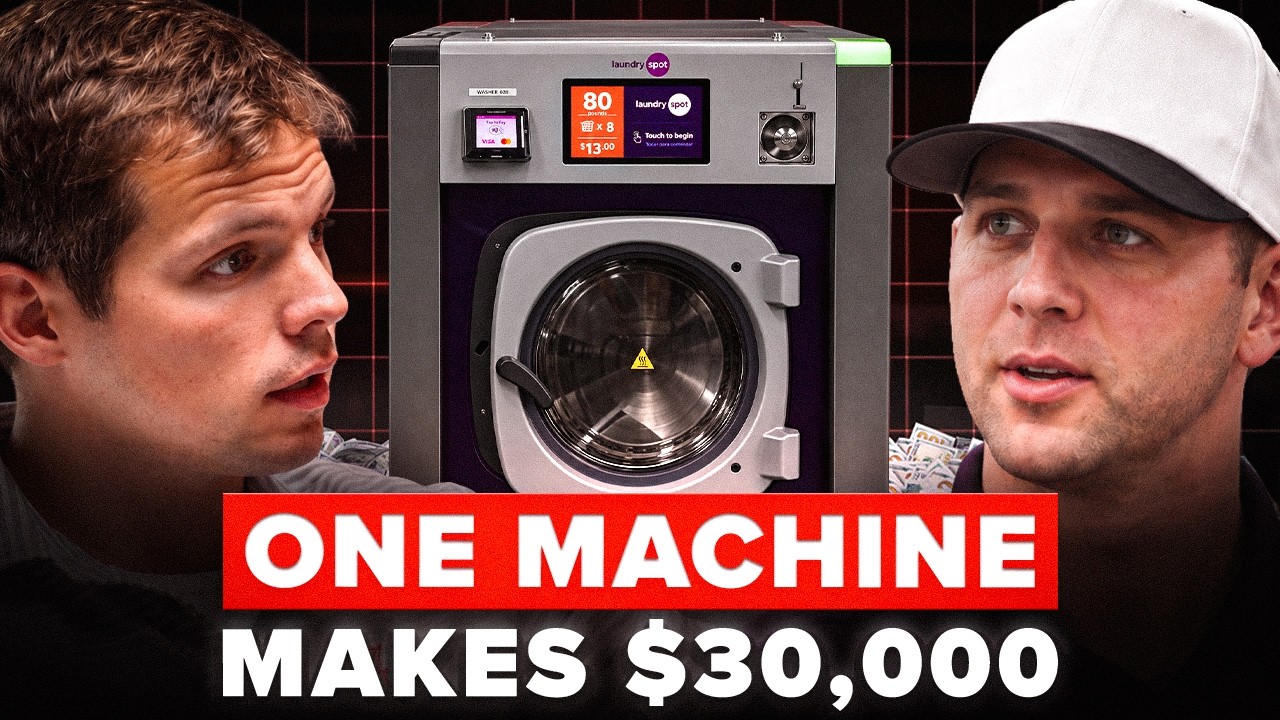
And would you believe this one machine makes over $30,000 a year?
We did $1,025,000 last year.
Wow.
I would never drive by a laundromat and think that place makes a million bucks a year.
Yeah, I know. It blew my mind. The bar is so low.
Yeah.
It's like you could go in and own that city. Everything can be done remote. Yeah, our sales during COVID through the roof. Even all these horrible times, still like laundromats, gotta wash your clothes. People gotta wear clothes.
So recession resistant, certainly AI resistant. How can people finance these if they don't have much cash? So a couple years ago I met a guy on the internet that claimed to own laundromats that profited over $400,000 a year and I didn't believe him, so he said, come see for yourself. Here I am, Cincinnati, Ohio. Flew here from Dallas just to see how do you open a million-dollar laundromat and how do you find the perfect location. Today we're going to learn all that and more, so let's go meet Tyler.
This is Hamilton. This is our newest store. This was built in 2022. Bought the building during COVID 2020. We had 2 tenants in here. There was a Liberty Tax and like a check cashing place, so we had to wait till they got out. That's why we didn't open up till 2022.
But you bought this with the intent to turn it into this?
Yeah, 1,000%.
You just had to let the leases expire.
Exactly. Yeah, we couldn't just boot them out, you know. So yeah, so we gutted the whole thing on the outside. The EIFS, everything is brand new. It was down to the studs in here. Saw cut the floor for the, the drains and the plumbing and the bulkheads. And as you can see, if you're looking out of the store, it's kind of a mirror image of each other. Most people don't have the space, to be honest. Yeah, I mean, most laundromats are 2, maybe 3,000 square feet. This is 8,000.
Wow. How many square feet is just like the consumer-facing?
This is around 5,000.
Okay.
This area out here. And then we got about 3,000 between back of house, office, utility room and stuff, which we'll, we'll get to later.
Okay.
My father-in-law David, who is the OG of Laundry, you know, started the first laundromat in 2006. He likes to say there are a handful of sexy things in this laundromat. Our new equipment is one of them. So we'll walk over here, we'll check it out. We are the only Laundromat in the United States that's not a manufacturer that has their own washer. The only one. It's super cool. Kind of goes from small to large over here. Most laundromats, the biggest they have is this 80-pounder, is what we call it. We go by pounds. Also, you can go by baskets. You know, this could fit 8 small baskets of laundry. This 130 is something that barely any laundromats in the US will have.
Yeah.
This is a monster machine. Look how much you can fit. And the nice thing about these machines is you can fill it all the way to the top. Most people think, oh, you can only put this much in here. It's not gonna get my clothes clean. No, as long as there's like a hand that you can put at the top.
Yeah.
But the cool thing is this equipment, we can do auto-dosing or direct soap injection on. We can do custom cycles on here. So with this equipment, we can modify how fast it spins, how much water goes in, how long it runs, you know, extra pre-wash, extra rinse, or whatever. We can modify that all on the back end from the cloud. We don't even have to be here to do that. We can do that from our, our Our laptops. We've gotten amazing reviews so far. I think this week alone we have 50 5-star reviews just about this equipment.
Yeah.
'Cause we just put this in last week.
And it's getting good usage so far?
Oh yeah, oh yeah.
And what did this cost you?
List price for this machine would be about $55,000.
Okay.
We'll get it, and our franchise will get it, franchisees will get it in the 30s.
Okay.
You know.
And how long will this take to pay off?
This bad boy, we're hoping in the first year.
Wow.
Yeah. On average, you know, we run about 6, 7 turns a day. That's a laundromat term. You know, how many times is this specific washer Started per day.
So $130 a day, give or take.
Yeah, yeah, at $22. And that's base price on this machine.
Yeah.
And then we can get to even more adders. Hey, do you want an extra pre-wash? Do you want an extended wash? Do you want extra rinse? Sure, let's do an extended wash. You go here, and now as you can see, $24, $25. Swipe your card, start the machine.
What would you say your gross margin is on, on that $25 for your detergent, your water, and your electricity?
So our utilities run Under 10%. That's wild.
Revenue.
Yeah. So—
That's insane.
And that's because this equipment, it will weigh the clothing, put the exact amount of water it needs in there. It's very efficient.
Yeah.
And that's a benefit of newer, nicer equipment. For a lot of laundromats who have been around for a long time and they have equipment that's 20 years old, their utilities may be 20, 25.
Yeah.
Even up to 30%.
Yeah.
So that gives us an edge because people think, oh, you guys are more expensive than all the other laundromats in the area. We're really not.
Yeah.
Because—
When you consider that.
Not, not when you consider how efficient we are.
Yeah.
And so, oh, that's a compelling argument. Customer walks in here, sees this.
Yeah.
You know, they're not more expensive than where I was. I'm never going back there.
Yeah.
Now I know this machine is an outlier. This is your biggest machine.
Yeah.
Right?
Yeah.
There's a lot of machines out there. I'm just thinking from my like lizard brain here, this will make you like $28,000 to $30,000 of profit every year. Yes.
Right?
And of, I'm guessing this will last you 30 years, right? Like—
So it absolutely could.
Yeah. If you maintain it and everything. It's just like, to me, I'm just like, okay, we're in Hamilton, Ohio, a city I've never heard of. And this machine could gross or net you $1 million over 30 years. its life, or 500,000, or 30,000 a year. Like, no matter how you slice and dice it, that's, that's impressive because there's a lot of machines in here.
I know, it's funny, you know, everybody's like, you know, our numbers are great obviously, and we'll talk about that later, but I'm like, we're in Hamilton, Ohio, people. We're not even in Cincinnati proper or like Dallas.
What is the population?
Hamilton, I think, is 60,000, somewhere around there.
There's thousands of cities with 60,000 people. I, I know.
So yeah, for, for the franchise, as we're talking with people who are interested, we're looking at cities, you know, in Alabama that are similar to a Hamilton, Ohio, where like—
Roll Tide.
The competition, the bar is so low. It's like you could go in and own that city with 3 laundry spots, no problem. And so it's funny, I love looking at the different cities as we're talking to prospects.
An average city of 60,000 with similar demographics to this, how many laundromats total could it support, give or take?
So for laundry spot, I would say probably 2.
2 laundry spots.
Yeah.
Now, how did you know that there was demand For a machine this big here?
Our data, I mean, we can run data, anything you could think of.
How do you get that data? Like, are you asking people or surveys?
No, so we know every quarter, we know every cycle, we know every single piece of data that comes through this machine on the backend. So we can search it in our database, run reports on anything we want to know, see what machine is turning the most, where it is in the store, does it matter, you know, larger, smaller. But our data suggests our old 80-pounders, which was the biggest before we had this, did 1 turn per day more than on average than our other equipment, you know? It's anecdotally when we talk to customers, they want big equipment, but we also see it in the data. It's plain and clear. All the other equipment is sitting right here on turns per day and the 80-pounder's up here.
Yeah.
So we expect, you know, the 130 and the 100 to do even more turns.
So we'll— Well, I like that it shows 13 loads.
Yeah.
'Cause to me it's like, what does 130 pounds mean?
Exactly, exactly. So this is what we call the bulkhead.
Okay.
So this is where the drains are. This is where all the water connections come in here. So this is something, That we do. We manufacture this. Generally in laundromats that are older, you can barely even squeeze back there.
And it looks crummy and dirty.
Oh, it smells. I mean, looks disgusting. If you have a problem with a washer, how are you gonna get back there and fix it? Yeah, some people have to pull the equipment out to fix it. We can just walk right back in here. And come on in, I want to take you back, back in the bulkhead. Yeah, you can see we got some lights in here hitting everything. One of our team members who helped us create, you know, this and the dosing system. He's got a saying. He calls it trucks to bucks. And what that means is how quickly can we get something off of the truck to making money?
So everything drains out here.
Everything drains down. Yep. So it'll go down to this end where we walked in. So as you can see right here, the water comes down here, fills up in this trap here to make sure, hey, this is where everything gets caught. And you probably got $5 of change in there right now. At least. This is what we call our money wall. At all Laundry Spots, you can pay by quarter, you can pay by our loyalty card, you can pay debit, credit card, Apple Pay, tap to pay, whatever. We don't discriminate on how you want to pay. We prefer customers use our loyalty card. One, they get discounts. So when you use our loyalty card right now, you get free dry credits every time you wash. Customer adds money to their loyalty card, they come over here, swipe it, start a machine.
Is there much of a margin difference between drying and washing?
Yeah, you make a lot of your money, most of your money on washing. I mean, it's not even close. Yeah, I think our split is somewhere dryers end up being 10 to 15%. 15% of washer revenue. And our washers are so awesome that people don't have to dry very long.
Yeah.
And a lot of older mats, dryer revenue may be higher 'cause they have to dry for an hour.
Yeah.
You can pay however you want. 28% of our customers still use quarters.
Wow.
Do you wanna mess with that?
No.
And maybe not bring those customers in?
Yeah, you gotta remove all the friction of receiving money.
Exactly. And what's weird is the laundromat industry has been very inward looking. What's easy for me as owner?
Sure.
Oh, I don't wanna collect quarters.
Yeah.
You know, I don't wanna have to lug quarters to the bank. Well, what does the customer want?
Yeah.
And so we're all about what does the customer want? And so you can pay however you want when you come to Laundry Spot. So that's something that's an industry, you know, back and forth and a lot of headbutting on.
Show me the bathroom.
Okay.
Yeah. Because, you know, they say any— you can tell how any good business is ran by how clean or not.
Yeah. Let's go chat in the bathroom. So yeah, we have 2 unisex bathrooms. You know, we try to keep them nice. Again, customer experience.
You eat off the floor.
Try to keep them clean. We can cook something in here later if you want some breakfast. You know, changing tables again. A lot of kids come through here, family, so I want to make it easy for them. But yeah, you know, everybody likes a nice bathroom wherever they're hanging out.
So how many employees do you have here on average at any given time?
At any given time, this store will go up to maybe 6 at a time.
Which is probably high for a laundromat.
Very. I mean, very high because we're doing a volume of the commercial, which you'll see in a second.
What about just on this floor?
There's one store that we don't even do commercial at. And so most of the time we'll have one attendant.
Just kind of helping.
Yeah, helping cleaning, doing some drop-off because we'll still do— people will come in and drop it off. So we still do a small amount of that. Weekends, usually 2, just 'cause 50% of the self-service revenue is done on Saturday and Sunday.
Oh wow.
Yeah. Out of the week.
Yeah.
50% the other 5 days?
Yeah, exactly.
Wow.
You come in here on a Wednesday, which is our slowest day of the week, you'd be like, man, how's this place—
How are these guys making money?
Yeah, yeah, yeah. How are these guys making money on this?
What's the busy time of day?
It's usually, you know, mid-morning, evenings. The fluctuations, even the months of the year. Summer's very slow, you know, less clothing, smaller clothing.
Yeah.
Spring and fall, our revenue is higher than summer, and then holiday season, people are saving money for Christmas and all this thing. Once back to school hits, that's where it kind of starts ramping up until about November.
Okay.
Believe it or not, just because you're watching this doesn't mean you're subscribed to my channel. YouTube's going to show you stuff even if you're not subscribed to it. Over half of people that watch my videos are not subscribed. It would mean the world to me if you just hit subscribe. Thank you so much.
I think we have 40-some cameras in this store, so more than your local bank. And I'll show you those when we get into the, the office back there. This is kind of our commercial processing area. So as you See, tons of laundry in here. Most of this right here is a, a hotel. This location does about 21% revenue in commercial.
Wow.
It's our largest commercial laundromat.
And how does it rank on consumer on all your locations?
It's our second highest self-serve, but it's going to be the first here soon. This is our newest store. This is our flagship. This is the only store that has even some of our new equipment in that all franchisees will have going forward.
So it's your newest and your best, really?
By far.
Yeah, by far. Well, that's encouraging.
Yeah.
Do you have to fold it as well?
Yeah, all this is washed, folded, stain removed. Now, you know, we upcharge if there's— we call it, you know, extra soiled or stained. So we upcharge for those things. But yeah, we move 30 pounds a month through here. We have a new commercial account this month that will add probably another 20,000. So we'll be doing maybe 50,000 pounds in August out of here. Which is just insane.
A month?
Yeah, in a month in August.
What does that equal in revenue?
Uh, depends. Commercial pricing's all over the board depending on what we're washing, how much of it we're washing, but anywhere from $1 a pound up to $2.50, $3 a pound depending on the account.
I mean, you'll be closing in on $100,000 a month just in commercial from this one location.
Yeah, yeah.
Wow. Are you intentional about finding these commercial accounts? Like, do you have a salesperson? Are you doing outreach or are they coming to you?
So our GM does a lot of that, so we do get some inbound. Our GM is big in the community. It's, it's joining your local chambers, it's talking to the business owners. You know, when we opened this store, we had a VIP red carpet grand opening, catered food, open bar, music at a laundromat.
Wow.
You know, like something crazy. But we got business owners in the community to come here for that.
Yeah.
I think we had 50, 60 people here for that party. And so, wow, get the word out, you know, meet other business owners who have a laundry need, all those things. So it's a lot of boots on the ground type of stuff.
Yeah.
You know, calling referrals. So this store was the first time we did 2 weekends in a row free laundry. Dream.
Because it worked so well.
My thought is, okay, when we did one free laundry weekend, like, okay, people found it. They maybe told some people Saturday, like, hey, come tomorrow. Well, I'm like, well, if we gave everybody a whole week to tell everybody they knew, like, the second weekend is probably gonna be—
They post about it online and then it gives them—
It gives them a whole week. So we did 2 here and it was just absolute chaos. But our theory is we just need to get people in the door. Yeah, literally, if we just get people in the door, they're not going back to the other line.
Well, how long have you been You've been open a year?
November will be our 4th full year.
Okay.
Well, so this was the first location where you did 2 free weekends.
Yeah, yeah, yeah.
And it's about to be your best location.
Yeah, exactly.
They're habit-driven, I'm sure. So once they fall in love with this, there's no better, nicer laundromat in the area.
They're customers for life. So like, for instance, in Hamilton, we are the number one laundromat, but there's still a handful of other smaller ones still hanging around.
Yeah.
We've put out 11 laundromats with our 4 over the years.
Put like out of business?
Yeah, yeah.
Out of business. You've opened 4.
Yeah.
And 11 have gone out of business.
In our areas.
Yeah.
Yeah. That's wild.
Yeah.
What percent higher are your prices than the guy down the road?
We're actually underpriced on some of our machines compared to some people in Hamilton, which is crazy to think about. That's what we do when we go into a market. We look at the pricing.
Yeah.
Because we don't want to be more expensive. We want to go in, give the customer a better experience, and then be like, oh, this is the same price?
Like, yeah, how is that possible?
What reason would they have to go back to their other laundromat? There is none. Sweet.
What's over here?
Well, let's go through this door. I want to show you. And this, this is The sexiest thing that you'll see today, a soap injection machine that we've been working on.
Oh, the DSI? Yeah, for sure.
Yeah, for sure. So there she is.
What percentage of laundromats around the United States has direct soap injection?
It's not even a percentage. I think there's like 15.
Wow.
And it's not even as many options as ours. So ours, we can put up to 8 different options. So right now we have 3 detergents, 3 softeners, 1 bleach. We could add 1 more. I don't even think any systems out there right now have that many options. Most of them are one, maybe a couple, like you get detergent and a softener or just a detergent. This is a key, key differentiator for us as Laundry Spot. You can see huge water lines. I mean, we need a lot of water coming in here. We've got our ozone systems there. So— What is an ozone system? Yeah, so ozone, ozone is like natural sanitization. It's O3. We use it for mold restoration, fire restoration. Customers can select an ozone cycle on the washers. You got dirty football, stinky football, gym equipment, whatever, totally gets the scent out. I mean, literally wipes out any scent outside of just a fresh, clean smell.
I didn't know that was a thing.
Yeah, so customers love it. Also a reason why our store smells so good.
I was going to mention that, actually. Yeah, it's not the first thing I noticed.
It's not a detergent, it's just, wow, this store smells clean and fresh.
Everyone loves the smell of fresh laundry, right?
Quick word about today's sponsor, Beehive. They just launched something called Community, and it does something that I've never seen on any other platform. Every newsletter and podcast you publish gets added to your feed automatically, sitting right in front of the people who already love your stuff. So your biggest fans get a whole new way to find out what you love with no algorithm getting in the way of what it wants them to see. And the conversation keeps going. The replies that your readers send come out of your inbox and into a live town hall where everyone can jump in. You can add community access to any subscription you already sell in about 5 minutes, whether it's free, freemium, Fully paywalled or paywalled with upsells inside. And yes, of course, Beehive doesn't even take a cut of those earnings. A quick community post is easy to write and the feed is easy to scroll. So now you can keep your short form and your long form in the same place instead of renting that space on social media. Get more juice from everything you produce.
The link's in the description below.
Moving around here, another thing that we added was dry cleaning because we had so many customers say, hey, I'm dropping my clothes off here, can I drop my dry cleaning off? We went out It's not a business we want to be in, but if we're getting all these customers asking it and they're loyal Laundry Spot customers, why not? So we went out, we wholesale dry cleaning. You'll see some there. We do fire departments, police departments. Again, part of our local community. Yeah, like we want to be embedded there, do good work for them, you know, be a good referral source.
So, so for something like this, what do you charge and what do you pay for like one shirt?
So yeah, shirts are like $7, I think. And we get 50% of the top line.
You charge $7 and you pay $3.50, give or take?
Yeah, yeah, exactly.
For sure.
This is our garage. This is how we get the laundry around. This is Betsy. She hauls all of our laundry. As you can see, there's more laundry in here. We love the Ford Transits, big fans. We have 2 of 'em. This is a 250 Transit, high roof, so you can stand up in there. And then also long wheelbase. So this is as big as they make 'em.
So how did the first year or first month How did that first location go that you guys went in on together?
It went really well. That was our Fairfield location. We did the weekend grand opening, you know, within, I think it was 6 months, that was our best performing self-service monthly run rate. Like we were already the best performing self-service store.
Wow.
So that's kind of when we found like we were onto something, you know, that location's 4,400 square feet. That is our only leased location.
Okay. What is your lease there?
Yeah, so our lease there, it's, uh, $14 a square foot, 4,400 square feet. We have— the original lease was 10 years with 5 5-year options after that.
Okay.
So 35 years if we want. And that's what we want, long-term leases.
Yeah, you got a lot of money in here.
Got a lot of money in it. You don't want the landlord to be able to just kick you out and be like, oh, I'll run the laundromat out of here.
Per month, what does that shake out to? $14 a foot?
It's like $4,600 a month or something.
Okay, that's not bad.
Yeah, yeah.
Let's talk startup costs on the Fairfield location.
Yeah.
What did it cost?
So I gotta speak FDD numbers. The range is kind of wide, again, depending on size of store. But, you know, our FDD says, Startup costs anywhere between $1.2 million all in to $2.2 million all in. Again, how big is your store? How much equipment is in there?
And that's not including real estate?
Not including real estate.
That's assuming—
White box.
You're leasing and first, last month.
Exactly.
That's part of that.
Yep. That's just, hey, here's a white box, we gotta turn it into a laundromat. You know, obviously we have to fix the plumbing, update plumbing, electrical a lot of the times, and do all that. The 2 biggest pieces are obviously the equipment You know, you're going to spend upwards of possibly, depending on the size, you know, $1.1 million in equipment. The nice thing is that bonus depreciation's back. You know, you can, you can take all that in year 1 if you want. It's a nice business for other business owners because you can offset some of that other income. Turning it into a laundromat, like all the utility updates and everything, that's the other big cost. Those are going to be the 2 big line items that make up most of it.
Now, would you ever buy a laundromat and give it a facelift?
No. So there's a story on that too. Back when I first teamed up with Dave and my father-in-law, we thought like, hey, let's go buy a bunch of them, turn them into laundry spots so we can have a bunch at the same time. So we were close to buying a pack of 4 and doing all of our due diligence, you know, sale price, all the costs of us updating it to be what we want as a laundry spot. And, you know, all of a sudden I'm just like, why would we buy this, put all this money to fix it up when I could just go across the street the same way he did with his other 2 stores and just put it out of business. And again, that just solidified our mindset of like, hey, no, we're gonna do it the way from the beginning that we want.
Yeah. So let's say with a store like Fairfield, you spend $1.5 million to open it. If things go well, 5 years later, what could you sell it for? I'm trying to like compare and contrast buy versus build.
Yeah. So our laundromats, we could sell 5 to 6x probably.
5 years later?
Yeah.
$8, $9 million?
This store does $421,000 last year, bottom line.
Well, let's say Fairfield, something, something more along the lines of average as opposed to outlier.
Yeah, I mean, Fairfield can go for around $2 million.
Okay.
Yeah, yeah.
And then what would something like Fairfield cash flow every year?
Fairfield does high 3s net.
Wow. And what did you pay to open Fairfield specifically?
Fairfield was $1.1 million.
Okay.
But again, that was 2019.
Right, right. So So $1.1, you run it for, for 5 years and let's say you cash flow, you know, $1.3 along the way. So you get your money back in 3 or 4 years.
Is that accurate?
Yeah. Yeah.
The payback is usually like—
Back to zero.
Yep.
Right. Now you've got an asset that's paid off basically.
Yep.
And on year 5 you could sell it for $2 million.
Yeah.
About $2 million. Yeah. Give or take. Okay. So you basically, and then you profit along the way. So you're gonna make like $2.5 million profit in 5 years from that location. Do you think buying one, a smaller one, could be a good option to get your feet wet in the industry?
So there's a lot of influencer stuff going on right now with laundromats, right? Like the hype is great. I love laundromats. I love the industry. But a lot of people don't handle their books like we do and track every single quarter that goes through. So verifying income and expenses is almost impossible at an old crappy laundromat. Most people overpay for them. They quickly realize like, oh, this isn't passive at all. If you have older equipment, stuff is breaking all the time. You're constantly fixing equipment. Unfortunately, a lot of people who fall into that trap find themselves that they just bought themselves a job, like a low-paying job.
Mm-hmm.
You're netting $50,000.
Yeah.
On a laundromat and you're working it like full-time.
Yeah.
Like that's not fun. That's my gripe with like a lot of the, oh, laundromats, passive income, buy an old one and throw a new floor and some paint up on it.
Right.
And you're gonna make millions.
I have a gripe with basically anything that's ever called passive income.
Yeah, yeah. I mean, I hate that word.
I'm still looking for passive income.
Yeah, I hate that. That's my least favorite word.
Yeah.
I think out there.
Yeah.
Because nothing is passive. I mean, we have a GM and an AGM and still not passive.
Yeah.
You know? Yes, it makes our job a lot easier, but it's work regardless. Yeah. Like you still need to make sure operation is running smoothly and doing what you want.
Guys, TKowners.com. That's my community where people are building businesses. I do AMAs, Q&As every week live. You can ask me anything you want. You can have accountability partners. It's about 1,000 people in there building, starting, growing businesses. Check out TKO, as in the Koerner Office, TKowners.com. Okay, so Fairfield, $1.1 million to open. What did the 5-year ramp look like? What was year 1, year 2, year 3, as far as net profit is concerned?
Yeah, so with Fairfield, we We ramp pretty quickly, which is nice. So just for instance, for this store, after our grand open, second grand opening weekend, that first quarter we were opened after that, we were at $100,000 in self-serve revenue.
Quarter, a month?
A quarter.
Yeah. Wow. Okay.
So, you know, $400,000 tracking run rate.
Yeah.
At the end of the 4th quarter of that year, we were at $155,000.
Wow.
So tracking for $620,000. Fairfield was very similar, you know, ramped up pretty quickly. What you'll find is self-service matures at year 2 or 3 for, for a laundromat. Because again, there's only so much pie in our 1, 2, 3-mile radius, and you kind of hit that at about year 2 or 3.
Yeah. What does a mature location look like? Like year 5, year 8? Like, do you still see growth?
Yeah. So you'll see, for instance, this store this November will be our 4th year. We did top line $1,025,000 last year and bottom line $420,000.
Wow.
You know, there's, there's a few things. New customers are still trickling in. Obviously commercial is growing. We raise prices like any business. There's that as well.
I would never drive by a laundromat and think that place makes a million bucks a year.
Yeah.
Or that place profits $400,000 a year.
Yeah, I know. It blew my mind.
And they don't, like most don't.
Right.
Yeah.
I mean, you're, yeah, you're, we're kind of at a different level than what, what's out there. But that's our goal going forward. Like we want million-dollar laundry, every, we want Laundry Spots to be million-dollar stores.
Yeah. What'd you spend to build this one? And then what are the numbers like today?
So this one, it's, it's a little unique because we built during COVID You know, it was a little over budget on what we spent. Still made a lot of sense for us. If I remember correctly, it was right around the $2 million mark.
Okay.
A lot of supplies were higher because of COVID and all that stuff. Again, top line does $1.25 million.
What did it do the first year in profit and revenue?
I think we did mid-$700,000 first year. Yeah, first year open.
All right. Give me, give me like the secrets of site selection.
Big thing we look at is like what laundromats are in an area. You know, if we see 3, 4, 5, you know, in a nice little area, we're like, okay, there's a laundromat market there for us.
Yeah.
We love to see laundromats. That's just been a successful formula for us.
How much research do you do at how busy those 3 or 4 laundromats are?
A lot.
You go hang out there?
So yeah, so I'll just say I've got a lot of water readings in my day on competitors. Yeah. But yeah, we do a lot of research obviously. Obviously, you know, we start by, okay, what's in the area? Google Reviews. We go there, spend a day there, do our laundry there.
Read the meter.
Yeah.
Check and see. Gallons divided by this.
Exactly. What's the pricing? We know these machines use this much water. Okay. We kind of get a gauge on the revenue. Take notes. What's good about it? What's bad about it? I mean, yeah, we definitely wanna know everything about our competitors before we go in there. Then, hey, let's look at the demographics. Let's see where they match up. Let's see exactly where the demographic pockets are. So could we be a little closer than that? If we can narrow that block to who we really serve, then let's try to do that. You know, a lot of people will be like, oh, there's a new apartment complex coming down the road from me. Like, it could be perfect there. I'm like, probably not.
Yeah.
We don't want new.
No.
We want the apartment, we want the 1990s apartment.
Yeah.
You know, that probably has shared laundry in the basement and the owner doesn't take care of it at all.
Yeah.
And these people need to go to a laundromat.
So we talked about secrets of site selection. What about the secrets of the grand opening? 'Cause it seems like you guys are doing something different.
Yeah. So grand opening, usually we start 3 months out, we start to do like a coming soon. You know, we do mailers, we start getting in the chambers, building some buzz. We get in publications.
Every door direct mail?
Yep.
Is that what you're doing?
Yep, yep, yep. We just mail out flyers, say grand opening coming soon. Here we held the VIP grand opening, you know, about a month out. That went great.
Red carpet?
Red carpet. We had a guy playing guitar in the corner. We had open bar.
Wow.
Catered food, door prizes. So that was amazing.
What do you spend on that?
The VIP event, it wasn't— I mean, it wasn't bad. A couple thousand bucks. Yeah, a few thousand bucks. So we do that. About a month out is when we start hitting grand opening. Free laundry weekends coming. We have the weekends on there, blast that out. 2 weeks, we do it again. Free laundry weekend, you know.
Only on the weekend.
Yep, only on the weekend. Coming soon, you know, here are the dates. And then we get to the free laundry weekends and, you know, there's 20 people waiting outside our doors. Everybody is here. Yeah, every employee we have, all the owners, you know, we're, we're here. We're getting the Google reviews. That's another huge thing is like, how many 5-star reviews can we get as quickly as possible?
Why wouldn't you get a 5-star review? They're not paying.
Exactly. Easiest time to get it, to get a review. And so it's exhausting, but it's amazing. Again, I've cried with customers. Yeah, people who haven't been able to wash clothes for 6 months because they've had to buy food instead of wash their clothes.
Wow.
And they come in here, they wash 6 months worth of clothes. They're like, Thank you so much. Like, I mean, there's a lot of great stories that come out.
So you're not even charging more.
Yeah, exactly, exactly.
You don't have to price gouge.
We're not price gouging them. We're like, hey, we're here, we're giving you a better experience, you deserve it. Yeah, you don't need some subhuman experience just because you don't have a bunch of money.
Yeah. What is the story of Laundrespot?
So, um, let's see, I started doing this about 10 years ago. It's a family business, so my father-in-law had 2 laundromats. First one started in It's kind of a funny story how he got into the laundromat business, so I'll start there. He's a super entrepreneurial guy, has done all sorts of things in his career, super smart guy, knows what he's doing. He wanted to open up a car wash, bought some land, was like, you know, going around looking at different car washes, talking to different people, you know, trying to figure out what type of car wash he wanted to build. Someone said, hey, go check out this guy up, uh, north near Cleveland, see what you like. He has a great car wash. He has a laundromat attached to it too, so it's a pretty cool, unique thing. So he goes up there, you know, he's looking at everything, talking to the owner, and the owner is like, don't get into the car wash business. You know, he's got a nice beautiful tunnel, but he's like, when a part goes down in here, the whole thing's down.
Yeah.
No, I'm not making any money until it's back up and running. He said, with my laundromats over here, I can have 1, 2, 3, 5 machines down, I'm still making money. And I— and something clicked in his head and he was like, all right, laundromats. are the way I'm going. So he bought some different land right next to the best laundromat in town.
And that was on purpose?
That was on purpose. He's, he's the nicest guy ever, but he's a businessman killer.
Life confidence.
Yeah, it is. So built the laundromat, the first laundromat from scratch. It was called Express Laundry at that point. Okay, built that one up, put that guy out of business. 2008 comes around, he wants another one, goes a mile and a half down the road, goes to the second best performing laundromat in the city and gets Sorry, what city was this? Middletown. So this is our north stores. Yeah, our 2 north stores are in Middletown. Okay. He was right across the street at this point. The first one was right next to it. This one was right across the street. Built that building from the ground up, and that was called Coin Laundry. So again, you know, back then there wasn't really branding for laundromats. So, you know what's funny about that? And we touched on this earlier, card versus coin. First store was card only. Second store was coin only.
Yeah.
He literally had an A/B test.
And so it wasn't just the name, it was— How he accepted payment.
Exactly, how he accepted payment, and the coin store performed better.
Yeah.
So eventually turned it to hybrid, you know, accepting both and all that. But testing from store 1 to store 2 to store 3 to store 4, we're always testing, you know, and seeing what makes the most sense, what works the best. So he got those 2 stores open, amazing business. Me and my wife get married about 10 years ago. He comes to us and he's like, hey, I think this laundromat thing is, is a good business. Like, do you guys want to team up? And open up more of these things. I'm a finance guy, you know, I'm a numbers guy, you know, that's my career. And I didn't really know anything about laundromats, you know. I used one in college, crappy. Like, I'm like, this isn't— this can't be a good business. And I was like, well, can you show me the books? Like, does this thing make money? You know, do these things make money? And he, you know, slid it over. I took a look and I was like, whoa, you know, I'm, I'm in, I'm sold.
What are your employee costs? Like, what do you pay for like the lowest level, the up to a GM?
So labor costs are actually our biggest cost. Yeah, as a, as a chunk of revenue, they're around 20% of our revenue overall. We started about $15 an hour.
Wow, for the lowest level?
Lowest level. Yeah, brand new attendant coming in.
Just someone helping people and offloading.
Yeah, cleaning, helping, folding. So anyone, you know, can come apply, get in at that rate. We have attendants/managers who we give a little bit more responsibility, making up to $22 an hour.
How many competitors How many stores did you say have gone out of business?
11.
I'd be curious to see the net job gain from all that, 'cause they probably weren't employing very many people at all.
Mostly not. Mostly they weren't employing any.
Let's say you— it's a net loss of 7 employees. Your 4 locations open, and each one has on average how many?
10, 12 part-time employees.
Each?
Each. Yeah.
Yeah. Wow. So you're bringing 40, 50 jobs?
Yeah. 40, 50 part-time jobs.
To the area that lost 7 jobs because of you?
Maybe. Probably not even that many.
So it's a net job gain to a large degree.
For sure.
Yeah.
And we pay them well too. It's not like we pay them $7.50, which is minimum wage in Ohio.
Right. Wow. Okay. Now let's talk utilities, water and electric. What does that look like?
Utilities overall are a little under 10%, so right around 9.5%. The reason is very efficient equipment on all fronts.
Insurance, I'm sure, is minimal.
Insurance is not bad. No, I mean, negligible on the grand scheme of things.
What other costs are there?
Property taxes?
Taxes, not bad.
Yeah, minimal. Anything else that we're missing?
Maintenance, repairs, maintenance.
But they're newer machines, so—
Exactly. Yeah, most of our, you know, our oldest machines right now are at the first store when we first redid it. They're 8 years old, so those are our oldest machines. Yeah, at any store right now.
Yeah. What does the future look like for you?
Yeah, so we have—
what does growth look like?
Yeah, the franchise is live, started in January. We've sold 36 units.
Wow.
Across the US so 36 territories? Yeah, 36 territories.
Across how many markets?
There's some in Florida, some more in Ohio, Kentucky, Alabama. That's why I like an element of surprise when we come to a market. So I'm not going to tell you what city, but that will be— Laundry Spot will be coming to Alabama soon. Indianapolis, talking to people, you know, all over the place.
36 units in 8 months. That's incredible. How many laundromats are there in the US?
So the number that everybody likes to say is 30,000. But that's like what you can find. A lot of laundromats are out there and don't have a Google Business page. There'd be more. Don't have websites. Yeah. So most people think there's like 40,000. I mean, that's still a huge market. 40,000 laundromats out there.
So I mean, there could be well over 1,000 laundry spots.
Yeah.
In maturity.
Like that would be our goals.
Yeah.
You know.
Well, if people want to learn more, where should they go?
Yeah. Just go to our website. I, yeah, you have our link, you know, throw it in the comments. Uh, just reach out. I think this video was very educational and this is the first video or anything that we've given someone a full behind-the-scenes tour. So right here. So you got it, man.
Okay, so thank you, Tyler.
Yeah, absolutely. Thank you.










