The Margins on this Boring Business are Insane
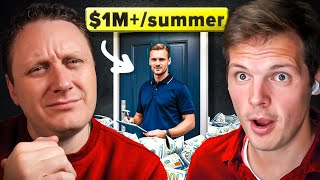
Chris Koerner and Nick explore why pest control is so profitable. A $134 quarterly fee takes 3-6 minutes on-site but costs only $11 in labor and chemicals, leaving 88% gross margins. Sales teams paid 1.3 times first-year revenue can still make money for the company.
Chapters
They go out. They go and get business. Let's say they generate $1 million in business. The pest control company. These large pest control companies will pay them $1.3 million. They're out. There are whole businesses of guys who just rent out their licenses.
There's not a right or wrong way to do it. It's just a spectrum, right?
They'll go and they'll sell for the summer and they'll make like 300 grand. He told me there's guys who make seven figures doing summer sales, which blows my freaking mind. In his first year, he made like 100 grand in three months. He's like, holy crap. This is amazing.
I think when you teach yourself things, it's more painful, the lessons sink more deeply, and you're able to learn a lot faster.
We're on an AI kick right now. I'm going to start with a non AI kick because I talked to somebody this week on my podcast, Nickonomics. It was freaking. An incredible conversation. I had a conversation with the pest control guy on Twitter. I think you've met him before. I can't remember.
Corey.
Casey.
Casey. I haven't met him in person, but I see him.
It was close. It was close. Anyways, dude, you and I are lds. We're Mormons. So we've grown up around sales bros. Solar, roofing, windows, pest control alarms, all of that. Right. Like, because. Because we come back from our missions and it's like I have a skill set. I have a very particular set of skills. We know how to knock doors and get rejected. And so it's like you go to these door to door and you become door to door sales bros. Did you ever do summer sales?
You act like we haven't been best friends for 17 years. You don't know my life.
I'm teeing you up, bro.
No, I don't do these fake questions. Let's do real questions. Okay.
I never did summer sales either, but we've obviously had friends who've done summer sales, and they. And they've done exceptionally well sometimes.
I have a lot of friends that didn't do well, but the guys who.
Do exceptionally well that, like, do it year after year after year, they'll go and they'll sell for the summer and they'll make like 300 grand, something ridiculous. So anyways, I've been. We've both been infatuated by this business model, but we've also both kind of stayed away from it because we feel gross about it. Am I right? Is that fair?
Oh, yeah. There's a direct correlation between the how much money a sales guy makes and how slimy he can be.
Yes, Well, I would say that's my perception.
Well, there are exceptions, but I think that the rule is the more money you make in sales, the kind of more you flirt in the gray area. And there are exceptions that are very ethical. Men and women that do really well at sales, that are very forthcoming and ethical. But I think they're outliers and exceptions personally.
Interesting. You're saying sales in general. So would you say the stuff that you do is very gray hat? It's just different.
What do I do?
I mean, scraping lists of people who didn't opt in to have their texts notified, ringless voicemail drops, emails that aren't publicly available that you figured out a.
Way to get right.
Like, people would look at that and be like, that's not ethical.
Yeah, I think that's gray hat.
That's interesting. I wouldn't put those in the same category. I don't know why I feel grosser when it's like, a guy who's at the door hard selling a single mom. You know what I mean?
Yeah, No, I definitely agree. All else equal, the door to door sales guys are much slimier than an average sales guy. But I'm just saying, in general, like a car sales guy or a course sales guy, like, the more effective they are. Like, they're persuasive, they're convincing, they're tactical, and, like, that just gets in the gray.
Okay, well, I went off on a tangent there. I thought that was for those of you who've done summer sales. We're sorry for offending you. Anyways, Kasey did summer sales. He worked for this company. He did summer sales, and in his first year, he made, like, a hundred grand in three months. He was like, holy crap, this is amazing. He told me there's guys who make seven figures doing summer sales, which blows my freaking mind. I don't know what they're selling, but they're making a lot of money. So he saw the inside. He saw the economics of that business, and he decided to start his own pest control company. And I want to tell you the economics of the business, because I don't know if you've ever. I'm sure you have, but I don't know how much you've dived into this. It blew my mind. Are you ready?
First. First you asked me if I've done summer sales. Then you asked me if I know anything about pest control when I literally worked that job for four years selling. No. Pest control. Yes.
I asked you if you knew the economics. I didn't ask you if you knew about the business.
Yes. Anyway.
All right, so here we go. Here we go. The average customer, they have them on this, like, yearly maintenance program, right? It's pretty normal. So if I'm a customer and I'm like, oh, I have pests. I need to have my house sprayed. I don't want spiders and ants and scary things. They can do some upgrades. They'll do rodents, they'll do whatever else. But I'm just talking about strictly pest control. Every quarter, I want you to guess how much a customer pays them for that quarterly maintenance.
It's like 180, 134 a quarter. Okay.
Is what an average customer pays them. All right, so what are they paying them for? They're paying for them. They're paying them for a treatment. So the guy goes out, sprays around the house. How long do you think it takes for them to spray around the house?
I did this four summers in a row. Took me about three to six minutes.
Okay, so Kasey told me 20.
But, well, including drive time, like, I would think it would averages out at 20. If you include. If it's because I would. I would clock in and I'd get a route for the day. You're doing these 23 homes. And so if I were to take the hours I work divided by 23, it'd probably shake out to 20 minutes. But most of that is drive time.
Okay, did you do any, like he said, they do, like, some cobweb cleaning. They do some, like, I'm saying, like, light maintenance. Maybe something inside. Did you do the same thing?
We would do that just as, like, a sign of goodwill, but it wasn't, like, strategic or anything.
Okay, so you're an hourly employee making 20 bucks an hour. And I'm going to. I'm just going to say it's 20 minutes. All right, so about. About a third. So it's about $7 in labor, and then 4. $4 is what he estimated for the chemicals. So if you just do the math, 134 gross, and your gross margin is $120. It's like an 88% gross margin. Then after that, like, once a business is stabilized, there's not a ton of administrative costs. These are like 40% net margin businesses, and they can expect 30% year over year growth while still maintaining a 30% margin. Net margin. So, like, they're insanely profitable. Insanely profitable. And he told me about these companies that will come in and they'll either buy a business, but. But most of the time they don't buy a business. They'll come and they'll say, hey, we're going to hire a sales team. We know it's going to generate X in sales. We're willing to pay you 1.3 times first year's sales in order to do that. So they're these like professional sales crews. They're just like mercenaries. They go out, they go and get business. Let's say they generate a million dollars in business. The pest control company, these large pest control companies will pay them $1.3 million. They're out. And then those customers stay on for forever because the lifetime value of these customers is so long and they are very sticky.
I just have so much to say. I'm so glad we're talking about this. Oh, okay. I'm sitting up in my chair. First of all, I agree the lifetime value of these customers can be very long. And in case these case, they probably are, because he's doing a good ethical job at selling them what they actually think they're getting. But I had a long conversation with Matthew, our friend who does this every summer, about the LTV customer. Go ahead.
He does pest control or he sells it.
Yeah. Okay. And he said that the shadiest companies do the most sales and their LTV is the worst. They will have cancellations out the yin yang because they're promising whatever they need to promise. Like just outright lying to the customers just to get them to sign on the dotted line. And then three, six months later, half have churned. But if you do it right, Casey probably does. The LTV can be amazing. The lifetime value.
So if you go out and just hire these mercenaries, they're like, whatever, I'll sign up anybody and everybody because I'll get 1.3x of whatever I sell in the first year. Yeah, like they don't care about the fulfillment side of things.
Yeah. And a lot of these, there's like three to five nationwide companies that sell pest control. And some have a good reputation, some have a bad reputation. The bad reputation is don't buy those contracts. Like, if you're Terminix, you don't wanna buy from X, y or Z Co. Because the multiple stinks because they churn so fast. So it all comes down to how ethically you sell them at the door.
When you say there's five companies in the country that sell pest control, are you talking about the Termin X or are you Talking about those, like, hired guns.
I'm talking about, like, the guys out of Utah that are building multimillion dollar businesses. They're just building a book of business door to door engineered to sell to a big pest control company, never intending to actually service those contracts.
Yeah. And like, those guys are just constantly looking for new assignments. Right. Constantly looking for new markets that they're opening. Like, that is just their whole thing. They're just going and they're selling cold. Here are a couple other things that I found really interesting about it. Casey was saying, if you're an investor and you want to get into the space, you could just go and say, hey, I'm going to invest a million dollars. And know that that's essentially going to get you about a million dollars worth of business. But because it's sticky, you're essentially spending a million dollars to get a business that has like $2 million of enterprise receivables.
Yeah, yeah, yeah.
Not just receivables, but it's like, okay, I built the business, I spent a million dollars. I got, let's just say, a million dollars of business. It's 40% net margins. I'm getting $400,000 a year in cash flows. Five times cash flows is a $2 million business. Right. Like, that's just generally how they're, how they're valued. So I thought that was interesting from like an arbitrage standpoint. The other thing I thought was interesting is there are whole businesses, and I didn't realize this, of guys who just rent out their licenses. So in order to spray these chemicals, you have to do it under somebody who's licensed. And in order to be licensed, you have to have done it for a certain number of years and then pass certain tests.
Right.
And then guys who have done that, they don't even do it anymore. They don't. They just supervise it and they sell their license to the companies that are getting up and running. So, A, I thought the business model was super interesting, but B, I thought this, like, idea of finding professionals who have specialty licenses could be a contractor, could be, you know, pest control. Guys like this in the skilled nursing facility world, they hang licenses on the wall as well. And then working as a marketplace or a middleman to place the license licenses with license demand. Now, I hate marketplaces, but I thought this would be a really interesting idea for somebody who's very ingrained in a specific space that knows about licenses, just working as the broker between the demand and the supply side.
What do you think that's a Great idea. And then just take a cut. It's almost like equity, right? Like, I need 10% equity in your business, and you're going to. I'm going to hang my license with you. Then the broker could say, all right, of that 10%, you. You have. I have 3%. Or just give me 30 grand today. Right. And I'll.
Cause Casey, I was like, hey, how did you find your guy? He's like, oh, he was a family friend. And we just had some conversations. It was just somebody. He knew somebody.
Right.
But how many companies are there who, like, they want to start up and they don't. They don't even know where to find somebody like this or the other end of the spectrum. Guys who have these licenses, maybe they're not. Maybe they're an owner of a pest control company, or maybe they're not doing it anymore. It's like, there's still value there. They could be supervising and getting paid something for it, but they don't know who to go place it with.
Right.
Like, you could be. And I think you could rank for this pretty easily through either Programmatic SEO, mainly Programmatic SEO was my idea. Or if you wanted to spend a lot more money, you know, go to, like, paid ads. But I think Programmatic SEO would be the place to start and just focus on those keywords in those specific markets of, like, that, you know, it's going to rank.
So the regulations to start a pest control company vary by state, but in Florida. It's so funny because you and I have talked about this a lot. Danny was my boss in the pest control business. It was called Quantum Pest Control. He sold the Terminix while I was working there. Like, I was there as they were doing due diligence. They were going through all the tickets. Like, I cut my small business teeth in this industry, and I just, like, smile thinking back on it, because I had no idea at the time how transformative it would be in my life. But I just remember driving around in this. This rap truck asking, like, how do you sell contracts? Like, what are they paying per contract? How much? And I wasn't using these terms. I didn't know these terms. Like, what was your churn like? Like, what was the ltv? Asking all these things in very ignorant ways. And I found these questions interesting since the day I was born. Right? But that gave me, like, a fertile playground to learn and ask these questions. And then in my 20s, I actually got to start doing those things myself. So Danny's partner was named Glenn. And Glenn had no operational role in the business. But he graduated from the University of Florida with an entomology degree, which is like bug sciences. And in Florida, at least as I remember, you had to have an entomology degree to launch a pest control business. Because I remember asking Danny like, I'm going to start one of these when I get out of college. He's like, it's not that easy. Like there's a lot of barriers to entry, yada yada. And that's exactly what you're talking about with the licensure requirements. So that's interesting. And then I'm. You're talking about the margin on the actual chemicals. And he said $4. And I bet you anything it's like way less than that. He just, he didn't want it to sound. I'm speaking for him. I could be wrong. He didn't want it because he's in the industry. You know, there's some conflicts of interest. But as someone who's not in the industry, this is what I would do. This was my job. I was 16 years old, I had a Chevy S10. And every morning I would, I would go to Ted's Diner in Ormond Beach. I would, I would eat, I would have a country fried steak covered in gravy with two cans of Coke with all the pest control guys and Danny. Then we go to the office, we'd have our morning meeting, we'd talk about all the tickets for the day and then I would get like a stack of tickets, there's like 10 to 15 of them, like the carbon copies. And I'd go in the truck and I had a physical map, like there was no Google Maps, right? This is 2000, like summer of 03 04. So video is cool. But you know what's better? Long form audio via podcast and my newsletter, tkopod.com go there to subscribe for free to my newsletter. It's one email a week, very tactical. And then go to my audio podcast, three episodes a week, stuff like this, you're gonna love it. All free, no sleazy sales pitch. Tkopod.com I had this physical map and I would drive all over New Smyrna Beach, Daytona Beach, Ormond Beach, Holly Hill and just service these accounts. And I would roll up and these guys, I had the same amount of tickets as like the 40, 50, 60 year old dudes, but I would finish by like 11am or noon and then like go home and play NCAA football, right? I got paid, Nick, I got paid $5 an hour, $5 an hour to Spray below minimum wage.
Oh, my gosh.
I was not licensed. I had. I was not on the books. $200 a week, 40 hours a week, and then I got my meals paid for. Biggest ripoff ever. But honestly, not based on how much I learned. But this was my whole job. This was my job. This is it. Okay? You're talking about all these different bugs. This is Florida. More bugs than anywhere on the planet. I had a metal can with like a manual pump. It was like a one, a one gallon can. And I had picture like, like a protein powder container, a small or like a supplement container. It was like that, maybe like 16 ounces of powder with a scoop. And I would roll up to a house, open the can, go up to the customer's hose, fill it up with water, scoop, one scoop per can, shake it like this, you know, it was really hard to shake. And then I would manually pump it and I would just go. I would just hold the trigger and walk around the perimeter of the house once and then leave. So tell me how long it takes to walk around a 2,000 square foot house. That's it. That was the job.
Do you ever like think about not just this instance, but any instance where it's like that powder could have been nothing? Yeah, they could have been flour for all you know. And you went and sprayed around that. Like you could see a business owner being like, oh, we don't need this much. The people don't even know anyways. They think they're going to get their bug sprayed. Jokes on them, you know what I mean? Yeah, just like trying to save costs.
And I remember going to Danny and I was like, after a month or two, I was like, danny, is this, is this all I'm doing? Did you give me like the easy job or is this what everyone's doing? Like, we're just talking. Like you'd think that like I have a whole toolbox full of different powders. I'm like, oh, you're seeing it. You're seeing banana spiders. I'm going to use this, like a whole recipe. And it's like I had one ingredient and a can of water. And I remember asking, he's like, yeah, that's it. And I went to my co workers and I was like, is this really, is this the whole shtick? And one of my co workers, he was like, listen, man, pest control's a scam, okay? I'm just gonna say it. It's a scam. Like, this is just a scam. This thing that we're spraying. You can buy at Home Depot. Anyone can buy it at Home Depot. I never forgot that sentence. Pest control is a scam. And that's like, from the quote inside. And so I tweeted about this, like, six months ago. Pest control is a spam scam. Go buy Spectrazide for 997 at Home Depot. Spray your house once a year and you're good. And, like, Casey got super triggered by that. He, quote, tweeted me all these reasons why I'm wrong and I'm ignorant and insurance and all this, but, like, 95% of the comments and there were hundreds of comments were like, yeah, it's a scam. This is exactly what I do. I haven't seen a bug in years. So it's like, they're outliers. There's like, well, in this area and that area. Sure, they're outliers. But by and large, that's all I do. And it works.
Maybe this is a framework as well. Many businesses are a scam.
If you're looking at scams with this framework. I. I agree.
Yeah, yeah.
Like, it's not actually a scam, but. Right, right.
But like, the point I make, I go to McDonald's. Well, you could just make your own food at home. Yeah, that's true. Or I mean, this is more of a scam. The water filtration systems in your house where it's like, oh, here, let me test your water. Oh, yeah, you got arsenic. Oh, my gosh.
You have to have it right now. Yeah, right now. You just got it here. But, like, take a sip of your water real quick. Yep, now you have cancer.
How many businesses are there that are quote unquote, scams based? But, like, basically we're assigning scam to something that is a convenience business where you could do it yourself, but you decide to pay for somebody else to do it. Like pest control, you could do it yourself, but you pay for somebody else to do it once a year because of the framing. Well, are you licensed?
Oh, wow.
Do you even know what kind of bugs are around here?
Yeah. Oh, you're buying peace of mind. You're buying a third party support a quote expert.
Exactly. So in a. In a strange way, I think that's an interesting framework to look at and think what kind of businesses are there that are convenience businesses? Because those can get probably spun up pretty quickly, make some really good money. Dude, I talked to a lady yesterday, Christmas lighting, she started it. She's a hustler. Year one. She starts it in August, November 30th, they had $150,000 in the bank.
It's crazy.
And she ran this business for 13 years. It became an eight figure business, and she ended up selling it. And, like, it did exceptionally well. Even when it got to scale, it was doing like 30, 40% net margins. That's a convenience business. Right. And she focused on where the convenience demand would be the strongest. She went to, like, very wealthy areas. She was like, yep, I went to the best neighborhoods. I looked at the best houses. I literally parked my van in those neighborhoods. It was in San Francisco. Parked my van in those neighborhoods. It was free advertising. I placed flyers on every single door. And guess what? When Mary Jane down the street started getting her lights up and her neighbor comes out and is like, mark, Mary Jane's putting up her lights. I think we should put up our lots. Retention was 85%. She's like, the business just grew every single year. And it was high margin. But it's a business that is not maintenance. What's the word? A nice to have.
Right?
Like we're talking about with pest control.
It's a vitamin, not a painkiller.
Oh, wow. Is that a framework? I've never heard that before.
But, like, yeah, the word scam gets clicks. Right? Like that. It's salacious, but, like, it's not literally a scam. Like, I would hire a pest control guy to come get a raccoon out of my attic, right. I wouldn't pay him 150 bucks a quarter to do something I can do almost for free.
Like, I feel like that maintenance is like the high margin upsell for having to do the crappy stuff of like, come get the snake out of my house. You're like, oh, okay, I'll do that at cost, but I'm free. I'm charging you an arm and a leg.
Yeah.
Because I hate snakes.
Here's a. I mean, you mentioned Christmas lights. I got a little side hustle idea for anyone out there. You ready for this? Okay. Okay. You heard of jellyfish lighting? Nope. Jellyfish is a, I don't know, eight or nine figure brand. And it's a franchise, and they sell permanent lighting through franchisees that own territories.
Across the US Permanent lighting of permanent.
Yeah, they're per. It's like per. It's not permanent Christmas lights because you can use them year round, but it's an alternative to Christmas lights that stay up year round, that are led, that you can control with your phone. You can change colors, you can do patterns, you know, on St. Patrick's Day you make them green. Valentine's Day, you make them red. It's growing in popularity and it's costing like $1,500 to $3,000 to get them installed. But you never take it down. So really it's an investment in your future because you save.
You're just adding $3,000 in value to the house.
Well, that and you don't have to pay $400 to the Christmas light guys every year. So after five years you break even, right? This is a deal. No, but seriously, like anyone listening to this jellyfish is going to hate me for saying this, but you can find the equivalent of this on Alibaba and AliExpress. Of this permanent lighting, it's probably low hundreds of dollars. You buy by the foot, couple bucks a foot. As soon as November hits, you go door to door only to the houses that already have Christmas lights. And you say, hey, beautiful Christmas lights. How about I take them down for free and you can return them to whoever, maybe they're yours, put them in the attic, whatever. And. And I'm going to install permanent Christmas lights. X, Y or Z price. You can install an app on your phone to control them, leave them up year round and you'll never have to pay $500 every Christmas ever again.
That's a pretty cool sales channel.
It's great because you're fishing where the fish are. You know that those people value lighting on their homes. They're probably going to 85% chance, as you said, Nick, that they're going to do it again next year.
Especially when you've hired a company because many times those Christmas tree, Christmas. I keep saying Christmas tree. The Christmas lighting companies, they do install some hardware on your house so that when they come the next year, it's just way easier, right? Like they're not just hanging the lights and then taking everything down. They're putting in some type of an infrastructure. I don't even know what, what I would call it, but some type of infrastructure.
I mean I have Christmas lights every year and they, we plug them into the. We just freaking plug them in.
There's nothing special, there's nothing up top that just makes it easier for them to lay.
No, they just clip them in. That could be different.
Both of my brother in laws have it and that was like. The thing is like year one they come out and it costs more because there's the setup fee, which in the first year I guess is expensive because they've got to put all of that stuff in and then each year it's it's cheaper because they don't have to do the setup. It's just pretty plug and play. And it makes sense for the tree. The tree. Freaking A. It makes sense for the lighting company because it. It's way quicker every single year for them to put down the same lighting along the tracks that they've already laid.
That could be one model. But how they do it here is. It's more expensive the first year, just as you say, because you're buying the lights. But then they store the lights. They keep them every year. So you pay for the lights up front once, and then, you know, let's say the first year, $700. Every year after that will be 350, because you've already bought the lights. You're just paying for the labor. But there's nothing. Like, there's nothing different being done every year. No foundation being laid.
Anyways, the point I was making with that is I was talking. So her name's Ann McGinty, and she reminded me of you a lot in this sense. They had the idea in July. They launched it in August, and by November 30, they had $150,000 in their bank because they'd done the work.
Right.
She just did it. She just went out and was like.
Yep, I'll figure it out.
And they, you know, they wrapped their car, they bought some equipment. They did pay for a course. So they took a course and they figured out how to do it, yada, yada. So that's like one end of the spectrum of entrepreneurship. Those are just like the, hey, make hay while the sun shines. And then there's like, the other end, which would be probably a little bit more me, which is. Well, I'm sure there's a franchise that does it. I don't want to reinvent the wheel. How do they do it? Oh, maybe I could go sign up. Oh, jellyfish exists.
Cool.
I'll go see what they're doing, and I'll buy a territory from them. But it's like, if it's July, me, Nick, I'm not going to have that Christmas lighting business up until December of the following year. Whereas, Chris, you're going to have it up by December of this year. But you're also going to have to go through all the headaches. You're going to have to like, yep, I'm going to have to go to Lowe's. I'll figure it out. I'm like, it's probably not going to look as good for the first couple of customers. Et Cetera. But, like, you just. You got in and you. And you got it done. I just think it's interesting how there's this broad spectrum of entrepreneurs within entrepreneurship. Right? Like, we're just not. We're not all the same.
I just talked about the same principle on my podcast two days ago with a guy that owns a pressure washing business, and he started doing Christmas lights. But it took him five years to go from pressure washing to his second service, which was window washing. Five years. Like, I'm only doing. And he said no to every. Every. You know, everyone was like, can you do landscaping? Nope, nope, nope. And then he did window washing. And then two years later, he did Christmas lights, but he did what this lady did, and he took a course and he actually learned how to do it. And we had this conversation. I was like, I wouldn't even pay for a course. I would just freaking go buy a ladder and start hanging those things. And he would look like crap. And there's no. There's not a right or wrong way to do it. It's just a spectrum. Right? Right. So he pays for a course, and I pay for refunding my first few customers. Cause it looked terrible.
That's an interesting way to think about it. Yeah, I'll just refund my customers instead of paying for the course. This is just an interesting question. Do you not think courses help you skip the line?
I'm sure they could. I'm just cheap sometimes to my detriment.
Hmm. Interesting. Has that changed over the years at all?
Can't teach bulldog new tricks. Tiger don't change his stripes. Nick.
Are you any more likely today to buy a course than you were 10 years ago? No. That's interesting. I am. I'm way more likely today to buy a course than I was 10 years ago. Like, I would have never bought a course.
I think when you teach yourself things, it's more painful. Even though it's more affordable, it's more painful, but it. The lessons sink more deeply and you're able to learn a lot faster in the future. That's my hindsight bias.
It could be differing perspectives as well, because, like, I did a hospice from scratch, and you, like, you screw up the licensure within a hospice, literally a A T not cross turned straight to jail. Well, you can go to jail. That is very true. You can go to jail, but you have to prove intent. But even if you don't have intent and you just mess up, you could be billing for a year, and then they come back to you and they're like, oh, all that money you billed for, you have to pay it back. It's like, well, I took care of these patients. Well, it doesn't matter. You actually missed this on the form. And so because of that, you gotta pay all this money back. Yeah. So I think just having that experience with home health and a hospice in particular has probably made me more concerned with getting started and making sure I'm not missing anything. I'm not at a knowledge deficit because the risks were so high if you missed anything. Right. Whereas the stuff you started up, it's like they're asymmetric bets.
Yeah. I can remember a couple times where move fast and break things hurt. It was a little painful. What?
When?
Not even in business. When I was on my mission in Hungary for our church. I was serving in Chopron in Western. And I, you know, as missionaries, sometimes we get asked to do things. Like in our local congregation, in addition to being a missionary. And I was the clerk. I was in charge of the money. Okay. And. And so we hosted a smoothie. Bouli. And buli is Hungarian for party. And we used church funds to do that, which would be fine if they were not tithing funds. And they were tithing funds. So we didn't know. We didn't know. I didn't know any better. And so we threw the smoothie party. They had never had smoothies before. They loved it. Smashing hit. And then I had an audit with other Valentine. And he's a very kind man. And he was looking at the books, and he's like, smoothie Boulevard Kerner. What is that? And I was like, oh, it was a party. We had a party. It was so fun. He's like, you use sacred tithing funds for that Other Kerner. That is very bad. That is very, very bad. So, never been a clerk since you're.
Like, oh, buys for action.
What do you want me to say? Move fast and break things. Move fast and get executed.
I'm good, right? Is my name still in the book of life? Am I still. I'm not. Oh, whatever. He'll get it.
All right. What'd you think? Please share it with a friend. And we'll see you next time on the Kerner Office.










