This AI Finds the Idea, Customers, and Does the Work
HyperAgent builds autonomous AI agents that work 24/7 on sales, design, and lead generation. Signal prospects constantly, other agents build websites from reviews and monitor marketplaces, while custom agents handle industry-specific tasks like pond-dredging leads. The platform lets agents spawn sub-agents, browse the web, and integrate with Slack and email.
Chapters
Anything that you do on your computer, your agent could be doing, and in many cases should be doing.
This is someone on my quote unquote payroll that never stops working and costs 99% less than an actual human. It's going to an actual browser and browsing like a human.
My hands are off the mouse and keyboard here. You can hook up Telegram, WhatsApp. Anytime anything's on your mind while you're just on your phone, you can put your agent to work. We have probably 20 agents running autonomously, like fully end to end. I have an agent that is like my visual designer and motion designer. This is crazy. This is crazy to me because it would take me hours.
You set it up, you go to sleep, you wake up, you have leads.
You could do this for any niche. Your agent can go and find these candidates and actually build them new digital properties to the point where you could sell the implementation of that website specific to them. That becomes your template that you then stamp out across all your clients.
You could start this for almost nothing. The guy that I talked to actually did. I knew I asked it to do this, but I didn't think it actually would. That's incredible. Boom. That was incredibly easy. I bet you can't find me one person that wouldn't want AI to just go out there, an AI agent, and do stuff for it while they sleep. Well, today we're talking about how to do that. Claude's cool. ChatGPT, awesome. Those are awesome. But what if it went a step further? What if ChatGPT was in a robot body and could go a step further and do stuff for you? Times 100 AI agents. That's what we're talking about today. How to make money with them, how to build them, why they're cool, why they're important, why they're dangerous, how to guardrail them. And if you're the type of person that agrees it's better to show than tell, stick around because at the end of this, I'm actually gonna build something with HyperAgent for myself. Super cool. Please enjoy. What is a practical, realistic use case for an AI agent today that you're seeing people use on a daily basis?
Yeah, I'll jump right into one that's super visual and easy to understand. This will start off as kind of like a one-time task, like a project for an agent. And then I wanna show you how you can start to change your thinking and, and consider these agents as persistent 24/7 employees. Okay, so this is a run of an agent that has found local businesses that have great reviews, but no website or outdated websites, finds their contact information, learns about their brand, learns what customers love about them, and then actually builds them an entirely new website. So let me walk you through what the agent actually did here. So what you're looking at basically is all of the— thread with the agent here is on the left, all of the thinking process. It spins up sub-agents to delegate different tasks to break things down, make them happen in parallel. And then on the right here are all of the artifacts. So you can see the agent has visited some websites, taken some screenshots. It actually literally opens and runs its own browser over here on the canvas. So while it's running, you will see it actually navigating the web. And then the final deliverable here is in the form of an all-encompassing webpage, which is meant to be for my consumption, which contains all of the business candidates that it found, as well as the websites that it built for them. So for example, we've got CS Automotive here, 300+ Google reviews, fantastic reviews, but, uh, no real digital presence, no website. And so it has actually, based on its understanding of what they do, just from the customer reviews and the things that people love about it, Built them an entire website here that has a booking system as well.
Oh man.
So you can come through here, even get an estimate. These are all just based on best judgment or best standard, best guess of pricing, right? But if you were to actually get this in front of this business, you could make this specific to them. So the idea here is from one prompt, if you're watching the video, pause it, screenshot it. You could do this anywhere. You could do this for any niche. Your agent can go and find these candidates and actually build them new digital properties. To the point where you could sell the implementation of that website specific to them. So you could put this in an offer and say, hey, we've learned about your business. We think people probably can't find you the way that they should be based on all your amazing reviews. Here is an example of the type of website we'd be able to stand up for you within days. Or there's even this notion that maybe that website is just like a free giveaway because of just how easy it is and how fast it is to do this at scale. Sure, keep it. Hey, this is yours. This is yours for, for zero cost. So you see a few different things that I'll call out there that agents are capable of. One is extensive deep research all happening in parallel. This whole run was about maybe 20 to 30 minutes from the research, finding the candidates to actually building all these unique websites. Browser use, like I mentioned, being able to actually judge visual quality kind of qualitatively to say, hey, that, that's right. Yeah. That looks like kind of an outdated website that could be better. That's going to be a candidate for. Yeah. The outreach, actually managing, drafting that outreach per business. So tool use in there as well. So it's going to be able to use your email and draft those messages. You can approve them or you can just trust the agent and say, go for it. So a really good example of what pretty close to a one-shot task that you can give an agent. And this skill is on the marketplace for free as well. If anyone wants to try this for a certain domain of businesses or in their locale. You should, you should give it a try.
So let's say 3 years ago, I have an internet agency that makes websites for local business owners. Yeah, I'm going to spend my downtime, you know, browsing through Google Business Profile, finding businesses with no website, looking into the reviews. Do they have pictures? Are they optimized? Oh, here's one. Find their email, scrape it, cross-reference it, email them. I see you don't have a website. Can I build that for you? Your response rate is going to be 0.5%. 1%, maybe. And then you respond, you hop on a call back and forth, days elapse, weeks elapse. Then it's like, all right, what kind of a website do you want? Let me close it. Let me invoice you. And now you're saying like, you set this up, which you can just get the template from you. We don't need to start from scratch. You set it up, you go to sleep, you wake up. Theoretically, you could have leads.
Yeah.
So there's a Seinfeld episode where Kramer takes this car out, and he tries to push it as far as he can go.
Yeah, yeah.
That, you know, how far it can drive on empty.
Yeah.
If you were to get really bold with this and go further, like send the invoice, accept the payment, fulfill the service, hop on a call with them with your product, how, like, how far could you push this agent if you really wanted to be hands-off? And I'm not saying people should, I'm just curious. Yeah.
Anything that you do on your computer, your agent could be doing, and in many cases should be doing. If it's more of a chore, then your agent absolutely should be doing that. Like if you feel while you're doing some computer task that your brain is like almost off, You should never be doing that task again. So actually running the outreach and watching your inbox 24/7. This is another huge one, Chris, where I'll, uh, if I go into one of my agents here, I'll just show you where we can set up tools. So when you go into tools and integrations, you know, if a lead comes in overnight, that needs to get a response immediately, right?
Mm-hmm.
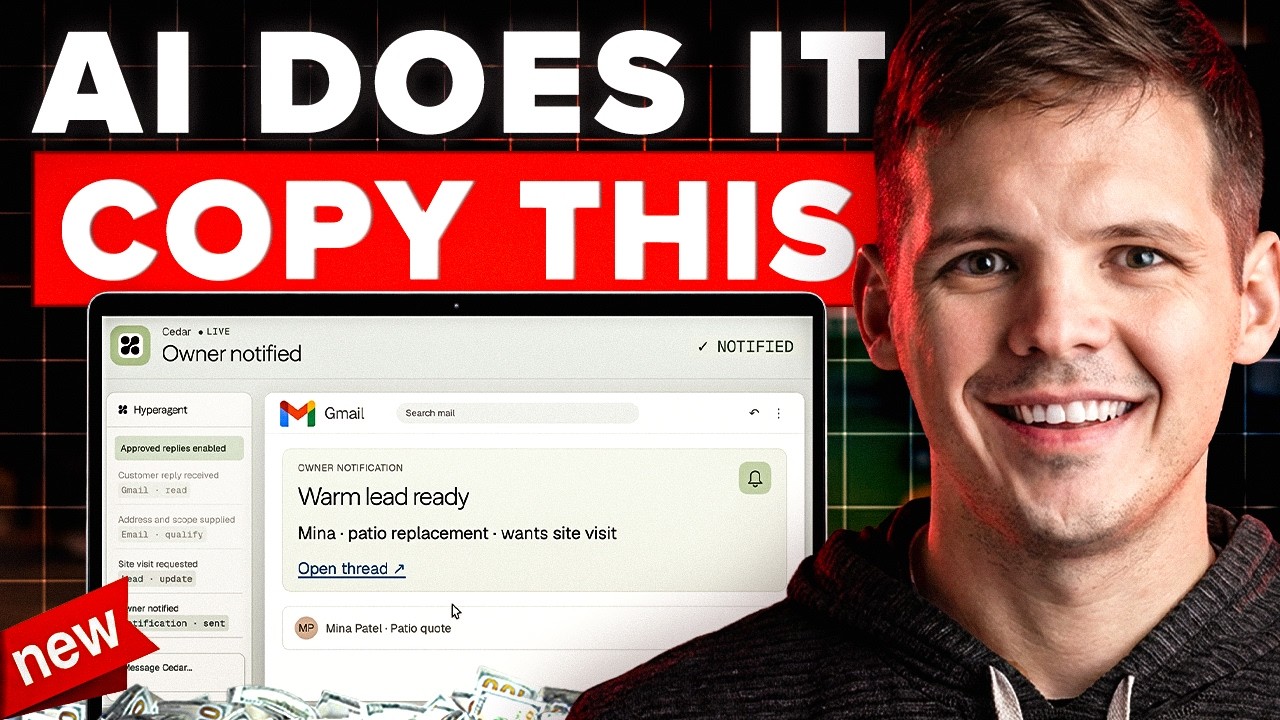
So there needs to be an inbox kind of night owl agent as well. Where anything that comes in inbound or earns a reply from your outbound is immediately getting that, that response, that acknowledgement. We have agents running ads as well autonomously, like fully end-to-end generating the creative strategy, optimizing the spend, doubling down on the winners, killing the losers. So everything related to filling your pipeline, outbound, ads, inbound, sales coaching is another one. So get your note taker on your call. Have those notes automatically passed back to your team of agents so they can give you feedback on your performance with that client. How can you improve your close rates? How can you sharpen your own script and, uh, and your ability to actually secure that business? Daily marketing competitive intel and industry briefs, feed that into your team of agents as well to, to tune up the outreach that they're doing. Are there things that are more timely or more relevant they could be including? I'm also just showing directly through the web interacting with these agents, but another big shift is being able to just message your agents as if they're teammates. So Slack is a big one for us. You can hook up Telegram, you can hook up WhatsApp, just like you would communicate with an employee anytime anything's on your mind while you're just on your phone, you can put your agent to work. So if I click in here to my team of agents, each of these cards here is a different agent that has a different job. And that helps me actually organize, okay, I only want to give my agent access to be able to post on X. If it is the agent that knows my brand voice and that I'm explicitly told and granted that permission. I want a separate agent that's actually touching customer data and financial data. Those 2 things better not ever cross. And I can create hard guardrails by assigning those permissions to different agents. It looks like with our team internally, these aren't our literal agents, but we've got 4 of us on the growth and marketing team here, and we have probably 20 agents. Each with fairly broad sets of responsibility. Like I'm not talking like, oh, like one little workflow or approval. You know, I have an agent that is like my visual designer and motion designer that creates all the stuff that we post on website or on X. We have like a CMO agent that orchestrates to all the other ones, copywriter agent. You really start to think of these in terms of full-time jobs.
Okay. So what's an example of a bread and butter agent? Like simple but helpful that you see a ton of your users using. And then could you show me how to build that live?
Yes, sir. Okay. So the most popular agent on our marketplace, which is where we have all these different agent and skill templates, is called Signal. This is your always-on 24/7 sales agent. So it works end-to-end owning the full pipeline. I'll walk you through some of its key capabilities and then I'll, I'll show everyone how to actually grab this agent and start setting it up for themselves. So it is responsible for growing pipeline, growing our business, getting us more customers. So that's the explainer on Signal, and then I'll jump into seeing it in action.
Yeah, let's do it.
Okay, so this is our thread with Signal. So the way this is structured is in what we call live mode. So there's basically one thread that keeps getting the same prompt on a set cadence. In this case, I have this set to every hour. And Signal wrote this prompt, this loop effectively. For itself based on everything that I loosely instructed it how to do. So this is a good, like, general point with our agents as well. I just describe a job description the same way I would give an employee a job description. And the agent is the one that can actually scribe those detailed instructions for itself to the point where, you know, there's been a lot of, I think, excitement over the last several months about, you know, skills and we have our skills on our marketplace. I'm excited when a skill does the job. You won't really find me diving into like the exact wording in that skill or in the pieces of it, because it's not really for me anymore. It's for the agents to run themselves. So every hour in this same thread, this live mode prompt gets kind of reinserted into that thread, and then Signal goes to work. So it does everything that was just in that explainer. It goes and finds new prospects based on our ICP. It will build personalized landing pages for them. So let's take a look at this one. I've switched my context here. This is a different type of company that we're kind of representing the sales outbound function for. This is a real company, uh, that I've been working with on their hyperagent setup. It's called Swish Solar and they actually sell self, self-cleaning solar panel technology. Very, very cool tech.
That's cool.
And so you can imagine the types of prospects they're looking to sell into are like industrial-grade solar projects. They have found that their agent can go out and actually source real information and run deep research for specific people that are the project leads on specific solar farms and industrial projects. And then the idea here is that this is a personalized landing page just for that person. So you have, you know, what in the CTA in their case is let's, let's discuss a study or a pilot program. We actually have videos here that the agent has created here as well. It's got screenshots of the software. It's got real images of that project that's all incorporated into this hero video.
Mm-hmm.
Some animated explainers discussing how the technology works, more shots of the product UI. So you can imagine like you are receiving this very, very personal and unique proposal of a technology you're not familiar with, but has clearly put in the work to understand your business, the specifics of your project. You know, we think we have a much better chance getting, uh, someone on the, on the phone after receiving a proposal like that than just a plain, uh, text kind of cold email.
I feel like this is very ego-friendly. I like to say, like, if you're—
if we were— Yeah, I like that.
On a live sales call or a demo, and I'm actually interested, but I don't want to really show it, then I'm probably not going to ask as many questions as I want to ask. I don't want to lead you on. So I'm like, I don't know, I'll check it out. And then I might or I might not. But this is very async, right? He can do it on his own time. He could ask it a bunch of questions, go through, take his time without the fear of anyone watching him or anyone pressuring him, you know?
100%. Yeah. And think about, I mean, again, the old school way to do this, I mean, the classic cop-out response from any buyer is like, oh, send me some materials. Well, now it's like, I can send you some materials. It is something hyper-specific and personalized to you. And hopefully if we do that actually earlier in the process, we stay out of that trap of just needing to, you know, send someone some materials. And so we're, we're actually really earning that buyer's attention and respect by putting in that deeper work for what is in this case, especially a very high consideration type of purchase. We're really starting that relationship out on the right note. So as I'm just scrolling through here, you can see that Signal, this agent, as it's been running in live mode, just working 24/7, has been building out these, uh, these contacts for real projects, been building out all these pages. And then it's doing all of its other kind of routine chores in every run as well. CRM discipline. It's gonna post an update over to Slack for me as well. So if I switch over to Slack, this is what that looks like. We're big fans of wherever possible, we think. Agents should be prompting their humans rather than humans needing to prompt their agents. Your agents should just be working. Like your agents should be working 24/7. They should have clear guardrails, tool access, and then when they need your attention or just to update you, they will let you know, hey, in my 3:00 PM loop, here's what I did. Added some new prospects, built out their pages here in the command center. Here are some things I learned. That's the other really powerful part. Once you get this wheel in motion is the constant learning. So for the outreach that does earn a reply, you're going to see more of that from Signal. For the tactics that don't work, you're going to see less of that. And it's always going to be passing those learnings back to you. Hey, here's the type of prospect that actually seems to be responding better to our offer and the type of messaging that's earning that click and that call book.
Interesting. Do you have any like anecdotal case studies of people using your agent for Outbound sales that have like actual wins that they've reported?
Yeah, there's been a couple. Um, let me show visually what some of it looks like. We had, for example, a landscaping company that has been using agents to actually build out their proposals based on inbound leads in their case. So imagine you are looking to get some work done on your yard. You send in a very short description of what you're looking to get done with a picture of your current yard. Maybe you send that out to 3 or 4 different local companies. One of them gets back to you very quickly and actually has a vision for you of what your backyard could look like, your actual yard. Like, this is where you started and this is what it could look like. Meanwhile, the other 3 companies are like, well, we'll see when we can come on site. Probably took them 1 or 2 days to get back to you anyways. Like, what a competitive advantage it is to not only have an agent that's able to reply right away, And kind of respect that, that lead as soon as it comes in, but actually potentially sell them a little bit of a vision and not have the customer have to use their imagination for an offering like that.
That's a desert to fail. We're not creative beings, right? Like we, we shouldn't have to expend brainpower into how we can give you more money. We need to do all that for you. Take away all that.
We got to see, yeah, people have to see it to believe it. Even things that are, you know, a little bit less visual, but still, uh, it's kind of warrant this approach. We have a paving company that is using satellite imagery of, uh, large lots, like parking lots that are clearly, you know, past their prime and showing with that satellite imagery and AI image generation, here's exactly where we would repave estimates on the cost based on what we can see from satellite and, you know, the impact to the value and kind of like street curb appeal of your, of your business or your commercial property, whatever that might be. So there's some really cool use cases like that. I'll share one more was Uh, a company that does branded, like, company apparel, essentially. So, you know, you might get your, your company polos or hats or whatever. Uh, again, you can see where this is going. Let's build that prospect list. Let's actually take their branding, put it on some of our products, use AI image generation to show, hey, this is what your team could be looking like when they show up to the site or show up to the trade show. Here's some different visual styles, you know, interested in, in understanding more about what we can do. do. So those are some of the fun ones that are a little more on the visual side that people have been doing.
What about, um, this is just a personal idea I have. So I, I just bought a ranch here in North Texas and it has this pond that needs to be dredged. And so I'm looking for like pond dredging companies, pond maintenance companies. And, and I had the thought and I prompted Claude, like, are there any companies that's like the ZoomInfo for ponds? Like if I were a pond management company, Could I buy a customer list? Could I get leads from somewhere? And then I asked Claude, how many ponds are there on farms and ranches in Texas? 800,000. Okay, 800,000. And I said, is there a directory? Is there a place where I could sort through that? It's like, no, that's not a thing. It's like, well, that's very niche, but certainly people would pay money for that. So could I use HyperAgent to build an agent that could go take— I mean, all this stuff exists, just satellite data, GIS mapping, spreadsheets, and just take a measurement.
Yeah.
All right, like this lake is 1 acre. The address is this based on the pin and just put it all in like a Google Sheet.
I like where you're going. Yeah. Do you think any of that data would come from like zoning applications or anything, or would, would straight up satellite image analysis be the best source?
It could come from tax records, zoning applications.
Yeah, yeah, yeah. Like, right. Let's try it. Well, I'll, I'll let HyperAgent run and we can, we can keep chatting and we'll, uh, we'll see what it does in the background. Let me prompt it here. Uh, just got an idea from my friend Chris for, uh, our pond dredging company. Uh, we're in North Texas. You pick the, the, the town where this might make sense, but what we want to do is build out a database of all of the ponds that might need dredging in the area. We're thinking you might be using satellite imagery to do that, or maybe zoning applications or other sources of data. Do a little proof of concept sprint, see what you can find using different approaches to find leads for our pond dredging business.
Oh man, that's so good.
So we'll let our agent run there and See what it comes up with. Yeah, it's not the best use of time, but it is a little bit fun to just watch them run. Yeah, you get to see their whole thought process. You get to see them lay out different approaches, rule them out, whether they work or don't work. All of its actual artifacts will pop up on the canvas here as we go.
It's like Claude in a human form, right? It's like a robot whose brain is Claude or ChatGPT or Grok or all of the above, or whichever one it decides to use. With the ability to go out and do the thing that you're asking questions about.
Yeah, exactly. Yeah. At a technical level, it's worth mentioning in every single thread, every agent actually literally does have its own computer. It has its own virtual machine where it can do things like run commands and install libraries. And you're going to watch it right here, open up its own browser. So my hands are off the mouse and keyboard here. It has spawned what we call subagents. So it's got a couple subagents here where it's, it's sort of—
So they're running like in parallel then?
Yeah, exactly. So it's kind of got like the, you know, it's got the gang together and said, all right, here's the overall plan. Agent 1, I need you to check the satellite data. Agent 2, I need you to check the zoning applications. And they're going to go off and run in parallel and then report back to, uh, to the main agent as they, they complete their, their work.
Okay.
That's a good one. Yeah. We'll see how it does. I'm curious, what else have you seen from your, your audience when it comes to this concept of having agents that you really start to treat more like, like employees or coworkers?
Yeah.
Are people pretty early in that journey? Are you seeing some, some cool experiments that people have started to get real value out of?
It's very early. I know a lot of people that have AI implementation businesses, they'll go into small to medium-sized businesses and do an AI audit, or just help them install AI tools. So I am curious how agents could help them find more customers or help them fulfill customers they already have?
Yeah, this is a group that we're thinking a ton about, and I would speak to it on 2 levels. So one is for the AI automation agency itself, for your own internal operations, use these agents, whether you use the prebuilt templates or come in here and build AI employees for yourself to find more customers and also to service your customers, run your own operations, project management, things like that. But you could use that exact same flow that I was sharing where that same single agent is running outbound, inbound, nurture, finding leads within your niche, whether that's kind of, uh, physical service businesses or something more upmarket, whatever that might be. The second thing is using this as a platform to actually deploy the agents that you sell. So any agent here that you create, like you might have an agent for your niche that, let's say we stick with this like pond dredging example, that's like the pond dredging project manager agent, and we're going to go sell this to all the pond dredging companies. That becomes your template that you then stamp out across all your clients. So we think that our platform also has a really strong position as being the way that AI automation agencies actually choose to sell, package, and deploy those agents to the end client. And I'll, I'll come back to this agent in a second, but essentially the way that's structured is we have this concept of teams. They're kind of like different workspaces. And so I could have a workspace for just one client, like Apex Landscaping. I could have workspace for another client. And then I, my client can be in there and actually be the one paying the bills for the ongoing AI costs. But I'm the one actually managing and editing those agents that are inside this workspace just for them. So I have that backend access. The client can just use the agents. You could give them edit access if you want, but for most of those AI agencies, we hear that they and their clients just want the client to be an end user of the agent and any backend changes to that agent, any config is going to happen by the agency. And so you can set up that exact model right in here. We hear that AI implementation agencies are doing a lot of like very creative, and I would say often like hacky stuff to be able to set up, standardize, and package their offering, deploy it for clients with like a lot of technical stuff with different private servers, everything like that. And then actually charging for it is, uh, is a bit of a hassle as well. We can simplify a lot of that with, uh, with this setup.
Yeah. Beautiful. How does HyperAgent know what a good website looks like?
It's going to be looking both visually, and by visual, I just mean literally like it'll take a screenshot and then process visually what it's saying. It can also look at the code itself. So things like the color choices, the layout choices, the use of negative space. I'm looking at the landscaping one just because it's what I had handy, but this is obviously a page that that agent has built itself. Code has become The language of agents now. They're so good at looking at code and understanding what they're seeing and understanding how it could be better and how that code is going to visually present itself. So it's twofold. It's one is straight up image recognition. Like if you were to just take a screenshot at this and say, is this a clear layout? Is this good use of color? Is this a modern, you know, font family, things like that? The second is actually by inspecting the code. Those are the two ways that that agent can come to that conclusion because they've seen.
Interesting.
All the examples and all the references in the world of every website that's out there and how web design trends have changed over time as well.
I mean, put maybe overly simplistically, it could just Google best looking websites of 2026 and just find random blogs and train itself on how that looks like. All right. We're seeing a lot of serif fonts. We're seeing a lot of pastel colors, choo choo pattern matching, pattern matching. Cool.
Yep, exactly.
If someone were a total beginner to AI agents, they've used Claude, they've used ChatGPT, never agents. What do you suggest they do from day one on, on your platform?
Yeah, I would say pick a part of your work that you find very tedious that you would like to not do anymore, that is like a computer job, and start with asking HyperAgent to build a dedicated agent for you to do that job. That should hopefully give you the first taste of what these agents can do. You can put that agent into live mode as well, like we talked about with Signal. So just every hour it comes through, it runs its checklist, it does that job. From there, you can start to get more ambitious. And then metaphor is less about, oh, what are like chores and tedious things that I don't want to do? And it's more like, if I had all the money and time in the world to make the dream hire and make that person really successful, who would I hire right now? And then what would they do 24/7 if they never had to sleep? So for example, with Signal, the sales agent, it's like, well, dream sales hire would be constantly sourcing new outbound, constantly sharpening its messaging and its approach to our ICP definitions. It would go. Super, super deep in its research for every single prospect and build them something very personal as a proposal or pilot or initial offer. It would never let a warm lead go cold and it would track everything perfectly in CRM and it would find it, it would get creative with where it finds contact information. List those things out and then push your agent to do as many of them as possible. And hopefully we've given a taste today of how far you can go with that.
What's something that you've seen HyperAgent do that genuinely surprised you?
Ooh, that's a good question. A lot of the browser use stuff is really impressive because it's so human-like the way it will actually just navigate through web interfaces that are not meant for agents. Like the web at large is still pretty hostile to agents. You think about things like even like CAPTCHAs that are just in the way. They're like trivial for agents to solve now, but they're still in the way from the era where we were so concerned about bots. Now the shift that's happening that's underway is People actually want to make their websites very agent friendly so that agents can find them as opposed to only being for humans. But seeing agents actually browse the web, visually process what they're seeing. We had our agent do like a landing page design teardown. So if I go back through here, yeah, this landing page teardown. So it was doing like, this would be for like a web design analysis or something like that using its browser, look at web design trends and then come back with annotated markups the way that like a really expert designer would. That was really impressive to me between the browser use, the visual understanding, and you use that, that word taste, which is becoming a hot topic for sure with any kind of visual work or even copywriting. In my experience, given the right context and instruction, the models are getting pretty good. A lot of the video work as well, Chris, has become really, really exciting. So if I quickly go over to our XFeed here, let me show you some of the stuff that I've been able to do with these agents. So. So let me let this play and then I'll tell you about why this was so exciting to me. So this video that you're looking at was created by a motion design agent. So it's very meta, but I have a motion design agent creating videos about agents. Historically, for me to do these demo videos, I have to use the product as if I'm the customer I'm trying to represent, and then screen record the process, show the agent generating its work, show a really good outcome. And then edit that video together. It's very like handcrafted and artisanal. You got to get the timing right. You got to make sure everything that's on the screen is right. What's happening here is this agent is actually using its own browser. It logs into HyperAgent and it says, hey, Alex has asked me to create a demo of an agent monitoring its inbox. It will actually do that, understand how that would look as a real run, and then through code, actually just create that whole visual experience and animate it and get all the timing right. It can also then take creative liberties where it has like these pop-up messages from the agent, a pop-up message from the human user that are there because it helps clarify the product story. This is crazy to me because it would take me hours to create a screen recording of this quality. And there's even things I wouldn't be able to do here where I'd have to like awkwardly punch in on the text. Now the agent can just have the whole storyboard of this whole product animation exactly the way that it wants. The creative possibilities that this unlocked have been pretty amazing for me as a marketer.
Okay, first of all, that's wild. Second of all, how, how much babysitting is required? Like with other vibe coding tools or prompting, like it's loading, it's loading, you're checking in, you're fixing, you're fixing, the last mile is really, really hard. What would you say to that?
I would call it less about babysitting. It's not so much that I have to watch it during runtime, but there are definitely a lot of iteration cycles. So to get this motion design agent for each of its runs, I expect to have to probably give it 3 or 4 rounds of feedback. So the rhythm of that is I start the thread, I let it run. It usually takes about 30 to 40 minutes because again, it's using its browser to actually study the product. It's actually coding up a recreation simulation of the product. It's thinking through the whole storyboard and then rendering the video. It then pings me when it's ready. There's probably things related to the timing or the visuals or the sequence that I want to see improved. Maybe some copy that is put in the video is off. It runs again. That run's gonna be much shorter, maybe 5, 10 minutes. And then maybe we have to do that a couple times. So it will get to a serviceable output every time. I don't have to babysit it in order to get it to a decent output, but to get it to my standard is usually gonna take a couple tries. But that time keeps getting lower because during every run it is learning as it goes.
Mm-hmm.
And so it says, okay, Alex has given me that feedback. I'm not going to forget that. There's always that per-run feedback and learning that you're going to have to be prepared for. Again, just like if you were onboarding an employee, the difference here is that those learnings will stick in the form of literal updates to its skills and its memories. Okay.
Speaking of Marketplace, can this browse Facebook Marketplace and message people?
It can do anything through the browser. It can do things more easily and faster when there's an API. I haven't tried the Marketplace example, but of course you could do that through, through the browser directly. So it could actually. Literally open Marketplace, scroll through based on what you're looking for, try different search terms, and either buy or sell on your behalf for sure.
So another example, I'm, you know, I bought this ranch, so there's a bunch of stuff I need to buy. I need to buy a side-by-side, a Bobcat, a tractor, ton of stuff. So I'm on Facebook Marketplace all the time and sorting and talking. When can I come see it? And I have my assistant helping me, but it's still a pain. So I'm wondering if I could go to my Claude project that I already have for this. It knows exactly the makes and models and prices that I'm looking for. Just say, Claude, give me a markdown file of everything, of all this. Give that to HyperAgent and say, hey, let me log into my Facebook account. You know what I want. You know what I'm looking for. Every hour, every 2, if you see something that fits my criteria, reach out and ask questions.
Exactly right.
Yeah.
I'll show you even step by step how you would do something like that. So let's imagine we had that markdown file. You would literally just attach it right here as you're getting set up. And I would just say like, create an agent that's going to watch Facebook Marketplace for sales that I specify. And we'll just see how this agent gets spun up. I'll just want you to see the, uh, the create agent flow here, which is really, really simple. So I've kept this one really general. If you had like specific products, specific buying criteria, you would just give all that to the agent. If you see this little card right here, we're now gonna get what we would call a named agent. So a specific agent entity that's gonna have its own name, its own avatar, like all these ones we've been seeing.
Cool.
Signal, Funnel, Redline, these are all named agents. So you can always use HyperAgent just for a general task, uh, kind of a one-time thing. But exactly what you started describing there is where we're seeing all of our customers start to shift. And what they want is these persistent employee-like entities that actually perform a job on an ongoing basis.
Mm-hmm.
So we've got this agent here called, let's see what it chose to name itself, Marketplace Scout. So as you see described here, this is going to be a persistent agent, browser access, listings table. So it's always going to be remembering what it's seen, what comes back around. So we can go ahead and save this agent right here. It's suggesting that we put the agent into live mode, which is that feature that I talked about where it's just going to wake up every hour, run through its list, run through its list. And if it sees something that fits your criteria, you can instruct it on how to notify you, whether that's through email, WhatsApp, Telegram, Slack, Discord, whatever. We'll enable live mode. And then when we go see that agent, we can see it's given itself the little shopping cart emoji as an avatar here. For fun, we can, we can generate one as well. Maybe friendly robot in a noir style. Why not? Let's see what we get here. And then I'll show you how we set up those integrations as well. But that's cool. Yeah, our CEO actually has an agent that will watch vintage sports car listings for him, which is very similar to what you're describing.
That's a good idea. Beautiful. Well, how's our pond project doing?
Let's see. The, the pond dredging lead gen analysis agent is still working away. Let's see what it's found so far. You can always, uh, jump in and just ask your agent to summarize, but it's been working hard. You, as you can see, like these runs, they do get quite long with the more ambitious tasks. And so let me just see what it's learned so far. Just pause work for a second and update me with a few key bullets on what you've learned so far. It gives you the whole thought process here. So a little out of my depth in terms of this, like geographic data it's looking at, but we can see what data sources it's been trying. Yeah, with a little more runtime, what I would expect to get back from this agent would be basically A single webpage artifact that is kind of like that command center that I had going for the solar panel tech company, where it's, here's all the leads. Here is the buying signal that I specifically identified, the data sources where I got it from, and here's exactly the message I would send to them as a reach out. So here's what the agent found. Let's have a look here.
That's so cool.
Here it picked a specific town in North Texas, looks like, based on some population figures. It's got imagery. It's got a pretty good start there, it looks like. And then, like I mentioned, I would just have it keep running and then deliver its findings basically as a briefing to me that uses some of that design and formatting that we saw from the other agents.
Amazing. Well, thank you, Alex, for your time. Where can we find you? Where can we find this product?
Follow us on X would be the best place to keep up with what we're doing. HyperAgent on X. And, uh, use, uh, the link that we'll provide for your audience to get some of the initial free credits to get you started. Give your agents some ambitious jobs, the jobs you would give, you know, really skilled people that you were hiring and see what they can do when you, you just let 'em run.
Yeah.
Let them help you, you know, find customers, grow your business, run operations. There's a ton of potential here and we've got some other customer stories that you can see on our socials as well if you wanna get inspired with, with what people are doing.
Beautiful. Thank you, Alex.
Awesome. Thanks, Chris.
All right. As promised, I'm gonna log into HyperAgent and build some pretty cool stuff so you can see for yourself hands-on how this actually works instead of just talking about it theoretically. Okay, this is HyperAgent, which I am an active user of, and it's built by the team at Airtable, which I've been an active user of for years. You give it a job, it goes off, it uses a browser and real tools and comes back with something that is actually finished. This thing can run a whole team of these agents at once. It builds real stuff. We're talking like entire webpages, dashboards, not just text or images. There's this one company that had a single dude build a fleet of 14 agents that his whole team now uses every day. So today I'm gonna use it for my favorite thing, which is finding boring businesses that quietly make a killing and then actually building one out. We're gonna start right here in the search box and type in this prompt. Find me 10 boring local businesses that quietly make over $500,000 a year and that almost no one talks about. For each one, tell me what it costs to get started, the typical profit margins, and why more people aren't doing it. Put it all on one clean page that I can read fast. Cool. Okay, let's see what it does. I'm going to leave it on the model that it chose by default, which is GPT-5.6. Okay, let's see what it's doing. Reasoning, asking me a couple of questions here. What should make over $500,000 a year mean? You know what? I'm going to say owner profit. Which market should startup costs and economics reflect? United States. Do you want business models or 10 specific operating companies? Both. So if you give it a crappy prompt, it improves it for you. Okay. I think it's really important that you actually watch what the agent does as it's doing it, because it's mimicking human behavior. It's going to an actual browser in a cloud computer session and browsing like a human. It's reading documents, searching the web. Portable sanitation. Oh, a little sneak preview right there. Now it's suggesting a couple skills that we can save. This is basically like a skill. It's a skill that HyperAgent just learned, and it wants to know if I want to save it and recall that skill at any given point. Kind of like The Matrix, right? They plug into his brain. He's like, I know karate now. That's a skill. He doesn't have to use that skill when he's talking to his grandma. But if a bunch of bad dudes in suits approach him on the street, he's going to access that skill that he had learned previously. Same thing here. We'll go ahead and save that. Let's go ahead and check in with it. How's it going? Okay. I went ahead and approved the plan as presented right here, and now it's cooking. Super cool. Research 4 boring US local facility or asset Based business model capable exceeding $500,000 in normalized annual benefit to the owner at established scale. Multi-store laundromats, laundry routes, self-storage, express car wash, parking lots. Cool. The initial screen is done. The threshold is genuinely demanding. Most qualifying operators need several crews, yada, yada, yada. Tightening the evidence row, especially the named examples. Searching the web. BizBuySell. BizBuySell. Cool. I like how it's not just being a yes man and saying this one can, this one can, this one can. It's saying a $500,000 owner profit threshold. Eliminates most easy side hustle examples and usually requires multi-crew or multi-location scale. Appreciate the honesty. So interesting watching it learn in real time. It's an interesting route it's taking. It says broker reported examples, so it's referring to a business broker, and it's doing this, I'm assuming, because I asked for specific examples of 500K SDE, seller's discretionary earnings, aka what the business owner actually makes. Because profit is not it. You could make a million dollars profit, but the owner Is only able to pay himself a fraction of that because he's reinvesting the profit back into growth, or he pays 38% in income taxes or whatever. So it decided to go look at business broker listings because that's where owner-reported net profit is. Super interesting. It says it's flagging unusually strong earnings claims rather than treating them as verified facts. So it's checking itself. Elevator maintenance, pest control, parking lot striping, towing company, commercial cleaning, tree service. Very cool. Okay, here we go. It's publishing it on a webpage for me. It didn't even ask it to do that, but I'm down. Okay. Research brief. 10 quiet businesses with a path to $500K in owner earnings. Scale is mandatory. Broker data is not audited. Okay. Parking lot and striping. I've posted about this twice. Interviews, like long-form interviews. We'll link to them below. $8,000 to $90,000 to start, which is not fully accurate. You could start this for almost nothing. The guy that I talked to actually did. You can buy a $5 paint roller, but But regardless, 35 to 40% net profit, you would need $1.25 to $1.43 million in revenue to have $500,000 in net profit. It works because paint fades every 18 to 48 months. People avoid it because it's night work, weather windows, aggressive selling, bid accuracy, yada, yada, yada. Septic drainage. Cool. Portable restroom rental routes, commercial janitorial contracts, pest control service routes. Number 5, elevator maintenance. Number 6, and it says the downside is license plus labor fortress, which I would agree. Fire protection inspection. Number 7, tree care and arborist. Number 8, towing, recovery, and impound. And number 10, pallet recovery, repair, and resale. Interesting. And it shows how to verify these earnings claims. Very cool. Now I kind of want to know more about the laundromat business, and I personally don't really like the elevator maintenance business, so I'm going to ask it to swap that. Swap number 6 with laundromats. Okay, look at that. Number 6, multi-store laundromat portfolio. There it is. Now let's have it go a step further. Take number 6 and build me a page I can actually publish. Put every laundromat within 30 miles on a map. I'll put a zip code. It's the zip code I grew up in. Put every laundromat within 30 miles of 32796 zip code on a map so I can see which towns have a gap. Pull in real photos. Which neighborhoods? I'm going to put 100 miles. Have a gap. Pull in real photos, then add what it costs to start, simple pricing, and how I land my first customers. Pull it all on one page I can share. Okay. Centered the study on Titusville, Florida. Building an overlapping search grid now because map indexes cap results per query. The page will describe. So it's scraping Google Places, which is awesome. Looking at census data, population, Bithlo, Mims. Yeah. Okay. Okay. Look at this. It's doing exactly what I said. There's where I grew up, Titusville, Florida, 32796, within 100 miles. It's making a map. Okay. I knew I asked it to do this, but I didn't think it actually would. That's incredible. It's interactive. It's like based on what seems to be the Google Maps API. This is incredible. Okay. Done. Built and published the Space Coast Laundry Opportunity Map. Okay. Interactive map with 78 laundromats and 4 screening gap areas. Overlap Tapping searches, and then it even has a design here. Where should the next laundromat go? Amazing. Click on a couple pins, pulls in the reviews, the address, star. Beautiful. Remember, these agents actually learn as you use them. They remember things like you remember things. So each time it runs and builds stuff like this, it's better than it was before. And guys, this is amazing. It's interactive. It's handing me the actual page, not like some theory, not some mockup or wireframe. This is something I could hand over to an investor right now. We want to publish it. We do. I'm just going to hit this dropdown right here. Allow search engines to index this page. Yes, please. Publish. Done. Done. That's it. Okay. Now we want to be sure that this saves. So on the left sidebar here, we're going to click agents. Cool. So I told it that I wanted to save this as an agent because I want it to update and run every day, every week, whatever. And it says, Click this, save as agent, and open this window right here. We're going to name it, uh, Deal Scout. Then we're going to click invitations right here, and we're going to create a schedule for it. Just in plain English, run every morning at 7 AM. Oh, got to be more specific. Run searches for new laundromats in other Florida zip codes every morning at 7 AM. Boom. Now it is on the team with the rest of my AI agents. I've got another one that scouts Facebook Marketplace. For me personally, every day looking for skid steers to buy because I'm on the market for one right now. This is someone on my quote unquote payroll that never stops working and costs you know 99% less than an actual human. Boom! That was incredibly easy. Just took four or five steps. You can let it find an idea for you. You can give it an idea. Either one. It'll do the research, create videos, publish stuff, everything you need. Go try HyperAgent. Use the exact same prompt that I used. Or your own, whatever, and see what it digs up in your town. Let me know in the comments what you find. Thanks for hanging out on the Koerner Office.










