You'll Never Believe How Profitable This Business Is...
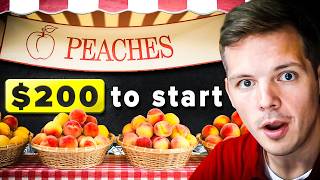
Shannon left her family's casino-software business to apprentice in peach sales, then opened roughly 100 roadside stands in her first summer with $200 startup costs each. She claims 70% margins and $2M in gross sales that year, running a seasonal operation from Memorial Day through Labor Day with mostly cash transactions.
Questions this video answers
100 stands.
Gross sales in excess of $2 million (selling only peaches).
Memorial Day to Labor Day (season roughly).
April (she went around in April to meet orchard families and reserve parts of the harvest).
10 hours per day (e.g., 9–6 or 10–7).
Chapters
We would just negotiate just a real minimum basic rental rate with the convenience store. Put up a peach stand in that convenience store, then go three miles away and put up another one. And they would not cannibalize or compete against each other. You can charge whatever you want. And I was like, holy cow, this is a little ATM machine that I can replicate over and over and over and over again. I opened 100 roadside stands, 100 peach stands, the very first summer. A good roadside stand should profit at minimum.
Welcome to the Kerner office. So I am very excited about this episode and I have no idea how it'll do. We're going to talk about roadside produce stands today because, oh, what an incredible business this is. Costs about $200 to start. You don't need a lease. Almost no regulation, 70% margins. You can buy the fruit directly from the wholesaler with a phone call. And Shannon opened 100 roadside peach stands in her first Sal Summer. We got super nitty gritty and tactical. These stands are much, much more profitable than you think. Please share with a friend. Enjoy. We'll see you next time. Okay, so let's back up and tell me what you do. Tell me about your business.
Okay, so 11 years ago, I am a reporter and a in depth researcher by trade. So I worked for the Forward Star Telegram for a number of years.
I love the Four Star Telegram.
Yeah, I was writing and I got in on the tail end of when it was still super cool and like the old guard was there and so, you know, got to hang out in the newsroom, got to work with the in depth investigative team doing research for those long term stories. My husband at the time so had a baby and, and anyway was staying home and trying to figure out like how to juggle 60, 70 hour weeks with a newborn. So I took time off and then started doing a lot of freelancing and then went to work for the family software company. We had a very large software company. We did casino gaming. So that's really where I learned the ins and out of marketing and the ins and out of consumer economics, consumer behavior. What compels people to purchase things in 2013? 20, yeah, 2013. My dad got very sick. So my dad is the one who founded this big software company. You know, it was quite big for our local area. And anyway, he got brain cancer and he passed away. And at that time I just decided I really want to do something that's more tangible and then like face to face so I can actually see, look somebody in the eyes and understand that I am doing something of value. So a friend of mine for years who had worked with us at the software company had said, you got to come out to South Carolina and see what it's like to sell peaches. Like, it's a roadside stand business. It's all cash based. Everybody's happy, there's no stress. Right. It's not a hard sell. It's the softest sell in the world. So I heard this for a number of years, and I just. It didn't really click with me. But when my dad got sick and passed away and then I went through a divorce and like, all this upheaval and transition, I said, okay, all right, I'm going to come to South Carolina. So I got my son Finn. Finnegan, at the time was 11, and I said, let's go. We're going to South Carolina. So just he and I went and we apprenticed for the entire summer and at roadside stands and, And. And then they were just straight up.
Peach stands and there's multiple stands. You were bouncing between.
Yes, yes. So that very first summer, I'm a little bit insane because I like to, like, go hard and go big in order to consume as many lessons as I can in a short amount of time. So that very first summer that we were there and I was boots on the ground learning, I opened 100 roadside stands, 100 peach stands.
The first summer when you were supposed to just be apprenticing.
Yes, Yes. I decided. I decided I had enough skill and aptitude and experience that. Piece of cake. Piece of cake. I can do this. What I. What I saw. What I saw in this unsophisticated business model was something that was elastic and scalable. And I was like, holy cow, this is a little ATM machine that I can replicate over and over and over and over again. And so that's what I set out to understand that summer. And with him, my mentor, this older gentleman named Rob, he's the OG Peach guy. With his help. And then at the time, I had warehouses. I had a lot of warehouses around different parts of the southern United States. I had, you know, a fleet of trucks, I had crews. And so it was very easy for me to kind of roll into that. That logistically and that kind of launch and. And I absolutely did everything wrong that year. But I learned how to recover quickly, how to pivot and how to make it right. And so that year, I think we did that very first year. Was that 2013? I can't remember, honestly, if it was 2013 or 2014. I think it was 2013, we did gross sales in excess of $2 million selling just peaches. That's it. Cash. It was insane. Insane.
Okay, first of all, why did you have all these trucks and warehouses? Like, where did those.
The casino business. Okay, the casino business. So at that time, I was phasing out of that business. My dad was in hospice and passing away, and I was ready to transition into something else. And I knew once he passed away and, you know, my husband and I were separating, so this was a bit a large family business. And so I knew I needed to do something else because I was not going to do. Right. I was not going to do software sales, a casino gaming without my dad there. So that's why I pivoted into this other business, not knowing really truthfully, I thought it would just be short term. That's what I thought. But after that first year, I realized that this is. This is something that. That can create a legacy. And so my son was 11 at the time, and now we're business partners today. He just turned 22. This is all he's ever done.
Okay, so what month did you go out there? And you were just going to go out there and learn, kind of get it. You knew business clearly, but you were going to learn from this mentor. What month was that?
So I. Peach season in the Southern United States starts roughly Memorial Day. And so it was probably early May, mid May, that. No, no, no, I take that back. My bad. It was April because we were touring. He already had lots of contacts among all the independently owned orchards in South Carolina. And so we went around physically to meet face to face, all the families that own these orchards so that we could reserve, you know, parts of their harvest, because that's kind of how it's done. I knew at that time I was not going to be a small player. We were going to be like, you know, tractor trailer load sort of player. And so when you're that big, you need to go in, reserve the harvest, you know, before it ever starts, is already reserved by other resellers or suppliers or brokers, essentially.
Yeah. How big was the business when you got there in April? What had he been doing it and how long had he been doing it?
He had been doing it for probably five or six years. He had only ever grown it to about, I think, at the height. He had done maybe five stands and he was doing it with his children also. He had two kids, or he still has two kids. And that's the business that they grew up in and learned entrepreneurial skills and Management and you know, all of that kind of financial responsibility, accountability. So he grew it to five stands and I think he said the most he was profiting. So this is probably like 2005 to 2012 roughly. So he was profiting probably about 100 grand. 150 grand.
Just over stands in four, three months.
Three months.
Three months.
When the season starts into May, it will go all the way roughly to Memorial Day. Or sorry, Labor Day. Memorial Day to Labor Day. That's how the season runs.
How long is a workday?
The workday at the stand is 10 hours. We do 10 hours to five hour shifts. So it goes from 10 to seven or nine to six, you know, however.
Okay. And these are mostly like state highways just right along the road.
Yes. So our favorite location and still is today is to co locate inside a very busy convenience store gas station. Not inside, but sorry on. On the premise. So in their parking lot. Because what we found in the casino business. And I ended up working with a lot. That's a whole nother story. But I learned how convenience stores worked. And convenience stores are beautiful because when they're independent and local, their radius is only three to five miles. So a convenience store is only pulling from, from a neighbor, you know, from a radius of three to five miles. And so that was perfect for us because we could put up a peach stand in that convenience store, then go three miles away and put up another one. And they would not cannibalize or compete against each other. So we, we would look for really, really high traffic convenience stores. And, and you know, over the years I got more sophisticated and started using.com Department of Transportation, you know, car counts in order to proactively select locations, which is what I do today. But back then we were just kind of eyeballing it and so that's. And so we would just negotiate just a real minimum basic rental rate with the convenience store. And all we did was throw up a ten by ten ten, you know.
A couple of lifetime table. Six foot table.
Yeah, yeah. A couple of folding tables, some chairs. I mean it was not fancy.
Yeah.
And still to this day, then we did only cash only. Today, especially since COVID we've had to really migrate to accepting cashless payment apps and credit card, debit card.
Okay.
So now we do both.
This gas station unlock was huge because you didn't care if a gas station was four or five miles apart. You're not going to cannibalize yourself because that's just not how consumer behavior works.
Correct. You are exactly correct. Yeah. Somebody who lives in the neighborhood with convenience store A is not going to patronize convenience store B, which is four miles away.
Okay.
Only if it's on their drive, but rarely. So we found that that helped us access the immediate neighborhood. And so then we could just pop up, you know, all over town. And that's how we grew to have a hundred stands. I mean, it was really, logistically, it's a little challenging servicing that many. And you know, some of them are dogs, some of them are winners, and some of them are just like, okay. And so we were constantly. There was an attrition, so we were constantly taking stands down and putting stands up. Over that entire summer, I learned that there were certain thresholds and criteria that would make a stand really profitable. And if I didn't see the results within three weeks, I knew I'll just pull it down and go reset somewhere.
So I have so many questions. All right, so you go in there, you spend like four seconds learning, and then you're like, let's scale this.
Yeah.
Which is what I would have done. Yeah, like, that's for sure what I would have done. And is he is your mentor? Is he cool with that? Is he trust. Trusting of you to do this?
He, he was. We, we were and are actually still just really good friends. And so he was. And he is the. Such a generous person. He plays Santa Claus every year. He physically looks like Santa Claus, and he's just a real generous person. And, and he was getting of an age where it's, it's really intensive labor, you know, unless you have a lot of health. And so he was getting to an age where the, the, the amount of labor, physical labor required was not of interest to him anymore. And so he was willing to just kind of hand over the legacy, the reins, because his kids were out. You know, one of them is a pastor now, the other one is a, a stay at home mom. And so his kids were not interested in that legacy. But me, I was like, hell, yeah. This thing is an ATM machine all day, every day.
How did you find him again?
He worked for our company, the casino gaming company. He came in as a salesman and I learned so many sales techniques from him. Yeah, it was awesome.
Do the sales techniques make a big difference on how well a stand does, or is it more about location?
They do. Location is critical because just like, you know, in prior to social media, visibility is key. So, you know, in the old days, in the, I don't know, 20s, 50s, 70s, motorists would visit, you know, visibly have to see the Stand with their eyeballs. And that's. That's it. That's the only way you knew a stand was there. And so there is this. Unlocked is a very good description. I unlocked this collective memory inside the American psyche, which people, whether or not they've ever been to a roadside stand, there's a collective memory that. That means happiness, that means. That means local. That means excellent quality. There's just this collective memory, and people are primed. This is what's so beautiful about this business. And there are so few businesses, I find, in the US that, that have the same attractive quality, which is the consumer is primed for the transaction before they ever even get into the tent and experience what's there. They just visibly see the image of an apple, the image of a peach or a watermelon, and they see a tent and they know, all right, I'm stopping. And so visibility was the number one criteria for all of the stands that we did, and it's still the number one criteria today. Has to have visibility. It has to have real simple symbolic signage. Signage is key also. So they have to be able. I mean, all you have to do is truly have an image of a peach or watermelon, you know, out on the. Out on the roadway, and that will cause people to turn around. That's how we started today. The. The business model is, for me and my son is really transitioning. So we still do all of the roadside stands now. We're taking this whole concept online. So we are starting to do a lot more online sales. We've started shipping things. We have started doing. We brought our. We're doing vertical integration is what we was. What we're doing. So the only thing we're not going to do ever is farm, because I just don't have the appetite for that. But we started doing our own delivery services. So we. We have subscribers who subscribe to us, and we. We go. We have a fleet of kids that goes out and delivers, you know, farm boxes and produce to our customers. So the online element now has really unlocked a whole new level of following for us. And it's. We've created this almost insatiable, raving fan base online. And it just grows and grows and grows every day. And people track us down all over the metroplex, wherever we are, and they'll just be like, are you at the roadside stand? Are you the roadside stand? You know, because they've seen us on social media. Yeah, they're excited to. They're excited for the experience.
Okay, I want to get back to that, but I still have so many questions. So first of all, like I'm a peach aficionado. I'm a fruit freak. Like I love fruit. I talk about on this podcast all the time. Like I used to save up money as a nine year old selling used golf balls so I could go buy peaches.
Right?
Like I love peaches. It's my number one fruit. What's like. And I've had roadside peaches, they're delicious. I like my peaches hard. Like I like them crunchy and big and like there's a certain point in the season when they're just outrageous. And like I'll literally buy tens of dollars worth of peaches every other day just to keep my supply full. Cuz there's just a unique flavor about em and then it go, it's gone. Where's like I shop at Walmart and Whole Foods sometimes, usually Walmart. Like where. What's different about these peaches? What's. Aren't they all coming from the same farms?
Yes and no. So what happens in agriculture like with these farms, particularly orchards. So there are, there are some orchards in the US who exclusively grow peaches for commercial destinations like grocery stores. Right. There's something that's called in the business a number one. So a number one when it, when it's talking about a fruit or a vegetable means that's the highest quality and it's the prettiest, it's the most visually appealing. And so those number ones, like peaches that are just beautiful and round, no, no marring on the skin, right. No splotchy coloring, those go to the grocery store. And so when an orchard, knowing the commercial destination, picks them early and then they immediately go into cold storage. So they're in deep cold storage and you know, big cold lockers, they're on cold reefer trucks, trains, whatever getting to the destination. And then once they get there, then they're in cold storage. However, longer what we do, we sell the ugly stuff, we sell the number twos. So this is fruit that is not the.










