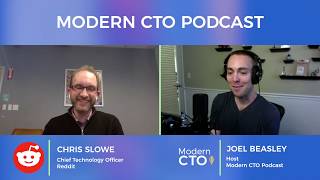
Chris Slowe - CTO at Reddit (Making The Right Decisions)
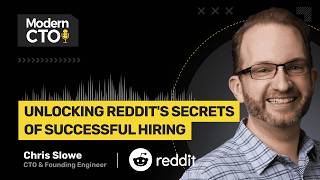
This is a recorded interview with Chris Slowe (CTO of Reddit) covering his personal background (early interest in computers, physics graduate school, startup origins), how he joined and later returned to Reddit (first employee; co-founder connections via Y Combinator), and his evolution into engineering leadership. Major themes: hiring and humility (Dunning–Kruger insight), building and structuring teams as Reddit scaled, balancing CTO-level architecture/strategy with VP Eng execution, developer productivity and monolith-to-service migration, and practical management habits (one-on-ones, written feedback, recognition). The conversation mixes personal anecdotes with actionable leadership advice.
Chapters
What's one huge lesson that you've learned, like, over and over again?
When you're confronted with a new problem, your first response is usually to say, oh, this is totally easy. I know exactly how to solve this. Right. And you are invariably 100% wrong.
You feeling good today?
Yeah. Yeah, no complaints. I just came from this morning was my youngest preschool graduation, which was a delightful experience. He was wearing a tiny little bow tie. It was very cute.
Oh, like a little gentleman.
Exactly. A gentleman in at least in appearance.
How old?
He's five, and he has an older sister who's eight.
Okay, I got one that's two and three and then one that's three months.
Okay. You're just at the start of things, so good luck. And there is a light at the end of the tunnel. Yes.
Thank you. Yep. I was up last night, like, two in the morning.
There is a time after diapers. I promise.
I'm looking forward to that. Cheers to that. So the oldest is a girl and then a boy. Yeah, that's the same. That's what we got.
Does your oldest obsessive. Is she in the obsessively mothering phase or what's the. Which way did she go?
She's dancing.
He's dancing.
She doesn't even care. She's like. My wife texts me videos, like, every day because all she does is run around the house and like, here's today.
Right? Check this out.
So, come on. Said grabs her foot and like.
Yep. Oh, man. See, that's the difference. Mine are three years apart, and so I think that. I think that extra year, you know, she was actually, like, aware that she had a brother other. And so it's been like this. It's been a thing ever since then. But that's adorable. Yeah.
Well, then you can have one, hold the bottle for the other.
Right? That's. That's the dream. It never worked out, but.
Oh, man. So are you out in San Francisco?
Yep. Guilty as charged. Nice. Nice. Where.
Where, like, what streets?
We are in the Tenderloin. So we're. We're on Taylor. No, Farrell.
Okay, cool. Yeah. For some reason, being in technology, I just happen to be in San Francisco a lot.
Where are you looking normally or where are you now?
Florida.
Okay. Yeah.
Yeah. But so many things happen out there, and so I like. I like it. The other last time I was out there, I. I ran from, like. I can't remember the exact area, but I ran the bridge, like, all the way down, and then to the bridge. I kept getting closer and closer and closer to the bridge. And, and my, my 30 minute run turned into like a three hour thing.
It's deceptively, it's deceptively far away. Like, it's actually like, if you're, if you start off in the marina and you're running along the coast, you're like, oh, I can totally run to the bridge. And it's like about a three mile stretch just to get there.
Yep. I was in a hotel and then I was like, I think if I go down that street, you could actually see the water. And then I get to this observation area. I'm like, oh, that looks like a 30 minute run over there. And it was like an hour later. And then I'm like, all right, now I'm at the bridge, I gotta go over it. I get all the way over it, right?
Yep, yep, yep.
And. And then there's this other area, like vending area, sightseeing area. And so I was like, all right, my meeting, I was speaking at William Sonoma, which is down there. And so I was like, all right, I gotta, I gotta give a talk in two hours. I gotta be back. I need to Uber back. So I flip open Uber, but where I am and the way the roads are, nobody, like, Uber forces them to like loop around the bridge and pay a toll to come get me. So every ride just kept canceling on me.
Ah, geez. Yeah, yeah, I know.
So then I'm like, all right, well, there's really no other place to go because most people have cars that get here. And so I was like, all right, maybe if I just run another mile that way down the road, it'll allow me to get an Uber. And it did. And it was. I made it to the talk on time, but it was very scary and my feet hurt a lot after that day.
Yeah, if you go down that, I think I know which path you went down. And there's actually a children's museum down there. Going back to. Kids actually live. I live in Marin on the north side. And so that area spent a lot of time and especially with two kids.
Yeah, yeah. Because you can't be like in the city city. Right.
With the kids.
You don't want to be in the city.
We lasted until we had the two kids in a two bedroom apartment situation, at which point things just, Things just fell apart rapidly.
Yeah, that's. You got to let them run outside too. Right? You can't do that when there's like people on the sidewalk. So ctr, Reddit, very cool. Right. But you didn't Start there. Like you didn't just wake up one day and your CTO read it. Like, where did you start? Where did you. Speaking of kids, right? When did you first fall in love with technology? Was it video games, Computers?
Oh boy. So I can, if you want to go way back. So I think so I am of a slightly older vintage. I'm 40, which means actually that makes me late. Gen X, I think technically speaking, I had my first video game system was an Atari 5200, which I got when I was about maybe 6 or 7, which was a heck of a lot of fun. And my first exposure to computer wasn't until I was in high school. So we had a 486 when I was 14 that I really just kind of fell in love with and started immediately trying to figure out how to program against it. I think at the time I was writing in Cubasic and trying to write very simple video games. The whole time though, like, I was actually much more of a science nerd than a tech nerd. I mean this is like the early 90s. And so I originally went to. I went to school actually, not for computer science, but for physics. Did physics and math for a while and actually got involved in the tech scene when I was in my fourth year in grad school and went through a pretty standard experimental degree burnout that happens right around that time. Grad school and experimental science is this discovery that you spend maybe if you're lucky, 3 to 4% of your time doing actual science and then the rest of your time doing everything else. So I spent like a third of my time in a machine shop building stuff. I spent a third of my time on a computer analyzing some results that I had or building models. And I spent a third of my time doing all the other miscellaneous stuff involved in studying experiments. Nice thing is it was actually like nerd finishing schools. So I can, I can weld. I know how to pl. I know how to like do plumbing. I used to legitimately walk around non ironically with a Leatherman on my belt for most of my time in grad school for the full seven years. Because at any given time there was a potential of me having to like hold something together, live while it was falling apart and having having a pair of pliers available at all times really helpful. So to make a long story short, what ended up happening was around that time like 2004, 2005, I had a friend of mine who was also a scientist pitched me on this idea. I will use modern words. He pitched me on what Turned out to be a startup, but at the time just seemed like, hey, you know what's really annoying? It's really hard to find stuff on my hard drive. And this is like, you know, this is at a time when the state of the art of desktop search was like this, that. That dog that would come up on Windows XP and ask you what you were looking for.
Not the paperclip dude. You switched from clippy to the dog.
I just remember that being one of the stock ones that came up originally. Those were originally, I think Microsoft Bob was the origin of it, that they kind of ported into being the help system. And I just remember thinking like, yeah, this is gonna be a simple solution for this. And like most, like most things, the first mistake is always that initial ignorance of not knowing how hard the problem really is. It's like, oh, this is like, I'm just going to write a thing that solves the searches for files on my computer that turned into a startup and then actually turned out into me getting into the first Y Combinator batch in summer of 05. So we ended up pitching this. Me and my co founder pitched this idea of solving desktop search. And this is pre Spotlight, this is pre Google Desktop, and pre everything being on the cloud, on the web. Anyway. And so that was kind of my origin story. I'm getting into tech. It was totally circuitous. So, I mean, I ended up actually finishing my degree and like continuing down some of the science path. But I think part of the discovery of doing a startup at that point was that I was able to find that the outlet that I liked in academia was this kind of there's a problem that's hard and if I break it down into pieces, I can solve it and then have something to show at the end and like, achieve something and like further humanity. Right. And I think that tech, the roots of tech are very much in the same thing, which is that there's a set of fundamental problems. There are things that we're good at, and there are things that computers are good at. And if we can make the computers do our work for us, our lives can get better. And that, that was really, I think, the root of the, of the journey.
Now I'm one of those people that whenever I hear something I don't understand, I have to ask about it.
Yeah, sure.
Tell me about that word you use. Circuitous.
Oh, circuitous. Just like the circuitous is like not taking the direct path, but taking the long meandering path and ending up in the same place. Like, you know, oh, man, yeah.
Sounds like a lot of decisions in my life.
You know, the nice thing about getting older is you get a chance to have some hindsight and discover like, how many things in your life are just the side effect of some random event that happens, right? It's like the John Lennon quote, I think the Beatle, not the, not the, not the communist who. I think he said that what life is, life is what happens when you're making plans. And I think that's sort of true here. It's like, you know, I ended up getting involved in the root. The root of me getting involved in startups was legitimately, you know, the way that. The way my original startup kicked off was I happened to randomly go to a talk while at university or in grad school, and I happened to run into this person, Zack Stone, who ended up being my co founder. We knew each other, we weren't friends at that point, and we ended up striking up a conversation. And it was one of those, like that random conversation turned into effectively the catalyst for my entire career, because otherwise I was kind of like, not necessarily dead set on being an academic for my whole life, but at least was on that, on that trajectory.
And so, like today, Reddit is essentially a household name, right? But like, it's not just a clear, perfect, beautiful path from let's co found Reddit to it being the behemoth it is today. Like, tell me a little bit about how your role evolved, like what you learned. You were, I guess, were you ever a team lead or anything like that prior to being the CTO of Reddit? Like, tell me about that.
Oh, yeah, no, it's been a long, it's been a long journey. So the, the other, the rest of the story is my start at Reddit was. I was Reddit's first employee and so I got involved with. So you know, Reddit was founded by Steve Huffman and Alexis OHANIAN in summer of 05. And they, you know, they were also in the first recombinator batch, which is how I met them in the first place. And so another one of those kind of totally random events that changed my life was, yeah, at the end of the summer, my startup failed and I had an apartment with two free bedrooms and I was friends with Steven, Alexis, and so they moved in. And then two months later I was working on Reddit. And you know, at that point, that was very much the, like, I mean, it was the. In a, in a crappy Somerville apartment version of the bunch of nerds in a garage or in a Basement just kind of working on something. Like we had a. We had this office that. Where the office, our office was our living room and we were in this like third story walk up in Somerville, Mass. And the floor in the office was nothing even close to level. Like if anything it was actually kind of V shaped. So if you let go, if you were sitting in a chair with wheels and you let go of one of the desks, you would just fall towards the middle of the room. Like it was, it was really, really janky. And so it was really. The startup was very scrappy. The whole experience was, you know, learning how to develop a functioning web app, live while you're doing it. And so that was much of the experience for the first like, you know, five years was very, very small team. We got acquired originally by Connie Nast in 06 and kind of got pulled in to that company and just kind of were mostly left to our own devices to kind of like, you know, continue to iterate the product. And it was really just like we were doing what we thought was best, not really knowing what was right or what was wrong or how to actually do it. So for me the path to CTO was actually much later. So you know, after, after four years working at Reddit, post acquired. So Steve Alexis left in 09 to go do other things. I left in 10 and ended up joining back up with Steve to work on another startup. And that was where we did a startup called Hipmunk, which is a travel startup.
What, the hip Chipmunk? Yeah, yeah, I know, the Hitmonk.
Okay, well that was, that was, that was. Steve was CTO at that company. And, and so I kind of got, I kind of jumped back over to work with him and that was where we actually got a chance to do all the other things that a company needs to do to become a successful company. Like so Reddit was always kind of. Reddit was always kind of in a state where it was very small staff. We never really had to do things like grow it. The traffic was totally organic and it always grew. And in fact one of those pitfalls we had with starting Hipmunk was we just had this like pre, this like preconceived notion that, you know, the way that you launch a product is you just kind of put it on the web and just people just come because like that's what happens. Like I don't know what I'm talking about. There's a lot marketing and launching, like what just you just put it up. And then we discovered like really Quickly that, oh, no, that's not a normal behavior. And so then you kind of learn really quickly how magical Reddit Reddit is as an experience. But what Reddit was lacking was like, we never built the actual company around Reddit. We got acquired as a very early startup and we were always small. And so Hipmunk was great because it gave us an opportunity to kind of learn all the rest of it, right? Like how to grow and scale a team, how to actually, like, hire good managers, how to be a good manager, you know, the importance of getting good talent. When is it important to have an HR person? You know, why. What exactly. What are these PMs actually do? Why do I care? Oh, and oh, designers. You mean somebody makes things look good for you without you having to figure it out yourself? That's just wonderful.
I know.
And so it was really enjoyable, enlightening. And we grew that company up to about 100 employees. And then, so at that point, I was doing engineering management and had gotten. I was running a back end. I was basically running the back end team there and then switched over to decided that, you know, Reddit was going through some tough times in middle 15 and kind of came back in early 16 to kind of, you know, I'll say I thought I had mentally divorced myself from the company in a lot of ways in the product, but then I discovered that actually, no, I felt like a parent still, like, want to make sure things were. Things were kind of okay. So came back originally was doing IC work and then just started building teams. Was the. Was what ended up happening at that point.
So we. I'm curious about the building teams part.
Right? Yeah.
So one of the things that I've found to be true is that your vibe attracts your tribe, right? Like the people who you are, like, you'll attract as you get this mass, you'll start attracting other people that are similar to that. Was that true for you as you started growing your teams?
A little bit. So I think what happened initially was, so the state of Reddit in 2015, 2016, was still very small, given its reach. Right. So company at that point had 250 million monthly active users, and the total size was about, I want to say, 60 or 70 employees, which means engineering was only about 30. Right. So very, very small team. And that was basically split down the middle of kind of like half back end, half front end, a little bit of multiple in there mixed in. So just enough of a team to kind of be able to keep the ship running, but not really to evolve the product. And so the original mission and part of the job up front was actually kind of turn the company into a functioning business and turn into an actual working company. And the first thing to do there is hiring, like actually getting people in, working through the fact that there was a lot of stagnation in the meantime. There's a lot of things that hadn't really been developed. It was actually kind of. It was a little funny coming back for me especially because I think for Steve as well, because, you know, we had spent five years like building another company and learning a bunch of things. And then coming back to Reddit was a little bit like coming back to like this parallel universe where they chosen a different path. Like, we're like, oh my goodness, they never invented that here, figure out how to apply these learned I come bring you fire. And so the initial version of that was starting to structure into engineering teams as opposed to being kind of ad hoc groups. We had a lot of tech leads and not a lot of like actual managers. And we had a whole bunch of very clearly identifiable gaps. And so my original role was like I said, I was doing IC work. And then I started to basically like quickly I was talking to our CTO at the time, Marty Wiener had. I kind of gave him my list of things we need to get built and he's like, great, why don't you go start one of those teams? And so I started. The first time I started when back was this team that does all of our kind of site integrity work, has a great name, anti Evil. Their job is to build tools to make sure that users remain safe and that the site has a certain amount of integrity to it. Very, very important job on a social platform like Reddit. And so really just kind of like carved out a couple engineers and started building that team. And then it quickly turned into just. I started with, through no fault of my own, accumulating teams. So I think my, you know, whatever the opposite of a land grab is, it was just like that. It was like, okay, it's going right over there. So here Chris have another team. So I think I kind of quickly assumed the role of director of most of our backend teams platform. In the meantime, we'd also hired a vpe. It's great guy by the name of Nick Caldwell, formers Microsoft. He came in and also helped us level up in terms of figuring out what engineering Org structure should look like when you have eventually 100 plus engineers just starting to get some structure in place. And so it took about, I think I started as CTO two years ago now. So it was a very rapid ramp up over the course of a year and then all of a sudden discovering that I am now in charge of the ship, which is existentially terrifying, but also very gratifying.
On that climb. What are some of the biggest takeaways? The biggest. Or we could just pick one. What's one huge lesson that you've learned over and over again?
Oh, I mean, I think that the real importance of hiring and like finding the right people, you know, I think that, you know, there's a couple, a couple of big lessons there. You know, one is like we've, we've always, we've always striven to make sure that we hire people who are passionate and who also have a certain amount of humility with the work. And I find that just from, just from like personal experience that, you know, there's this thing called the. Actually there's a well known effect called the Dunning Kruger effect that I kind of mention before, but I will bring up now. The dining Kruger effect is that when you're confronted with a new problem, your first response is usually to say, oh, this is totally easy, I know exactly how to solve this, right? And you are invariably 100% wrong. Like you invariably. So if you look at, if you look at your level of confidence as a function of time, you're immediately very confident. And then you discover how quickly that you're incorrect and you end up plummeting into this chasm of despair is usually is what's called McGrath. So there's like the peak is called Mount Stupid. And then after, and then you spend the rest of your career climbing back up and you never achieve the level of confidence you had in that first like few minutes of like, oh, this is totally easy because you kind of, the more you know, the more you know and the more you know your own gaps. And so I find that that kind of one way to short circuit that is if you kind of, if you've been through that experience enough, you realize that most things are not actually easy and that incurs a certain amount of like global humility in your approach. Of like this will be hard, but I will deal with it as the upfront thing. And so I find that that is definitely an important characteristic to be able to kind of set out for early on. I also think it's a function, a little bit of stage of the company is important. Right? Like having a bunch of very determined hotshot people is extremely valuable at the startup stage of the company. And it can be very, very difficult at a larger stage company where everyone has much more specific roles. Right. You know, if I've got, if I've got a 10 person engineering team, everyone has to know what they're doing and has to be self driven and there's no way, impossible for me to like, you know, they will work it, work it out. When you get up to 100 people, you have to have a lot more structure in place just because you don't want people stepping on each other's toes. And you need to make sure that there is clear coordination and clear communication as opposed to, oh, I don't have to worry about it because I know, you know, she's working on it over there. I might not even know who she is. Like there's an entire team that's in charge of something that might be out of my control. So that's been a big one. And I think that the other part of that is really when it comes to mentoring and making sure that people are able to progress in their careers, it's much more worth everyone's time. If you're working to improve the people who you have that are already really good as opposed to trying to salvage a situation that went wrong because you hired incorrectly or because there wasn't a fit up front.
Yeah, that's investing in your people and turbocharging the existing people who are already running is super, super valuable use of time. So as a CTO currently, if you were to make a pie chart of the top three ways that you spend your time, what would that look like?
Well, I should mention right now that I'm currently dual wielding as CTO and VP Eng. So I probably have two distinct pie charts.
Let's start with the CTO pie chart.
The CTO pie chart, I think that most of the. So that the CTO role at Reddit is primarily one of being kind of a chief architect. And so the goal is I have a small group office of cto, group of four engineers who are kind of like company level architects, very senior folks. And their job is usually described, I describe it usually as extreme tactics and extreme strategy. So either their job is to like drop in and like add a whole bunch of help and firepower to something that's falling apart or it's on fire, or start to make sure that we have a plan for making sure that we don't have a fire six months from now. I'd say the current intermix that I have for that work is probably still about 80% firefighting and you know, 20% making sure we don't have fires in the first place. And you know, my job is to kind of start to shift that function up towards strategy to make sure that we really do have like a long term plan strategy. Another, another kind of important bit there is that, you know, as the company gets bigger, one of the natural states of affairs is the, it gets a little bit more siloed. Everyone has their kind of role, but we're a single company and there has to be some way to connect together all the initiatives into an overall goal and to make sure there's a place to land work that is kind of pan engineering. And so that work ends up landing kind of like either up on my plate or at least up on October's plate to kind of like figure out. So that would be my, like probably the biggest part of the CTO role for the VP end role. I mean the clear cuts there are execution, you know, figuring out how to take the product plan and the engineering plan and turn them into the plan and make them into something that is actually like actually executed and trackable. Wrangling OKR is making sure that people have clear goals, you know, expectation setting, management. Of course, you know, I have a, I have a team of eight directors who are keeping the, keeping the ship afloat. I think the, you know, the fun and terrifying part about being at both VPE and CTO is that, you know, a natural state of affairs. I think it's not as extreme as for being CEO, but the natural state of affairs is that I want to make sure that everyone who reports into me is far better at their job than I would ever be. Right. Like they, they need to be just great at their, at their thing. And so my job is to facilitate them being as productive and as, as enabled as possible and to kind of get out of their way or provide air cover. I think the joke I usually bring up is that, you know, all orgs end up naturally being shaped like a pyramid kind of in a hierarchy. I think the right way to set that up is to actually have the, have the point on the bottom. So you kind of want to be there to kind of support everyone who's above you, make sure they can kind of be their best.
I like that we'll have you teach a class called like the Upside Down Pyramid.
For a book or potentially a band. I'm not really sure which one I want to go with.
Yeah, I like that. Well, talking about management and engineering, I was talking with the CIO of Atlassian. You're familiar with them, right?
Yep.
And we were talking about engineering performance management and this concept like sales has metrics and they look at like they're very metric driven now. Right. With the softwares, marketing is very metric driven with cost to acquire things. And then they were looking for like where are the metrics in engineering? And I came across this company, this whole, this like new category, sort of like an emerging category called like engineering performance management. Have you heard about this yet?
I've seen some companies that are getting into this. Like I think the ones that come to mind are usually like tools that write on top of GitHub or tools that write on top of like you know, Slack and try to do a little bit of like, I don't, I can't not say the word creepily. Like creepily. You know, kind of keep track of like everything that's going on and figure out where there's inefficiencies in the process. But I'm curious to hear some of the ones you've seen.
Yeah, so I had this guy on my show from, he did Appcelerator like previously, remember that company? And now he's doing this thing called Pinpoint and very, very cool. Him and his co founder have had this amazing relationship for the past 19 years which is really cool. To do multiple companies with the Same person over 19 years is really interesting because we're always talking about trust and co founders and so I was like this is a picture perfect relationship. So I was actually interested after we spoke and so I was like, hey, let's see what it actually does. After the interview he gave me one of his co founder and then like he did a product demo with me so I could see it. Dude, it is so like this stuff is really cool. I can't even describe all of it. I'm not even going to try. But all I'm saying is that that category of software is definitely something that I believe is going to. There's going to be like a hundred of those companies right now. I think there's only like a handful, but I believe in the next three or four years it'll be like 100 of them.
I mean, you know, it's something that it's something that I definitely struggle with or at least as an org we struggle with a little bit because you know, it is a little bit harder to define engineering productivity if only from the standpoint of like I think what's underestimated for engineering work is that it is ultimately a creative endeavor. Right. Like you can't Just say like work harder or ship more lines of code or like have a straightforward. You know, there's an old, I mean there's an old story about, I always forget, I'm terrible with names in general and I'm going to butcher this story, but I'll give it anyway. There's a story about how like early on, I believe it was Apple used to measure productivity just by straight up like lines shift. Right. It was like a very clear metric. And you know, it's like very early in their, in their career like a company and they, they hired, they hired this guy who was, who knew, let's just say he knew what he was doing, he's very good at his job and his first commitment was like a negative 10,000 line plus 200 line commit. And it was just this demonstration of like, oh, actually, okay, so this guy just like actually has therefore negative productivity by our measurement, even though he effectively made this thing faster and more efficient. And so I think that the one way we're trying to actually solve some of this is we're just looking at sort of things like almost developer happiness is the first thing to touch. Right. Like do developers themselves feel that they're being productive or are they being bottlenecked on things? So, you know, good old fashioned survey of like name things that you were stuck on or like what where have you, where do you think we could do have improvements. And that at least has helped with facilitating starting to find like. Yeah, we know that, we know that our developer setup is not optimal right now. Right. But also identifying that. Oh yeah, it's actually really easy for a developer to break the build on our developer virtual machine and then find out like, okay, so if it breaks the build, that means every engineer in the company has to spend an hour like fixing their broken build. Well, that's a lot of time that's wasted when you average, when you add up, you know that's an entire engineer month at our scale. Yeah. And that only gets worse. And so being cognizant of that, that kind of level for us I think is the starting point, I think.
Sounds like a project for your super team.
Yeah, that'd be like, oh man, if I had, if I had more capacity for my super team, I should rebrand them as. Oh, I should rebrand them as super team. That would be a good idea. Does that, Were they capes for that? I think they probably get capes.
Either capes or snuggies.
Masks.
Masks, Capes and snuggies. Just let them pick.
Yep.
Every battle, they win, they get a new accessory.
What about, I mean, maybe like a sash with merit badges that they can accumulate. I think that would be a good way to go. Like, almost like, you know, military regalia to make it feel very. Well, military might be too extreme, but we'll figure something out.
But it also gives more flexibility when, like a Snuggie would confine you a little bit, you know, so you want, you want the ability to move because you have to run. You have to run to the emergency. I assume that that's what they do. They run with their laptops to the location.
Yes, I know. Actually, we have, we have a. We have fireman's poles and parachutes. It's a very, very dramatic. We had flash powder for a while, but it was a bit of a fire hazard.
Yeah. And somebody. And Bob had allergies, so don't get.
Me, don't get me started on Bob. Oh, man, this is good.
No, I really like you. You're a pretty great person, man.
Thank you very much.
You never know when you're going to these interviews, right?
I think, you know, don't forget one of the features of the, of the job is having to spend a lot of time on Reddit. And I always like to say that I'm actually. One of the side effects of being on Reddit for so long is I'm actually much funnier in text form. So I apologize if this is the version you get.
It's adequate.
Okay.
Do you do. Let's go back. Let's. Let's get. Let's get the audience some love. So we get people to write us like, right. And ask us questions. And then I ask them to the guest. First question, how do you do one on ones? What's like the cadence? Like, how do you approach that?
Okay, so I think for having. Having had a lot of different hats over the last five years, it varies a little bit by level, but I'd say that one on ones, it depends on the level of person you're kind of doing the one on one with. I think back when I was an engineering manager, my general rule of thumb was I would do bi. Weeklies with all of my kind of established people and then weeklies with anyone who was like, very junior or like, new to the team until there was like a good notion of a cadence. Generally. One change I've made over the years has been I've gotten much more into being a little bit of an agenda, like, you know, required. Like, doc, I'd like having a place to Refer to for what we're going to talk about and if only because it enforces a certain amount of structure on the discussion. You know, it means you can do things like say like every four weeks we're going to talk about your professional development, which is something that I think is easy to follow by the wayside otherwise. It also gives you a chance to take what can be a very unstructured discussion and turn it into actionable things that you can do before the next meeting or as like ways to make progress. And so I've gotten very much into that approach of like let's have a doc. The kind of the good, the bad and just miscellaneous topics. And I think you know, as like with more senior talents and like with directors there's generally sections also involves like okrs specifically in the one on one doc. Not because okr, not okrs necessarily for their org but for them and their org kind of combined like what do they want to achieve? And then it provides an outlet for checking in. And so I think that. And the last bit is actually over the last few years I've definitely gotten very much into making sure there's an outlet for feedback and for candid feedback as part of a one on one and making sure that it's as bi directional as possible is important. I would say that I've definitely learned that written feedback, though harder, is also generally more effective. And the structure that seems to work for me is when it's come up is like if you have it as part of the one on one then there's always an outlet for it in the doc and it means you have to kind of collect your thoughts and get it down first. It also means there's less room for ambiguity as long as the purpose is to inform the other person and to have the chance to talk about it live. Right. So it's not like I'm going to send you an email with a bunch of feedback and then I hope you do the best of it. It's like no, we're going to sit in this meeting and we're going to read the feedback and we'll talk about it and try to figure out a solution to it. I think that's had a very, you know, it's had a little bit, a little bit of structure to meetings but at the same time the structure is generally good because it means that there's like an outlet for that kind of information. I think, you know, I'm sure that one of the things you hear the most is like just getting candid Feedback is just like, the hardest, most valuable thing you can get. And it kind of comes back to the humility part. Like, if you're not a little humble, you're not willing to accept feedback, then you're not going to really internalize it or progress from it. The person is giving you a gift by giving you feedback. And maybe it's like, maybe the gift is we have poor communication and we have things to talk about. Or maybe the gift is like, hey, you're actually doing a great job. Thank you for being so good at your job. It doesn't have to be always constructive feedback. It is actually good to hear stuff that's going. Right.
Yeah, that's. I actually had one of those today. I was giving feedback that we. You know how you told me about designers, Right. Well, we had a designer start about three weeks ago, Pam, and she's, like, straight killing it. Like, she's doing so good. And I did that thing where, like, I had an idea and then I had another idea, and she didn't jump and, like, adjust and do the thing that I was most excited about. She finished her work and prioritized it herself. And I was like, just, thank you. Like, thank you so much, because that means you can self organize and I can just keep feeding you stuff and you can organize it, and I don't have to worry about, like, having a special Pam, don't tell her this now list, and all this stuff. And yeah, so I was like, that's amazing. I'm super glad that you have that skill. And so that was my feedback with her today.
Yeah. Yeah. It's really easy to, like, just kind of dwell on the problems and not really take the wins. Like, you do have to actually recognize people for the good stuff they do. And it's kind of an important part.
Right. Recognition makes people feel good. And it's true. And when it's true and you have an opportunity to allow someone to feel good, like, do it, and it goes back.
It also goes back for me to, like, the career development question and the stuff around making sure that you're actually fostering people who are good at their job. Right. You know, somebody actually is legitimately killing it, and you can help them to kill even more. And that's a way to do it is like, yes, you are doing the right thing. Continue doing the right thing. And that's speaking as somebody with a huge amount of imposter syndrome. Oh, my God.
I don't even know what to say right now. See, at the end of the day, I'M like, I'm all excited.
I've got a couple extra hours on you. It's only 2 o' clock here, so.
It'S only 2 o'. Clock.
Okay.
Next, next question. I don't even know how to do it. I'll just text it to you. You make a lot of big decisions, right? Or we'll just say that you do. And yeah, you're a leader, you're a senior leader at a, at a enterprise. And so decisions, things that come up. What advice do you have in the decision making space? Like what's some of your good nuggets of knowledge? There's.
Well, I'd like to go back to my statement before about that. You know, one of the things about being a senior leader is that ideally the people who work for you are even better at their job than you would be. Right. And I think that in that case, part of the role of being a leader is actually to get out of the way of people and let them do their job. I think it kind of comes back to you're talking about your designer and her ability to prioritize. Right. Like if I am doing too much micromanagement of, of anyone on my team, something is pathologically wrong. Right. I mean, I. The whole purpose of having a team to start with and the fact that we're not a 10 person startup is because we want to have a whole bunch of people with different perspectives and with different ideas, be able to organize and like solve problems. And so if anything, I find that one of the, one of the, one of the roles of being the kind of leader in a room when there's a discussion or meeting or debate that oftentimes your people know what the answer is. They just need somebody to tell them that like it's okay for them to do that. Or at least they, you know, they just need to talk it out and convince themselves they're right and convince somebody else in the process. And so just kind of being there, like, I usually joke, it's like a rubber stamp for me. It's like, just go do it. It's not. Because I'm just saying that I don't have an opinion in the matter. It's. I'm saying that your opinion is probably more from mine and like, why are we even talking like, go do it. And of course it varies a lot by, it varies by experience, it varies by level. I mean, like, you know, I have the luxury of having a bunch of very senior, very senior leadership also reporting to me. I think when it comes down to, you know, rank and file. When you're talking about ICs and EMS, it's the same kind of direction that happens. People become experts at their, at their job, or they should be allowed to be experts at their job and therefore be allowed to make decisions and not feel like they're going to be countermanded. And that's not to say that we're always going to say yes to everything or that I always say yes to things that are presented to me. Sometimes things are timed wrong or have to be delayed or it comes back to prioritization, like, yeah, this sounds like a really good idea. Is it like a now kind of idea? Or like, you know, how does it compare to these other 30 things that you need to do? And if you tell me it's number one, then we can nab that debate, then, yeah, let's go do it. If it ends up being number 29, which usually is the case, then usually that discussion helps to foster the reasoning behind the why we're not doing it now or why we're not doing it at all in some cases.
What's like the biggest priorities on your mind right now?
Oh, man. So I think the big one for me right now is so last year we did a major desktop overhaul for the website. It was a quiet, very quiet thing. Nothing really happened from it. It's Reddit. Nothing ever happens on Reddit. And that went really well overall. It took a good year in the making and it took a good year and changed to kind of roll it up gradually to make sure that we listened and, and provided outlets for feedback and encouraged. Speaking of feedback, we're doing the same right now in our backend. Our backend is mostly a 10 year old now monolith that has a lot of my fingerprints all over it. And so I am actively working to get all of my blame off of the code base. I'd say, you know, we're doing the kind of standard things, we're moving to services where, like, we're starting to build out a more modern stack while the whole thing is flying and making sure we don't break anything in the process. So it's a very exciting and delightful and terrifying experience. And that actually goes back a little bit to productivity on our side. You know, a monolith is a great thing and it's a stable thing. It's not a great thing when you have 160 engineers who need to work on things on it.
When you said you're gonna bring it back, I thought you're Gonna bring back the kids. Because you said, terrifying. I was like, is it gonna bring all the way back to the beginning?
I was like, this is great.
I was like, you're wrapping up the show for me, man. This is awesome. Okay, I gotta run a hypothetical past you.
Yeah, go for it.
All right, you're in San Francisco, right? You're driving down the street, right?
Yeah.
Not. Not in an interview, not in a podcast. You're driving down the street and at the red light next to you, guess who. Who pulls up next to you?
Who?
Elon Musk. Oh, yeah. You like this? Okay. He's like. Rolls down the window. It's like, what up? And he's like, I just built this new invention. You want to come check it out? Follow me to my house. So you're like, what the heck?
Let's follow Elon Musk as Elon does, because. Yeah, yeah, yeah.
He regularly does this, by the way.
Yeah, yeah.
He's known for this. Yeah, yeah. And so you follow him. You're at his house, and he shows you this, and he takes you in this room. He's got a time machine. But here's the deal. You go into the time machine, and you can only go back to Harvard, right? Like, where you were studying. You're welding, right? You're welding, you're studying. You've got the belt on the pliers. You're welding at Harvard. You can go back to this exact moment and you can gently whisper some advice into your ear. And that's it.
That's it.
Just like this little whisper of advice. What would it be?
Oh, that's a tough one. So this is going to totally wreck my. Well, so going back to my career feels like it was a series of fortuitous events that kind of accumulated into a result. Like, how much of the card castle am I destroying by whispering something myself? I mean, my joke answer would be, probably buy Bitcoin in 2009, right? I mean, like, you know, straight up, like, this will fix everything, I think. Oh, God, that's a tough one. I think. I think a lot of the stuff that's been most valuable has been by experience. And, like, the actual. The actual. Maybe that's the. Maybe it's. The advice is that the journey is the kind of the point, right? Like, the destination is less important than the journey. Because I think that especially getting in my own head in grad school, I was all about like, yeah, if I get my degree, then I get my degree and I can start working on my postdoc. And then I'll work on like getting a per professorship and like milestones kind of lay out for yourself, when in actuality, life's a heck of a lot more complicated than a bunch of milestones that you kind of accumulate for yourself. So I'll stick with that one. I'll say it's about the journey, not the, not the destination.
I love it and it's good and it's true, right? It's a great piece. But you did bring up a question. You did bring up something in my mind. It's like, is the. Here's the question. I'm going to try to form it right now. Is the journey more special? Having a milestone, having a destination?
I mean, I think, you know, it's funny because actually this is something that we do think a lot about as a company right now, which is, you know, we talk a lot about north stars in the company and like, goals and the. I'd say, to answer your question directly, yes, I think that the having a destination in mind is always important because otherwise, you know, like, what's kind of, what is the point? And it kind of comes back to one thing we bring up a lot here has been the. This kind of potentially totally false anecdote about NASA in the 60s where, you know, all of NASA was set up in the 60s to be about putting a man on the moon. And they'd set up their culture in such a way where if you asked literally anybody at NASA, like down to the janitors who are playing the floor are like, what is your, what is your job? What are you doing here? They would respond, I am working to put a man on the moon. And they were able to connect their story up to that goal. Like, I think that that part is important. I think that the learning for me is that the result might not be to achieve that goal. But that doesn't mean that the original goal was like, false, right? Like sometimes, sometimes a goal is a means to a better goal, and you just don't have the insight to figure out that you're going in the wrong direction. I like it.
What big mission do you have for Reddit and we don't have. We could edit this part out because we already had the great answer. We already had the great answer at the end about the advice you give your past self. The interview's over. But I just want to know what's the big thing at Reddit?
I mean, I think we're always just trying to make, honestly just continue to grow the platform and make it better. It's A really. I mean, it's a mundane response, but, like, honestly, I think for one of our. One of our biggest learnings over. Over the time here, you know, like, Reddit is this wonderful piece now that's. That's almost 14 years old. Like, it'll be at least 14 years old this month. It's gone from being a small posting board, effectively, into a giant collection of networked communities. Right. And one of the lessons we've learned over the years is that fundamentally, our users are always more creative than we are. And so our job is to, like, build things and build tools that allow our users to express creativity in ways that surprise and delight us, and that helps kind of foster the platform. So, you know, we're. I mean, for me, I just want to continue to see that happen. I think that, you know, being a technologist, I have at my disposal the tools needed to build those tools and build that technology that makes it work. Yeah.
So, like, build communities or build communities. Serve the community. I mean, that's essentially what you guys do. You serve the Internet. Like you're. You're a portal. You're a filter for the Internet.
Yeah. I think we've tried to figure out exactly the best way to describe what Reddit is, and I think the one that we've been settling on recently has been Reddit's a city. Like, it's a. It's a giant, giant city that has neighborhoods, and the neighborhoods all have their own flavor. And as a city, it's going to have every aspect of humanity, so you're going to see the good, the bad. And the point of a city is that you do get a chance to see the good and the bad. Right. There's nothing. Everything's out in the open. Nothing's hidden.
There's your North Star. What are you doing? You go up to Janet Reddit, what are you doing? They say, we're building the city.
I like that a lot, actually. That's a good way to build the city. Build the city. That's it.
That's what you guys are doing?
Yeah.
Right?
Yeah. That's really good, actually.
I'll send you a bill. Marketing and advertising. Branding. Sorry. Oh, man.
Dude, we did it.
Chris.
We made a podcast. That was fun.
Awesome, dude, this was fantastic. Thank you so much and your team and everything for putting it all together. Jake and Chloe, they're gonna let you know when we're gonna release the episode, and we'll put clips and I'll connect with you on LinkedIn so we can post and be like, look at this awesome professional advice from Chris.
Sounds great.
Awesome, man. Have a fantastic day. And the next time I'm out in sf, I'll let you know and maybe we can hang out, grab a bite to eat or tea or something.
Yeah. At least I can show you the. Show you the office and give you some swag.
Show me the city.
Show you the city. Yeah. And my time machine. Oh, come on.
Don't get me excited about that. I want to meet the superheroes though. Definitely want to meet the superheroes. All right, buddy, you have a fantastic day. I'll talk with you soon.
Sounds good. Bye.
See you, bud. Thanks for watching this interview. I hope it brought you a ton of value. If you liked it, give us a thumbs up. Don't forget to subscribe and leave your thoughts in the comments below. Tune in to the Modern CTO channel weekly for more amazing videos just like this one.
More from Chris
Reddit CTO Chris Slowe: The Engineering Decisions That Built the Front Page of the Internet
Chris Slowe (CTO at Reddit) Fireside Chat at Startup World Cup Grand Finale 2023
How We Are Building External and Internal Communities at Reddit - Chris Slowe, CTO at Reddit
How Reddit CTO Chris Slowe Started His Career | How to Run a Tech Company ft. Reddit CTO
Elevate Conference — Chris Slowe, Reddit's CTO — "Managing During Growth & Change"