How Mario Götze Builds Dream Teams ⚽ | Changemaker Insights Ep. 1 🦋
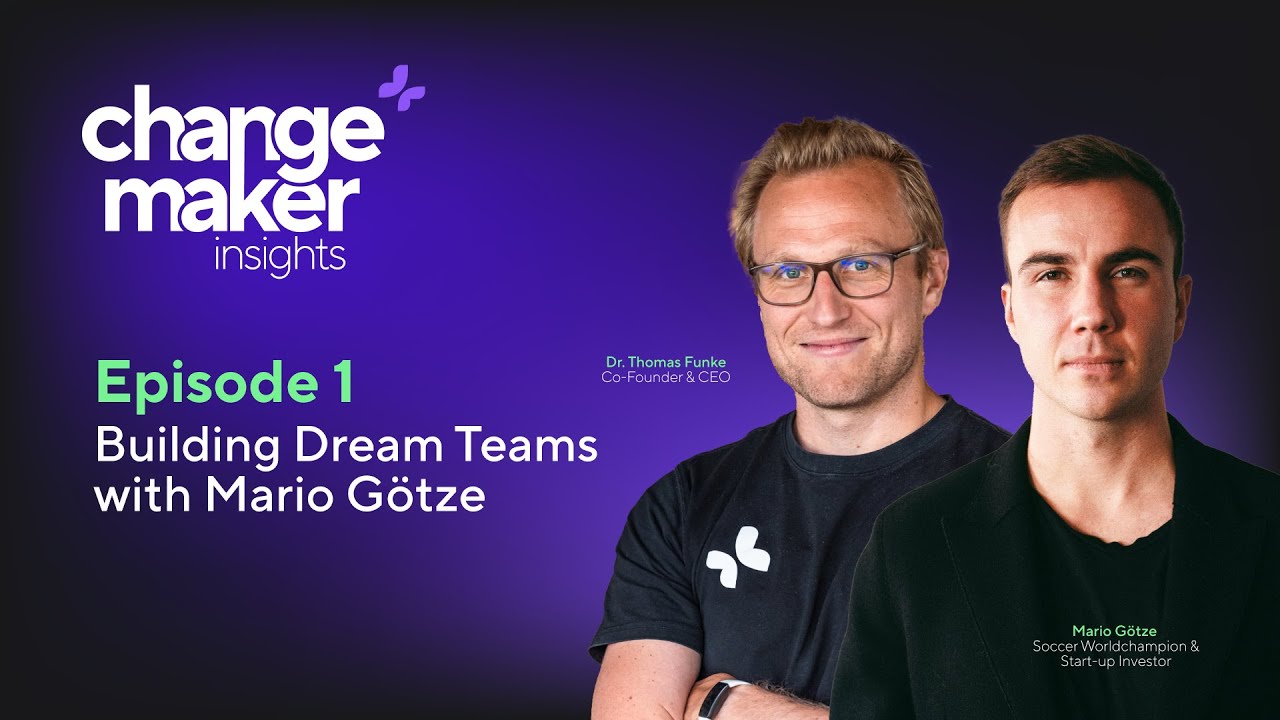
In this Changemaker Insights interview, former professional footballer Mario Götze discusses his philosophy of building and leading high‑performing teams, drawing parallels between his experiences on the soccer pitch and his work as an active angel investor. He defines a team as a group sharing a common vision and long‑term goal, emphasizing that successful teams are built over years, not weeks, and require a mix of experienced and younger members. Götze contrasts the dynamics of national teams—meeting only a few times a year—with club teams that train together daily, noting language diversity but also the ability to communicate non‑verbally through shared understanding of the game. He highlights the importance of player roles, leadership, and the coach’s influence, arguing that a coach sets standards and culture while adapting the level of rules to the personalities involved. Conflict resolution is portrayed as a rapid, often self‑managed process, with coaches intervening when needed. Transitioning to his second career, Götze explains how he built a small, values‑aligned investment team and a network of mentors to support over 50 startup investments. His investment vision is to create a resilient portfolio spanning pre‑seed to private‑equity stages across industries and geographies, supporting founders throughout the lifecycle. He outlines a two‑layer evaluation approach: hard factors (market, timing) and soft factors (team drive, values), acknowledging the difficulty of assessing soft traits and the balance between data‑driven analysis and gut feeling, especially at early stages. Red flags such as dishonesty, arrogance, or misaligned values are deal‑breakers. His support model for portfolio companies is largely passive—providing occasional advice, introductions, and leveraging his network—due to time constraints. Finally, Götze shares personal insights on patience, perseverance, and the importance of hands‑on, open‑minded collaboration, both in sport and venture capital, and hints at future ambitions at the intersection of sports business and private equity.
Chapters
Welcome, Mario, to talking about building dream teams. I couldn't imagine a better person to talk to when it comes to building dream teams, but not just building them, potentially also leading them, uh, winning championships. Um, really happy to have you and yeah, talk about one of my favorite topics, how to build dream teams. Thank you so much.
Thank you for the invitation and also great to speak about that topic. So especially for me as an athlete, so Being in teams since like, I don't know, since I'm 8, 9, 10 years old when I grew up playing soccer. So yeah, it's great to talk with you about it.
That's wonderful. Maybe we start right away with exactly your experience. So for us, it's always interesting to understand the definition of teams. How do you define teams for you and what particularly makes a great team for you?
I think I would put it very simple because in the end it's just like a group of people working on the same goal, the same idea, the same vision at the same time for a longer period. So that's what I experienced when I was young, but also the last 10, 12, 13 years when I became a professional soccer player. And I think that's, that's for me the most easiest and also simplest Yeah, most easiest definition of, of a team and a group in the end to be successful. So particularly for me as an athlete, being in that environment for like, I don't know, 10, 12 years, but also in the youth. So I think that's, that's the best way to describe it.
Having a shared vision, a common goal, that's one of the things that, that clearly differentiate a team from a group. For example, Do you have an example for an outstanding team? I mean, apart from Eintracht Frankfurt that you were, are a part of, and could you describe that just like in a couple of sentences?
Yeah, of course. I think when I look back now, playing soccer since 13 years, I think the most important thing also for me when I scored the goal at the World Cup in Brazil, I think it was clear that we had a really, really good, interesting team. I think the combination of like older players, younger players, but also to understand that this team is not built like within weeks. It was built within years. You know, it's like they started very early also with Jogi Löw as a coach, 2006, building that team, building that vision. And then it took them like almost 8 years to have that success in the end. So I think that's very important also to understand that it's not The dynamic has to grow, the team has to grow. You have to make like experiences like positive and negative. You have to stick together but also grow together. And I think that's probably the most important learning I had the last 10, 12, 13 years to understand that it takes time first, but also then to like add different things to a team. Like for example, for me as an athlete being one part of a team, but also you have to coach, you have different people. In the team and the team around the team. So it's not just 11 players on the pitch. So I think that's also important to understand that that's more to it than just the success and it's built within years and not, not within weeks or months.
That's a, that's a wonderful topic because I'd be really interested, especially when you think of the national team or also like your club. I mean, you all come together from, from anywhere. You're, you're You're forming a team not by free will. I mean, of course you are, but then you join a club and you don't know the 10 other people and maybe you know some of them, but are there any particular team building activities that are done? Like, what is it to build a team over 8 years? Is that just playing soccer together and then perhaps have a drink or is there any specific team building that you do?
I think you have to differentiate a bit. First, if you compare it with the national team, it's very different because in the end you meet, let's say, 6, 7, 8 times a year to have like, to have games, to play games, to have an event or World Cup, European Cup. So it's more difficult to create that dynamic and also build that team. But on the other hand, you know, there are only German players. You understand each other, the language, the culture and everything. And the big difference to clubs or teams in clubs in general is that, yeah, it's, it's you see them every day, you play together. That's also the beauty of sports and beauty of soccer because in the end, also now in Frankfurt, we have so many different languages and cultures and in the end you understand each other on the pitch. I think that's the biggest difference to big corporate companies or whatever. So in the end, this is the beauty of sports in general. But it also makes it difficult because in the end we have, I don't know, 5, 6 languages in the team. To some I can't speak because I don't speak French, for example, and they only speak French. So it's a bit difficult, but in the end you understand each other on the pitch. So that's a bit the good thing, but also the bad thing about it. And then it's more the common vision, you know, the common vision to go on the pitch, to play together, to understand each other on the pitch. You don't necessarily need the language for it. So that's, that's the beauty of soccer in the end. And, um, yeah, it, it can work out in a perfect way, but it can also be, um, a difficult, uh, difficult thing.
And, um, maybe speaking of, of roles in a team, so is there any attention paid to the composition of a team and certain roles? Because everybody is a different— has a different attitude. Maybe someone is the natural leader, who's the Very outspoken person, somebody who's more shy. Is that taken into consideration or is it only how you deal with the, with the ball on the pitch?
Yeah, I think on a higher level, like for the club, you have to have that filter, like also to, to have different characters in the team. You have maybe older, more experienced players, but then you have younger players who can develop and grow. I think from a, like a leadership perspective, in the club who make these decisions for the team, for the coach and everything. You have to consider that for sure. But for me, like, especially as an athlete, you're just a part of that and you have to fit in that team. You have to fit in the system and the philosophy and everything. And then you have to perform and give your best. So I think it's a big, big thing and it's very important in the end if you are successful or not. to build that ecosystem, that energy, that dynamic in the team to, to be, to be successful in the, in the end.
Yeah. And, and one more role, of course, that's very often spoken about is the, is the coach has a decisive role on the success of the team overall. And he's usually the first one that is fired when it doesn't work or maybe, and then, then the players that score the goals are promoted. But what's the, what's the actual influence a coach has? Is it really as it is always talked about or?
I mean, I think yes, because in the end he is really the leader of that group. He is the guy who sets the standards, who is giving his philosophy to the people, to the people in the club, to the players. So in the end, the coach is very important. Also, the team around him is very important. So in the end, he bears the responsibility for everything. But of course, he has certain players. He has a certain number of players in the team who has to follow him and is probably more closer to him than other players to like transfer it from like the coaching perspective to the training pitch, to the games. So to have that relationship with him. So in the end, that's also very important to build that synergies. But in the end, he plays a big role. for the team, for the players, and for the club, of course.
Nice. Maybe already moving a bit into the direction of business because you're also a very active business angel. And sometimes I wonder how you even do that. If I believe it's correct, you have more than 50 investments. But before we go there, because that of course also has to do with teams, there's a very interesting book that is quoted like several times in the past years in the startup community, which is from Netflix, No Rules Rules, where it's literally about a team functions.
Wow.
If there's not that many rules, how is that on the soccer pitch? How is it, how many rules do you actually have and how much of it is spirit in the team? And just as you say, just nonverbal communication, it just works. But how much of it is really set rules versus spirit of the team in the—
Yeah, I think that's also a tricky question because in the end it depends always on the people you have in the team. Because if you have people that need leadership, they need rules, you have to form that team in a certain way. I think then you need to have more rules. But if you have the feeling as a club or as a coach that you have a team, a group of people who is like they play more instinctively or they need more freedom on the pitch, off the pitch, then you, I think you have to loosen that a bit. So In the end, you have to have a good feeling for people. In the end, I think it's it's people business, of course, and then set standards. But at the same time, be disciplined in in a couple of things. So I think that's the tricky part also for a coach, for for a team, for the club to have that that feeling and then make the right decisions for it. So it it can I think it can vary to to a certain degree, and you have to be like very. Yeah, you have to be very, um, yeah, individual. You have an individual approach to, to that.
So overall, you'd be, you, you'd say leadership and the, the human approach beats rules. Um, so in line with no rules rules, right? So it's, it's in the end, you're—
Yeah, maybe kind of. Definitely. Yeah.
Yeah. Maybe speaking a bit about the dark sides, and I'm not sure how much you wanna reveal about that, but usually teams are also full of conflicts. It's not, not only harmony and and going all well. Sometimes you lose, sometimes you learn, but how is it, or when you speak of conflict management, that's also one of the reasons why many startups, for example, fail because they're not able to resolve conflicts, right? How does that work for you and your teams? Do you have like a special way of resolving conflicts? Because I'm sure there's many or there has been many.
Is there a special way? Not really. The good thing with us is, for example, if you lose on the weekend, you have a training 2 days later, so you can prove yourself again, or you have another situation again. So in the end, we have so many games, so many training sessions, and also within the team, then sometimes you have a bad phase and then you have a better phase. So, and then like if it's blended together, you have these moments and you need to have these moments, of course, as well. Sometimes it's the team has to solve it by themselves. Sometimes the coach has to intervene. So I think there's a variety of topics during a season because for us it's normally you start at a certain point and then you have 10 to 12 months of a season. You have to work on certain things to develop, to grow during the season, to reach your goals in the end. And I think there are not one— there's not one rule for that or to like solve this problem that way. So there are so many factors all the time, like on the training pitch, on the, or if you have games and there are difficult situations, sometimes you have better situations and this kind of like energy and dynamic needs to be solved either right away or maybe the next day to work together because in the end you have to perform 10 months and we don't have that time to like look back and say, oh, okay, last week we lost, now what we are going to do? So in the end, this needs to be resolved very, very fast.
Yeah. So it's a, it's a commitment to conflict resolutions as soon as they, they emerge.
Yeah.
One last soccer-related question, maybe, maybe some more a little later, but is there like an outstanding person, a teammate that you have played with in your career that was for you an incredible team player that always was the glue that, that really made the team stick, no matter if it's a coach or a fellow player? Anybody that comes to mind and why?
Yeah, in the end, when I look back now, the last 12, 13 years, when I become— since I become a professional soccer player, I always mention Jürgen Klopp because I think he has this natural gift, you know, for like understanding people and then making like communicating it in the right way and then making the right decision. At the right moment, so I think that's also a skill you need to develop. But I think he has that talent for it. If you see how he, how successful he was in Mainz, in Dortmund, in Liverpool, and then transferred it to all these clubs, not only in the team but also in the in the whole ecosystem of the club, I think that's that's pretty impressive.
Yeah. Yeah. Well, he maybe he become the national coach after he leaves Liverpool. Maybe. Maybe spending a bit more time now in your, in your second career, which is you becoming a very active angel, which I really find great because the people, the world needs more people that actually invest into new ideas that potentially may fail. But I'm quite sure that you're not doing that just by yourself.
Yeah.
I'm sure you have a team, like I couldn't imagine managing 50 investments just by myself, but Can you like walk us a little through how did you build the team there? How did you build your career there? What did you take into consideration when it comes to actually starting to become an angel?
Yeah, I think it's, it's very similar to what I do as an athlete because in the end it did not happen like over 2, 3, 4 weeks. So in the end, I started 6 years ago when I had the feeling that I need to look outside of the pitch, you know, and see what other athletes are doing. For example, in the US, They have built their own PE firms, they have built their own venture fund. And I was always curious, why did they do it and how did they set it up? So that's where I looked at the beginning a couple of years ago. And the biggest bottleneck I have in the end is that with family and soccer, I barely have time for these things. So in the end, I need good information, I need a good team, I need to make the right decisions. Most of them are out of syndicates in the end because I need to have the right approach to it because I believe if you want to do something the right way and 100% and you want to be successful as an investor as well, then you need to put it in everything you have. So I do this on the pitch and if I can't have, if I don't have the time for it, I need the team for it. So that's how I started. I have a small team in the background and a great network of people who I reach out to who understands the space, the industry. the people and then to make the right decision. Of course, startups, especially pre-seed, seed stage is a different game. And also I know that it's a high-risk investment. I know there are a lot of people and businesses who fail at that point, but that's what I, yeah, committed to. So yeah.
Part of the game.
Yeah, exactly.
Fail and learn. And you said you have a small team, you have a network, but how do you select these? Like how, why, Why do you work with these people and, and, and not with others? Based on what criteria do you actually assemble your team?
Do you build your team? I think it's also, it's pretty simple also to like have that shared vision. They have shared values, the values I have. So I try to filter that because in the end I have to work with them. I, it, it doesn't necessarily mean they have to be like me, but in the end they, they should have a similar approach to similar values. And that's how I try to assess the people who I choose to work with. In the end, of course, there's also sometimes fluctuation. For me, in my case, for example, I moved from Munich to Dortmund, from Dortmund to Düsseldorf, from Düsseldorf to Frankfurt. So I also changed my ecosystem, my environment a couple of times. So that's also not easy to build a team hands-on. Luckily there's a bit more of a remote culture now. So this, this, in that case it helped me a bit, but also makes some things a bit more difficult. But that's how I try to assess it. And of course you have different phases also. When I look back 6 years ago when I started in venture capital, I make different decisions now than 6 years ago. And that's also what I try to like, yeah, help with my people also to make mistakes, to understand it, to learn, to grow. And to get better in the end, that's how I approach it also in the venture capital space and also with my team and the people in the background and try to encourage them in that way.
So you have people that work with you, for you on your personal vision, right? On a vision to actually fund younger startups that actually make a dent in the universe or change. But you also mentioned that you have a certain network that you can turn to when it comes to new investments.
Yeah.
At Tomorrow University, we ask all of our students to actually build a personal board, which is literally a set of mentors, 3 to 5 people that they constantly can reach out to when they're stuck with their mission, when they cannot really work any further, where they need support to a certain area for growth. Do you have a number of mentors? Do you have mentors that have accompanied you for a certain while, or is it like changing persons that you listen to that give you advice?
I think both ways. So in the end, there are like topics and where I have to like a certain need and then I reach out to that people for that certain case. But I also have like 3, 4 people, like for example, in the soccer area, I have a management agent who I like getting advice from. But also in the venture capital space, I have 3, 4 people with whom I share a lot and they have been in that industry for a long time and I have also like 2, 3 other people in the sports business area who I reach out to if I need a certain advice. So I, I really like that idea what you mentioned, which I try to, to live to almost every day, every week. Yeah.
Great. And do you have a very clearly defined vision and mission also then for your investment activities where you say, that's exactly what I want to do over the course of the next years? And then you assemble also the team, the supporters, plus of course the investors. investments circling all around that and also defined values, for example?
I have a vision for that. Yes, I want, because I started 5 years ago, of course it changed and varies a little bit, but in the end what I want to do or what I want to build is a, like build a resilient portfolio in that venture capital space. So in the end, what I want to have in that firm is like a different kind of like stages, industries, geographies, like from angel to private equity. So for now, there are more than 50 angel tickets, different stages, pre-seed, seed, Series A. Then I have venture capital funds with different industries, different geographics, and so on. So to build a resilient portfolio to either like help the startups, for example, from pre-seed to maybe private equity exit. So to have that whole lifecycle, and that's what I want to build and have a resilient approach. You know how it is. Some startups won't make it, but I think that's good to have that value, to generate that value, to accompany them like over the whole lifecycle they have. And that's the idea I have for the next 5, 6 years. And then it has a certain value and a certain base to build that all over again.
And speaking of these 50+ tickets, how do you actually select your investments? Do you have like a clear like team evaluation criteria? Do you speak to the founders and then see how they tick? Or is it really more on the market opportunity, more on the recommendations? Due diligence, can you really do it when it comes to the team? Because I know many investors that say the idea doesn't really count, you know, in the very like early stages, the idea is nice, the market is important, but even more important is the team. So how diligent are you when it comes to selecting based on team?
I think it's a good question because in the end, what I do normally is you have the first phase where you have that market, the idea, the, you try to assess the timing of the company and all these kinds of things where like, I would say like hard factors, which are like, you can assess really good with your team and people. And then you have this like soft factors where you try to assess the team, the people, the values, all these kinds of things, which is not really like, you cannot put it really into numbers or data or facts and you have to just like build that feeling a bit, which is very difficult to assess. But in the end, I have these 2 approaches and then try to like find the people or the founders, the teams who have that, like, let's say that drive, that understanding, that, that's something, you know, that something within them which they could like lead them to something special. But I think it's difficult to assess because also when I see it as an athlete, what I've done or seen in my career. You have to work with them, you know, you have to see how they fail, what they do, how they decide. So how do you assess that before you work with them and understand how they would react, how they work, how they like build, grow, and so on? So I think that's, that's very difficult, but that's also the, the, the beauty of it.
Wonderful. I mean, just touching some, some elements when it comes to working with the startups, but before we go there, You spoke of also you have some data when it comes to investing into startups, but how much of it, like everybody has a different approach, how much of it is gut feeling from your end? Like, wow, that's a great team. And how much of it is really data-driven in the sense that you get references, you look at past performances and all of these things?
I think this depends also on the stage of the company or is it a VC fund or whatever. So for funds or later stage companies, you have more data, more facts you can assess, but especially especially in pre-seed, seed, whereas ideation stage or whatever, which is very difficult to have a lot of data. So I think it depends on the stage of the company where they are at that moment when I invest. So that, so in the end it varies also a bit depending on the stage of the company. And yeah, of course you want to have as much data as possible to assess the outcome, but normally, especially at pre-seed, it's almost impossible.
Gotcha. Yeah. Is there any founder entrepreneur that stands out for you? Same question as, as with regards to the, the, the soccer pitch where it was Jürgen Klopp. But is there anybody where you say, wow, that's an impressive leader and team player in like the entrepreneurial realm?
Yeah, I think that's a bit more difficult to like say one name now because in the end I worked with Klopp for like a couple of years. I was there hands-on. I've met him like every day and trained with him, spoke with him. So In the end, for me, that's difficult to assess because the only thing what I can say is that I had a couple of calls, like 5 to 6 calls where you have that feeling in the call or when you meet someone that he has that drive, that understanding, he has that clear vision. But I can't say one name now. So in the end, I think it's also like be there, understand it. That's what I said a couple of weeks ago also in an interview where what I want to do after my career is like to learn to be hands-on, to really stay there like every day and understand what they are doing on a daily basis. Because I think then you get that feeling, that understanding, and can assess even more if that person has that quality and skillset for success.
I mean, you said very much when you take a decision to invest, it needs to be aligned. They need to be driven, passionate, clear. And is there anything that would prevent you? So given that this is all there, but is there any characteristicum of the team or any, anything that you observe where you say, that's a red flag for me. I would never invest into a team like that if they show behaviors like that, if they act according, not according to XYZ. Is there anything?
Yeah, I mean, I, I, I probably think this is the, like the typical things. If, if you have the feeling he's not telling the truth, if you have the feeling there's something not right, like within the team, If you have the feeling that there's there's something like he's I don't know out of nowhere he might be arrogant or he's like these kind of things where I would say I don't want this guy in my team when I play soccer. I don't want to invest in this guy who has the same values like when I this is something I wouldn't do and I wouldn't invest in. So I think there's certain also soft correct characteristics. which I would not like to see.
Yeah. And interestingly, there was a study particularly pointing out the topic of arrogance because that means that you're not able and willing to learn if you're arrogant. Not to be conflicted, of course, with overconfidence. A certain amount of overconfidence is good when it comes to starting a business. You have to build the crazy vision that you come up with. Maybe, Just one or two more questions before we wrap it up. I'd be really interested in, you said you also work with the teams to a certain extent. How can I imagine that if you have like 50 different investments? It sounds like impossible that you can't support them in any way. But is there, how do you support them? How do you work with the startup teams?
I would say it's more like also a passive approach. It depends always because in the end now there are like For example, two teams in Frankfurt who I meet a couple of times during the year. Sometimes they maybe only need like one advice per year. Other companies, they are like reach out on WhatsApp and say, "Hey, do you know this guy? Do we have someone in the U.S.? Can you introduce me to this one? Or do you have a company who could be like could we reach out to?" So in the end, it also depends on the company, what they need, in which stage they are, where they see a lot of value. So. This is very— this varies a lot with some companies. I maybe see them once a year, if at all. So that's how I try to approach it. But it's more like a passive support because in the end I cannot, like, during my time and energy management with family and soccer, it's impossible.
Yeah, I fully understand. And maybe speaking of an outlook and your vision, I mean, I hope you're going to play for quite a while and still keep on playing for quite a while. But speaking of that second career, what's your vision for it? Is it even more investments? Is it even an own fund? Or in which direction do you want to move when it comes to helping and supporting founders?
I think it's not clear yet, but in the end, I want to do what I started 5 years ago in the next 5 years. And then we will see where I am at that moment. What I really like is to like build that intersection with sports and, and for example, private equity and venture capital. I've just recently seen the role of Zlatan Ibrahimović. I don't know if you have seen it, but in the end he's an advisor to Redbird Capital at the same time advising AC Milan. So like building this intersection, I think it would even like progress and develop even more in the next couple of years in Europe. And I, I really like that intersection, like sports business and what specific role it is in the end, we will see. But that's how I, how I see myself in a couple of years.
Yeah. Cool. I know the model of Serena Williams. I'm myself a, a tennis player. She set up her own fund. I think that's also an interesting one.
Yeah.
Yeah. Cool. Maybe a final question because most probably you get like requests every day and investment pitches and pitch decks every day. But for you personally, what makes you a great team player? Like if anybody would want to work for you, this is what they can also expect from you and that's what you are as a team player. I'd just be very interested.
I think it's also very simple. I think it's Being like very hands-on, very open-minded, always like have a certain drive, like which comes from within. This is probably because this like accompanied me since I was 10 years old, like to build something, to be curious, to like work like hell and try to change something. I think this is what I want to see in the end because I've seen it when I, well, I've lived it when I was 10 years old and it accompanied me the the last, the last years since I started playing football. So in the end, that's what I also want to see in that space. And yeah, that's probably the most important thing.
And the most important advice that you ever got that you want to pass on when it comes to building teams, leading teams?
Building teams. I think when it comes to that certain area, it is to understand that it doesn't happen over a day or a week because I, when I was young, I wanted to do everything at once and now, and it has to happen tomorrow, otherwise it won't work. So I think to have that patience, which I didn't have when I was young, which might also be good that you have like, um, not that standard and you want to reach some heights you have never reached. So that's also good to have that drive, but to also have that patience to understand that you have to fail at a certain point, that you have to take, it has to take time. For the, for yourself, but also for the team to be successful in the end. And also if you see the big companies and very successful and sustainable companies, it takes time.
Yeah. Yeah, it takes time. It takes commitment. Didn't it? Wasn't it Michael Jordan who said you have to fall 7 times and stand on 8?
Yeah, probably a couple of more times.
Most probably. Wonderful. Thank you very much, Mario. I, I, I personally found it incredibly insightful to learn from you.
Thank you.
Uh, when it comes to building leading teams, I'm sure that, uh, student learners will do so too. And, um, yeah, I'm curious to see where that all leads you. I think—
Me too.
The second career that you're starting is, uh, actually just starting. So good luck with all of that.
Thank you so much. Thank you for having me.
More from Christian

What Comes After Graduation? 🎓 | Class of 2026, Berlin & Building What’s Next

This Is What an Online University Meetup Looks Like 👀 | Berlin Immersion Summer 2026 🐝


This Is What an Online University Meetup Looks Like 👀 | Amsterdam Immersion Week 2026 🦋
Food was never meant to be this complicated. 👀 Student to Founder. #food #entrepreneur
How We Helped Rescue Food with Berliner Tafel 🍎 | Tomorrow University Social Impact Day
Why Most People Are Mentally Checked Out at Work (And What Fixes It) #burnoutstress #mentalhealth


What Comes After Graduation? 🎓 | Learning with AI, Remote University & Berlin 2025