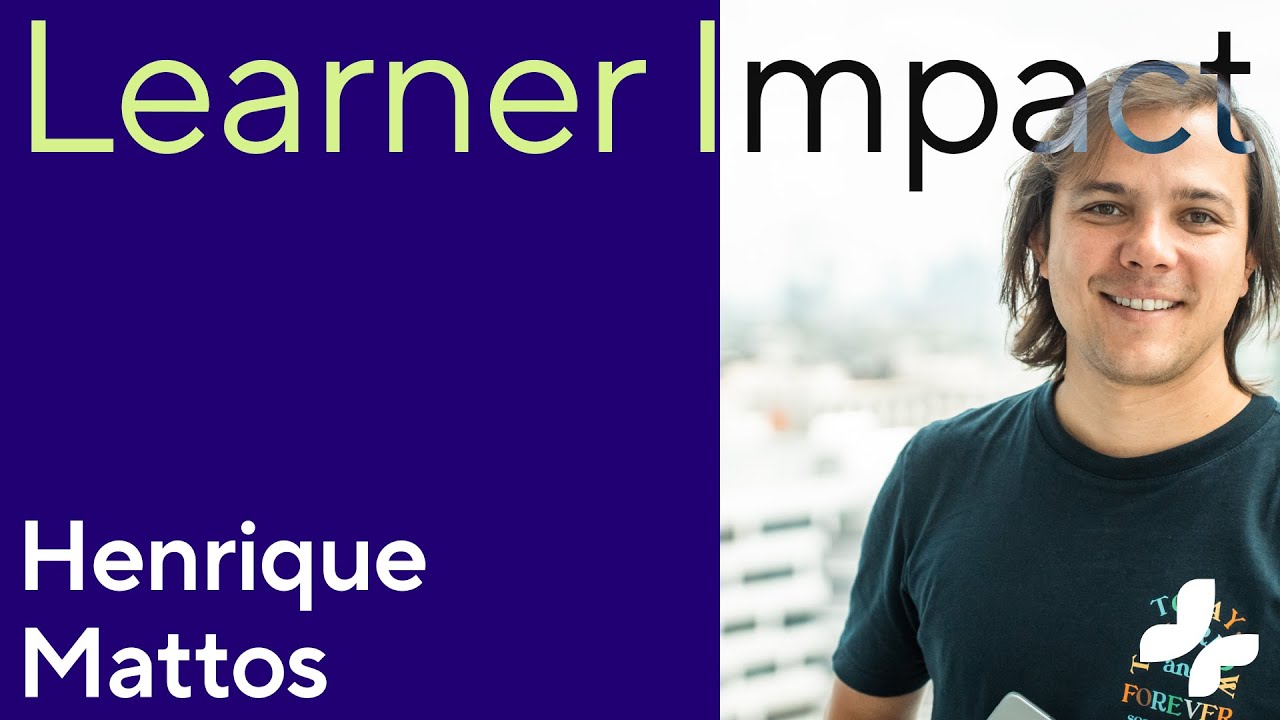
In this testimonial, Henrique, a 36‑year‑old Brazilian, recounts his unconventional path from a childhood ambition to become a professional tennis player to founding a web‑development company at 17. He joined SAP in 2012 as a data and technology consultant, later relocating to Germany, where he spent a decade developing software and engaging with SAP’s sustainability initiatives. Motivated by the pandemic’s focus on sustainability, Henrique enrolled in the Tomorrow University master’s program (hosted by Chalmers) to bridge technology, entrepreneurship, and sustainability. He reflects on his ongoing tension between being a product owner/entrepreneurial idealist and a full‑time employee, and emphasizes his lifelong mission to use data‑driven technology to improve people’s performance and daily lives. Henrique also highlights the strong community aspect of the Chalmers program, describing regular meet‑ups in Hamburg and Berlin that reinforce peer learning. Throughout, he philosophically questions what technology truly means and how it can be leveraged to alleviate societal challenges such as poverty and time scarcity.
Chapters
My name is Henrique, and I'm from Brazil. I'm 36 years old, and before I joined TU, basically, I didn't have any graduation because I was running my own company at the age of 17. Before that, when I was 6 years old, I started to play tennis, and when I was 12, I was pretty sure what I wanted for my life. I wanted to be a professional tennis player. By the age of 18— 17, yeah, I noticed I was not good enough. Tennis is a very demanding, very high-performance sport in general. It's very difficult. And then I was already programming and I started my own company for web development and basically doing micro-websites for English schools, second language, or bakeries and restaurants and parties and so on. And in 2012, I wanted to move from Rio de Janeiro to São Paulo and I took this job at SAP, this big German company, worldwide big actually. And I started to be a data and technology consultant there, which gave me a lot of opportunities, including the opportunity to move to Germany where the headquarters is. And then once in Germany since 2017, I started to think about master education and yeah, how the world is evolving and how technology is playing a vital role. And with the pandemic, I started to think about sustainability and I started to search about studies on this field where I could bridge technology, entrepreneurship, and sustainability. And I don't know if it was a coincidence or a divine sign, but Tomorrow University was basically starting this course and I applied. I'm still employed by SAP. I'm a software developer. It's been 10 years with SAP now, and it's a company that invests a lot in sustainability. SAP is a very flexible company, and I like that a lot, and I value that a lot. But I still feel that I am a product owner or a business idealist, so I'm still struggling to say, okay, I'll just entrepreneur, or no, I'll just work full-time for this company, which is very nice also. I played tennis my whole teenager lifetime. For about 16 years, I was playing tennis, and later when I stopped, I was already programming. I started programming because of tennis, because I want to gather data about my games, my matches. So you really had to take scouts to take notes of your games. And then I had all this pile of paper and how do you compile these and how do you analyze these? Business intelligence was not there in 2004, especially in Brazil, for example. So I started programming by this time and my areas of interest have been since then always technology, focusing on data and focusing on improving people's life and improving performance. When I started software programming, there was no YouTube, there was no Google Chrome, there was no iPhones and no app stores. So it's very difficult for me to tell you exactly what I will build and how it will impact people's lives because it might not exist yet. So I'm still discovering what it will be. And that's the thing about technology. When I joined Chamorro University online, almost self-paced, Learning experience, I was thinking if I would miss the community part of it, but actually quite the opposite. Chalmers University has a very strong community. Whenever I'm in Hamburg, I meet my colleagues there. Whenever I'm in Berlin, I meet my colleagues here. Every last Friday of the month, I'm here in this, in the Ahoj cowork with the Chalmers University crew. Sometimes other colleagues, other students come, and it's very nice. I did the initial certification. I failed about 3 or 4 times. It's a very interesting course, and it for me it was very interesting that my mission is the same for the last 20 years. I do the same, but I really like it to bring technology to make people's work better, to perform better, and to improve their daily routine or daily work. So that's basically what I have been doing all the time: automatizing process and creating tools and bringing technologies to. Let people run their lives, their business, or whatever they want to run better. But that's a very abstract concept, actually. What is technology? What kind of technology? Run better like water. And that depends. Some people want to have more time with their families. Some people want to make an impact to their communities. Some people want to change the world. And how do you define it? Yeah, you're going to improve people's life in which way? Are you going to take people out of poverty, out of misery? Well, hunger. I don't know, maybe I bring the technology, you bring the idea, for example.