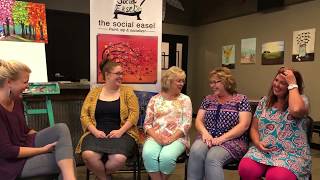
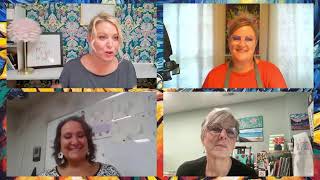
In this conversational testimonial, Becky recounts her artistic development under the guidance of Christie Renee Hawkins. She began with a poppy painting at a church paint party, inspired by her grandmother’s favorite flower, and soon joined Christie’s in‑person and online Social Easel paint nights. Through these sessions Becky sold her first painting, then seven more, exceeding her original ten‑year retirement‑by‑painting plan. She describes how word‑of‑mouth sales (mason‑jar flowers, coneflowers, a variegated barn) propelled her confidence, while also confronting creative blocks around composition and self‑trust. Christie shares her teaching philosophy: encouraging students to see themselves as creators, using sketchbooks, thumbnail studies, and multiple iterations to build a mental roadmap before painting. The dialogue highlights Becky’s growing enthusiasm, occasional frustration, and the supportive community that enables her to keep learning and selling art.
Chapters
You probably a little over 6 months now. The very first time that I painted with you, you were at a local church and you were doing a private paint party with the poppies at Ridgecrest.
Yes, I remember that. And those poppies look good today. I know. I think we talked about those like 8 times.
What drew me to that, that was my grandma's favorite flower. And so that was when I took the very first painting class. And then I noticed that through Facebook you were starting doing more of these paint nights through the Social Easel at the Pitch. And so I signed up and got started. And then when you did the online, I was right on board. And since all of this has transpired, we've done a private interview with the first set selling of one of my paintings, and since then I have sold 7 more.
7?
I didn't know you got to 7!
Oh my gosh!
Our artist! I know! And so, yeah, this has just been— the 10-year plan was that I was going to learn how to paint for retirement, and it's happened way quicker than what I ever anticipated. And I'm just having a joy of doing it, but I can't find time to paint. I'm just kidding. I'm getting frustrated. You're ready to retire.
I'm ready to retire.
Yeah, she's ready to do it now.
So you can just keep selling more while you're working and then you'll get to retire early.
Yeah, but what was really cool was that I had a high school classmate had seen one of my paintings that I posted after a class, a local class, and he said, is that for sale? And I said, well, yeah, I guess so if you really want it. And so that's when I texted you at 11 o'clock at night and said, what do I do? I don't know what I'm doing. You had to sell it. Sell it and paint another. And so I did. But then as I was getting them packaged up, ready to go, just by word of mouth, a coworker saw that I had painted some something and said, hey, could you do that? It was the cotton balls in the mason jar. He wanted that one, the guy from Iowa. And so a coworker said, could you do flowers in a mason jar? So that's when the coneflowers came into play.
Yes, those turned out so cute.
And they're my nemesis because coneflowers and I don't get along. And so anyway, then he got that for his mom. And so it's just kind of brainstormed. I've had the happy camper palette that I sent back to Kansas to a friend that I worked with back there. And, and so yeah, it's just gone off way faster than I ever anticipated because I still have a lot to learn. And I—
you're doing great, but I feel like I don't know much.
Well, you know what, that's true.
You know what, but that brings up a good point because I think a lot of people think you have to be an artist or you had to have— like, I've painted since I was 5, so everyone's like, well, you've done that forever, so you're the only one who knows how to paint. And that's not true. Like, we all have that creative part of us on the inside, and it's just pulling it out of you guys and showing you guys that you actually know more than you think you know.
Well, I had to create a variegated barn, you know, the— what looked like a barn for the coworker. I'm thinking, how in the world do I do that? Oh, I know, blend like what she showed us how to do. So I used black and white, and then I used kind of like a chocolate brown, and then some kind of rust color, and made the rust spots on it.
Yeah, and it looks good.
And I guess it was my impression of what it was, you know, compared to the picture that he sent to me. And I'm thinking, what are— what is kind of scary, because if people want you to compose something, and I'm not at that level where I can just brainstorm yet, that's where I've got to get out of that comfort zone that I'm in right now. You are creating for us, and you are allowing us to paint those strokes and be able to get the picture. But I've got to get that mindset that I can create something myself and be okay with it, and it'll be fine if I just let go and let the paintbrush do the work and me not— I get— I have to get my mind out of the way.
And I think when I— go ahead.
Well, that's what's been fun too, is I feel like I could make something on my own, like, and I have.
I would have never done that before. Like, I've learned so much I can compose my own. Yeah, that's awesome. And I think it's so important when you get to that step, you know, you guys are advancing and you're like, you're getting more comfortable, you're, you don't have as much fear like you did maybe in the beginning. But, you know, like I told you guys, when I come up with ideas, I'm usually drawing on receipt papers or scrap paper, and then I have a sketchbook and I'll draw draw little thumbnails, and you could do up to, you know, 5 to 8 versions of the same— yeah, of the same thing that you're working on and deciding, well, I like that there or that there. And then when you go to your painting, your brain has already been like, oh yeah, I know where this is gonna go, you know what I mean? So that helps a lot when you're going through the composition part of it too.
But I'm enjoying myself thoroughly, and I'm gonna stay with you as long as you want. Until she kicks us out.