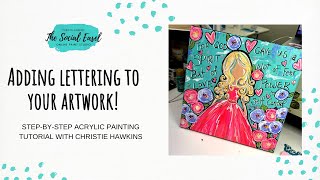
Christie Renee Hawkins shows how to add lettering to paintings using a scratch-art technique: paint a black canvas, sketch letters with a pencil, then apply thick white or colored acrylics so the black shows through. Mistakes wipe away with your finger.
Chapters
So I'm going to show you how to do this type of lettering in your artwork, which is really easy and just a fun way to add Bible verses or sayings or whatever you want to, to your art. So I'm going to switch the camera view, and I have already prepped a canvas that I'm going to do with you guys today. So I just took another canvas that I didn't like and painted it black. So that is step 1 of doing this technique, is to paint, paint your canvas black. All right, so I'm going to switch this off. Let me know how that looks to everybody. Thank you, Miss Kathy. Hey, Twyla, thank you. I'm glad you think she is beautiful. And don't you love it when God uses you through something? Yeah, absolutely. And I feel like that is, um, what he's shown me again and again is, um, how he can use each one of us through the desires and the passions that he gave us, um, with the gifts that he gave us, when we are open and willing to use those passions and gifts to honor him. Um, so what I have done so far— let me scoot this over just a little bit. Okay, so obviously this is the example. I'm going to do a different verse today. So you want to paint your canvas black. That's step 1. Have yourself a pencil. I personally like a good old number 2 pencil that you can sharpen. You're going to get paint on this thing. So when I did that one, all I had up here was a mechanical pencil. I made it work, but it wasn't my favorite. A good old number 2 works best. So everyone's got some extra pencils laying around their house. So the first thing you're going to do, paint it black. Get your paint I'm doing white and pink. Obviously you can do whatever color you want. I'm just going to mix these together. Now my preferred method for this is to be very heavy-handed, so I am using thicker bodied acrylic for this. You don't have to, but I do think it makes this technique easier. And you may want to work in sections, especially if you're not using thick bodied Thick-bodied paint dries slower than just like your regular craft acrylic. And I'm just painting a messy background here. Your brushstrokes don't matter, that's all up to you. I like to see the brushstrokes, I like to see the different colors. I don't want it to be perfectly blended, so this is all about embracing the messiness of this. Someone said let's do Barbie and someone said no Barbie, so we're not doing a Barbie. We're doing you. We're doing a representation of you. We are not doing a Barbie painting. However, I am using Barbie pink today. So this is just two colors. You can do whatever you want to. There are no rules for this part. So I'm working quickly, just spreading this around. And if you decide you like this technique, I would say, you know, do several canvases at the same same time. If you set up systems for yourself, then it's even easier for you to produce more. Um, so I thought it only appropriate that I take the verse that I shared with you guys earlier, and that's what I'm going to write on this today. So it's kind of like a combination of writing and scratch art. I've got 2 minutes, I'm gonna have to go fast. So, and I just do it in my handwriting. You can do it however you want. You can look at different fonts, but I just kind of go with it. I'm not overthinking this. And you'll see me wipe off my brush as I go. Where'd my paper towels go? Wipe off my brush, wipe off my pencil. You can go back over But think in your head, the messier the better. So that black that's coming through is not from the pencil lead, it is from the black underneath our painting. Now let's say you do something and you're like, oh, I don't like that, or it's now it's not in the right place, whatever it is. This is so easy to fix. I mean, you can use your fingers, you can get your paintbrush if you want to again, and just rewrite it. So this is a very forgiving technique. And here is the other fun thing. Just like I am doing in— by the way, the name of the workshop that we're doing, this one is called A Spirit Not of Fear. So that is the name of the workshop. And when I did that, you can do the lettering and then you decide what's going to go around this. You can make this whatever you want. Do we want to add flowers around it? Do we want to add vines? You can turn this into whatever you want to. So that is what I wanted to share with you guys today. I— 20 minutes, 21 minutes with me and a little talking, so not too bad. That's my quick tip for you for today of how you can add some quick and easy lettering and words to your artwork and let it be yours. Let it, let it show your personality, your handwriting. It's about being messy and just being free and, you know, getting, getting your words on your artwork. And what I love in this style is that the imperfection is what makes it so special, I think. None of my lettering is the same size. It's all different. It's not positioned a certain way. It's just freehanded, fun, and messy. So I hope you guys liked that technique. I hope you enjoyed it. Mary said, what acrylics are heavy-bodied? This is heavy-bodied acrylic, so the ones that come in the art tubes instead of craft acrylic, which is very thin and runny. This is really thick. So that's your— all kinds of brands, just go to Michaels or Hobby Lobby or Walmart, they all have them. Okay, y'all have an awesome day, and I hope to, um, see some of what you're working on.