How to find Floral Inspiration and Organize your Ideas!
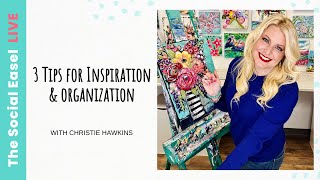
In this live workshop, Christie Renee Hawkins of The Social Easel introduces her upcoming 8‑week Floral Painting Masterclass and shares a free Floral Inspiration Quick Guide. She explains why many artists struggle to create original work and outlines three primary sources of floral inspiration: (1) personal photographs of real or artificial flowers, (2) curated Pinterest boards, and (3) self‑made still‑life arrangements using store‑bought or home‑grown blooms. Christie demonstrates how to capture, organize, and refine these visual references using phone photo albums, Pinterest boards, Canva layouts, and black‑and‑white value studies. She discusses basic color theory, the value scale, and how to translate grayscale images into custom color palettes. Practical workflow tips are provided, including using portrait mode for focused shots, tracing with transfer paper, and employing transfer carbon paper. Throughout, she promotes the free Quick Guide (PDF with links to tutorials, brush guide, and supply recommendations), announces weekly live sessions, text‑alert sign‑ups, and a discounted preview class. The session is conversational and enthusiastic, with frequent audience interaction, but the core content remains a step‑by‑step instructional roadmap for gathering and organizing floral painting ideas.
Chapters
Hey everybody, it's Christie Renee Hawkins with The Social Easel, and we are going live for the first session in 3 that I'm going to be doing with you guys over the upcoming weeks. So each week on Wednesday at 3, I will be sending out a link just like I did today. You can connect live through that link. It's direct through StreamYard, and you can also go to watch the replay from that link, or it will be on my Facebook page and our YouTube channel as well. So hey everybody, I'm super excited to share with you guys what I have been working on. It's kind of been top secret, and we're only sharing little bits at a time, but, um, if you have missed the news. I am creating a master class. This is my first ever course, and I am super excited about it. It's going to be an 8-week course, an intensive workshop, kind of like going to art school with me. So over the years, I have been teaching for 10+ years now. Um, for those of you that are new to me, I have been an artist my entire life, and, um, over that 10 years of teaching. The question that just keeps coming up again and again is, I can follow your tutorials, or I'm fine painting if I, you know, have instructions to follow, but if I just sit down with canvas or paper, I feel stuck and I don't know how to create my own originals. So this has been something that I have been thinking about, been planning for almost 2 years, and, um, it's now finally the right time to bring it to you guys. So, um, these next weeks we're going to be working up to the release of that new course, and over that time I'm going to be sharing little tidbits and tips with you of how I come up with inspiration for my own floral paintings specifically. So this master class is going to be all about florals because it is my favorite thing to paint. I could paint flowers every single day, um, all different types and styles. So let me know in the comments if this sounds like you, if you would like to learn how to create your own artwork instead of just copying from an image or following the steps of a tutorial if you'd like to be able to create your own. I'm so excited about this, and, um, I just— I was talking about it with my tribe the other day, and I just get giddy thinking about all of the amazing work that is going to come from this master class. So I'm so pumped about it. Um, I am gonna— hopefully I can drop this in the comments. Okay, so if you have not already signed up, I just dropped the link, um, in the comments. I am giving away a free floral painting inspiration quick guide. This guide is going to give you, um, basically what I'm sharing with you today live. It's going to give it to you in a form that you can, um, reference back to. It includes clickable links. Um, one of those is to my top 10 floral tutorials that are over on YouTube for free that you can learn some techniques from. And then, um, it's also going to go into color theory a little bit because color is a huge part of art and design. And once you learn how to master color and understand how it works together, it's really going to open up a lot of doors for you. So this Floral Inspiration Quick Guide is completely free. It's in the comments um, below, and we'll make sure and, um, send that to anyone that missed it. You can also just go to thesocial easel.com and, um, sign up for it there as well. And that is going to give you all kinds of, um, great tips and information for painting. And I included the brush guide, um, as a part of that. So not only are you going to learn some painting inspiration, um, how to get your mindset right, a little bit about color theory, but I'm also going to tell you how I take care of my brushes and what the different brushes that I use are used for. So make sure you go back and click that link below. So today I am going to give you 3 tips for inspiration and, and show you how I organize those. So I'm going to be doing some screen shares. We're not going to do any actual painting today. This is going to be all about sharing my ideas of how I get inspiration. Um, Karen said, my biggest challenge is knowing what to paint and how to make depth in the picture without instruction. Um, that's a good one, Karen. Uh, so if you haven't had any painting experience before or art experience before, some of these basics and in that quick guide, the 10 floral lessons that I have in there are going to be a great place for you to start. Um, and it's— I don't paint flowers, as you can see behind me, I don't paint flowers one way. Um, I love doing a variety of different techniques with my florals. Some are more realistic, some are more abstract, some are whimsical. Um, so through those different floral tutorials, you're gonna see some of the different ways, um, that I teach. So if you haven't done any of my lessons, I highly recommend starting there, going to my YouTube channel, following me over on Pinterest and Instagram, um, so that you can keep up with some of those techniques that I have out there for you. Um, Donna, I see you here in the chat. Cindy said, I've loved both floral classes I took, and I'm very excited to hear about making designs myself. Awesome. Um, Joe says, my It says the stream is starting soon. So, um, the rest of you can see me, right? You can see and hear me. Um, so yeah, try going out and coming back in, um, if I'm not showing up for you. I'm gonna take my sweatshirt off. I was freezing downstairs, but it's a little warmer up here. So there are 3 ways, um, that are the typical ways that I come up with some of my original floral paintings, and that's what I'm going to share with you guys today. And then I'm going to show you some examples of those as well. Thank you. Hey Patricia, yes, I've got new glasses, um, so if you're not used to seeing me in those, I'm trying to wear them on a more regular basis, so so that I can see better. Um, you did— like, I swear, you turn 45 and all of a sudden you're blind. Um, so anyways, we are gonna go over 3 different, um, inspiration pieces. I get my inspiration from photos, and from photos I mean that I take. Um, that could be from my own garden, that could be flowers that I'm growing, that could be going to a botanical garden in your area or going to the parks I have— I can't tell you how many thousands of pictures I have on my phone. So I am always, always, always taking pictures of everything around me that inspires me. And it may not be something that I use immediately, but I always grab it because then I can go back and reference that photo later. So I'm always taking pictures of things. The The second way is to get inspiration off Pinterest, and I'm going to go over that in a little bit more detail because it is important for you to know, if you don't already, that it is not okay to just go on Pinterest and whether it be my design or another artist's design, it is not okay to just go and copy their painting. You want to learn to be inspired by other art without copying it. So I'm going to share some of my ideas on how you can do that and how to create different boards on Pinterest to organize your ideas and give you that inspiration that you need. I think it is a common misconception of a lot of people that artists can just think something up in their head and then put it on canvas or put it on paper. Um, all artists use references. Okay, so whether that be from a photo, whether that be from real life, whether it be from memory, you start with references. If you are— let's just use a daisy for an example. If that's what you're interested in painting, then you would dive into that subject specifically. You would look for pictures of daisies. You would understand how it comes together, how each petal is laid. Like, you would start paying attention to those different shapes and sizes. It's not something that you just recall, um, from your head. So I'm going to show you how, um, you can use painting inspiration on Pinterest, but how you can also use Pinterest, um, for, um, looking up photographs of the flowers that you're wanting to paint and then use that as your idea for a composition. And then the final way that I come up with my own designs is by creating my own still lifes. And this is something that I love, um, and you can even do this in a craft store. So next time you go to Hobby Lobby or HomeGoods or Michaels or Kirkland's, any of those places And if you see a beautiful flower arrangement, um, or maybe they have a whole bunch of different greenery, I all the time will go in and just start taking pictures of that stuff on the shelf. It doesn't have to be real, it doesn't have to be out in nature. You can do this with artificial flowers as well. And, um, oftentimes I end up buying the artificial flowers that I love and creating my own still lives at home. So, um, I brought an example to show you, and I have a whole bag of florals from my home. So we're going to start with that one first because I think this part is really, really fun. One, you can find exactly what types of flowers, um, it is that you want to paint. And I was just in Walmart the other day waiting on a prescription, and I had time to kill. and I went down the floral aisle and they had these beautiful peonies, um, and they were only like $2.50 a piece or something like that. So I bought several of those, and I bought some ranunculus, which I also love. Um, if you've seen any of my funky flower paintings, a lot of my circular-shaped flowers All of these are inspired by ranunculus. I love them. I love all the petals that are inside of them and just all the circles and rings in those flowers. Hang on real quick, I'm going to grab a drink of water. Pauline said, I have tons of photos for ideas. That's awesome. Cindy said, I'm going to the craft stores and taking pictures of this displays and flowers. That is a great idea, and it's just fun. Like, you'll have so much inspiration, um, on your phone, you won't even have to worry about looking at somebody else's design. Um, so anyways, this is just— I haven't done anything with them, just bought them. They still have the tags on them. And then I have a whole bunch of different, like, arrangements and florals that I have from home that I use in some of my stuff. In my decor. And then you also want to think about what that base is going to be. So obviously, like in some of the paintings behind me, you can see I've got stripes, I've got clear vases, I've got dark vases. I'm always changing what my flowers are in. So be on the lookout for interesting different shaped containers that your flowers can go into, and also think about that when you're looking on Pinterest. Not everything is just in a glass vase, and there's all kinds of different sizes. So this is just my most recent glass vase that I got flowers in for my birthday. I always take pictures of any of my birthday flowers and Valentine's flowers that Corey gets me and save those for inspiration for later. Um, I love wood boxes with flowers in them is another great idea. That is kind of where this idea came from, this wooden box and my country flowers back here. This is a canister from my kitchen that I usually keep coffee pods and stuff in, but you can also make this into a vase for inspiration for a flower painting as well. So I'm just gonna encourage you to get creative and start paying attention to like what's around you and what could you use to make an interesting composition. Now I'm just giving you the quick tips today, giving you ideas for inspiration, and I'm going to talk to you a little bit about how to organize those ideas inside the master class. In the course is where we're really going to break down exactly how to utilize these ideas that you come up with and turn them into your own composition. So this masterclass is going to be an all-inclusive, from idea in your head to completed painting, over an 8-week course of time. So like, isn't that pretty already? Just throwing that in there without even, um, you know, playing around with it or doing anything special. Some of my most popular paintings, um, the Jar Full of Sunshine— I don't have that one behind me, it's actually, um, at home. Um, that was inspired by a floral artist that I had come in my group, and she put a floral arrangement together and then sent me pictures of her finished piece. And that was what I used that inspired my painting Jar Full of Sunshine, which, if you haven't had it and you would like it, you can, um, visit my website at thesocialeasel.com, and you can purchase that class, um, for $15. Um, so that is still available if you haven't done it, and it's a great, great class to show you kind of all of the steps through that floral painting. So number 1 is creating your own still lives, and we can go further into that, but right now I just want you to start thinking of ideas. This week is all about gathering that inspiration. Pauline said, I need to minimize my ideas, way too many, and I rarely do them. They're still good to keep So if you can— and we'll talk about that here in just a little bit— if you can gather your ideas, and then I'm going to talk to you about how to organize them a little bit so that when it comes time for you to sit down and start creating, that you're not just sitting there wondering where to start. So, um, the other thing I want to mention is when you are playing with your own, whether these be real flowers or artificial flowers, don't always just think about them being in a vase or a certain angle. Get creative with the photos that you are taking. So a lot of beautiful floral paintings are just close-ups of flowers. So you could set these flowers or get your camera over top of your floral arrangement and really zoom in on the details of a flower, or maybe just a cluster of them. And then I also look for, um, it may be a certain type of flower that inspires you, or it may be certain colors that inspire you. So the next thing I want to share with you is, um, over on Pinterest. So I'm going to share my screen here, and if you go, um, if you search the Social Easel over on Pinterest, you can actually follow along with me while I'm doing this. And you can save ideas from these boards that I've created. Um, okay, so I moved things around a little bit, um, on my Pinterest page just to move these to the top for you guys so that you could find them for inspiration. So if you go to my first row here under all my boards, I started a new one that's flowers to paint. You'll see color palette ideas, floral paintings. These are just some of mine, video painting tutorials. So all, all of this, if you guys are not following my Pinterest, I highly recommend it because you're going to get so many ideas and links to tutorials and different things that you can use to start practicing as well. So let's go to this first board that I created. And you can create as many boards as you want to in Pinterest. So you may want to come in here— these are going to be mostly photos that you're going to see here, but you may even want to create subfolders or several different folders of peonies or, um, coneflowers or gerber daisies, whatever your favorite flowers are, you might want to create different folders for those. Or maybe you have it separated by flowers and vases, or loose abstract flowers. There's lots of ways that once you get in here, um, you can, you can start brainstorming and figuring out— everyone organizes different, okay? Um, you might want to organize by color, like all pink flowers, white flowers, whatever it may be. You can organize and set up your boards however you want to. And yes, you are free. These are not my photos, these are photos on Pinterest, and I love using this just for inspiration. If you're not in a place where you can go to a craft store and take photos, or, you know, it's still snowing where you are and there are no flowers, or you don't have any delivered to you, you can use these photos as ideas. So I just start looking, um, like, you know, here's another one. Of my favorite ones. Um, I just love ranunculus flowers. And then the— I— what I love about Pinterest too is once you find one idea, Pinterest is like, oh, you like that one? What do you think about this one? And then you can again add it to— why did it take my, um— you can see I have a bajillion boards. Some are just for me, but you can save them to specific boards. And now you've got all these different ideas, all these different reference points of what the actual flower looks like. And let's just— this one is just really interesting to me. I'm going to save this real quick, but I also want to zoom in on it, um, because I think oftentimes when we think, I want to paint a flower, like in our heads we go back to like childhood when, you know, we would draw just the flowers with the petals and all the things. Once you start looking at these ideas that you're coming up with, I want you to start like looking at the shapes of the petals. Don't look at this as one whole flower in its entity. I want you to start looking at the different sections of the flowers. And then this is where your mixed media pad or your sketch pad is going to start coming into play. You can start looking at these, and I, and I'm not I'm saying like it doesn't matter if you have any drawing experience whatsoever. We're going to go into further detail of that in the master class, but this is to just help you start learning to look at shapes of things. You can also save images of all these different photos. I wish I had an example. I don't think I have one of my sheets here. And you can go in Canva is a free resource. You can just go to canva.com and create just a one-page document, pull all your photos in there, and then print it. And then you have a printed piece of paper with all these different flowers on it. And you may— here's what I do. Like, let's go back to this, this board where maybe there's a lot of different ones to look at all at once. I may look at that and say, okay, I love the way that flower is open right there. That'd be a great main flower in the middle of one of my compositions. But then I love the, um, the ones that are not fully bloomed that are coming out of this ranunculus bouquet. And you may love a vase in another one, or the way that these stems come out and they're all, you know, swirly and crazy. You're going to start really dissecting pictures and looking at different elements of those photos that are interesting to you and that you think would be interesting, um, in your composition. Um, and, and then it just becomes fun. Um, so again, I'm not gonna— I'm not gonna jump into how to do those, how to take those, um, ideas and turn them into sketches right now, but, um, I want you to start kind of looking at these photos and this inspiration in a different way. Use Pinterest, um, to start creating your own boards and searching for different flowers. to create and paint. Again, you can do that by, by color, by genre. And then another way— let me go back here— um, is I not— I talked about this earlier, but I don't paint just one style of painting. I like to paint lots of different styles of painting. Let me see if I can find— like, this, um, board that I have is abstracts and shapes, and I have saved all these different paintings from other artists. Now what I'm not doing is going in and clicking on that and saying, okay, I'm going to make my composition exactly like hers, make the flower the same size and the same color and all the different things. I'm looking for ideas and inspiration from all these different sources and taking little pieces of each thing and then creating my own unique piece. Of art from that, and you will find things that speak to you. I am drawn to abstract and loose paintings, so this one's a perfect example. You can't make out what any of those types of flowers are, but you know it's a floral painting, right? So there's not just one way to paint. This isn't about painting super realistic. Some are going to be realistic, some are going to be more abstract, but you're using all these different resources to get creative brain going and to start paying attention to what you're drawn to. And whatever you're drawn to, start making boards for that. Maybe you are drawn to, um, like a farmhouse, very simple style. Look up farmhouse florals or something like that, and you'll start finding things, um, that are suitable for you. I obviously— you can tell from my Pinterest board and from the paintings behind me that I love bright colors. Um, that's mostly here in my art studio though. At home, most of my colors are very soft, and I have blues and teals on my wall, and it's all very soft and calming. All my crazy bright colors are here in the studio. So, um, whatever you're using as your inspiration piece, um, go with it. It could be you bought a new comforter for your room And that just made me think because Sophie, we just redid Sophie's room. And so she is coming up with ideas of what she wants for the art on her wall. So we could use inspiration from her wall colors, we could use inspiration from her new comforter as a color scheme. So talking about color scheme, let's go back to this other board. Color palette ideas. Again, you guys can follow this board. It's, it's public on my Pinterest page, so you can go directly to this. This is— and once you click on one of these, Pinterest is just going to keep showing them to you. But it is fabulous to give you ideas of what colors look good together, um, and maybe what you're— again, what you're naturally drawn to. And you start seeing all these different color combinations, and you're like, oh, I wouldn't have thought of those colors together. And like, this is so— oops, I saved that to a different board. Like, all these more subtle, not so bright colors. Um, so anyways, I save a lot of color palette and color palette ideas as well to come up with my different ideas for floral compositions. Sharon, I'm going to share yours because this is a great tip and one that I recommend doing as well. She said, I print in black and white too, so the shaded areas show up better. So, um, you will hear me say this a lot. Um, the more you paint with me, the more you'll hear me say it. But in my lessons, um, value is very, very important in paintings. And one of the ways you can really see the true value of what it is that you're looking at is by turning your photos black and white. So So I like keeping a full color image of my photos, and I also like having a black and white grayscale image because you can really see the different values in that painting. And again, that's part of composition that we'll be going, um, into more over the next few weeks. Um, okay, and then the last thing— and let me know if you guys have any questions as I'm going, um, just let me know and I'll try to answer those. I'm gonna pull up my, um, photo library. I just started, um, I have a couple different folders on my phone. I have ideas to paint, I have flowers, I have landscapes. Like, I, I try— I won't say I'm great at it because I take so many pictures. Sometimes it just requires me to sit down while I'm watching a show or something and go through my phone and organize them into albums. But I'm going to show you guys, um, some of the albums from my iPhotos, which is from my iPhone. Um, if you're not a Mac user or an iPhone user, I'm sure your phone has albums just the same. I just don't know about them. So however your phone organizes your photos, you can do the same thing. Amy said, can you please explain, uh, value? So value means like a value scale. Let me see if I have my color wheel here. So I'll make myself big again because I'm gonna stop the screen anyways. So value means on a scale from black to white. Okay, so black has a value of 1, so it's the darkest, whereas the white has a value of 10, being the lightest. So everything in between that is the grayscale. When you turn a photo black and white, you're really going to start seeing that. And the other thing we're going to go into more detail about with color theory in future lessons is how to then take your black and white photos, and instead of using the, the real photo and the colors in that real photo, how you— once you turn it black and white, you could make those colors whatever you want to. But actual colors have value to them as well. So if you're looking at this color wheel, what do you think is closest to the color black? Out of the colors around the color wheel. So I can just keep turning this. So this is a great example. We're talking complementary colors, yellow and purple, opposite on the color wheel. Violet or purple is going to have the value of 1. This is going to be your darkest hue. Whereas yellow is going to have the value of white, and this is going to be your lightest hue. So we're going to go into more detail about that, but that is the value scale. And then we're going to talk about how color translates with those values as well. Um, okay, now I'm showing you my photos. I got a little sidetracked there, hang on. Well, is it gonna let me— here we go. Okay, so this is from my phone. These are all the pictures that I have taken, um, and oops, clicked on the wrong tab here. You'll even see, um, on here some that I have started sketching out. This is on my blog too, all the— these, uh, tulips. They're really wide open. That was a photo from my front yard last year, and how I took it, it was yellow in real life, and then when I painted it, I painted it red. But you can see even in this, I took that photo and then I started tracing around the shapes of the petals. This isn't something you have to freehand. You don't have to have intense drawing skills to be able to do this. You are simply going to print the photos, and they don't need to be on photo paper, just regular paper, and you can trace those shapes around. This is going to help you start learning and understanding the different petals on different flowers and just the nature of them in general. But you can just see here all of these different flowers I've taken pictures of. Again, These are just some lilies from my garden, and when I'm taking pictures, I'm also trying to pay attention to interesting angles or focus and like including, you know, some that haven't budded all the way yet, some of the leaves showing. And then I love portrait mode on an iPhone because it makes the focus here on the flower and it kind of blurs out the background. And that's important to pay attention to in a painting because you're not going to have the same amount of detail in the background of your painting as you would in the foreground of your painting. So portrait mode on your camera, if you have that, is super helpful because it kind of fuzzes out that, that background area. And then here are some— this is flowers that Corey got me from one of my Funky Flowers classes. Um, again, a whole new bouquet I can use different inspiration from. My little stacked pumpkins on the bottom— all of these are great ideas that you can make your own, um, however you want to. You can create your own still life, and you don't have to have a studio space to do this. You can use any, any table anywhere in your house. This is outside on my deck. I'm going to be showing you here in the studio how to create them just like I used to do in art school. But you can do this anywhere, and you don't need a, you know, a designated setup space for this. This can be something super fast that you set up and you play with. You take a couple pictures of— maybe you take it outside so that you have some natural light that shines light on one side of it to give you that light and dark and give you a light source. So there's lots of different ways that you can start using these ideas and how they will play into your compositions. Um, Terry said, is this going to be available to watch later? Yes, Terry, you can go back to this same link to watch the replay. Um, Sharon was asking, would you recommend carbon paper? Yeah, transfer paper, um, is just super helpful to have in your art studio always. And then let me show you a couple more photos on here, and then I want to show you my bee with Lily. So So this was back from one of Kylie's birthdays. Her birthday is in October, so we were doing a fall theme. And we just posted about this, um, this wood, um, crate that Corey made for me and I stenciled on. But I put little mason jars in there, and I, I rotate my flowers. I fill it with different flowers all the time. But you'll see on my camera roll, I just kept taking different pictures, different angles all different types of flowers and arrangements of them. You can go into the store and take ideas of flowers that you see, um, in paintings. But again, I don't want you to look at this and say, okay, I'm going to go home and just copy that. Like, you're using this as inspiration. Maybe you take one, a section of flower that's dangling like that, and have it drape out of a vase. So like you can still use those ideas, um, without copying a painting. And then this is just some of me going into a craft store and looking at their artificial flowers and loving them. And I'm like, you know what, I'm gonna grab these and I'm gonna take a couple pictures and save them. This is going to be what helps you, um, you know, learn how different flowers look, um, different shapes of containers. So you kind of get the idea of where I'm kind of going here. And then here are just some more. I love tulips, they're my favorite flower, so I have a bunch, a bunch of pictures of them. I'm so excited for this year because we planted over 500 bulbs. We dug all our bulbs up and we redid our landscaping. And I, um, it is my dream to one day have a Monet-inspired garden at my house, so Kori is helping me with that, and we have planted over 500 bulbs of tulips that are already starting to sprout up for this season. So again, you can see I have lots of inspiration, lots of different styles of photos that you can learn to paint from. And we just made a post about this the other day on the Facebook page. You can go back and check that out. Um, okay, what was the last thing I was going to show you? I'm going to go big. Again, let me know if you guys have any questions. I can't even reach it. See that? I'm too short for that. My, um, Bee with Lily up at the top here, this was— I was at home one night, and I'll try to not stand right in front of it while I'm talking about it, and I was just in a funk, and I, I knew I needed to paint, and I needed to just have some time to myself, but I didn't feel like going into the whole thing. Like, I didn't feel like sketching, I didn't feel like doing all of that. And I had this like Farmer's Almanac magazine laying on my studio desk, and I just started flipping through it, and I was like, I'm just gonna find something in here, I'm just gonna find something in here, and I'm gonna paint from it. And, um, so that painting was taken from an image, um, a photograph that I saw inside that magazine. And I just took some tracing paper, laid it over top of the magazine, got my basic design for it, and then I turned it into my own painting. So that is just one of the examples— I'm always opposite with the camera— that is just one of the examples of, um, an idea that I came up with, um, from being inspired by what was around me. So I really like— once you open your mind to the possibilities, you'll never again say, I don't know where to get inspiration from. You're going to be like Pauline was in the comments saying, I have so much inspiration, I don't know where to start. But that's a great place to start. What we want this week is for you to start focusing on ideas and for you to start looking at the world around you through a different lens. I want you to start looking at it through an artistic lens. I want you to start looking at shapes and colors and, um, you know, values and like dark and light. Like, you're gonna start just seeing things that you haven't seen before. And this is what I love about art and nature, and God has just given us all of this to be inspired by. And then we get to try to capture that however we want to and turn it into a painting. So I'm so excited about this. I can't wait to share more with you guys next week. Wednesday, 3 p.m., same time. We'll be sending a link out as well via email and for our text alerts. If you would like a text alert for the upcoming lives, let me throw that up here real quick. Hold on, I have to edit this real quick. This is going to be the number I'm getting ready to put on the screen for text alerts. If you have a— I think it's a US or Canadian number. So just text this number if you want text alerts when we're going live. Just as a reminder, I sent one out today an hour before just because they deliver slowly when we have thousands of people that are getting a text. So I'm going to be sending them an hour before I go live each one of the upcoming Wednesdays. And then in a few weeks, you'll find out more. We're only doing a little bit at a time so you guys don't get overwhelmed. There is going to be an amazing workshop at the end of these 3 weeks that you guys are going to get to be a part of with me as well. That is going to be free, and we'll be sharing more about that in the upcoming weeks. So let me know in the comments if this was helpful for you, if this gave you any inspiration of where to start getting ideas, um, for yourself, for your own paintings that you want to do. It's such a great resource. I highly encourage you to create a Pinterest board, create albums on your phone, look for inspiration in the stores around you with artificial flowers, or in real life in gardens and parks or your own yard, and start gathering those photos and inspiration. Because, um, I'm going to start showing you a little at a time how to take these ideas and turn them in to a painting. So, um, again, super excited. We have so many big things we're working on right now at The Social Easel that I am dying that I can't share them all with you. Um, but just be ready for some more fun to be coming over these next few weeks because we've got a lot to share, and I'm so excited about it. Um, yeah, that's it. So text that for text alerts. Um, I am going to post post the link. Um, oh, Megan just posted it for me. Thank you, Megan, she's already on top about it. If you did not already get the PDF guide, make sure and download the Floral Inspiration Quick Guide because it's everything that I talked about today, um, and some additional information that you can print, that you can open up on your computer or your phone. There's clickable links in there. I'm going to talk about supplies and colors in that And all the supplies I talk about, they're linked. So when you click on that, when you open it, it's going to take you directly to where you can either purchase it from my store or from Amazon. Um, and then all of the ideas I shared with you today are going to be there for you as well. So I will see you guys next Wednesday at 3 PM Central Standard Time. Um, and we will be talking all about supplies and setting up your creative space for success. So I'll see you next Wednesday. Bye.