Sunset Painting with Gel Medium || The Social Easel
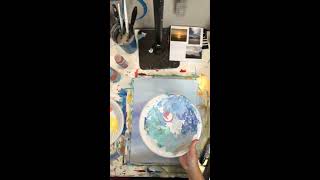
In this 1‑hour live tutorial, Christie Renee Hawkins (owner of The Social Easel) demonstrates how to create an abstract ocean‑sunset painting using acrylic gel medium and palette knives. She begins by revisiting a recent triptych project completed in her membership group, then walks viewers through setting up a simple blended background, mixing colors with gel medium to achieve a thick, non‑dripping consistency, and applying texture with a variety of palette knives. Throughout the session she shares practical tips—photographing work in progress, stepping back to see the overall composition (Monet analogy), and observing real‑world color cues rather than relying on preconceived notions. Christie also promotes her upcoming membership launch (Sept 15), highlights community activities (free dandelion tutorial, contest, mixed‑media practice pads), and announces a collaborative pumpkin‑palette workshop with Heidi of Texas Art and Soul, including a business‑focused guest speaker. The tutorial blends technical instruction, artistic philosophy, and community engagement, encouraging viewers to experiment, practice on mixed‑media pads, and join the Social Easel community.
Chapters
Hey guys, how every— how's everybody doing? Stumbling on my words. For those of you that don't know me, my name is Christie Renee Hawkins, owner of The Social Easel, and tonight I am gonna show you how to use gel medium and palette knives. So if you missed the post a few— I think it was a few weeks ago, I posted and asked you guys what you want to learn. So I have a list of all of those things and Oops, I'm getting a notification on here. And one of the things that you guys wanted to know how to do was how to use gel medium and how to use palette knives. So I am combining those into one quick little lesson for you. Hey Tammy! Um, yeah, so as you guys are hopping on, let me know you're here, where you're watching from, and if you have any friends that want to see it, make sure you tell them about it too. Um, so today I did something really fun inside my membership, which opens on September 15th. Save the date. And we did a triptych, which if you don't know what that is, it is 3 panels, so 3 canvases put together to make one painting. And you can do this on wood or canvas, whatever you want to. I've never done one before and I've always wanted to, and I wanted to do a big ocean scene. Hey Debbie! Hey Shirley! Hey Mary! So, hey Christie! So that is what we did today in the membership, and I was gonna show you guys. I have a time-lapse of it I'm gonna post later, which is always fun to watch. It takes an hour. That was an hour video that I did with my group, and it turned it into 25 seconds, so you can see me speed paint it. But I was gonna take you on a quick little tour in my house so you can see the finished product. So I had to post it on one of my shelves because there is no way for me to get high enough to show it overhead. I really had to configure this little, um, camera holder back here and luckily found another attachment to get it to go high enough that, um, they could see the whole painting. So I am going to show you what we did today Ignore any mess you may see. My office is always dirty. I'm gonna flip you guys around if it will let me. Hopefully— there we go. Hey Lynn, catching a live today. Hey Kelly. So how fun is that? I have beach-themed bathrooms. I have two of them. I have one in my guest room in the basement and then our bedroom. If you don't know me yet, I love being at the ocean. It is one of my favorite places to be. It's my happy place, and I've always wanted to do one of these huge paintings. So can you guys see it okay? Shoot me up some hearts and thumbs if you guys can see that okay, and I'm gonna get a little closer. So this is all with palette knife. Hey Holly, good! I'm so glad you enjoyed the dandelion. If you guys haven't gotten your free tutorial, I will post that link below so you can get your free tutorial from me. Also, we have a little contest going on, but it's only inside our free Social Easel group, so make sure you get that tutorial and you're inside my free group. Awesome, thank you guys! I love all those hearts. So I have to say, this was so much fun. Look at how the palette knife adds all that texture in the clouds. And I'm gonna step back and hopefully not trip on something, but I want to ignore the mess below. I want you to see it from further away because I just love the way it looks like clouds. And then when you get closer, and I think this is important for people to see, Think of a Monet. If you get close to a Monet, it's just a bunch of brush strokes that don't look like anything, but when you back up, it looks like flowers or whatever his subject is. So same thing here. So when you're doing this at home, you may think, oh, that just looks like a bunch of, you know, strokes next to each other, doesn't look like anything, right? Just looks kind of messy. But when you back up It turns into clouds. It's almost like an optical illusion, right? So this is really important, and this is something that I tell everyone inside my group. When you are painting, you want to always take pictures of your work while you're doing it, and you want to— I'm going to turn you guys back around now— and you want to and take pictures if you can. I, because of my setup, I can kind of record what I'm doing and watch it live. But as you're working, I can look at my video and see what I want to change. But take pictures as you're working along, because when you take a picture, it looks completely different than what you're looking at. It changes the perspective, and it allows you to see things that you really like or that you don't like. And it gives you a better idea of what it's gonna look like when it's hanging on the wall. Thank you, Mary. Just got back from the Bahamas. I want to go there. Oh, how fun! Thank you, Linda. Okay, so here's what we're gonna do now. I'm not gonna do the exact same thing again. That one was over 3 panels. Those were all 10 by 20s, so that's a nice big piece of art now that I can hang in one of my bathrooms as a big centerpiece. So really fun. I definitely recommend doing it if you haven't. Before. Find a subject matter that you want to make big. And Teresa said, will you hang these together as they are on the shelf or slightly separate? I haven't decided yet, so I'm gonna play around with it and have Cory help me kind of hold them up on the wall and just see what I prefer, like what I like better. You can do it either way. So hey Christie, hey Sherry. So here's what we're gonna do now. I'm gonna throw you up here in my little camera holder, and I'm gonna flip you around, and we're gonna do something similar but a little bit different. And I'll show you the pictures. That, that was taken from an inspiration photo that I took in Florida, and so that's what inspired that. And I'm gonna show you another one that I didn't paint that I also wanted to paint. We had some gorgeous sunsets there, so that's going to be what we do tonight. So you get to learn about gel medium, you get to learn about palette knives, and you get to learn how to take a photograph and turn it into a painting, or inspired by a photograph. So I'm going to flip you guys around. It's going to be a little crazy for just a second, okay? I gotta get Facebook to recognize me. All right, hang on just a second. Here we go. All right, so I'm gonna lower you just a little bit, but before I do, I'm gonna pull you up on my iPad so I can see what you can see. So if you are new to painting with me, I have a membership that opens on September 15th. You're gonna hear that date a whole lot. I want you to remember it because that's when we open the membership back up. So if you want to learn how to paint, I do 3 paintings per month with my group, and then we either have a troubleshooting technique week or a guest speaker. So this month we are having a guest speaker that is gonna talk all about business because so many of these women in my group are doing so awesome at painting that now they're starting to sell it, and some of them are even starting paint parties. So it's so exciting, um, for me to see the progress of what's happening inside our inner tribe. So tons of fun, and doors open September 15th. And the most important thing for you to remember now is the time to join because the price is going up in 2020. This will be your very last chance to get it at the price that it has been since I launched it. So last chance to do that. I am looking for an apron and I have no idea where I put it. All right. Well, I'm wearing a cheapy t-shirt tonight, so we're just gonna say it doesn't matter. So I am— this is my plate from earlier. Make sure I pull up these comments here. Well, if Facebook will let me see your comments. What is it doing now? Hang on just a second. There we go. No, you went away again. All right, I'm gonna see if this will— I have not had it do this before. Facebook has been glitchy lately. Hey, Lynette. So I'm gonna keep you guys over here so hopefully I can catch what you're saying, because Facebook's being weird and it won't let me change it. And it's also not letting me flip the camera so it's the right way. So this was my inspiration photo. Just real basic colors, and that's what I wanted because those are the colors in my bathroom. Just real, real basic. But I love this sunset picture with these peachy clouds mixed in with the blue. So we're gonna kind of take this as my inspiration. And what I want you to realize when you do this, it does not mean that it needs to look identical to your picture. This for me is not about photorealism. It's about being inspired by what I see and then turning it into my own. I'm gonna get a little bit of this orchid also. I think I'm actually gonna put that over here. We'll put it right here. So my style of painting is loose. And messy and free. So if you see this palette and it stresses you out, that's, that's kind of how— that's kind of how I paint. Let's get just a touch of yellow. See this little bit of yellow down at the bottom of the sky here? So I want just a touch of that, and it's really, really pale, so I want a pale yellow, and I probably don't have one pale enough, which means I'm gonna add some white to it. And these little swirls of white that you see there, that is not white paint, that is my gel medium. So what gel medium does— and you can get this one at Michaels, super affordable. This is a gloss. You can get it matte or gloss. So, and I'm just using regular craft paint. So the gel medium, when you add it to the paint— so you guys see how runny that is? That yellow is really runny right now. I'm gonna add some of this to it. Let me rinse my palette, and I've still got the blue on there from earlier. Hey, Kay! And I'm gonna mix this up so it doesn't change the color. But do you see how thick that makes the paint? That's why people use gel medium, especially with palette knives, because the paint doesn't drip off your palette knife. So it makes it a lot easier. So that's what those are like, and we're going to use these mixtures. But before I do that, We're going to paint a very quick background and we're going to blend. And this is the same thing I did in that one that I just showed you, and this is just to get a nice base color back there so when we add our palette knife brush strokes over top of it, we don't have to worry about it covering all of that canvas. So I'm just getting some like baby blue and white and just back and forth. Easy enough, right? The key to blending and getting a nice smooth background like this is having enough paint in your brush. If you don't— I'm gonna pick up a little of this purple and in there too. If you don't have enough paint in your brush, here's what's going to happen. It's going to start dragging and looking like this, and you're like having to force it into your canvas. So we don't want to mess with that. There's no reason that we should have to. So we just want enough paint in here that it glides super smooth. It's not tugging or pulling. And my ocean is not a ton different in color. Teresa, this is an 11 by 14 canvas board. So a board means it's not canvas wrapped around a frame, it's just a, just a board. They're really cheap and it's a great way to paint on canvas and then you can frame them. If you don't have room, if you're limited on space, the, the canvas boards are awesome for that. I, you know, I should have turned this horizontal, but that's okay. We're gonna leave it like this. I'm gonna grab a little more. This is going to be my watercolor down here. But see, it's already pretty with just the blending, don't you think? And then my watercolor is just a little bit duller. And again, these are just leftover colors that I had. That sky is really, really vibrant. And even my sand almost has a bluish tint to it in this photo. We'll add a little bit of brown and blue, so we're going to do a little color mixing. I love color mixing. See how that just tones that brown down, gives us a nice subtle ground. And it may seem weird that I'm painting the sand that color, but again, I want you to look at the photo that I'm going off of. This will help you because sometimes in our brains we're like, oh no, sand has to be brown, so I have to paint it brown in every picture that I do of it. But you don't. Look at— can you guys see that okay? I'm trying to make sure I'm holding that right. In this picture, that sand is like a bluish-gray color. It's not actually brown. So something to think about. Look at the way colors look in nature instead of what your brain tells you it is. So our brains say all greens are— or all trees are green, so I have to paint them all green. But in reality, depending on the way the light hits them, They're not. So a perfect example of this, if you want to have some art history lessons, go back and look at Monet's Haystacks and all the different, different ways that he does them at different parts of the day and how different they look. So interesting to go back and look at. Thank you, Tracy. I'm just gonna add a little bit more in here. I think I want to touch more of this blue. So that's my background. Now I'm gonna move to my palette knife. Now I mixed that orange and yellow already. I showed you guys. So now we're gonna do a little bit more with these colors. So this is just a pale blue. Any pale blue is fine. I'm not going to use that color. I've already got Blue Harbor on there. This is another shade of blue, so I've got basically 3 shades of blue. I'm going to get some more white. And again, this is not white on that. That is gel medium that I have not mixed yet. Thank you for sharing. So in my white, I want you guys to see this. This white paint is a studio grade. So a lot of people ask the difference between like studio, um, art paint and craft paint. It's the thickness. This is already thick, so I don't have to add any gel medium to it. These are craft paints and they're super thin, so that's why I'm adding the gel medium to them. Long palette knife— this is the one I want. Thank you for sharing, Lynette. This is a fun one. If you have any ocean lovers out there, they're gonna like this one. So again, I'm messy. I'm not worried about this being perfect right now. I'm gonna go ahead and mix this lavender too. I actually want this to mix. See all these pretty colors we're gonna make? I want this to mix with this blue because I want to tone it down a little bit and make it a little bit more purple. All right, so I've got this on my brush or my palette knife, so I'm just gonna go ahead and start with that. Now what I'm doing first are some of my darker colors because this is gonna be the shadowy part of our clouds. Pick up a little bit of white, some of this lighter color here. So you're pretty much covering that smooth background that we did, and now we're changing the texture of our painting to have this rough palette knife look. And I just keep moving. This is not something you want to overwork. Keep in mind, this is— there's layers to painting, and I am keeping my dark over on this side. Maybe lower down a little bit and add another cloud coming in over here because I get warmer. The sun's hitting right here, and that's where we're going to add in some of those warm colors. And maybe add a little bit here right above the horizon line. We want there to be some separation. And I may come back over this. This is going to be a little cloud that comes in, but I've got some warm colors that are going to bounce off of that too. All right, so these are just some of my base clouds. I want these little pockets of different color of blue mixed in here. See how that hint of that orchid color instantly makes that look brighter? So like the sun is hitting the bottom of that cloud. Thank you, girls, for sharing. Hey, Patty! Then I'm going to get a little bit lighter. So again, these are not— look at this photo, do you— you don't see a ton of white in there, right? So we'll have a hint of it, but most of it is going to be mixed with another color. I've got to add some warms in here too, and I want to be careful when I'm adding my warms. So everything on my canvas right now are all cool colors. Then we're gonna go to the other side of the color wheel. I'm gonna lighten this sky up a little bit. A little too dark here. Then we're gonna go to the other side of the color wheel and and grab that coral and that pale yellow. Making sure I'm not missing any questions from you guys yet. Hello everybody! Who's just now hopping on. Is anyone else ready for, um, their kids to go back to school? I love my children a whole bunch, and you guys know I do a ton with them, but do you know how hard it is to work from home while all 3 of your daughters are home from school. It's hard. But the reason I bring that up is because here's my goal: to be on live with you guys 2 times a week for the next several weeks and showing you some different things. A lot of the questions that I've had— again, if you're new to painting with me, I did a post a while back and asked people what they wanted to learn, and this was one of the things they wanted to learn, was how to do palette knife. Okay, look how fun this is. So each week I'm— my goal is Tuesdays and Thursdays, and based on what day it is, I'm thinking Thursday I might want to show you guys fun stuff and new products that I get from DecoArt. I did one of those— was it last week or the week before?— and showed you guys some fun stuff you can do with stencils and to do like some mixed media art. So one of those lives I'm going to show you some new fun things, and then the other live per week I'm going to focus on answering your questions your biggest hang-ups, what stops you from painting, so I can help you get past those hurdles and shut fear up and start to enjoy painting. Does that sound good to anyone? So see how we're starting to add in, and again, this is very abstract, but we're starting to add in some of those warm colors in here. And it's really warm right down here, so I'm just going back and adding a little bit more right where that sun is about to hit the water. Maybe we have just a touch of reflection there. So I have very little paint on there, and I'm just kind of dragging it across. So I've got that warm color in here. Now I'm gonna grab some white and yellow, and I did not wipe off my orange because these colors are going to go together. Then let's add some pops of this yellow. These are such Florida colors. This reminds me of when I was a little girl and we'd go to Florida, and every time we'd get in the condo, these were the colors that they decorated the condo with. I love them. I still love them. I love staying in old cheesy Florida condos too. So there's a lot of yellow-white sky over here. It's really warm. It's not completely yellow though, so I'm gonna pick up a tiny bit of this. So I've got a warm yellowy-orange. I'm going to start working this in, so I'm being careful to avoid any of my wet spots, and I'm just kind of lightly dragging this across. So any of my wet spots of blue, because if they mix, what am I going to get? I'm going to get green, and I don't want green in my sunset. And I do love this palette knife. It's a number 1. It's little. You can control a little bit more with it. Let's add— we need a little bit more peach, maybe a little bit more white over here. So what do you guys think of this style? It's light and loose. It takes a little getting used to. If you tend to be a Type A, this will be a little struggle for you at the beginning. But once you just tell yourself you're just having fun, you're not selling this, this is not supposed to be a masterpiece, this is you relaxing and trying something new. And trust me, it's not like I like every single piece of art that I do. Sometimes you just scrap them. I have people in my membership, which opens September 15th, I have people in my membership buy a mixed media pad, and it's kind of like a sketch pad for painting. And the reason I have them do that is because I want them to get used to practicing And sometimes I think when we just paint on canvas or canvas boards, whatever, or wood, whatever it is, to you it feels final and you feel like you can't mess up. Well, that's no fun. You want to be able to experiment and have fun, right? So that's what the mixed media pad is for, and you can practice, and if you don't like it, just turn the page and start all over again and try again. And Becky, I don't know if you're still on here. Happy birthday, by the way. Becky Walker in my group, she had struggles with getting the sunflowers. It was driving her crazy. She could not get the sunflowers the way that she wanted them, and she kept practicing and practicing, and she nailed it. And she didn't give up the first time. She just kept going because she wanted to prove to herself that she could. And I want you to remember something else about Becky is she had never painted before joining my group. She was brand new to painting in her 70s, never picked up a paintbrush before to paint on canvas, and is now just nailing it and loving it and having so much fun inside the group. And she has learned so, so much. So I'm just going in now. Got white on my side. Just kind of get— I really love how abstract this is. Trying to get those breaks in the waves, but we need some dark. We need some dark underneath those breaks. Then let's get some little purple and blue blended in here. And now I'm just really kind of scraping and blending. This is— oops— this is my sand in the front. And again, that may seem weird to you guys that I'm using these colors, pull a little bit of brown in there with my blues. But in the photo at sunset, that's what the sand looks like. It looks like a purplish blue. It doesn't look brown. Thank you, Diane. And if you guys— I almost forgot, Heidi and I are going live tomorrow night at 7, so jump back on here tomorrow night. We are going live to answer all your questions about our pumpkin palette workshop that we are doing together. So Heidi, for those of you that don't know, is the owner of Texas Art and Soul, and she's one of my friends, and we are collaborating together to bring you guys something super special. I'm going to teach you the pumpkin palette painting and how to build your own palette boards. And Heidi is going to teach you how to host your very first paint party so you can start making some money at this. Even if you've already maybe done a party before, she's gonna give you some extra tips to make sure that they're super successful. Okay, so I am Getting close to— Brenda got her spot. Awesome. Linda said— good job, Linda. She said she always does amazing pieces in her mixed media book. So, and here's the other thing about mixed media. Look, I'm gonna show you this really quick. And yes, I get distracted a lot. This is from my mixed media pad. And this is mixed media. I did this little bird. It's got scrapbook paper on, it's got all kinds of stuff, and it's just on a piece of mixed media paper. But they're 11 by 14, easy frame size to find, and all you have to do is get a frame, paint it some cute color, and you've got an awesome piece of art, um, ready to go. So if you do have a great piece of art from your mixed media pad, don't feel like it's just, you know, in there and you can't do anything with it. You definitely can just frame it. Okay, so I'm gonna do— I'm looking at my colors here. I want to do a little separation. I'm gonna grab some of this kind of a duller blue down here. I'm gonna pull it all the way across. So you can see a little bit more of my horizon line. And I think I'm gonna add a little purple above that. —and it's not in my photograph, but I like the purple. I'm gonna add it in there because it's my painting and it doesn't have to look identical to it. So that gives a little bit more separation there, and I like that. I think I want to add a little bit more up here, maybe just a few, few little spots. And then for our waves, just to kind of crash along this shore. Just gonna drag this across, then we'll come above it, give some separation there. Drag a little bit more across. You can decide how much waves you want in yours. And then I just want a tiny bit A little more yellow up here, and then I'm gonna add a tiny bit to my water, maybe just a touch. More of that peachy color. So that's it, my friends. I hope you enjoyed it. Very abstract, colorful sunset. So you can kind of see my inspiration piece, obviously without the foreground. Area there. Um, and yeah, palette knife ocean. So I hope you guys had fun watching that. And if you have not already, be sure to grab your free dandelion tutorial and to join our free Facebook group because there is a contest going on right now and all the details are inside the Facebook group, but you have to have the free tutorial. So If that link has not already been posted, I will post it when I get off here so that you guys can have access to that. So, um, yeah, I'll be back on tomorrow night with Heidi and we're going to talk all about the Pumpkin Palette. If you haven't seen it, scoot my little paint out of the way here. This is the Pumpkin Palette. And it is so fun. And I'm going to show you— my husband, I should say, my husband Cory is going to show you how to build a palette board. He did a video for me. I'm going to show you how to paint the pumpkin and sunflowers on the palette board. Heidi's going to talk to you about how to turn it into a paint party, and you get the whole workshop for only $20, which is a steal to come and paint the pumpkin palette with me. As your instructor in person is $50 per person, and you're getting this entire workshop for $20. So I'll post that link below. Um, we're going on live tomorrow at 7 to talk about it, and then I'll post the free dandelion. So, um, you guys have a great night, and I will talk to you tomorrow. Bye!