How to transition from climate heating to climate healing
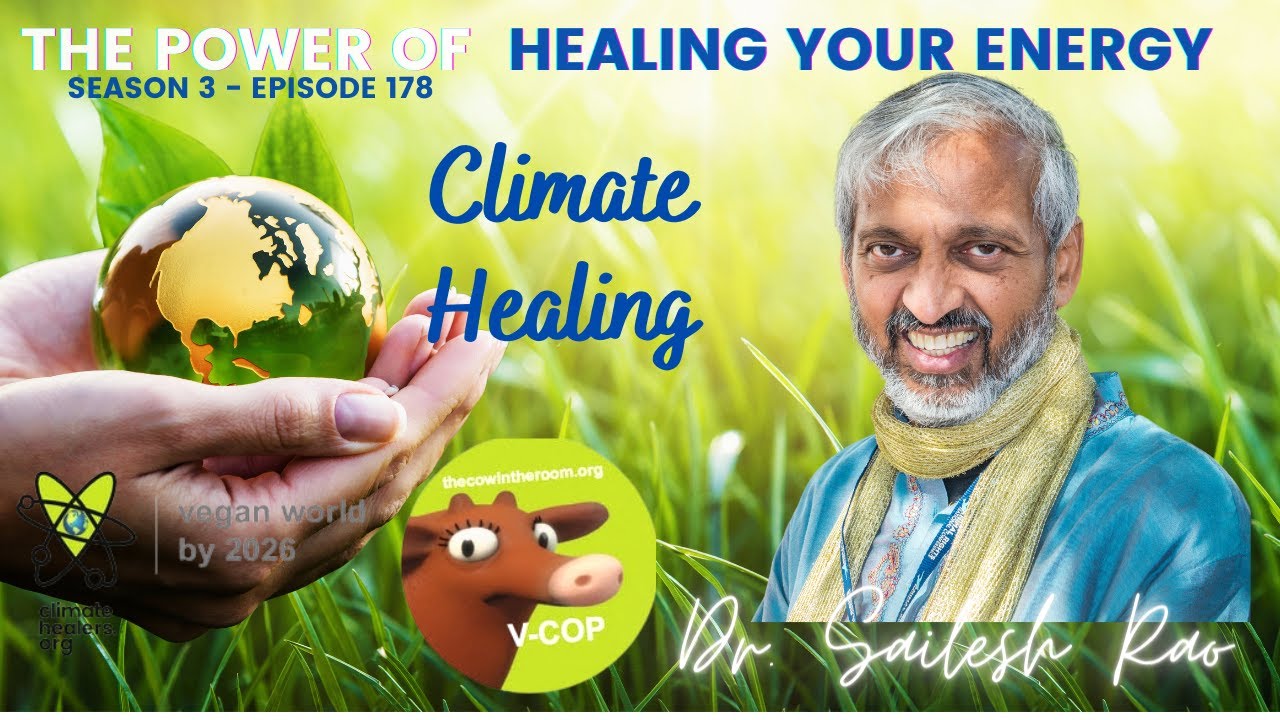
In episode 178 of The Power of Healing Your Energy Show, host Christine J. Gold interviews Dr. Silesh Rao, founder and executive director of the nonprofit Climate Healers. The conversation reframes humanity’s impact on the planet as a necessary "climate heating" phase that created the tools for a subsequent "climate healing" phase. Dr. Rao shares personal stories—his early career shock after Al Gore’s presentation, a transformative visit to India’s Western Ghats, and the influence of his granddaughter—that led him to view humans as a "thermostat species" capable of restoring planetary homeostasis. He introduces several analogies (the elephant that benefits the forest, the bathtub‑faucet model of CO₂ emissions, the "cow in the room" of animal agriculture) to illustrate how current systems are mis‑understood. The core solution he proposes is simple and actionable: eat plants, re‑forest land, love animals, and heal the planet. The dialogue expands into broader themes of conditioning, storytelling, and the shift from competitive “finite games” to cooperative “infinite games.” Dr. Rao also describes the 15‑year evolution of Climate Healers, his research background, and the upcoming Vegan Convergence of the Peoples event—a gathering aimed at mobilizing a vegan, climate‑healing movement. Throughout, the interview blends technical insight, spiritual framing, and practical calls to action, urging listeners to uncondition themselves, adopt plant‑based diets, and participate in collective healing initiatives.
Chapters
Welcome to The Power of Healing Your Energy Show. This is Season 3. I'm Christine J Gold, spiritual medium, intuitive energy coach, old soul healer, and soul purpose mentor. This show is all about your unconditional love, all about your light, all about your healing, and definitely about your soul's purpose. That's why you're here. And I truly believe that healing begins where the ego ends. This episode 178 welcomes Dr. Silesh Rao. He is the founder and executive director of Climate Healers. It is a nonprofit dedicated towards healing the Earth's climate, and he's going to talk about how this is going to be a vegan world by 2026. Hello, welcome everyone, come on in. This is episode 178 and I'm super excited, uh, to have my next guest on. You may have heard of Dr. Rao. I mean, he had— he's had over 3 decades of professional experience and, you know, he's really dedicated, uh, to healing the climate. And I came across him when I decided to sell everything and leave North America and live in an intentional community called Wisdom House. And that was almost 60 days ago. I am vegan and I am a lover of all sentient beings. And when I heard about Climate Healers and what Dr. Rao was doing and what he continues to do and why, you know, he does what he does— well, I'm just going to bring him on because Who really wants to hear me talk? So welcome to the show, Dr. Rao. How are you?
Very good. Thank you, Christine. Thank you for having me.
Thank you for joining us considering you, you know, you have a big event coming up this weekend, which we will talk about soon. And where I always ask my guests, I'm in Lima, Peru. Where in the world are you?
I'm in Phoenix, Arizona, in the United States.
Very nice. Very nice. So before I got, you know, you had a title for the show. I, of course, wanted to talk about the cow in the room because, you know, when I heard you mention that, I thought, okay, this is great. Did you want to maybe talk about, I mean, the episode really is about how to transition from climate heating to climate healing. You seem to have a real, you're a wordsmith. You have a play on words, or where do you get your inspirations from when you're writing?
I don't know. It just shows up, right? So it's, it's, uh, I'm just a channel for, for whatever comes out of me. And I, um, just to give you some background, I was— I, I started working on the environment in 2005, in 2006, when I saw Al Gore's presentation on TV, and I was really shocked. You know, I, I realized that I'm wasting my time working on making the internet 10 times faster, which is what I was doing at that time. And so I decided to focus on this full-time, and within, I would say, 3 or 4 years, I was one of the most depressed environmentalists on the planet because I thought there was nothing I could do. And, you know, and it is just careening out of control. So I thought that we are the only species that does not belong on Earth. Every other species just lives and the planet thrives. And we just live and the planet dies. So it's— so we look— to me, we look like an ecological mistake. Okay, at that point, and this was 2009, 2010 timeframe, and I had gone to this forest in the Western Ghats of India, and I had been observing how animals and insects and plants, how they interact with each other. And I thought that was the most amazing system design ever. You know, to me, nature is the most amazing system design ever. It's perfect in every way except for us as a species. It looked like we did— we are the only ones that doesn't belong, right? And so I had this thought in my mind, and I, and I was observing this elephant, um, breaking branches of trees. So the elephant would break branches of trees, eat the leaves, and throw the branch away, and take another branch, break it off, eat the leaves, throw the branch away. So I asked the owner, isn't that elephant destroying your forest? And she said, "No, everything the elephant does helps the forest." So wherever the elephant broke branches of trees, that's where the sunlight streams to nourish the underbrush. Okay, so nothing in nature is out of place. And I thought, "Wow, if that's true, who are we?" You know, "How do we belong? How do we fit in this?" And I was thinking about this and started doing my research on this. And then my granddaughter was born in 2010. Okay. And I came to see her when she was a month old. And I held her in my arms for the first time. And she looked up at me and she had this knowing smile as if she was telling me, what do you mean I don't belong? I belong exactly as I am. See how perfect I am? And I had this sense of perfection, you know, that she belongs exactly as she is, and we all must belong exactly as we are, and that we're not telling the right story. Because as human beings, we tell stories and we play games, and by doing those two things, we coordinate our actions among millions and billions of us. So I thought, okay, when I tell the story that we don't belong in nature, I'm not telling the right story. And so I started looking for that story where we do belong exactly as we are. And that's how I came across this climate heating to climate healing type of formulation. Because we are a species that has done something absolutely amazing. Actually, if you think about it, we have done something amazing. We have heated up the entire planet. Okay. So that the Earth can never go back to another ice age again. And we did that in this warm period because the Earth has gone through over 100 ice ages in the last 3 million years. And during that time, she spawned us as a species. And she gave us all the tools we need to start heating up the Earth. And we spread from Africa and went all over the world. And we started chopping down forests and we basically heated up the Earth by chopping down forests and raising animals. Okay, raising animals, domesticated animals. So with that, we, we heated up the Earth and now we have heated it beyond where it should be. So we heated it like another extra 1 degree Celsius beyond where it should be. But in the process, we created all the tools and technologies we need to understand that that's what we did. Okay? Because now we have the instruments to measure the temperature. We have the instruments to measure the CO2. We have, you know, so we can now know what it is that we are doing. And now we can become conscious. As a climate harmonizing species that maintains the body temperature of planet Earth, of Mother Earth. It's like Mother Earth said, hey, you know, I've given all of you homeostasis. Like, we have homeostasis. Our temperature stays the same no matter where we go. She says, I want one too. And she created us as a species to create, to help that happen, you know. And I think it's absolutely amazing. And you think about it. And I was so astounded when I discovered all these things. And but it was there all along, meaning, and as soon as we admit that we have changed the climate of the planet, we automatically assume responsibility for harmonizing it. Because it's—
That's a great statement right there. That's responsibility and freedom at the same time with truth.
Exactly.
Yeah.
Yeah. So that's who we are. So then I realized just like the elephant was doing something good, even though it appeared that she was doing something bad, we were also doing something good, even though it appeared like we were doing something bad. Okay, so it's just the perspective. And so climate heating was an essential phase that we had to go through to become climate healers. And so now we have to heal the climate and then we have to harmonize it. And keep it there forever. So we become like the thermostat species of the planet.
Thermostat, I like that. So how, how do we do that?
Well, it is, uh, everything we need is already here with us, you know. So we bring back the forests that we cut, and that will reverse climate change. Okay, so we calculate— I calculated that if you just bring back the forest that used to be there in 1800 And we can do that if we stop raising animals for food or for any purpose whatsoever. Stop, stop, you know, domesticating and enslaving animals. As soon as we do that, all this land gets freed up. And that land, if you just bring back the original forest, you can literally reverse climate change. So we can, we can heal the climate, bring the temperature back down by 1 degree Celsius so that temperature is where it was in 1800. And then our job is to hold it there. And we know how to hold it there. We know how to heat it up. We have been doing a good job of it, right?
Mm-hmm.
So it's just greenhouse gases. It's regulating the greenhouse gases in the atmosphere. It allows us to heat it— I mean, keep it there. I mean, we, we have already done a lot of that work because we have burnt all these fossil fuels.
Yes.
And those fossil fuels used to be underground. Now they are all up in the atmosphere. So therefore, um, it's easy to maintain the temperature there.
Absolutely. And while you were talking, I, you know, I heard the, the frog in the boiling water analogy, but you also have another analogy about the baby in the bathtub water.
Right. Yeah. So the baby in the bathtub analogy is a way to explain how would you solve this problem? How would you solve climate change? So the baby in the bathtub analogy says that, you know, the bathtub has 1,000 liters of water, which corresponds to the 1,000 billion tons of CO2 we have added to the atmosphere. And there are two faucets that are pouring water into the bathtub. One is the burning machine faucet, which is from all the fossil fuel burning. That's pouring about 35 liters per minute. And then there is the killing machine faucet, which is from animal agriculture. That's pouring 15 liters per minute into the bathtub. So that's how we are filling up the bathtub. Okay, so 50 liters per minute. So each liter per minute is like 1 gigaton per year. So a minute is like a year. Right, in this. So the idea is, you know, how would you shut off these two faucets? Because the faucets are also connected to other things, like the— because there is this opportunity cost of animal agriculture, which is all the land that's being used for animal agriculture. There is also the opportunity benefit of burning fossil fuels, because when we burn fossil fuels, we're actually also burning a whole bunch of cooling gases. We are sending a whole bunch of cooling gases into the atmosphere called sulfur dioxide and sulfates. And they are cooling the Earth by about one-third of the heating that we are doing. You know, it's like a— it's like a benefit we are getting from burning fossil fuels. So that benefit will go away when you stop burning fossil fuels. And you have to take that into account from an engineering perspective. It's like, you know, you need to know that you have to take your foot off the accelerator and then put it on the brake, right? You can't just pump the brake and put your foot on the accelerator at the same time.
You can't drive like my mom did with both feet? Sorry, I couldn't resist.
Right. So, I mean, this is a whole planet you're talking about, right? So a lot of lives are involved, are dependent on us doing this thing right. And there is engineering integrity that needs to come into play. But it's all about how now, how do you do these things correctly? So I think of the Earth as Spaceship Earth. And we have been given some responsibility on Spaceship Earth to maintain its climate, to harmonize the climate. And so it's— so which means that we have to do this as if We are all in this together. It's not just all human beings, but all life in this together. Okay. So, and we are serving the other life forms. We are not like the bosses of those life forms. We are actually, we are the employees.
That's a good way of putting it. Absolutely. Yeah.
Because we are, you know, we are maintaining the temperature and the climate for them. Not just for us, for all of them, right? And so absolutely, they are not looking at us saying you're not doing a good job. Um, so wake up, you know, wake up to your climate healing role.
Yeah, that, that's beautiful. And, um, I'm saying hello to everyone who is watching. If you have any questions, um, you know, shoot. I mean, I get asked questions all the time, like the, the animal part. They're like, okay, so somebody said to me the other day. So if we stop eating animals, every single one of us, what do we do with the animals then?
Right, yeah. Well, when you stop eating animals, you won't raise them. So, uh, and that's because these animals don't have their own families, and, you know, they're not like deciding to, to be born. We have human beings with professional titles like cow impregnator. What kind of title is that, you know? I mean, what kind of profession is that? So we had— we need to abolish professions like that, you know. So you don't need a cow impregnator anymore, a pig impregnator, or a chicken impregnator, you know. I mean, you don't need any of those. So then they won't be born. So that's where most of them are coming from. We have factories that produce chickens and send them out to farmers.
Yeah, yeah. I think of the one— I tried to watch this documentary and I couldn't do it. It was just too— I'm very sensitive, so I'd probably have to have— yeah, because I, I just— anyways, I'm a huge animal lover, but I was also a hypocrite. I, I will call myself out. I ate, I ate animals. I did. Because I was disconnected. But now I'm, you know, I think, is that a big piece of it as well?
It is a very big piece of it. You know, this is why we call it the cow in the room. It's like the elephant in the room that people don't want to talk about, the cow in the room that people don't talk about. And it is, we are conditioned to it. You know, we are conditioned not to see things. And we get conditioned from our childhood onward. The reason I know all this is because when my granddaughter was growing up, I basically decided that I was going to do whatever she wanted and not try to impose my will on her, but to learn from her. Because to me, she was very pure. She's coming from a very simple perspective, right? So in the process, I discovered all the conditioning that I had gone through just listening to her. And, um, like I was reading her a story, right, from our epics. And in the first chapter of the story itself, there is this king who goes around shooting deer. He's going hunting in the forest. And she stopped me right away and she said, Why is he shooting that deer? That poor deer was just drinking water in the river. And I said, oh, I didn't think about that. She said, why are you reading me stories like this? I don't want to hear about this anymore. So that was the end of that story. I put it away. Okay, so, uh, I realized that I was read that story as a child. Ah, and I thought it was normal for people to go around shooting animals.
Mm-hmm. Like, I think of Bambi.
Yeah, it's like we get normalized to these things. We are being— we are told stories to make us think that this is the way it is. This is the way life is, right? So that's how we get conditioned. And from that sense, you know, we are a very good herd animal, meaning we have a herd of 7 billion, right? 7.8 billion people. We are all one herd, really. Because we bought into the same stories, you know, the story of United States, that's a story. The story of countries and national boundaries, those are stories, right? So we buy into these stories because it's being drilled into us as children. And so it's about unconditioning ourselves from those stories and then looking at things afresh and saying, how would you really do this if you if your job was to, you know, become climate healers from climate heaters.
Yes.
Yeah. And so some of us, you know, I mean, I've been working on climate healers at Climate Healers for 15 years now. You know, and so, and to me, it's a process, right? We understand how do we retell stories and tell different stories and then play different games. Because if you look at all the games we play right now, they're all competitive games.
Yeah.
And we figure out who's better than who, you know, and, and in that game, human beings are the winners in the game, right? We, we beat all the other species. We are more, so much more powerful than all of them. And so we think we can do whatever we want with them, right? We can kill them, do whatever we want with them. But if you kill them all off, you're gonna die too. So when you realize that, you say, wait a minute, you can't play this game forever. I mean, it's the winning and losing game. At some point you have to stop doing that and start playing infinite games.
Yes.
And so the infinite games, infinite games, the purpose of the game is to continue the game as long as possible. Keep going. That's what sustainability is. Sustainability is about playing infinite games. And I discovered this also when I was playing with Kimaya, my granddaughter, because she hated games where there is one ending, you know, one winner. And when she was playing hide-and-go-seek with her dad, and one day her dad did a really good job of hiding, so she couldn't find him. So she came to me crying, and she said, I don't like this game. From now on, I'm going to tell you where to hide. That's what she started doing. She would tell me where to hide, and then she would pretend to look for me in other places because it wasn't about finding, it was about just playing the game. That's what she enjoyed, just playing the game. And, um, so that's when I started thinking about, oh, that's the kind of games we play, right? So if you think about the games we play, like baseball or soccer, there's usually a ball that's made from the skin of an animal.
Hmm.
So it shows our domination of animals. Okay. So it's sort of built into us. And then we beat the heck out of that ball.
Yeah.
That's also our way of saying how powerful we are.
Hmm. Oh yeah.
Who's more powerful than the other, right? So, and then there's one winner and the rest are all losers. At the end of it. Okay, so, and so that's the kind of game we play, and it's a game even in our economy, we play games like that.
Oh boy, do we ever.
Yeah, and those games have only, you know, have only one outcome, which is total annihilation for everyone else and one winner, so to speak, right?
Yeah.
And that's not where we want to go. We want to end up in a game that's infinite. Where we can thrive forever. For that, we need to start playing infinite games among ourselves as well. So we need to change the game of baseball, change the game of tennis or any of those games into something that you can play forever. Like, you know, I mean, I was playing Chutes and Ladders with Kimaya.
I remember that game.
Yeah, and so she suddenly started saying things like, you know, I mean, I don't want to go to the end and finish. I want to now, instead of climbing up a ladder, I'm going to climb down a ladder, and I'm going to, instead of going down a chute, I'm going to go up a chute. So she was moving around all over the place, and that was the game. It's basically, it's the play that was more important to her than, than, uh, actually getting to home base, right?
And that's an important thing is we need to play more. And that's something a lot of the work that I do with my clients is inner child activations, because it was shut down and playing and knowing your unlimited and law of attraction and all of that, because we, we forgot, we just forgot. That's all.
We get conditioned out of it. It's always there. It's in our mind still. Okay, it's just that it's buried.
Deep. Yes.
And we can just unearth it and we'll get it back right away. It didn't take me too long to figure out that that's what she was trying to do. And then I said, oh, wow. And I would love to live like that. Playing infinite games where we don't hurt anyone. You know, we are here to heal as opposed to heat.
Yes.
It's a different mindset altogether.
It is. It's not about me. It's about we. And, you know, collaboration, co-creation, connection, community, right? 2022 is all about that and the relationship with self and then the relationship with others. That's the big, big component. And thank you for, for doing this work for 15 years. I mean, um, you know, did you want to talk a little bit about the internet? And, and I mean, you're— you've got a PhD from Stanford in, in engineering, do you not?
I mean, yes, yes, I have an engineering degree and I was working on the internet back in the '90s. In fact, I'm connected to this program through a link that I created.
So amazing. Come on, you guys. Like, you know, you, you, I think you said you've done harder things. I heard you say that once.
Yeah, I mean, for me, that was complicated. And, you know, in the sense it is That was more complicated than what I'm trying to do now, because what I'm trying to do now is actually fairly simple stuff.
Mm-hmm.
Okay. Convincing people to eat plants, plant trees, love all animals, and heal the planet. That's it.
Yeah. You got your notebooks, guys? It is so simple. It's not 22 steps. It was what, 4?
Yeah. Eat plants, plant trees, love animals. And heal the planet.
Perfect. All right, I'm on board. Anybody else? I'd love to have some comments, or, you know, send, send them your, you know, send them my way. If you have no idea where to start, you can start with this talk, and you could start, start with Dr. Rao, and you can start with Climate Healers. Uh, did you want to talk a little bit about that? Because I, I went through all of the presentations, and let me tell you, I learned so much. Much more than my ego would like to think. So this was a perfect opportunity to really educate yourself, because really, I was ignorant. I will say that. I was ignorant. I throw myself out there all the time because if I'm going to walk the walk, I better talk the talk. So you want to talk a little bit more about Climate Healers and, and the site and what's coming up this weekend as well?
Sure, sure. Yeah, so Climate Healers, I started in 2007. And the— it was a response to the training I got from Al Gore, because I went and got trained by him first. And I was giving his presentation out to people. And then during the training itself, I asked him about animal agriculture. I said, if you bring back the forest that we cut, can we not reverse climate change? And he immediately turned to Roy Neal, his chief of staff, and he said, how did this guy get in here? Wow. It was clear that he didn't want to talk about it. And so then I said, you know, come on, I cannot do that as an, as an engineer. Everything has to be on the table. If you really want to solve a problem, everything has to be on the table. Okay, you can't say I won't talk about this, I won't talk about that. No, because that's maybe where the problem is, right? So that's when I started Climate Healers in 2007, uh, as in order to heal the climate as opposed to, um, as opposed to figuring out how to make money from it or maintaining it at a high rate of disrepair or whatever it is, whatever other agenda was going on there. So, and then I decided to do a lot of research work first. So I, I mean, I did a lot of practical research work and theoretical research work. I was going through the, uh, UN IPCC reports. I went through a lot of the scientific literature, and I also went to the forests of India and the forests of Africa, and I started working there, you know, um, with the, the women in the villages of India, and they taught me a lot, okay? And I would say they taught me more than I learned from my, from my research work in papers.
Yeah, you had hands-on learning.
It's all hands-on learning at that point, you know. And so that's how, you know, if you look at the website Climate Healers, it's a, it's a product of 15 years of research work.
Okay.
And it's basically systems research work that I did. And it's— I've never really worked on a problem for more than 3 years at a time or 4 years at a time. But this is the first problem that I had to work 15 years to figure this out, to figure out where we are and what to do about it, you know. So, and I'm saying I don't yet know everything, but I know I have a pretty good idea of how would you address the system. And this is why I said, you know, it's just 4 simple things: eat plants, plant trees, love animals, and heal the planet. And yet when you go to the UN meetings, I went to UN COP26 in Glasgow.
Mm-hmm.
No one wanted to talk about eat plants, plant trees, love animals, heal the planet. No one wanted to talk about that. That's the cow in the room that everyone is trying to ignore. When you talk about pandemics, the leading cause of pandemics is animal agriculture. And yet no one talks about the cow in the room. Okay, Fauci doesn't talk about it. And yet we are looking for, you know, miracle cures like vaccines. And yet we are continuing to do this exact same thing that spawned a pandemic in the first place, which means another one is going to come whether we like it or not. If you keep doing this, you're going to get another one. Okay, so we talk about chronic diseases. And there is also, there is also a cow in the room there because people talk about metformin instead of figuring out how to eat right so you don't ever get diabetes in the first place. It's because there's a lot of money being made on metformin, just like there's a lot of money being made on vaccines. And, and they also look about, look at all the money that can be made from, uh, solar panels and wind power. Instead of talking about how do you really heal the climate. So that's the cow in the room. And the cow in the room has to be exposed and addressed if we are serious about healing the climate, if we are serious about addressing climate change. And I'm saying climate change is something that you don't want to mess around with. Okay. This is not a money-making opportunity. Because if you treat it as a money-making opportunity, we are all going to die. It's as simple as that. So it's your mess. You're playing with the climate system of the planet. And there are all kinds of nonlinear feedback loops in that climate system. And as an engineer, I have studied nonlinear feedback systems, and I can assure you, you don't want to go there.
Oh, I would agree with that.
You don't want to go there because I've seen things happen in nonlinear feedback systems that are completely unpredictable, that no one can— I mean, no one knows. Okay, if someone tells you, we know we can do that, we can increase the temperature by another 1 degree Celsius and it'll be fine, They don't know what the heck they're talking about. Okay, because nonlinear feedback systems are completely unpredictable. And so, uh, Jim Hansen has said that if we keep burning fossil fuels and burn everything off, the Venus syndrome is a dead certainty. And he did his PhD thesis on the— on Venus. Okay, he understands the Venus syndrome. What is the Venus syndrome? If all the greenhouse gases are in the atmosphere instead of being in the ground, the temperature on Venus is 450 degrees Celsius. 450 degrees Celsius is double the temperature of your oven.
Yeah, I was gonna say that.
Yeah.
Wow.
Nothing survives in that. No. Okay. So No. Yeah. So you don't want to mess around with this. Okay. I mean, we have, we have already triggered a lot of nonlinear feedback loops in the Arctic with the ice melting away, with the permafrost melting away, methane bubbling up from the permafrost and so on. And we know that there is enormous amounts of greenhouse gases there. So I'm saying now is the time to get absolutely serious about healing the climate. And that's what the weekend event is going to be about. This weekend, it's called the Vegan Convergence of the Peoples. And this is the 8th Convergence of the Peoples that's happening, as opposed to the UN Conference of the Parties.
Yes.
It's also called COP, UN COP. And there they have met 26 times. In over 26 years, and they're still not talking about the cow in the room. That to me is not serious, not taking things seriously enough.
No. Yeah. It's almost like a party. I feel like it's a party.
It is a— I've always wondered what the heck is going through their minds, you know, because they need to understand this too. They probably understand this too. Because they have engineers who understand positive feedback systems, you know. I mean, I'm not the only one who understands these things. So why are they still doing it? And the only thing I can think of is that they're trying to engineer a depopulation of the planet or something like that. Mm-hmm. I think that they can just, they can just say, uh, we didn't do it, nature did it, you know.
Yeah. Oops. Oops.
Yeah, it's one of those things. Whoops. And I said, no, you have— you are going to bear responsibility if we let this happen. And so I bear responsibility if my granddaughter is hurt. I take full responsibility for that. And I've said to people, you know, if anything hurts even a single hair on her head, I will do everything in my power to prevent that from happening.
I totally agree. I'm with you. And it's not just for one generation, it's for— you got to think like multiple, many, many, many. And YOLO does not, you know, compute anymore. I'm sorry, there is no more YOLO, you know, you only live once, because guess what? You reincarnate. So anyways, that's a whole nother discussion. Um, so yes, it's this weekend. You have a ton of guests. Um, all the links are there, and, and And there's— you're also giving away a free gift, Carbon Yoga and Carbon Dharma. So if anybody would like to be entered to win a copy of Carbon Dharma, you can comment Carbon Dharma and/or Carbon Yoga. So you have a chance to win two books and maybe you win both. I have no idea. So I'm going to leave this contest open for a week.. So it gives people a chance to, you know, catch up whether you're watching or you're listening on your favorite podcast. And here is the event poster as well. So you— I put all the links in there. You have to register. It's through Facebook, the main page, and then you register. But some of the guests, I mean, um, we have a keynote, the Million Vegan Grandmothers and the Wisdom Carriers Pledge. With Tammy Hay and guests. We also have— I mean, you might know this, this gentleman, Captain Paul Watson from Sea Shepherd, and he's talking about save our oceans to survive climate change. And then, um, Vega the cow and Silesh and maybe myself, we are going to be screening Don't Look Up. I mean, who has not seen that, uh, who has not seen that yet on Netflix? If you haven't come on over and, uh, we'll enjoy it together. There's so many aha and epiphany moments in that movie. Um, I won't even start talking about it yet, but, uh, and then I'm going to be hosting a Rainbow Reiki meditation with Vega as well, and it's a global healing Reiki share for everyone, for Mother Earth, for all sentient beings. So I really hope you will be able to join us. All right, um, I always ask too, um, and I pretty much I have an idea of the answers, but maybe you'll surprise me. Um, how can we as a collective energy help make your dreams come true? I always ask, what's your Moby Dick? What's your big whale? What's something that all of us can do to help you?
Well, you can do thing— do something 3 times a day to heal yourself, to heal your body. Eat the right foods, eat healthy, whole plant foods. Okay? And that heals your body, it heals the planet, it heals the animals. And that's the best you can do. Because to me, it's about healing ourselves first. This is the oxygen mask rule. And then we can go out and heal the planet.
Yes. Love that. That's again, so easy. It's, it's not complicated. It's not complicated. And this one, I, what does magic mean to you?
For me, magic is my, is my granddaughter. She's, she's the magic in my life. You know, she came when I was so depressed and she turned my head around.
Yeah, I love that. That's beautiful. That's beautiful. All right, is there anything else you'd like to share with us? Um, any last words?
Yeah, I mean, we are in the greatest transformation in human history, so I'm so glad that we are all alive at this time to make this happen. And, uh, it's my privilege to be walking with you on this journey.
Couldn't have said it better myself. I absolutely agree. I'm so glad we, uh, crossed paths. And, uh, if you guys are inspired, uh, as much as I am, or maybe you're a little bit curious, or maybe it's bringing up a whole bunch of feelings you thought you, you never felt before, feel free to reach out to us, even out to Climate Healers, um, you know, maybe even sign up and start going through all the, the documentaries like Cowspiracy, Seaspiracy, What the Health. I mean, there's so many out there. There's really no excuse not to at least have the curiosity of a child's mind and just explore and play, if anything. All right, well, thank you so much for being here, and, uh, please remember everyone, healing begins where the ego ends. Take care.
More from Christine










Your coping skills didn't fail you, menopause did #menopause #health #plantpowered
