Money Money Money
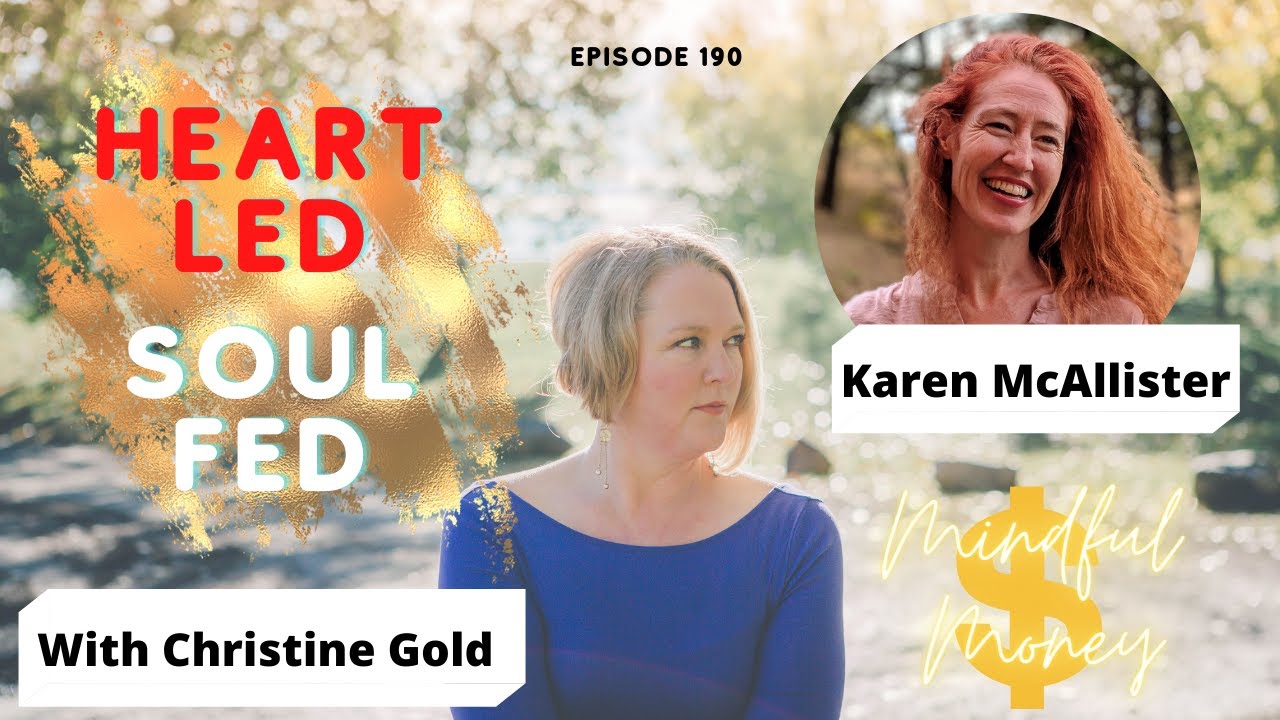
In this live episode of the Heart‑Led Soul‑Fed Podcast, host Christine J. Gold interviews Karen McAllister, a certified money‑and‑business archetype coach, nonprofit leader, and spiritual seeker. The conversation explores how cultural history, family ancestry, and the modern “animal brain” drive anxiety around money, especially for empaths and lightworkers. They introduce the Money Archetype framework (Warrior, Magician, Fool, Creator) using a car‑seat analogy, explain how each archetype functions in daily financial decision‑making, and discuss the “stopper clutter” that blocks people from acting on their intentions. The dialogue weaves personal stories, global examples (Ireland, USA, Canada, Japan, Brazil), and practical advice such as taking the 8‑Money‑Types quiz, free 30‑minute consultations, and integrating spirituality with a quadruple‑bottom‑line approach (financial, environmental, social, spiritual). The episode ends with encouragement for daily mindfulness, boundary work, and embracing magic as ego‑transcendence.
Chapters
Welcome to the Heart Led Soul Fed Podcast. This is Season 3. I'm Christine J Gold, and yes, formerly known as The Power of Healing Your Energy Show. Let's go. This is a live show and podcast all about love, light, intuition, and your soul's purpose. This is episode 190, and we're welcoming Karen McAllister. She's a certified money and business archetype coach, nonprofit leader, and spiritual seeker. Depression and anxiety are a side effect of not living your life intuitively, not trusting your gut, the lost connections with yourself and others, and I truly believe healing is the end of conflict within yourself. And that healing begins where the ego ends. My first book, Intuition Saved My Life, is a guide for empaths, lightworkers, and sensitives, and it's available on Amazon now. Unleash Your Soul's Purpose mentorship is now open. Work with me and other souls either in a 6-month program or a 1-year mentorship. Our third annual Annual Christ Consciousness Summit is back April 29th and 30th from 9:00 AM to 3:00 PM, live streamed or on the replay through Facebook and YouTube. Become part of our Patreon community where you get exclusive benefits such as shout out on all videos and audio. And I want to thank my two Patreon supporters Giete and Catherine. Replays can be found on Facebook, YouTube, and Anchor FM. Please like, subscribe, and follow. We are live every Wednesday at 3 PM Eastern. And I want to give a shout out to my— everyone, hello, hello! Thank you so much for being so patient and waiting for us. As you know, We are not all connected, uh, like North America is where I am, so I appreciate you all waiting. And come on in if you're new, say hello. If you are a fan and a lover of Heart Led Soul Fed Podcast, please say hello as well. Let us know where you're from and let us know how your day, evening, week, or month is going. And today I want to introduce Karen McAllister. And as I had said in, in the intro, I've learned— I've actually taken her money archetype quiz. And you're probably thinking, what is that? Well, that's, you know, we're kind of going to talk about that a little bit. But enough about me. And, you know, really, it's about my guest. And welcome, Karen. Thank you for coming. Thank you for being so patient.
You're welcome. I used to live in Brazil for many years, so I, I, I would go to the same things you do, living and calling in from Peru. So I understand.
Wonderful. And maybe, um, let us know where you are in the world. I'm in Peru, and you are?
I'm in the interior of British Columbia in Canada right now.
Very nice. Kind of where I came from, uh, originally, almost 6 months ago. And maybe you want to talk a little bit about yourself and about your center as well before we kind of dive into this money, money, money debate topic.
Yeah, thank you, Christine. Thank you very much. And it's just such a pleasure to be here, and I really appreciate you inviting me to talk about my work on your beautiful show, on your Heart-Led Soul-Fed podcast. I love the wording of it. Yeah, I'm calling in from Clear Sky Meditation and Study Center in the interior of British Columbia. And it's a center for transformational change. It's a meditation center. And so we're here about helping people to awaken more fully, more deeply. And we're all about the downgoing of suffering and helping people to wake up really to the idea that there is no self. There is no solid, definite self and that we really are, as I love what Christine Christine says about us being lightworkers, that we're really empath lightworkers trying to do our best in the world. Yeah, so a lot of my work, I started here in the, in A'Klir Sky at the center with the international membership. So a lot of people that I work with are spiritual seekers or spiritual explorers. And my work in the center since its beginning has been about the integration of the material and the spiritual. It's helping particularly spiritual explorers to not dissociate around the field of money and to actually integrate it into their lives and embrace it. And it just makes them much more effective as spiritual people in their work and in their relationships and then in their lives. So it's been a— I guess, how old are we now? We're 14— we're about 18 years old, 17, 18 years old. And so I've been doing this work for longer than that, but more or less 18 years, and, and starting with people who have a spiritual practice or who are spiritually inclined. I don't know, does that answer your question? Does that give you an overall feel of the place?
It does. And one day I'd love to visit, not just, you know, travel, astral travel as they say, and imagine, you know, that I'm already there. Thank you. Thank you so much for the work that you do. I mean, you've been doing this for over 20 years, and you've also traveled the world as well. I wanna— you talk about money issues, but you talk about them globally. So how is it different, let's say, from Europe to Japan to Brazil to North America, or is there a difference?
Yeah, there are a lot of differences. Money and how people manage their money or their relationship with money depends on the history that they come from. So if you take my own country, Ireland, you know, we have a history of colonization there. We've been colonized by the English and then by the church. And so that does have a direct effect on how people manage money or are with money or their anxiety levels or depression levels around money. And I feel like, well, for Ireland, I think it's more that there's never really been that history of having a lot of stuff or money in their history. So I think when the Celtic Tiger came along in 1996 or 1997, there was a huge focus on accumulating stuff because it was the first time in their history that they weren't, that they had money and they could buy stuff. And so it's what we call the Fool archetype in Money Archetypes where, you know, you just spend and spend and spend and accumulate and there's no actual research or thought behind it. So there can be the Fool archetype and also the Victim archetype, right? In Irish culture where people, you know, have a, you know, very suspicious around money and there's a feeling of, you know, maybe I'll be betrayed somehow. So there's a lot of, you know, stepping back around money, right? Whereas if you look in, say, the United States, they're much more— they have money as a value in their culture, right? So a lot of other countries don't have money as a value. So I think it started with the United States, where Americans tend to equate their worth with their financial net worth. You know, so it's much stronger in the States and what you do and who you are and how much money you have is very, is much more important as a value. If you take Canadians, Canadians and Japanese are the best savers in the world. They are the ones that save the most money. A lot of the research says so. There's a much more of a, you know, focus on saving in their countries. I could go on and on about different countries, but it's very interesting. It's very reflective of the sort of histories that they've gone through.
Yeah, it's interesting that you, you talk about— oh, it absolutely does. I could just see all the areas. And, um, I— when you talk about Ireland, I think of Peru, um, in the same sense. I see a lot of buying, a lot of, um, instant, you know, just buying whatever. And, and it's just interesting to see.
So, uh, being in a different country, so, um, so further Sorry, further to that, Christine, I recently worked with a client whose parents were refugees, came from a war-torn area in the East. And so, you know, how it showed up in her life, you know, even though she— they are now Canadian citizens, is that she has a good job, she has savings, she has a mortgage, but there's still a feeling that she doesn't know and a feeling that she's going to be a bag lady, that the feeling that she just doesn't have enough. And so a lot of that not enoughness or chronic sense of not enoughness is coming from her history of her family and being boat people, um, when they came over there in, in the last few centuries, the 1990s, I think, 1980s, 1990s, you know. So that had a huge effect. So a lot of my work with her was dealing with that part and healing that part of the history of the family.
So why, why do you think it's so hard to talk about money or even feel safe around finances? Is it mainly ancestral? Is it a combination of things?
Yeah, I think it's a combination of things. Um, yeah, so first of all, you know, we're not very close to our food anymore. Um, you know, we buy our food in supermarkets. So, um, yeah, so therefore money takes on a bigger thing in our mind. We don't grow our food anymore. So, um, food is money. And so there's Do we have enough food? Do we have enough money? Do we have enough resources to get by? Do we have enough resources for the future? So that's tied into our amygdala, or what they say is the animal brain, or the fight and flight brain. So, you know, in these COVID times where there's been a lot of people who've lost their incomes and there's been a lot of uncertainty and a lot of volatility happening, this can trigger our animal our fight and flight brain. And then people who already feel a sense of not enoughness in their being can be really triggered if their income reduces or the cost of living is going up. So there's a lot of triggers today that will trigger that part of the brain. So that's one thing is the animal brain. Then second thing, definitely the history, watching mom and dad. And of course, nobody talks about money. We're educated about how to build a budget. There's loads of apps out there, right? There's loads of courses that you can learn how to do a cash flow or how to to work QuickBooks or how to invest, but nobody really talks about the emotional and psychological makeup of how they are with managing and being and spending and earning money, right? Which is the very core of how we make financial decision— decisions in our life, right?
Absolutely. I mean, I work with that with my clients with that as well. So it's— and even myself, you know, I— it took a very long time um, you just, you just don't talk about it like you say, or, um, you feel afraid of it, like you don't even know where to start and you're overwhelmed. There's just a whole bunch of things. So I'm so glad that you're doing this type of work because I feel that really, um, is, is our, is our root chakra. That, that's our foundation of everything. So you need a foundation just like anything else. Like, you don't build a home out of sticks. I mean, you could, but something big comes along like, you know, COVID, or, you know, losing a job or a significant partner or whatever it happens to be. There it goes. It's like the Three Little Pigs and the, and the bat and the wolf, right? There goes the house.
That's a really good analogy.
So I took, um, and this is something that you're going to gift, um, to the people that join and ask for, um, to take the 8 Money Types or the Money Archetype Quiz. And I took it, and I was— I was— I had an idea where I sat, but you really enlightened me in regards to, um, the Magician, uh, the Warrior. I believe the Fool was in there, and then I'm trying to remember the last one, but you, you basically said one was supposed to sit in the front and not the back. I like that analogy about the car. And did you want to talk about that a little bit?
Yeah, sure. So the money archetypes, uh, first of all, I just wanted to, you know, tribute my— the inventor of the money archetypes, which is Deborah Price. And so I use her. She's from the Money Coaching Institute in California. So just a shout out for her work that I have been privileged to use over the years. And, um, she talks about a car analogy, which I use, which I think is very, very useful. And, and for having a very healthy relationship with your finances, you sort of need to have the Warrior in the driver's seat. And the Warrior or Hero part of you is that part of you that implements your, your financial plan, that tracks your expenses or tracks your money coming in and out, that pays attention to your budget, that researches when you are about to make any kind of investment in yourself or in your business or whatever it it has a set of criteria that you use in order to make a good financial decision for you, taking into account all aspects of your life. So that's sort of the archetype of action. It's the implementer. And of course, you know, you have to— there's many voices in our head, you know, so we want to have the right voices talking to the right voices. And so in the passenger seat of the car, you— or the navigator seat of the car, I like to call it the navigator— is Magician archetype, or the Sage sometimes I call it. And that, that's part of you that's watching your Warrior, making sure that, um, the action is in integrity with where you're going. Um, you know, are you being too tight? Are you overspending? Are you being too loose? Um, what else? It, it looks to make sure that your money is flowing to your highest good. It's flowing towards your mission if you have a business. It's flowing towards your vision or your life purpose, your personal vision in your life. So it's always making sure that it's not taking shortcuts and going down alleyways or going in wrong directions. Um, and so it's that internal self-reflective part of you. So those two, the Warrior and the Magician, need always to work together. They're in your financial life every day. And so it's just a really nice way of getting to know the behaviors you need in order to feel quite financially balanced in your life on a daily basis. So it's pretty cool. And then the back seat of the car, you want to have two archetypes called the Fool and the Creator Artist. And they're in the back seat because you don't use them every day. Um, you take them out, they— you take part, you take these behaviors out and you start behaving in this way, say for example when you're in transition. Right? When you're changing careers or suddenly you've lost your job or suddenly you have a health crisis or— I'm just thinking of some of the issues that people are facing today during COVID times and then you take out your creative artist and go, okay, you know, let's get back to the drawing board. Let's start to creatively look at how I manage this new crisis or this unexpected huge expense or a loss of income or so forth, so forth. And, and you start to brainstorm, and that's when you use your Creator Artist. And once you have a few ideas in that, then you want to get your Warrior to go out and go out and do the research and see if this is a good idea. And also your Fool. So your Fool part of you is the opportunity person. It's that part of you that's okay, I know my vision, I know my new product, I know the career I wants. So who are the people?
What—
where's the support system I need, right? Um, you know, it could be in the form of you need to get a loan from a bank manager, you need to talk to a financial advisor about, you know, your, your change in, in where you want your money to go. Um, it could be looking for promoters who will promote your work in some way. Um, it can mean very thing— it can mean very different things to very different people, but they're the main 4 archetypes you kind of need to have in your car to have a healthy relationship with resources. And I, I say resources because it's just not finances, um, in, in its resources in general, right? Does that help?
Oh yeah, I'm— now that you brought up the four, I'm like, okay, I'm putting them in the seat. I, I now remember them all, so, and I appreciate each, you know, each role that they have and And I even see, you know, a lot of the people that I work with or that listen to this show or watch the show, they've got— I know that they've got the Warrior and they've got the Magician. It's just a matter of really stepping in and owning it, as you said, right? And letting— it reminds me of ego as well, where I would describe ego used to sit here and block, you know, your one eye, your third eye. Now it sits in the back, like the back seat, right? It no longer drives our, our soul and who we are and why we're here, right?
Yeah, that's, that's beautiful. I'd even say, well, to put it in the right place, like to, to have it be the cart rather than the horse, right? A lot of people have their ego ahead of the horse and the horse can't move. The horse being an analogy for awakening or your higher purpose, right? So getting in your own way, getting in your own way, not able to get out of your own way is a really nice way of putting it. I hear many clients say that I got into my own way and realized I have read all these books on money, I have done all these courses on money, and it's still not getting— it's not putting the horse in front of the cart. It's still the other way around. I think somebody called it what was it, stopper clutter. Have you heard of that? I just heard about this the other day. Stopper clutter.
No, I have not.
Can I tell you about it? It's very interesting.
Go for it.
Yeah, well, you know, you have your normal clutter, you're in your house and you know you want to get rid of all those books that you don't read or all those clothes that you don't have. Well, stopper clutter are deeper than that. It's that part of you that you end up saying you know, I really want to do this and I never end up doing it, or I, I've— I want to stop doing that and I never end up stopping doing that. And what is going on behind that? So these, these deep, deep patterns that were built very young for our protection that get ignited and stop us from actually getting ahead and doing what we need to do in this lifetime for ourselves, right? And somebody called it stopper clutter. Which I thought was very interesting. And it's like a, you know, I guess in a drain when you have that stopper clutter prevents the clutter from going down the drain, right? I think it's just a very powerful image. Does that work for you?
Or it does. I can see it. I mean, it kind of reminds me of all those hoarding shows. Do you remember those?
Yes.
I don't know if they still have them on, but they would come in and stuff would be up to the ceiling. And it's all— it's just like, you know, anybody that has a really messy desk, they're like, well, you know, this is a creative flow. And I'm like, there's no way. Um, how can you see? How can you vision anything when you're just surrounded by stuff? It just becomes part of you, and it becomes a burden. It becomes heavy. Um, it might even take on its own personality. That was interesting. That just came in. So, well, that would make sense why some people do have some mental health issues around that as well, right?
Actually, can I, can I add something there? Because just what you said, I'm thinking of your, your audience or people that, that are really a great fit for your work, Christine. And you, you talk about empaths and lightworkers and My experience of, of people that are very, very highly sensitive is that they're not really actually into accumulating much stuff. It's not important for them. You know, this spiritual practice or awakening or, um, you know, being very in touch with that energy world is— and being in touch with spirit is, is the most important thing for, for lightworkers and empaths. Would you agree?
Absolutely. It is my bread and butter. Not that I eat bread or butter, but it's everything for me because before my dark night of the soul, I, yeah, um, I had no idea what I was doing. Now I know what I'm doing and I love doing it every day.
Yeah, that's beautiful. And, and so I, I feel like people like you and the, the people that are attracted to they have stopper clutter in their accumulation of beliefs that don't work for them rather than actual physical clutter. And I notice that one of the things where there can be great freedom and liberation for empaths and sensitive people are through actually embracing their relationship with money. Because I find, and I notice from over you know, 20 years of, of work in this area is there's a dissociation there.
Yeah, it's, um, that's interesting you say that because you are disconnected from your, your soul, from your God-like self, um, and the dissociation is with everything, like with your feelings, with other people's feelings, with, um, everything. That's amazing. It's like you're unplugged. I think of Michael Singer, um, The Untethered Soul. Beautiful idea. It's the same idea. Thank you for sharing that. Oh, I know that there's going to be people here, even on the replay, if this resonates with you, if that's— if you're like, that's me, comment, you know, send us an email, let's connect. Let's, um, because after taking the quiz with you, I, yeah, a lot. I think there were some big shifts actually, and a lot more came into my field of possibility because I was aware of it and I seen it, and I'm like, okay, I'm gonna, I'm gonna do the work and I'm gonna acknowledge it. And the more that you acknowledge and heal, the more the beautiful stuff comes into your into your aura, into your being.
Right, right. Yeah, yeah. Thank you for saying that. It is all about acknowledgment. Um, you know, in a way, Christine, it's, it's, you know, when you look at the world of money, it's sort of been hijacked by greed and hijacked by hate, you know, and hijacked by injustice and unfairness, right? And, and you see that in the States particularly at the moment, the polarization between haves and have-nots. And, and I think it's, it's, it's more obvious in the States because, you know, money is seen as, as you're valuable if you have made money, you're, you're valuable if you've been a financial success. That's the bottom line, um, what's the word, bottom line assumption, right, that people don't even know that they're, they're living or navigating their life through. And, and so for somebody who's an empath or a sensitive person who really has a heart of gold. I love that you're Christine J Gold, by the way, but has a heart of gold, right? Yeah, has a heart of gold. And then, you know, that energy of greed and, and, and, and of injustice can really affect the energy bodies of empaths and sensitive people. So the natural thing is to pull away from it and then also to throw the baby out with the bathwater and end up not looking after your personal finances too, right? So then, you know, you end up being the poor starving artist or the poor starving healer or the poor starving creator. And, and I don't— I would— I always love to help people heal that lack of integration, that disintegration, that, that, um, dissociation, so that they can actually show up in their full power with money so that they can do what they need to do, right? And, um, yeah, so it's a passion of mine. I see it. So I've seen it in me as well, right? I'm an empath, I'm a sensitive. Yeah, it's probably one of the reasons you reached out because you like attracts like, right?
Absolutely. There are no coincidences. Everything is synchronistic. I mean, I, I had a conversation with a lady in Australia and she says says, you know, I've been thinking of building my business and really coming out. And I pulled a card and it had, you know, Shaman Peru. And then she says, and you dropped out of the sky. And she says, and you're in Peru. And I go, uh-huh. And then she's like, so how did you get started on camera? I said, I just started. I said, I think the biggest thing is we have to get over ourselves.
Ourselves.
Yeah, this image, this judgment, this fear of what will people say. Well, it doesn't matter what other people say, it's none of our business.
So it's beautiful. It's none of our business. That's beautiful. Because I guess, um, empaths and sensitive don't know where they begin and where others end, right? It's, it's all just a big— and they, and they end up feeling depressed and A lot of the time it's not their depression or it's not their anxiety, right? And so, but that's why I love working with empaths around money because it starts to define the boundaries for the empaths or the sensitive.
Yeah.
It anchors them.
It does. It's transformational work that you're doing. And if anybody is interested in taking the money quiz, I'm— I've got it in the comments, so you'll have to go and check that out. If you have any questions for Karen, please feel free to drop them here. And even if you're on the replay, we, we won't leave you hanging. This isn't that kind of show where we're just here for, um, you know, comments and likes and shares and all that. We're actually sharing information that people need, especially, you know, at this time. With everything that's going on now. What, what would you say to someone who is struggling with finances and they're not sure who to, who to ask or where to get help? What would you say?
Well, I would say what you just said. I would say take the money quiz, and, and you are more than welcome to to take, you know, to have 30 minutes complimentary consultation with me where I can, you know, help you have a deeper understanding of why you're feeling the way you're feeling, you know, or why you behave the way you behave. And, and for a lot of people, it's an eye-opener and it's a relief that someone is talking about this stuff. Someone's talking and taking a different stand to them, to how you view money and how you are with money. And, and, you know, one thing I do find is that people come away realizing that it's not their fault.
Ah, oh, that's a big one.
Yeah, it is a big one. It is a big one. And I feel like, you know, cleaning up and decluttering, you know, clean up your relationship with money is, is almost as important as, um, keeping your teeth well, you know, making sure there's no cavities, you know, making sure you go to and having a dentist appointment. And so here at Clear Sky, we have a quadruple bottom line, you know, financial, environmental, social, and spiritual, with the spiritual leading. And so, um, you know, when I work with people, it's, it's how to grow you as a person, how to grow you not only spiritually but also environmentally, socially, and financially, right? So the whole integrated being is what's needed in order, I feel, to— if everybody was to do that, my gosh, you could imagine how we would be, uh, having— be in the right, right mindset in order to, um, change the trajectory that we are on around the planet today, you know. So yeah, it's exciting work.
Yeah, it's spirituality first, whereas as I learned it— for me, it was last. No, no, you gotta flip the script. It is spirituality first because everything falls into place after 360-degree healing, just like you're talking about. You look at everything, right? Um, because we tend to— ooh, shiny sparkly stuff, like I used to do, but forget this stuff. I just want to do this stuff. No, no, you got to do all, but not all at the same time, right?
Right.
It's called responsibility. Um, something that, uh, I, I feel many empaths feel they're responsible for everybody but themselves. But let me tell you, you first.
Yeah, you first. Yeah, yeah. And it's a training, isn't it, Christine? It's a training. It's a training to put yourself first, put your mask on first before you put your child's. You know, that airplane analogy, but isn't it such a big training for an empath? It's not something they've learned. They've learned to be of service to others at the expense of themselves.
That's right, that's right. And, and once you guys, you realize that, it's like, holy smokes, like, watch out world, here, you know, here we come, empowered, you know, um, healed with boundaries. With boundaries. And no is a complete sentence. Yay!
No is a complete sentence.
I, I so enjoy, uh, you and, and the work you do. You're, you're always so open and welcome— welcoming. And, um, I, I wanted to ask about Ireland. Have you— do you visit at all, or—
I do. Um, I have been I haven't gone back since COVID began. The last time I was there was 2019. And unfortunately, my father died when I was— in the middle of COVID And I watched him die on Zoom, and that was such a strange experience. So I was very sad not to be able to be with him as he passed away. So that was heartbreaking. For me. He was a lovely man. Very— actually, he was an empath. He was a highly, highly sensitive man, you know, too sensitive. And, you know, so I hope to go back next year as COVID regulations lift and more and more. So absolutely.
I heard Ireland's open. I'm all about what's open. Go, can we travel, where can we go? So I've been doing a ton of research, uh, and there's so many videos on YouTube that tell you about where you can go. So it's funny— no, it's not funny I brought up Ireland. There was a reason, and, um, we want to acknowledge him as well. And I, I'm sending you lots of love.
Yeah, thank you. Yeah, he, he's, he's— he gave me the gift of empathy, he gave me the gift of sensitivity, actually. And I'm very grateful for him to have been my father.
Oh, bless his heart. Um, he has a funny sense of humor. I don't know why, but I see dancing. I don't know, somebody likes to dance, or that's what I've seen, or wearing different hats. I don't know what that means.
Like, yeah, no, he, he, um, he was an engineer on the radio, Radio Caroline, and pirate radio ships, um, around Ireland and the UK. In the '80s, '70s and '80s. And he loved music and he became really great friends with many of the DJs on those ships. And so the DJs would come back to our house in Dublin and I would become really great friends with them. And I remember DJ Dixie Peach came to our house and I remember him putting on, doing a kind of a private radio show show for us, and me dancing with him, and dancing in the kitchen, and dancing around the house.
So, oh wow, wow, that's, that's amazing. Well, and sorry, what was your dad's name?
Uh, Peter McAllister.
Peter, lovely. Actually, my grandfather's name was Peter.
Oh, was he?
So see, we have lots, lots, a lot more in common than we think we do. Yeah, yeah, yeah. Wow. Well, I, I just love when Spirit just decides to come in, and it's, it's hard. It's distracting sometimes. Yes. Okay, thank you so much, Karen, for, for your time. Is there anything else that you would like to share with us? And I always ask one, one or two little questions at the end.
Sure. Um, anything to share? Um, we're in troubled times, um, you know, COVID polarization, climate change. So as an empath or as a sensitive, you know, just invite you to really have a regular daily mindfulness meditation, self-reflective practice, and, um, you know, clean up your, your relationship with money, get you prepared, and nurture yourself from the inside, and, and so that you can be of service in this ever fracturing world that we live in. And so all I would say is, um, you know, start to build the inner resources as well as the outer resources, you know. And, and have fun, have fun.
Yeah, and have fun because I could be gone tomorrow, who knows. So I'm just gonna, you know, um, live in la vida loca, right?
Yeah, yeah, yeah, yeah, absolutely. And explore, right? Explore life. We're really conscious those beings who are here for exploring the universe. So, you know, despite the, the survival and the feeling of panic and anxiety, you know, pick up a new language, you know, explore, explore your world that you live in, right? And take some time every day to do that.
Yes, absolutely. And how can we as a collective energy help make your dreams come true?
Do you have any question? Um, You mean me personally as a person?
As a person, or you could do for the world, or it could be a combo. It really is up to you.
Um, gosh, um, I think that anybody doing the work of liberation, the work of helping people suffer less mentally, emotionally, spiritually, psychologically, energetically, that that they may be able to protect their own happiness while they do that.
I love that. To be in service for others is actually a gift. It comes back, you have no idea. Yeah, yeah, lovely. And, uh, what does magic mean to you? I know you had put it in, in the podcast application. Um, it might be different But we'll compare. It's always fun to compare.
Yeah, magic. Um, magic to me is, um, is learning about how you have used the ego to protect the hurt and then disarm the ego so that, you know, your loving kindness can reveal itself so that you can heal the hurt so that you can really show up and be fully present for others and not afraid to be hurt, you know, and really tend to your hurt and heal the hurt and move on and learn how to let go more. And so when you lift that lens of hurt and suffering around you, then you can see the magic of the universe. You can see what you're really in. You truly, truly, um, just be in an awe state of this life that most of us have no idea where we're going, what we're doing, and that's okay. And just live in the mystery of not knowing, right? I guess it's Zen mind, beginner's mind, they say in Zen circles, right?
Yes. Yep, yep. Find your inner Buddha, your Zen Den. You know.
Yeah.
Ah, and flow. So let's go, let's go. That's wonderful. It's very, very close. You said magic means transcending the limitations of my ego, uh, taking off the deeply held assumptions of the ego which believes in a separate self and seeing life as it truly is. I mean, very exactly the same. Um, just you added a lot more beauty and, and magic and, and faith for, for others in that. So thank you so much.
Well, thank you, and thank you so much for giving me the opportunity to be here with you today and share this.
Absolutely. And if you'd like to work with Karen or myself, all of our information is in the description box below, or feel free to send us a message. Sending lots of love to you and to everybody wherever you are in the world. And please remember, healing begins where the ego ends.
Take care. Thank you.
More from Christine










Your coping skills didn't fail you, menopause did #menopause #health #plantpowered
