Why Society Is Missing Out On Different Kinds of Minds
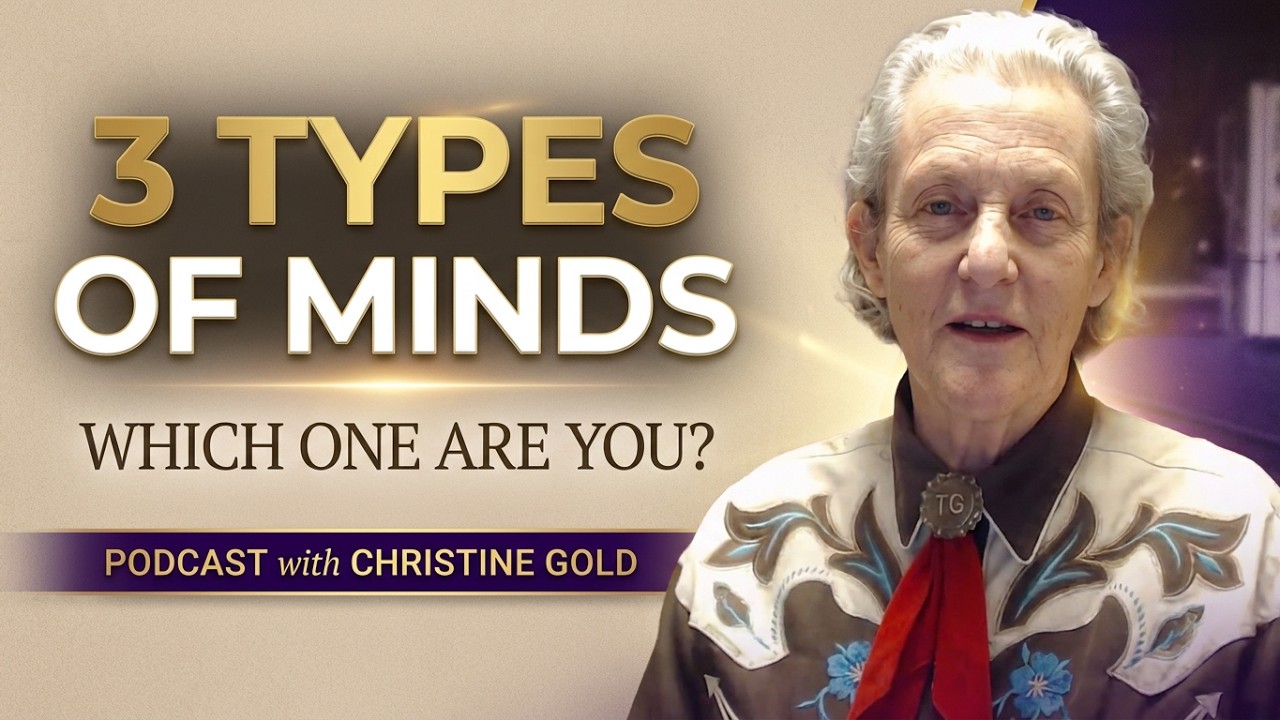
Dr. Temple Grandin explains how visual and pattern thinkers solve problems that others miss, from cattle handling to aircraft failures. She argues schools kill these minds by ditching hands-on classes for algebra, and warns that industry needs neurodivergent workers even as AI grows.
Chapters
Welcome. You're listening to a space created for sensitive, intuitive, and neurodivergent nervous systems. This is a place for empaths, cycle breakers, healers, and anyone who has learned to survive by staying quiet, staying small, or staying strong.
Here we move gently.
We don't rush healing. We don't bypass the body. You're invited to listen in the way that feels safest for you. You can pause, breathe, move, or come back later. Your nervous system sets the pace here. Let's begin.
There are people who don't just think differently, they see differently. And when they speak, it's like they're pointing to parts of reality the rest of us have been walking past our whole lives. And today I'm honored to sit with one of those people. Dr. Temple Grandin has spent her life translating worlds. She translated the inner world of animals to do an industry that wasn't listening. She translated the autistic mind to a society that misunderstood it. And in doing so, she helped all of us expand what we mean by intelligence. Dr. Grandin, welcome. Welcome to the show.
Good to be here.
So honored to have you. I've told you I had a couple books, and these are the two that I'm reading right now. I've got Visual Thinking, and then I've got your A Voice for the Voiceless, which, you know, this book, I really appreciate the text, how large the text is.
Okay.
Makes it easy for me to read.
Okay. Yeah, and the Visual Thinking book's got much smaller text. There's also a young reader's version, Different Kinds of Minds, and it's got bigger text, and it's a like a shortened version. Now, all the important stuff about thinking's in there, but some of the boring stuff about school policy I took out.
Absolutely, absolutely. So before we dive in, I want to name something. I think many people listening feel different. They've always sensed more, noticed more. I identify with this struggle to explain how they know what they know what they know.
Okay.
Your work gives language to that experience. So When you were younger, did you realize early on that you were seeing the world differently, or did that understanding come later?
I didn't realize I thought differently until I was in my late 30s. I thought everybody thought in pictures the way I do. And when I started out doing some of my very first cattle research, I got down into the chute to see what cattle were seeing, and people thought that was pretty weird doing that. Well, I guess if you think verbally, you wouldn't be thinking about what an animal was seeing, but it was obvious to me. —was in my late 30s, my first inkling that maybe not everybody thought in pictures is I asked a speech therapist, "Think about a church steeple. How does it come into your mind?" And she just got 2 lines, where I see specific ones around town. They kind of pop up like PowerPoint slides.
So in Visual Thinking, you describe how the world tends to reward just one type of mind while quietly relying on many others. And you talk about 4 kinds of thinkers, and that's When I, when I saw your interview and your award, by the way, congratulations, I was just like, what? Who is this person? I need to know this person and connect with Temple more. So I'd love for you to walk us through them, the 4 types.
Well, actually more or less 3. 3, okay. Object visualizer, and everything I think about is a picture. If I think about going to the airport tomorrow, I'm seeing some of the landmarks along the way to the airport. Okay. That's an example of visualization. If you say, think about a dog, well, I'm seeing my next door neighbor's dog. I'm seeing specific dogs. I don't, you know, now there's some people, if you say, think about a cell phone tower, they'll just see a generalized thing. I see specific ones. Like we've got a pretty good, pretty nice fake tree. And that's the first one I see, but it's specific. And visual thinkers tend to be very good with mechanical things. I worked with a lot of people that worked in shops. And they could invent just all different kinds of equipment, and they did not have degrees. In fact, us visual thinkers, we're terrible at math because algebra, there's nothing to visualize. In fact, I'm concerned that all these algebra requirements will screen out visual thinkers. Now, I have to know how to do arithmetic because I have to figure out how many concrete trucks I have to order to fill up some forms for building a bridge or something like that. That kind of math I can do because I can relate it back to the real thing. Now, the other kind of thinker is the pattern thinker. Your visual-spatial mathematical mind thinks in patterns. And in my book, Visual Thinking, also in the young reader's edition, which some people prefer to read, shorter, and it's got pictures, the concern that we're going to screen out our visual thinkers. Our visual thinkers that we're going to need to fix things. I just read about an airplane the other day where the engine caught fire at the gate, and they took it apart, and two parts had been installed wrong, one part backwards and another part where the seal wasn't right and the fuel leaked out. I'm— I want the visual thinker putting that engine together. Now you need the mathematician to design the engine, but to repair the engine, you're going to need the visual thinker. You see, you need both. And then of course you have people that think in words, and there's a lot of people that are kind of mixtures of the different kinds of thinker, but usually one predominates. But I'm an extreme visual thinker, and I'm seeing really smart people that own construction companies can't do algebra. And I think the mathematicians pushing algebra because they think you need algebra for thinking. That's not how I think. And we really do need all the different kinds of thinkers.
Absolutely. And I really appreciate that. Anybody who's listening or watching, maybe you want to let us know if you're a visual thinker, you think in images, maybe you're a pattern, you see systems and relationships.
Let's talk about the kind of jobs you end up in. Of it. Visual thinkers are often really good with animals.
Okay. Animals live in a sensory-based world.
Very good with mechanics. They love mechanical things. Photography. There's a lot of good photographers, both still and movie photographers that are visual thinkers, and art. Then your mathematical thinkers, they're gonna get into computer programming, mathematical, all kinds of mathematical things. And then word thinkers are good at writing. Also in word thinking, you often tend to overgeneralize. Where a visual thinker is very specific. They'll give you a specific recommendation where maybe you might say, well, we gotta make the classroom work for everybody. And I'm going, I wanna get rid of those LED lights that flicker. That's something specific. Where saying make it work for everybody, that's way more generalized.
Absolutely.
So when you look at society right now, which thinkers do you feel are carrying the most weight behind the scenes without recognition?
Well, I think in general, in government, at least in this country, are the verbal thinkers, lawyers. I'm— you see, in other— there's some other countries where there's kind of more engineering people in charge and they get the high-speed rail built and we don't. Oh, very, very— tend to just obstruct getting stuff done.
And thank you for being so passionate about the work that you do and what you want to share with the world. You're making, I mean, such an impact, even if it's one person like myself who struggle in the corporate world. I mean, I became a burnout. I had 20 different jobs. I, I now work for myself, and I mainly work with animals because— well, this is a perfect segue to talk about your work with cattle, how it changed the industry because you paid attention to what the animals were already telling us. So what do animals notice that humans consistently overlook?
Well, little things that bother them don't bother us. A shadow a reflection on the floor, some little piece of chain or something that jiggles. Little things that we tend to not notice, the animals notice, especially an animal that's not accustomed to going through the facility. If you have a dairy cow that walks into the milking parlor every day, she'll walk over the drain, she'll walk over the shadow, but the new heifer who's never been in there before is going to stop at it. And I started noticing that, and at the time that I was working on that, I was in my 20s, I didn't know that other people thought in words. And that's why they thought it was odd for me to get in the chute.
You got to get at their level.
How can you see when you're up here?
And so, oh well, they could see a truck through the fence, or they could see a reflection.
Yeah. And I believe there was one part in the book where you had a bunch of kids look at a picture. Was it the image of the cow with the light? And then you had a group of teachers, administrators?
Well, yes, it was a picture of a steer staring at a sunbeam spot on the floor. And when I show that to kids, most of them will notice the steer is staring at the sunbeam. I'll say, "Raise your hand if you saw that this animal was staring at sunbeam." Kids will raise their hands. Most of the teachers don't. You see, little kids tend to be much more visual. Then language kind of overwrites it. There's actually been some research on that.
Yeah, absolutely. I mean, all children have that ability. And unfortunately, at least in my experience and with some of the people I work with, once they get into the system, the school system, it all gets stripped away.
But the thing is, we need our visual thinkers. Let's look at something like the Starliner that had problems with the thrusters. Okay, you need the mathematician to get the precise re-entry angle so you don't burn up, but the thruster's got to work when the mathematician wants it to work. And I looked up the valves that were used on that Starliner, and I've put stuff like that together myself in the meatpacking plant. And if you get dirt into those things, or you're sloppy, that's going to clog up the thrusters. And that's probably what happened. So the mathematician tells it when to thrust, but you're going to need people like me to make sure when it's told to thrust, it will thrust.
Yeah, working together, collaborating together.
I have a whole chapter in my Visual Thinking book about complementary skills. Let's take things like building a large factory. The shop people are inventing all the mechanical things. You have somebody labeled drafting technician, and that person's laying out the whole entire factory. And then you need— if it's a food plant, you need the mathematicians to do the refrigeration. That requires mathematics.
You need to have both. Yeah, absolutely.
And not, you know, not one is— because I remember growing up, we had all these labels like, oh, they're a total math nerd, or, you know, they're— or they're terrible in school, or You know, you get put into these boxes.
People are mixtures of the different kinds of minds, and the school system's made for like average, but I've seen mathematical kids are not getting developed either. They'll make them do the same little boring math over and over again, then they wonder why they've turned into a king-size behavior problem.
Absolutely, they're not channeling their passion, you know, that spark. That's right. That spark. In the other book here, "Voice for the Voiceless," You talked about how you spent summers in Arizona, and it kind of reminded me when I would go spend the summer with my grandmother. Yeah. And I didn't want to come home. I know how you feel.
Ann out at the ranch was a really important mentor for me, and I had to fly all the way across the country. And at first I was afraid to go, and Mother gave me a choice. You can go for a week, come home, or you can stay all summer. Not going is not an option. And I got out there and I loved it. And that's how I got into the cattle industry. Yes. Because I got exposed to it. That brings up another very important thing. Kids get exposed to stuff to get interested. They get interested in stuff they get exposed to. It's that simple. And if they don't get exposed to interesting stuff, then they're not going to get interested.
Absolutely. I was a single parent of two boys, and when they'd be like, I don't like this, and I'm like, have you tried it? And they're like, no. And I said, well, you can't say that. So I would always challenge them, even if it was a piece of broccoli. So, so much of the conversation around autism focuses on deficits instead of abilities. Well, I worked with—
I spent 25 years out in industrial construction, you know, just living out in these plants and these shops, and I worked with people that definitely would be autistic, considered autistic today, owning big shops, and you should see their patents, 20 patents. And good patents, but it's all mechanical things. And these people are not getting replaced and we need them. They're playing video games. We do.
'Cause AI can't fix everything. AI, like you talked about, artificial intelligence can't fix things.
No.
When you have a 34 robots, you're gonna need people to fix things.
That's right.
So from your perspective, what strengths are we losing when we try to force people to think, learn, and behave the same way?
Well, there's a lot of people where they're kind of a mixture of the different kinds of thinkers, and they muddle through it, they'll probably be okay. But where you get into trouble is you get an extreme mathematician, or you get an extreme object visualizer, and they just don't fit in. That extreme mathematician, when he's 10 years old, may need to be doing college math, and don't give me BS reasons for not doing it. And my kind of thinker, maybe needs to be taking practical math instead of algebra, or maybe geometry. Because some of the visual thinkers can do geometry. With me, they just pounded away on algebra, never even got to try geometry.
And I love geometry, actually.
And it's a, you know, Fibonacci, the sequences that are part of that as well. But it's in nature. It's in every sequence. That's right.
No, I know the Fibonacci sequences.
Yes. So, and things like this.
So if someone listening has spent their life feeling too much or not enough, What would you want them to understand about their mind?
Well, the first thing, and I talk to a lot of business people, you have to realize different thinking exists and we need the different minds. I'm like, I'm very concerned about the airplane mechanic stuff. I read in Aviation Week that one airline executive was complaining at a conference that some of the new mechanics coming in had poor mechanical skills. And yeah, they're learning all the math, but we just had a plane go to the Denver airport real recently and the engine burned up at the gate. 2 parts installed wrong. They went back, that was the official report. Well, that's where you need the visual thinker.
Absolutely. I actually know someone who's an airplane mechanic and he is quiet and brilliant, but a gentle soul. Yeah. You've spoken at universities, conferences, and events around the world, and in fact, you're going on the road soon. You've written over 30 books. So when you—
I have about You know, about 12 basic books. I have a lot of books where I've done different editions.
I don't count those as books. Okay. So I'm doing that whole total of what you've done. I have about 12.
So when you step back and look at humanity as a system, what do you feel we're getting wrong about intelligence?
Well, the thing that—
there is research that shows that the object visualizer like me and the mathematician are very different in how we solve problems. There actually is research on that, and that is in my Visual Thinking, my Visual Thinking book. And, you know, the schools are kind of designed for the middle-of-the-road person. And the other thing I think's bad is taking hands-on classes out of elementary school. I had a student in my class who had never used a ruler in their life. A college student never used a ruler. Wow. Yeah, I think that there's something wrong with it. But the developed visual thinkers, we need to be doing hands-on things young. I did shop in 5th grade and Yeah, some of the high schools are putting it back in, the community colleges are putting it back in, but that's almost too late. We need to be hooking kids young that building things is fun.
Yes, and if you take apart something, it's not broken. It's— I think where there's, there's, at least for me, there's been too much focus on perfection. I don't do that anymore. So what are we finally starting to get right?
Well, there's a lot of stuff we've got right. I can't emphasize the importance of good teachers. It's just super important to have good teachers. And I had some very good teachers. I had a wonderful science teacher who encouraged me to do interesting projects. And then some of my being a bad student was I was just bored and didn't see any point in studying. And when I wanted to become a scientist, okay, then I had a reason to start studying.
Yeah. And I mean, mentors, teachers, you know, someone that believes in you more than you believe in yourself until you absolutely believe in yourself.
Well, good teachers are really, really important.
Yes. Yes.
So if education systems and workplaces truly honored different kinds of minds, what would change first, according to you?
Well, putting hands-on classes back in the schools. Yes. Woodworking, metalworking, sewing, cooking, all of these hands-on things. And I'm very concerned that we're getting too many kids totally removed from the world of practical. And now looking at AI, they're not hiring. Tech companies not hiring right now for beginner coding. AI's doing it visually.
Yeah.
And there are a lot of issues with AI. I mean, there's so many. I think for me, the biggest one, I don't know about you, is the climate piece, what we're doing to the earth. Well, and how much energy AI data centers draw.
One of the things I could think about the data centers, they're complete energy pigs. I mean, they eat huge amounts of power. But the other thing I wonder is computer equipment gets obsolete. What do you do with that computer equipment 15 years later? I don't think anybody's even thought of that. You see, where back years ago there was a boom in railroad building, and everybody went crazy building railroad tracks. But the thing about railroad tracks is they still work today.
That's true. That's the difference.
It is. And I also, you know, feel that we tend to repeat history. And whether you believe in Atlantis or not, they destroyed themselves through AI.
Well, what I'm mainly working on right now is I don't want to see our visual thinkers screened out. And I think we need to do some other math alternatives. I'm not suggesting no math. One of the alternatives could be just let them jump to geometry. Okay. Or doing very practical math, sizing hydraulic systems, figuring out how many trucks you have to order to fill concrete forms. Things that you'd actually be doing out in a shop or on a construction site. Yes, absolutely.
I want to circle to your, like, how long have you been speaking to audiences? I know that you had trouble at the beginning, and I— that is a person's number one fear, not death, but public speaking.
Well, when I first did public speaking, I panicked. I learned to have really good slides. That's one of the things to do. And if you have to do a talk without slides, make kind of a pilot's checklist of the things you want to go over and talk about. That can really help. The other thing that helped me, when I was in my generation, when I was 9 years old, kids had to sell stuff for charity. You had to talk to people. They had to dress up in their good clothes and be hosts and hostesses at parents' parties. That taught you how to talk to people. Well, that's something we need to start doing again, especially for the autistic kids. And it's something we can do and it doesn't cost anything to implement it.
Very, very true. And the autism piece, you spoke about kids, children, well, don't like to be touched. Do you want to speak about that?
Some of this can be desensitized with things like deep pressure. Also, if the child doesn't like a noisy thing like a vacuum cleaner, oftentimes they can get to tolerate that noisy thing if they turn it on. They turn the noisy thing on, the hair dryer, the vacuum cleaner, electric drill, a car horn, whatever the noisy thing is. When they turn it on, it's often much better tolerated.
That makes sense.
I appreciate that. Do you want to talk about the piece with animals? I believe it was reading about a young boy that didn't like dogs or anything but rabbits. There was a real—
One thing that kids don't often like about dogs is you never know when they're going to bark. Yes. So that's noise sensitivity. Rabbits don't meow or bark.
And they're really soft. That's right.
When they make noises that that the kid doesn't like. Now what might help would be to make a good audio recording of dogs barking where the kid can turn it on and off, because you can't control the real dog, but you can control an audio recording.
That is, that is very true. So you're, you're going, you, you travel, how often do you travel? Like is it half the year and you're going across the country?
80% of the time now. Okay. Do you like that? I like the results. Of it. Okay.
I'll have people say, well, my kid went to college because of your book, or my kid got a job because of your book. That makes me happy. And we've got to get kids off the screens, and we got to be doing a lot more real things.
I 100% agree. Uh, being outside, being in nature, being around animals— for me, that's everything. And I know that is for a lot of other people. And do you want to talk about the— your Are you working— is it the PACE organization foundation? Is that right?
No, I don't know what— well, I— there's an organization we have called PACO, Professional Animal Auditor Training Certification Organization.
I am an instructor for that.
You may be thinking about PACO. Yes. Yep. And you know, I'm, I'm still teaching my class in livestock handling. This is one of my books right here on livestock handling, my guide to working with farm animals. And we still have to teach people just basics of behavior, flight zone Point of Balance, you have new people coming into the industry all the time and they've got to be taught basics.
And what are some of the basics?
Well, for example, if you wanna make an animal go forward in a chute, you don't stand in front of it and then poke it on the butt with a flag because you're telling it to go forward and backward at the same time. That's a very common mistake that I see beginners make. The other thing is too much noise, yelling and screaming, and we need to be stopping that.
Yes. Yes. Calm.
Yeah. Confident, right? Love. I mean, those are some of the principles of Cesar Millan, which does, you know, better dog, better human.
Calm and confident. Yes, yes, absolutely.
They don't understand words. They understand tone and frequency and energy.
Voice, body posture. If you're calm and confident, the dog or the other animal reacts to that.
Yes. And you, you had a hand in revamping, like, just throwing the whole cattle industry upside down. And didn't you work with some big names, like some big companies? A lot of facilities.
And when I first started, when I was in my 20s, I thought if I could just build the right magical cattle handling facility, oh, it'd manage itself. No, no. A good facility makes it a lot easier to handle the cattle, but you have to have the management along with it. You have to have both. Yeah.
Again, two different minds, right? Two different pieces.
You know, that would come to— there's a—
you have to have at least adequate facilities. I mean, you can't have every gate busted and falling apart. That's not going to work, but I've taken some kind of average older facilities and with the right management made them work. Now, if I'm building something new, I want to use a good design. Wonderful.
Any plans to come to Canada?
No, I've got an autism meeting in the spring, ICAN conference. It's in Niagara Falls.
Okay. Okay. Yeah. Cause I really feel that you would do well up in Alberta, which is like cattle country.
Yep. I have, I have equipment I've designed in Alberta. Okay. Layout of the chutes at the Lakeside plant and the High River plant.
Oh, High River, Cargill. Yeah. Okay. Cargill plant.
That was done right around the real late '80s, early '90s.
Oh my goodness. Wow. You, you've like, I mentioned you to someone and she's like, you were born in— she's born in 1947. She's still— I'm like, she is still going. She is. So what keeps you going?
Well, you don't keep going, you die. You got to keep going. And now there's things I can't do. I can't lift heavy things anymore. Rotator cuff is torn up and I'm— it's physical things I can't do. Okay. I'm spending a lot of time lecturing, but I just got sent a drawing today for a layout for a beef plant. I'm still doing some design stuff, but it's more critiquing drawings other people do.
Yeah, let everyone else do the heavy lifting.
I get it. Well, the drawings isn't heavy lifting.
No, no, that's what I mean.
You, you do what you do best and let everyone do the rest.
So I also do exercises every night that I do not enjoy. I do 120 old lady push-ups every night. Oh my goodness. And 100 strokes on the floor.
Wow. Okay. Do I enjoy it?
No, but I'd like to stay mobile.
Well, at least you're honest, you know.
I hate exercising, but it's something that I got to do.
Yes. Because if you don't move it, you lose it, as they say. And I know all about that. I did my 10,000 steps today. I did yoga today. I did a bunch of other things, but— so what's one thing animals understand better than humans?
Well, they're much more aware of their sensory surroundings. Think about it. There's no words. They communicate with tones of their calls and their voice, tone of voice, okay, communicate a lot of things. It's a sensory-based world, not a word-based world. Now dogs are capable of learning some words like sit, of course, but it's a sensory-based world.
Yeah, I totally agree. I believe animals are, they show us what unconditional love is. They want us to have fun. Because we're way too serious. They want us to play more. Yeah, play. Yeah, I know I can be thoroughly entertained with my cats. They're always doing something strange and weird. So, um, so if there's one truth you've learned from animals and autism and your own way of seeing that you wish everyone understood, what would it be?
Oh, that's kind of difficult. Cult to say, you know, the thing that I really want is I wanna see the people that think differently get in the right careers, get out and have a satisfying life. Because a lot of the people that I worked with that built things, they really enjoyed their careers. And I think it's very unfortunate where they might say, well, special ed kids can't do shop. Well, in my generation, the special ed kids owned the shops.
Yeah.
I'm not saying that as a joke. I'm saying that absolutely seriously.
No, that is, that is so true.
In a world that try— it is such an illusion, the outside world try to instill fear. And I don't believe that every kid should go to college.
That's just me.
People are, you know, starting to realize that in some cases maybe they shouldn't. People I worked with that were brilliant, brilliant in things like skilled trades didn't go to college, but you should see their patent portfolio. You see, it's a different kind of thinking.
It is. It is.
We need more architects and visionaries and builders. Right, right. Well, Dr. Grandin, thank you for your clarity, your courage, and teaching the world how to see what it's been missing. I, you know, when I picked up your books a couple weeks ago and when I saw your PBS special, and you also have documentaries, and I believe Claire Danes plays you as well.
2010 HBO movie. And the thing about it, it shows my visual thinking. Absolutely accurately. That's really accurate. And they also recreated my projects. I just love that they recreated all my projects that I had done when I was in my 20s.
Wow. Wow. I can't wait to watch it.
It's on my list. I mean, there's only so many things in a day.
That's the title of it, Temple Grandin. There's a new movie called Anne: Open Door that's been put out by Colorado State University. And that's more of my later career teaching, a lot of emphasis on teaching. And that's available on Amazon Prime and on Apple TV.
And then you're—
there's also your TED Talk as well.
Yeah, 2010 TED Talk. Perfect.
So for those listening and watching, I highly recommend everything we talked about. All the mo— if you're more about movies and documentaries, go do that. Maybe pick up the books Visual Thinking, Thinking in Pictures, Animals in Translation, because this is one of those conversations that stays with you. I know it stayed with me, and when I reached out to you via your— yeah, and when I reached out to you on your website and asked if you'd be on my podcast and you said yes, I was like, what? I couldn't believe it. So here we are. Okay, great. And I so appreciate you, and good luck on your tour. How many weeks, months are you out?
Well, I'm going to do a lot of traveling. I talked to a lot of farming groups. I also talk to a lot of young, um, you know, teenagers and FFA and talk about careers. And I emphasize to kids, get out and try lots of stuff. Okay, a lot of people want to be a veterinarian. That's the only animal career that they know about. Well, shadow a veterinarian so you really find out what that's all about. And then after you do that, you're going to go, oh, I love this, or maybe, oh, this isn't quite what I thought it was going to be. But I, I recommend to students, get career-relevant internships. Help professors with different research that they're doing. Get out and do things. Find out what you like. It's also important to go, oh, I tried that and I don't really like it, because I want to have you get into a career you're going to like. Because I got introduced to the cattle industry as a teenager. I didn't come from a livestock background, but I got introduced to it and I go, oh, I like this.
I love that.
Like, when you know what your purpose is and it's not your job, it's your passion, That's really what I want everyone to have in their life is they felt like they contributed to something. They're not just a cog in the wheel.
Okay, great.
Well, thank you so much for being on the show. I really appreciate your time. And if you'd like to reach out to Dr. Temple Grandin, the books, the movies, I'll leave all the links and show notes below.
Take care of yourself and until next time.
TempleGrandin.com is about autism and Grandin.com, just my last name, is about livestock. Perfect.
Well, you heard it there, guys. Take care. Thank you for listening.
If this episode resonated, join my weekly emails for support and guidance for sensitive, intuitive, and neurodivergent nervous systems. And if you feel called to work with me, I would be honored to connect with you. The link is in the show notes.
More from Christine










Your coping skills didn't fail you, menopause did #menopause #health #plantpowered
