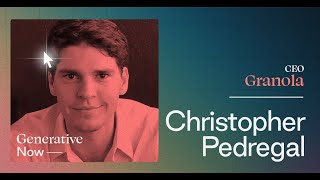
Interview (May 14, 2025) with Chris Pedregal, co‑founder and CEO of Granola, about the company’s product evolution and roadmap. Granola launched (≈under a year before this interview) as a Mac note app that records meetings, rewrites/fleshes notes using AI, and over time became a searchable repository. The product added team-level chat and support for reasoning‑focused models; Granola balances RAG/vector search for lookup use cases with very large context windows for analysis/coaching queries. The company is model‑agnostic (defaults to auto; often uses Sonic Claude 3.7 reasoning mode; power users can pick Gemini O3, etc.). Pedregal frames Granola’s long‑term vision as an AI assistant for work that automates busywork, integrates across meetings, email/Slack/docs, and may enable agents to take actions. Operational details: Granola recently raised a $43M Series B, grew from ~4 to 18 employees since launch, transcribes “millions of minutes… a day,” and plans hiring and US expansion.
Questions this video answers
$43 million (Series B).
"A little under a year ago" (as stated by Chris Pedregal in this interview).
At launch: four people. At interview time: 18 people.
They transcribe "millions of minutes" — stated as "millions of minutes a day".
Sonic Claude 3.7 (reasoning mode); power users may select Gemini O3, etc.
Chapters
How are you doing?
It's Granola time. What's happening?
Congratulations.
How you doing?
We're doing great. Would you mind introducing yourself and the company a little bit?
Totally. My name is Chris. I'm the co founder, CEO of Granola. How much you wanted me to tell about it?
Tell us everything.
Yeah, I mean, two minutes. The evolution, specifically the evolution of the product because I know people think note taking, but you're doing a lot more. So give us kind of the. What was the initial minimum viable product? What's the product today? Where's it going?
Totally. So we launched Granola a little under a year ago and the idea was the best way to take notes during meetings and to do that in collaboration with AI. So it's an app that lives on your Mac. It looks a lot like Apple Notes. You can take notes however you want, but it listens to the conversation in the background. And when the meeting's over, it'll like rewrite your notes to like flesh them out to make them great. Yeah, and that's the basic product. We tried to keep it super simple, really minimal. And I mean, I think, I think that design resonated. I think we can talk about that. But I think there are a few things about the way we built that that people really liked. And then I think what we noticed happening was that once you start using Granola, what happens is you have a meeting and like a notification pops up saying, hey, this meeting starting, do you want to use Granola for it? And once you start using Granola for lots of meetings, it kind of becomes this like searchable second brain repository thing. Like you can kind of be like, hey, what did that person say? And you kind of turn to it. And we noticed lots of users doing that. And then kind of the evolution, like what we launched today is now you can do that across your team. So like now you can, you can chat. We added a bunch of support for these great reasoning models and you can chat across, across meetings, across your whole team and ask questions. And it's a stepping stone towards like the bigger vision of where we're going.
Yeah, but yeah, tell me about search. Are you stuffing every granola note into a vector database or are you just doing a huge context window? What are the strategies to actually surface insights?
I mean, it's definitely evolving. What we found is rag or like stuffing it into a vector database is really good for certain types of information lookup, like search. What it is terrible at is basically if you ask questions like, hey, coach me, how could I be better in my one on ones, right. Or when let's say you're trying to sell something, it's like, hey, when I get this type of question, like, how good are my answers? And how does that compare to the answers that other folks on my team give? Like, it completely. RAG completely breaks with that. And what we find is people turn to granola to ask a lot of these kind of analysis type questions, like, hey, what are the biggest burning fires, right, that I should be focused on? Or something like that. And rag's not suitable. So we actually make a lot of use of stuffing these massive context windows with the right. With the right transcripts and notes.
What's the favorite context window to stuff? I know Gemini's got a big one.
Yeah, yeah. They all have trade offs.
Llamas.
Do the big ones scare you?
No, no, the big ones scare me. OpenAI's context windows. Perfect.
We just. Today, starting today, we let users choose. Before that it was, you know, we do it. We have.
Everyone's going model agnostic. This is a trend, right?
Yeah.
I mean, Windsurf is model agnostic now. Who else were you saying? Harvey just went model agnostic. This seems to be the trend. Really. Drinking the commoditization Kool Aid.
Yeah. The product person in me, I have mixed feelings about surfacing it to the user because it's like one more thing a user has to think about and your average person shouldn't have to think about. We should do the best thing. So it defaults to auto. So we try to choose the right model, which for a lot of it is like Sonic Claude 3.7, like the reasoning mode of it. Because we find that for the type of queries that we're getting is it works the best. But, you know, if you're a power user now, you can choose Gemini O3, like whatever you want.
Cool.
I gotta ask, what was your reaction to Notion's launch yesterday? Many people said it was a granola clone.
Do we have a Shots Fired?
Yeah, we need like a Shots fired sound effect. But yeah, I'm curious to get. I'm curious to get, you know, your reaction to it. I'm sure it's not even the first time that somebody's taken a little inspiration from you guys over the last year.
I mean, it feels like it means we're doing something right.
Is.
Is my first reaction. Like, I. It'd be easier if I didn't like Notion. We really like Notion, right?
Like we.
We think they're great. Like Ivan actually DM me on Twitter, letting me Know it was coming beforehand, you know, as in like, hey, wow, that's sweet. It's really cool. You know, he's like, we respect you. I hope this leads to us pushing each other to build better products for people. So like I like them. What it means for. I mean I think the world changed overnight with AI and we're like 2% of the way there figuring out what does that mean in terms of products and tools. And there's just a ton to build. Right. I feel like Transcription from the beginning has always been a commodity. Right. Everything is going to have transcription. So I think the question is how do you go from what we have today to like a true AI assistant that kind of understands you and helps you like be a thought partner and do most of the work you want to do?
Yeah.
What was the.
It feels like there's like three different like approaches to building a new AI enabled note taking app or something like that in this world. It's like greenfield project with startup that has a fresh clean slate like you guys. There's Notion, which is like a well funded scaled company but still in founder mode. Can still like we saw this with like Figma roll a bunch of new features in Move still pretty agilely compete. And then there's the hyperscalers which are just like we have a monopoly. And yeah, it might take us 10 years to add this feature, but you're probably still gonna be using an iPhone. So yeah, expect Apple Notes to get an update in 2035 or something like that. But I'm interested to know, kind of like, do you see the market that way and how are you thinking about the broader competition? Because I imagine that if you just look at the overall like people taking notes, Apple Notes is probably still the number one product or something like that, or Notepad and so maybe that's the real opportunity and you and Notion can both win.
Yeah, I think it's an interesting question. Okay, so one angle is like I think we underestimate you remember when mobile came out and everyone tried to port websites to the iPhone and it took us a little while to figure out that that doesn't work and that mobile apps should look really different. The jump from mobile to, from web to mobile is a fraction of the jump of pre AI to post AI. I really think the future is going to look very different. And in a very different future, I think the products that are kind of like invented in that new medium tend to do better. That doesn't mean the massive companies won't be able to add really Cool AI features. But if you think about the AI features you use on a daily basis, how many of them were launched by startups that came out in the last two years versus how many of them were launched by big companies? It's like an interesting assessment to do. So the way I see it is like there's a ton of opportunity. I really think like when Sam and I started Granola, it wasn't our vision was never meeting notes. Our vision was to be like a tool for thought that is contextually aware and AI powered. You can see the stuff that we wrote before launch and Meeting Notes just turned out to be a frickin awesome wedge. We thought it would be a good wedge. Turned out it's an amazing wedge. Way better than we thought because there's like so much information in our conversations that we don't.
Also like a viral loop there where people are sharing their notes with each other. Onboarding, I imagine.
Yeah, I mean like basically the Granola product is nothing like there's no growth stuff built in. Like until today there's, it was like single player product.
Oh really?
It took something. Really? Yeah, there's something super inherent about the information and meetings and wanting to share that. Right. So it's, it's all been like word of mouth until now. Yeah, I think.
But I imagine if I take notes in a meeting I could share a static link and we're not multiplayer in that, but I could share my notes and then I'm seeing granola.com and I'm just.
That's true. Yeah, yeah, you can't. You can share a link and now you can even. You can like put a bunch of meetings together in a folder. You can share a folder and someone who doesn't have Granola can now see those and you know, if they log in and then Granola AI, Sorry, I.
Got the domain not wrong.
I'm curious, you have a, do you have a strong thesis around agents? You know, I can imagine at some point companies have agents that are calling people and companies want to kind of understand the context of those conversations and what, what happened, what, what kind of neck next steps need to take place? Is that something that would live in Granola or is that more at the CRM level? What, what, what's your theory there?
Oh man, I, I mean I, I think the, you mentioned CRM, I think the product categories that we've had for the last 20 years, whether it's like, okay, you have like a wiki company, you have a CRM, you have like your docs company or I think those are all going to get redrawn because I think in an AI world it's all about context, right? And then how do you make use of that context to do work? So yeah, if you have agents calling people, I don't think that's very different from other folks on your team calling people. And then how do you make that context useful? I think that could live in granola. I also think agents are just one of those terms or I think we throw it around now, but we don't real. There's probably like 15 different things that today we are calling agents that are going to be their own separate things in the future and it'll be really interesting to see how that evolves.
So I got a real time follow up question from our mutual friend Michael at Lightspeed who was in is in the new round, but he asked is there an opportunity around agents to take action based on meeting notes? Right. Cause in a beautiful world, humans get together, they have a conversation, you figure out next steps and then things immediately start to happen autonomously.
100% like a hundred like that. That's the whole future of granola is basically like how do we use this context for meeting notes but also in the future email, Slack, you know, Google Docs, whatever to help you do work. And like our vision for granola is like AI should do all the busy work for you, right. And you should only be left with the judgment. So you can imagine a world, you come out of a few meetings, it's already kind of done all the the post meeting work or suggestions and all you have to do is kind of be like a little bit more this way or. Yeah, that looks good. Yep, yep, yep, yep. Do that and then move on to your next thing.
What's the use of the funds? 43 million Big Series B. Is LLM inference a material cost to your business right now? Is it just hiring more engineers, product people? Doesn't seem like you're going to be training foundation models if you're moving to model agnostic. But what's the use of funds look like over the next 12 to 18 months?
Yeah, I mean like I said, I think there's a, we're like in this pivotal moment in history to build the future tooling of work. And it's a big vision and we need to hire the best people in the world to go out and build that. And there's just a ton to build. So that's the primary use. LLM inference is it costs money, transcription actually costs more. So we transcribe millions of minutes. Millions of minutes a day right now. So that actually does cost some money. But people also pay for granola, so, like, that the funds are really like, can we go after this massive vision?
That makes a ton of sense.
And what's. What's. What's the dispersion of the team going to look like over the next couple years? I know you're in London now. You are an American, though.
Yeah.
What. What. What does it look like?
Yeah, I mean, I think we. So when we launched Canola, we were four people. We're 18 people now. We're still tiny. Right. But we got a great group of people here. So we're definitely going to grow the team in London because I think there's a lot of talent, but our ambitions are global. Right. So we're definitely going to be opening up more offices probably in the us probably multiple in the us, but all of that. Tbd.
Awesome.
Very cool. Thank you so much.
Congrats on the milestone.
Congratulations and love to see Nat Friedman making some money.